
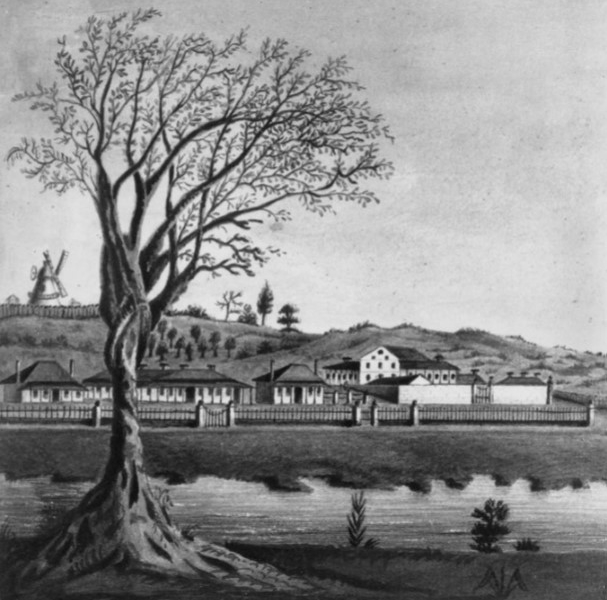
More threats to public safety and happiness from the early days of European settlement in Brisbane.
Termagants
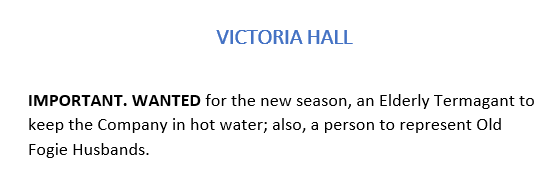
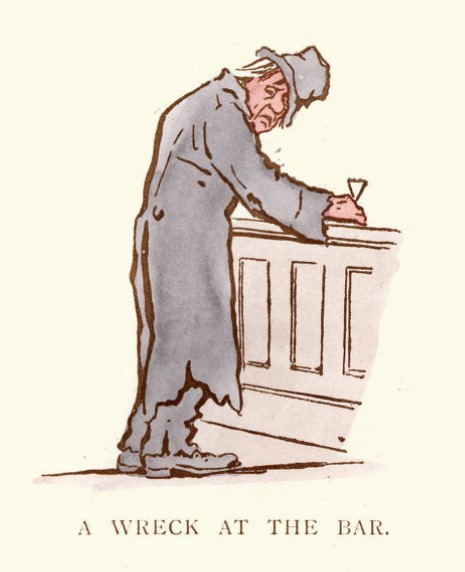
The Victoria Hall seemed to be the only part of Brisbane that welcomed termagants, and that was for theatrical purposes only. The idea that women might get drunk and/or fight was simply too much for the Courier. In 1849, it reported, with a degree of amusement on one dispute:
FEMININE BRAWLS. – There have been some indications of unamiability on the part of the softer sex during the week. On Friday last, Mrs. Dwyer, not having the fear of the law before her eyes but being moved and seduced by the instigation of her temper, did make an assault upon the fair person or Mrs. Violet Fitzpatrick; for which offence she was constrained on the following day to pay a fine of 5s., together with 10s. costs.
But the following year, the Courier had had enough. Never mind that men drank, swore and fought – that was reported on with glee under headings like “Pugilism,” with the wash-up in Court as entertainment. Women were not supposed to be “shrewish” or “termagants.” The Courier even suggested that a spot of domestic violence be applied to unladylike wives.
“SHREWISH BRAWLS AND OBSCENE LANGUAGE. —Frequent remarks have been made in the public press concerning the waste of time and trouble at police-offices, in investigating disputes arising out of the squabbles of termagant women. A case of this kind occurred at the police-office last Tuesday, when the defendant was charged by her neighbour with having used threatening and obscene language towards the complainant.
“As regards the common quarrels and recriminations of feminine belligerents, instead of occupying the time of the public with their details, the husband of the offending party might advantageously exercise his authority, and settle the dispute in a summary manner.”
Fortunately, or unfortunately, Brisbane Town was a frontier outpost, and there were lots of unladylike women to keep the bench occupied, and the Courier in horror, for decades to come.
NUDITY
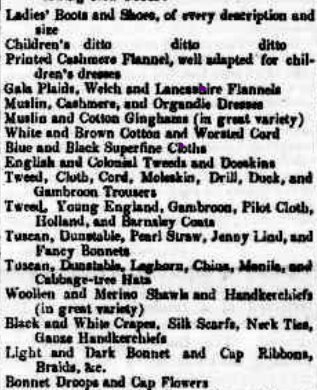
Clearly, wearing as much as possible was important to settlers.
Clothing was important to European settlers for many reasons, not merely as a covering for skin prone to sunburn. One’s clothing – the materials, colours, embellishment, cut – showed one’s class, wealth and occupation. And one dressed as one did in the old country, regardless of the climate and conditions in the new world.
Imagine, then, coming to a country where the original inhabitants lived their lives in a state of nature. And didn’t care.
“Several of the inhabitants at Kangaroo Point have lately made great complaints respecting the natives being permitted to perambulate the streets in a state of nudity. The nuisance has become so annoying that respectable females do not care to venture beyond the precincts of their own dwellings, and we have been requested to draw the attention of the authorities to the subject.
“It is the duty of the constables to put down offences of this nature, and if they would only act energetically, the natives would soon provide themselves with garments, when they found it was not allowable to walk about without them.”
The ensuing decades saw police, clergy and schools acting energetically, and the problem of undressed indigenous people disappeared from the streets. Sadly, most of the indigenous people of South-East Queensland also disappeared, along with much of their precious traditions, customs and language.
LOST OR STRAYED MAGISTRATES
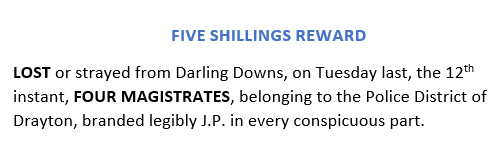
Magistrates today still travel a long way on court circuits, but have the advantage of sealed roads, cars and instant communication. Nineteenth century magistrates had to travel by horse and cart over rough roads and long distances. Sometimes, the Court convened, and found itself without anyone to preside. Litigants, who had also travelled long distances to settle their disputes, were not amused.
Presumably the beaks in question were tracked down, identified by their brandings, and taken back to their owners, who would keep a closer eye on them in future.

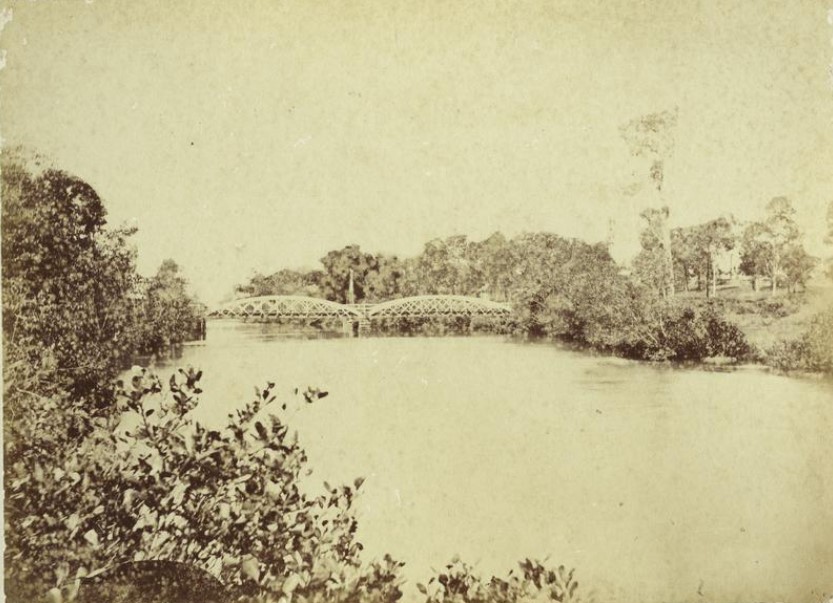
THE BRIDGE THAT KEPT FALLING DOWN
To say that infrastructure spending in Brisbane was not a priority for His Excellency the Governor is an understatement. In the mid-late 1840s, as Captain Wickham was begging for funds to keep the hospital open and convert the old Female Factory to a gaol, the Colonial Secretary transmitted dozens of beautifully-worded versions of “over my dead body” in reply.
The convict-era Breakfast Creek Bridge was sinking into disrepair. Or sinking into the water, more accurately.

In 1846 Mrs Gage, wife of a market gardener, unhitched her horse from its cart, knowing that the bridge wouldn’t stand the weight of the cart. She led the horse over gingerly, but one of the rotted planks gave way, sending Mrs Gage and the horse into the creek. Mr Gage came to the rescue, and there were no serious injuries. Barely 18 months later, Mr Gage nearly lost his life in identical circumstances. Fortunately, a neighbour was able to rescue him.
The Courier, having reported the accidents in a serious fashion, turned to humour to press the point, publishing the Bridge’s petition poem one week, then a description of a ‘Coroner’s Inquest Extraordinary’:
‘On Wednesday next, an inquest was held over the remains of old Mrs. Bridge, which had been discovered in Breakfast Creek late on the preceding evening. The jury was composed of five and a half of the oldest children in the settlement, Zedikiah Blubblings, jun., acting as foreman. No surgeon being at hand, an aged wet nurse officiated as medical man, and, after making a post mortem examination of what was left of the body, gave it as her opinion that the deceased had died of a spinal complaint, commonly known under the name of broken-back fever; with this opinion the jury would not coincide, part of them wishing to find a verdict of “felo de se,” while others wished for a verdict of “found drowned;” their opinions, however, were much altered on one of the juveniles producing, from his great-coat pocket; a, copy of the Moreton Bay Courier for last Saturday, and reading the lamentable petition it contained from the aforesaid Mrs. Bridge, addressed to the authorities, and which had evidently been written on her death-bed; after hearing which, the jury soon became unanimous, and returned a verdict of ”Starved to death by some party or parties unknown.”‘
Humour didn’t work, and Captain Wickham had his hands full with the hospital and gaol. His Excellency and the CS wouldn’t budge on further funding. By 1849, the entire bridge structure had collapsed.
A subscription was set up to rebuild the bridge, and after a year of meetings, donations and plans, a contractor was appointed in 1850 to construct a new, safe Breakfast Creek Bridge. And, as the slabs went in, one of the support piers fell down. Rectification work commenced immediately, further delaying the rebuild.
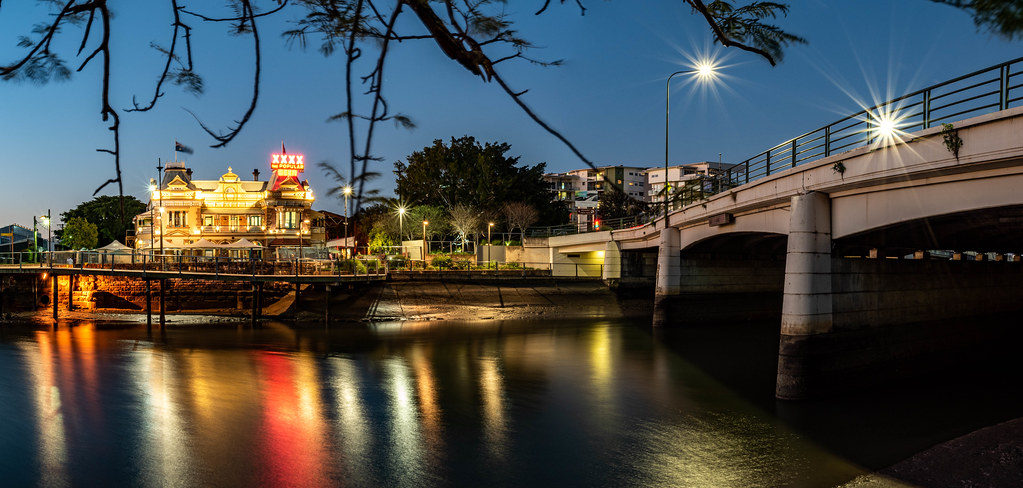
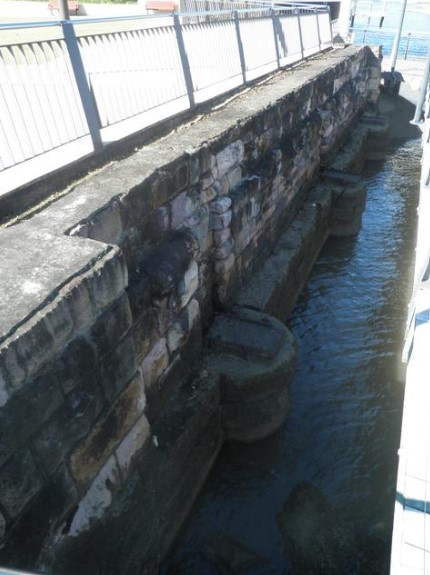
Over the years, a number of Breakfast Creek Bridges, went up and fell down, but later residents were more fortunate and were not left without a crossing for years on end.
Moreton Bay Courier (Brisbane, Qld. : 1846 – 1861), Saturday 11 September 1847, page 2. Moreton Bay Courier (Brisbane, Qld. : 1846 – 1861), Saturday 3 October 1846, page 2. Moreton Bay Courier (Brisbane, Qld. : 1846 – 1861), Saturday 5 February 1848, page 2. Moreton Bay Courier (Brisbane, Qld. : 1846 – 1861), Saturday 12 August 1848, page 2. Moreton Bay Courier (Brisbane, Qld. : 1846 – 1861), Saturday 26 May 1849, page 3. Moreton Bay Courier (Brisbane, Qld. : 1846 – 1861), Saturday 5 August 1848, page 3. Moreton Bay Courier (Brisbane, Qld. : 1846 – 1861), Saturday 3 August 1850, page 2. Moreton Bay Courier (Brisbane, Qld. : 1846 – 1861), Saturday 10 November 1849, page 2.
 Moreton Bay and More