

John Hayes was an Irish labourer who had arrived in Queensland in 1873 on the Landsborough. There might well be a fortune to be made by a man who would work hard. Perhaps after a few years he could own some land, have a family. Perhaps he could send some money home to Ireland. It was a new country after all.
Hayes was in his thirties, a small, wiry man with blue eyes and dark brown hair. He couldn’t read or write – in fact the closest he came to being a man of letters was his tattoo – J.H. – on his right arm.
Death at Lansdowne Station
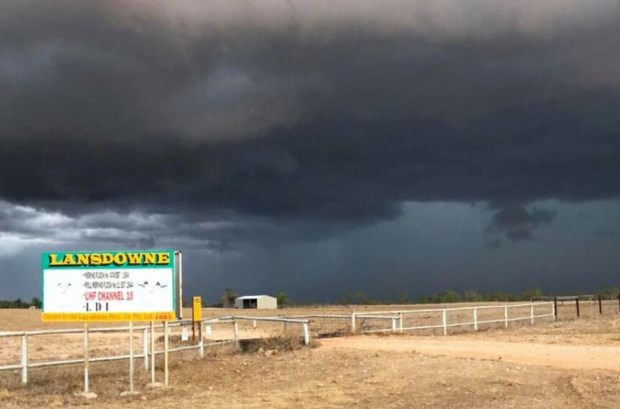
Clouds over Lansdowne Station (ABC, Chris Turnbull)
In 1876, Hayes found himself working at Lansdowne station near Tambo, roughly 500 miles north-west of Brisbane. Lansdowne was a vast pastoral holding that began operations just after Separation. Hayes was hired on as “the odd man about the shed.”
On 31 August 1876, shearing had finished at Lansdowne, and only a few men remained in the labourers’ cabins, waiting to be reunited with their horses in order to travel on to the next job. It was a hard life, and when temporarily idle, the men drank hard.
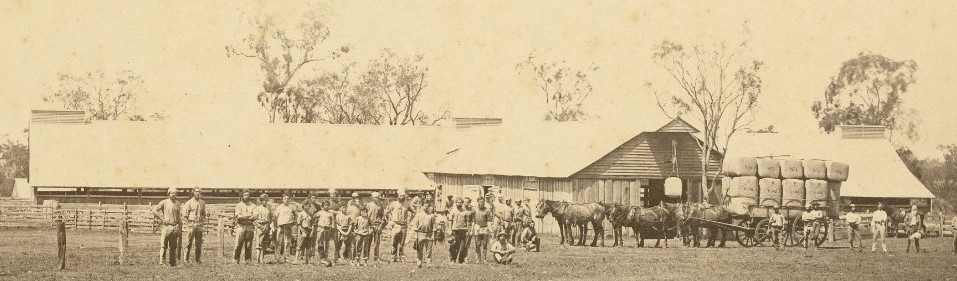
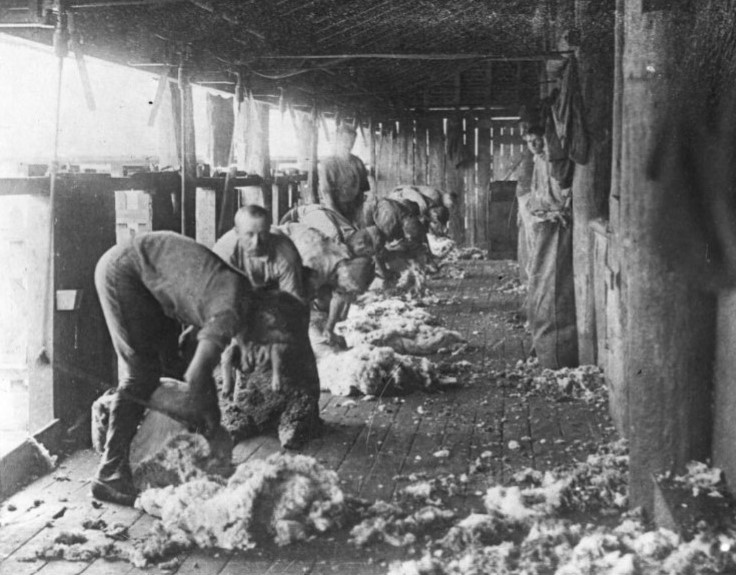
The shearers’ cook, a German named Kaspar Hahn, had been into the town of Tambo, getting supplies, including a good deal of grog, to help the men while away the hours in good spirits.
A game of cards was taking place between Edward Carr, Jerry Cook, John Hayes and a fellow known as Patsy. Kaspar Hahn came in and asked to join, and Jerry Cook gave him his place at the table. Hahn and Hayes were partners, and the game had been going for about two hours when Hayes became “noisy and disagreeable.” Hahn and Hayes played on against each other, and things became heated when Hahn won. There was an argument about the winnings, then another about Hayes wanting another drink. Hayes kicked Hahn, and Hahn threatened Hayes with a gun, saying “I’ll blow your bloody brains out.”
The gun was quickly removed by Edwards. Hahn found a stick and hit Hayes across the forehead with it. The blow left a very drunk Hayes in tears; he said “Edwards, you took the stick from the cook, and you are no man if you don’t see fair play.” Hahn was still angry, and another scuffle took place, and Edwards heard Hahn cry out “Oh God! Oh God! men, he has stabbed me. He has stabbed me with the shears.”
Edwards struck a match, and found Hahn lying under a table, bloodied and groaning. Hayes was still upset about the wound on his face, saying “See what a cut I have got, and I have said nothing about it.” And “Look at the state I am in, his case might have been mine, and perhaps if it was, there would not have been so much ado about it.” Hayes seemed to feel that he really was the odd man about the shed, and that no-one had taken his head injury seriously.
Later, a broken and bloodied pair of shears was found near the table. Shears were routinely left lying about on the floor of the huts, and it appeared that during the scuffle, Hayes had grabbed a pair that was at hand, and stabbed Hahn about the head.
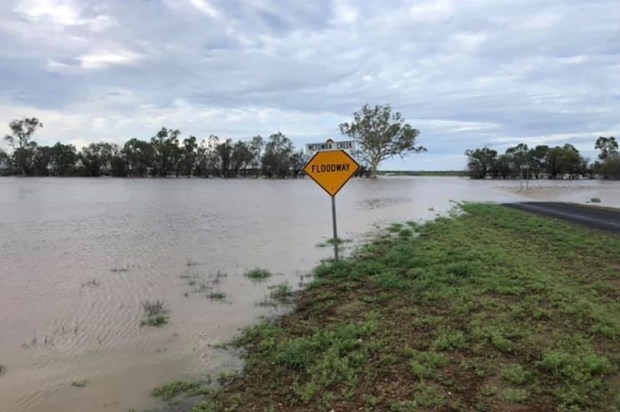
Rainfall at Lansdowne Station. (ABC, Chris Turnbull)
The station manager was brought to the scene, and the police were sent for. The manager told Hayes that he ought to hang from the highest tree in Lansdowne. Hayes admitted that he had done it, but “You can’t blame me for it.” Hahn, who was still alive and conscious, was taken to the hospital at Tambo, where he remained for four days before dying.
Kaspar Hahn was interred at the Sandridge Cemetery, and John Hayes was taken by the steamer Bunyip to be taken to Toowoomba for his trial.
In February 1877, he faced Toowoomba Circuit Court, and Chief Justice Lutwyche, charged with murder. Unlike Wells, the bank robber, Hayes was legally represented – by Ratcliffe Pring, QC. He pleaded not guilty. Chief Justice Lutwyche made a careful summing-up for the jury, outlining the difference between manslaughter and murder. The jury returned a verdict of guilty of manslaughter, and His Honour sentenced Hayes thus:
“John Hayes, I have looked over the evidence taken in this case, and after a very careful consideration of it, I can see no mitigating circumstances. You have been guilty of a very great crime and must give such a punishment as will notify persons in your walk of life that they cannot give way to their passions with impunity. The sentence of the court is that you be put to penal servitude for ten years.” It was reported that Hayes seemed overwhelmed at the length of the sentence.
Death at St. Helena Prison
Hayes was sent to St. Helena Island penal establishment, a gaol built on one of the islands at Moreton Bay. The settlement was noted for its harshness and isolation, and that may have been a factor in his apparent suicide on 18 October 1881.
John Hayes, one of the prisoners at St. Helena, died, apparently of his own act. About half-past 8 o’clock he asked a warder to unlock the covering of a tank so that a bucket of water might be got out. This was done, and the opening, called a “manhole,” was left in Hayes’s charge. This opening is only a little over 2 ft. square, and the last seen of Hayes alive was when he was winding a rope round the handle of a bucket to lower it in search of water. He was missed from the yard, and on search being made his cap, and subsequently his body, were found in the tank, which contained about 15 ft. of water. The small dimensions of the hole through which Hayes must have passed go to show that he was neither thrust down nor went down accidentally, but that he deliberately and of his own will committed suicide. He had the character of being, as it is called, ” cranky,” but that is mere, hearsay. An inquiry was held on the spot by Sir Ralph Gore, as visiting justice, Dr. Wray examining the body and various witnesses being called. The depositions will in due course be forwarded to the Attorney-General. Why, we might ask by way of commentary, run risks of any sort with wells having 15 ft. of water in them ? Pumping gear is not very expensive and would almost abolish all risk of a death such as is described, even if deliberately contemplated.
John Hayes had found nothing but hard work and loneliness in his new country, and perhaps this lonely island prison was simply too much for him. Kaspar Hahn had found hard work and no doubt personal disappointment in the same country and met his death over a disputed card game.
 Moreton Bay and More
1 Comment