

The 1875 prison photograph series contains a lot of men who committed serious assaults – near murders in some cases. Looking at the prisoners’ photos, it’s hard to overlook the number of Chinese men serving time for assaults. The accounts of their court hearings are notable for what they do not disclose – motive. Anything the Chinese prisoners said in their defence is lost to time. I doubt that the European journalists were interested.


Ah Kan, pictured in 1875, during the fifth year of his 15-year term of imprisonment, looks remarkably cheerful for a man in his position. He was sent down in 1870 for assaulting Mary Skewcroft with intent to murder her at Yabber, in the vicinity of Gympie.
The victim’s account, which was backed up by her 11-year-old servant, is that she paid Ah Kan some money for gold, and then there was another transaction regarding payment for a knife. He went to the door, looked into the store area, and told the victim “too muchy fire.” Mrs Skewcroft then told him “You come out of that, that’s not your place,” which caused him to return to where she was standing, wait for a few moments, and then wordlessly set about stabbing her around the head and hands. Constable Bowen, on catching the offender, was offered the explanation, “Too muchy drink.” (Whether Ah Kan actually spoke in such racist cliches is a matter for speculation.)
There was no doubt that Mrs Skewcroft suffered serious injuries from the attack, and the Court sentenced Ah Kan accordingly. Regrettably any explanation Ah Kan had for this sudden, apparently unprovoked and silent attempt at murder is lost to history.
Albert McDonald had been a well-known publican in Rockhampton, but his downfall was gambling. In September 1874, McDonald and a chum named Henry Solomons shook down a gold miner named William Fogel, and in the process, inflicted injuries to Fogel’s neck. The jury found him guilty, and the judge felt it necessary to punish the offenders harshly, because this was the first case in Queensland of an act that was rampant in England – garroting.
McDonald appears casual in his prison photo, but he was reported to be visibly shocked at his fall from grace when sentenced to three years’ penal servitude.
An earlier case involving Albert McDonald failed due to an invalidly worded summons, but it was gloriously 19th century. The complainant, one Ellen Goodwin was, in her own words, “a poor unfortunate girl, (who) frequented the Scandinavian Dancing Hall, sometimes with a riding whip fastened to her wrist.”
Miss Goodwin noticed Albert McDonald at the bar, and decided that he was rather a swell, and asked him to shout drinks. McDonald, she declared, said “get out you ________,” and hit her over the eye. Temporarily defeated, Miss Goodwin decided to dance a polka-mazurka, then returned to McDonald to ask him why he had called her such a bad name. He repeated the slur, and hit her on the mouth, causing blood to stain her polonaise. She insisted that she had only tasted ginger-beer that night. Their Worships were not convinced.
Denis Quinn‘s exact crime was not reported in detail, but he was charged in July 1875 with assaulting a woman, and was sent promptly to gaol for two months, without the option of a fine. It must have been a serious assault for the Bench to act so decisively.


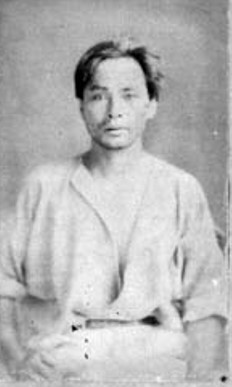
Henry Foley’s crime was not widely reported, but his trial is neatly summed up by The Queenslander on 5 June 1875: “Henry Foley was charged with shooting at one William Henry Brown, at Georgetown, in March last, with intent to murder. The prisoner was defended by Mr. Norris; was ultimately found guilty on a second count, charging him with shooting with intent to do grievous bodily harm, and was sentenced to four years’ penal servitude.”
Hugh Brisling (or Bressling as he is called on his charge sheet) was a 35 year old American man, convicted of shooting with intent to murder. The crime took place in September 1874, at remote Edward’s Town on the Palmer River goldfields. Mr Brisling had been visiting the camp of a family named Jevlin, and had used “improper language” to Jevlin’s young daughter. When her parents returned home and heard of Brisling’s behaviour, the girl’s father set out on the warpath, followed by his anxious wife, Bridget.
Brisling had armed himself with a fowling piece and declared his willingness to use it. As Bridget Jevlin tried to intercede, Brisling fired the gun, presumably at her husband, but the shot hit Bridget in the face, leaving her eye “entirely destroyed.” The cause of the crime, according to the Rockhampton Bulletin, was “over-indulgence in the use of ardent spirits.”
Brisling only received 12 months’ imprisonment for the attack, due to the unusual (for the time) amount of pre-sentence custody he had served, waiting for witnesses to be transported to first to Rockhampton, then Townsville Courts.
Jimmy Ah See was a butcher who hailed from China, and was convicted, alongside Lin Kum on 27 November 1875 at the Clermont Court for unlawful wounding. Both men were taken to Brisbane to serve their four months’ hard labour. I suspect that the person who was allegedly unlawfully wounded was a fellow Chinese man, only because an attack by two Chinese men on a white person would have received rather more press attention.
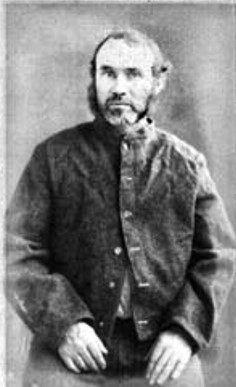

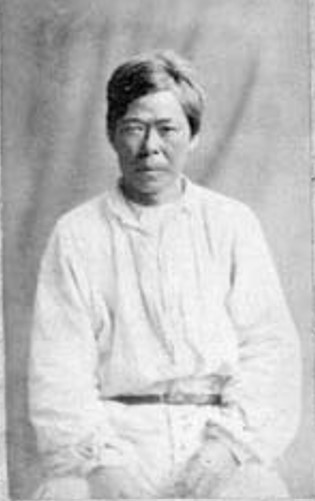
John Breen rented a cottage in Edward Street, Brisbane, from a Mr James Goodwin, who lived in a house on the same property. One Saturday night in late May 1875, Breen went to Goodwin’s and paid his rent. Mr Goodwin decided that this was as good a time as any to give Breen a notice to quit the premises for being “an annoyance to the neighbours.” Breen exchanged some harsh words with Goodwin and returned to his cottage.
Shortly afterwards, Goodwin went out to fasten his gate, and received a thump to the head, knocking him out. When he came to, he stated that he had seen Breen just before feeling the blow to his head. John Breen was sentenced to four months’ imprisonment.
John Trotter was a hotelkeeper at Cooktown who decided to settle the question of a patron’s tab in an unconventional manner. Charles Burns, a miner, was in the hotel bar with a group of friends when they had a dispute with bar staff about the size of their tab. The party left the establishment, not realising that Trotter was following them with a revolver.
Charles Burns was shot in the back from a distance of about four feet, and the ball glanced off his shoulder blade, which saved his life.
John Trotter was remorseful and told the Court that he was suffering from fever and ague, and had taken laudanum and other medications that had affected his judgement. The jury recommended him to mercy, but the Judge felt that three years’ penal servitude was as much mercy as he was willing to grant.
Johnny Dinn was charged with maliciously wounding a labourer at the Corella Downs Station on 27 July 1875.
According to the complainant, William Tighe, he was unwell on that day, and didn’t eat the meat that the station cook, Johnny Dinn, had prepared. This, Tighe claimed, made the cook suspicious that Tighe had poisoned the meat. Tighe told Dinn that he was mad, and that if the station superintendent didn’t chase him off, Tighe would. Dinn then chased and stabbed Tighe, aiming for the stomach, but inflicting serious wounds in the arms. Tighe told the Judge that he thought Dinn was mad, and prone to taking opium.
As the Rockhampton Bulletin put it, “Cross-examination by prisoner elicited nothing of importance.” Dinn’s address to the jury was also not reported.
Only the evidence of the arresting officer seemed to give a motive – on charging Johnny Dinn, the prisoner told him that the “old man” had been trying to put him in the fire. Other statements he made to the policeman indicated a degree of paranoia. The jury took 15 minutes to find Dinn guilty, and he was sentenced to three years’ imprisonment. The Queenslander noted only that he was “a very dark-skinned Chinaman.”

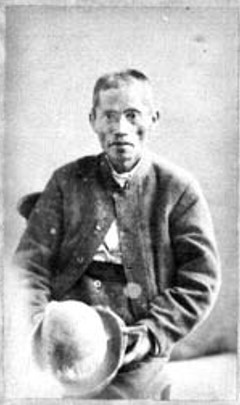

Lim Kum was the co-accused of Jimmy Ah See. Both men were butchers, convicted of unlawful wounding at Clermont on 27 November 1875. The press did not report on their trial.
Moon Sing was 45 at the time of his conviction but looked much older. He was a labourer and shepherd at Yandilla on the Darling Downs, and it looked as if his fifteen years in the colony involved a lot of hard work and little success.
Moon Sing was accused of attacking his hut-mate, Thomas Reynolds, with a tomahawk in July 1875. Reynolds and Sing had been on good terms until Reynolds woke one night to the blow of a tomahawk. Reynolds, covered in blood, ran to the engine-driver’s hut and raised the alarm.
Reichel, the engine-driver, apprehended Moon Sing and asked him what had happened. Sing told him that Reynolds had stolen £2. Reichel couldn’t find that much money anywhere in the hut, and he pressed Moon Sing further. Moon Sing replied that he hadn’t seen Reynolds take the money, and Reichel quoted Sing as saying, “No, the man was asleep when I hit him – if he was awake he would run away; I was robbed by a man before at Wyaga of 25s., and I could not fight him because he ran away.”
Ratcliffe Pring appeared for Moon Sing and told the court that “it was something extraordinary that this old man should strike the prosecutor without either rhyme or reason.” Opium was again blamed for the crime – either Reynolds saw Sing “stupefied with opium” and decided to rob him, or Moon Sing came up with the robbery theory as part of “the dream of an opium smoker.”
Another 15-minute jury deliberation resulted in another guilty verdict. The Crown Prosecutor, who rejoiced in the name of Pope Alexander Cooper, recommended a light sentence. The prisoner had no criminal history, and he was a foreigner. Moon Sing was accordingly given twelve months.
Thomas Stevenson was either incredibly drunk or incredibly angry, or both. On the night of the 10th of July 1873, Stevenson had been making a ruckus in Sydney-street, Mackay, and attracted the attention of Constable Murphy, who approached him and asked him to desist. And go with him to the watchhouse please, because he was under arrest. Stevenson refused to go with Constable Murphy, who took hold of him.
Stevenson, whose only criminal behaviour up to that moment had been a whole lot of shouting and singing at an unseasonable hour, struck the constable in the neck with his right hand, which contained a knife.
Sergeant Doyle was urgently summoned to the scene by a boy who had witnessed the attack and found Constable Murphy on the ground with a severe cut to his neck, and Thomas Stevenson surrounded by angry locals. The knife had been taken off him by two citizens, one of whom sustained a cut on his hand.
Constable Murphy’s condition was serious for some days – an artery had been cut – and the Court had to adjourn to his house to take his evidence.
At the trial, Stevenson did not call witnesses, and had the Clerk of Arraigns read his written statement. His recollection was that he was cutting tobacco with his knife, thought the constable was a robber so he stabbed him, and at the time he was very drunk. Sorry.
The jury retired and quickly returned with a verdict of guilty to unlawful wounding. The Judge told Stevenson that a man who used a knife was always a coward, and that it was “contrary to the spirit and instinct of every Englishman” to do so. Three years in Brisbane Gaol was the punishment for un-English behaviour.
 Moreton Bay and More