

“An extremely painful sensation pervaded the quiet little community at Sandgate when it became known that Germain Dubrocca, a French recluse of industrious habits and inoffensive disposition, had been done to death in the most violent, brutal, and cowardly manner within a distance of less than three miles of the township. A survey party working in the Brighton Paddock has stumbled over the mangled remains of the unfortunate Frenchman and conveyed the shocking tidings to the Sandgate police at about half-past 8 o’clock on Friday evening. The murdered man has long been a mystery to the inhabitants of Sandgate.” [i]
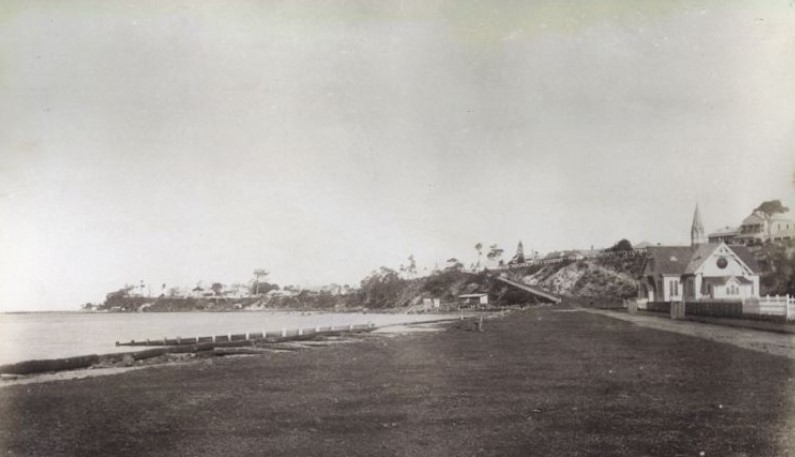
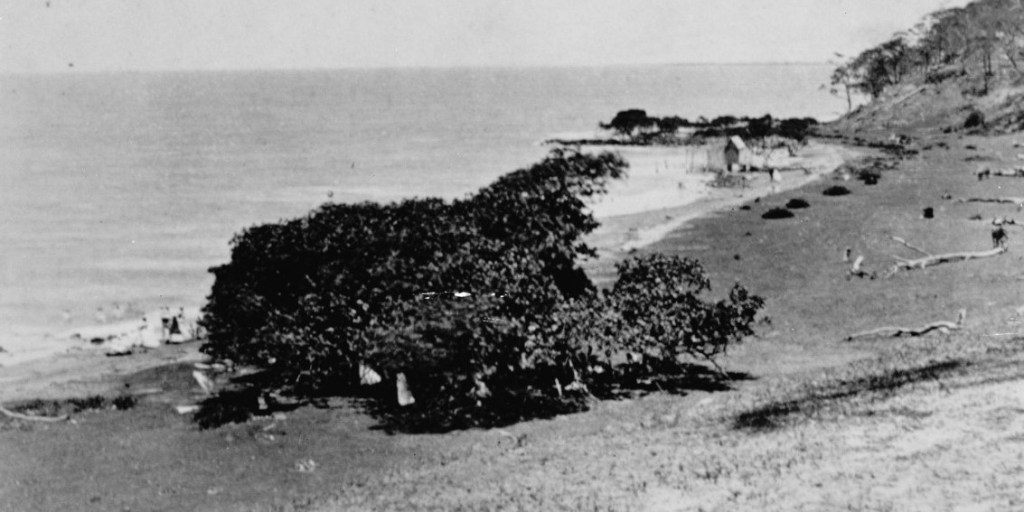
GOOD FRIDAY, 1890
Samuel Foley and two other men from Hamilton’s survey party were finishing up their day’s work at Sandgate around 5:30 pm and heading to their bush camp, when a furiously barking dog rushed out at them from the scrub.
The dog drew their attention to a body lying near the road but wouldn’t let them approach. The body was that of a man in his forties, and its injuries were such that the men knew that life was extinct. Foley reported the find to the police (after he’d had his cup of tea, mind). When the constables arrived, it took a small army of men to draw the distressed dog away from his master’s body.
Dr Paul was called to the scene, and examined the dead man in situ, before taking him to the Osbourne Hotel for an autopsy and inquest. The man was easy to identify. He was a well-known local character – Germain Dubrocca, a French recluse who made a scanty living selling his hand-woven baskets and mats. All that was known of him was that he shunned society, refused charity, and yet had the manners and bearing of a gentleman.
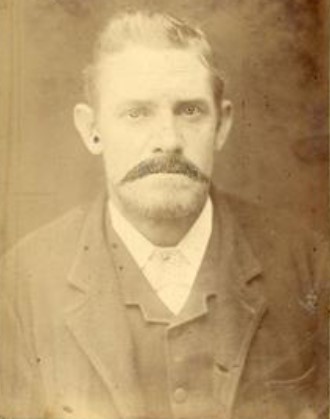
Dubrocca had suffered numerous stab-wounds and crushing blows about the head and was found lying with his arms outstretched as if he had been dragged into the bush. There was a bag over his head, but that turned out to be Dubrocca’s headwear of choice, as seen in a haunting photograph of him in the State Library of New South Wales. The tip of a penknife was found embedded in one of his wounds.

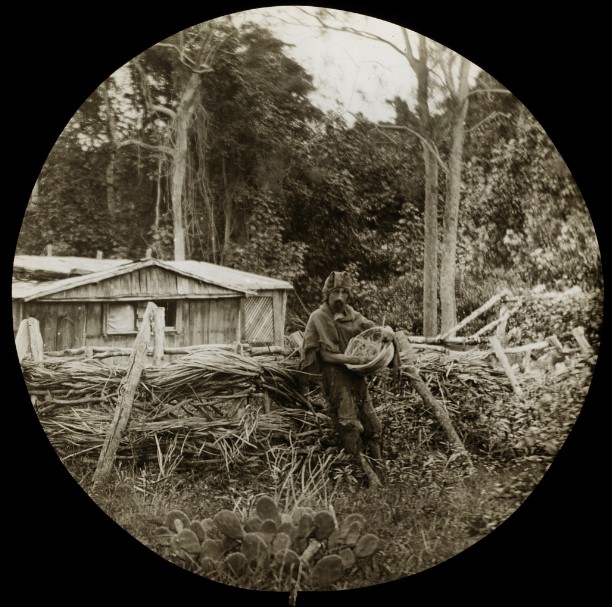
There were signs of a terrible struggle between Dubrocca’s dwelling and the scrub in which his body was found. In his humpy, the police found very little – just a basket, fishing-net, a bag of rice that had been torn open and scattered around, some biscuits, and a blood-stained copy of the Australasian dated 29 March 1890. Dubrocca had bought these from the local grocer the day before his death.
It (the humpy) is constructed-6ft. high and with a flat roof-of old packing cases and strips of rusty tin. It contains three cheerless apartments, without floor or furniture. [ii]
The photographer who had visited Dubrocca also recorded the hut in all its isolated poignancy. The surrounding bush has barely been cleared, and access to the front entrance was by climbing over a complex “staircase” of roots and branches. [iii]

Sandgate was a very small seaside community. Scrubland and mangroves were starting to make way for housing and farmlands, but the settlement was small enough for people to know each other and each other’s business. Two witnesses recalled seeing the familiar figure of the Frenchman, bag on head and bamboo cane in hand, walking with characteristic speed along Deagon Street on Good Friday morning, about 9 am. Clues were scarce, but the closeness of the community would surely disclose a stranger, or a killer.
“In Sandgate the victim was much liked, and although the murder was committed over a month ago, the anxiety to hear of any clue to the detection of the murderer is as strong as ever. It is said openly here that had the victim been of more importance socially a large Government reward would have been offered and the whole district scoured by a larger number of police and detectives than have been employed in this case.”[iv]

Detail of the Germain Dubrocca photograph. Was this ragged man once a professor and/or a jeweller to high society?
Two weeks into the investigation, enquiries yielded a sighting of a stranger in Sandgate on the day of the murder. A young man was seen crossing the paddock near Dubrocca’s house on Good Friday. He turned out to be an Irishman named John Rigney, who had been in the area looking for work. Rigney had stayed overnight at a boarding-house in Sandgate, found no jobs to be had, and, in the way of the poor working man in the 19th century, set out on foot back to Brisbane. Police arrested Rigney at his boarding-house in Fortitude Valley and brought him before the courts.
There was little or no evidence against Rigney, beyond his visit to Sandgate, and his walk across the paddock. The police applied for, and were grudgingly allowed, several remands to obtain further evidence. The patience of the Bench wore out in early May and Rigney was discharged. The Police Magistrate, J. Vivian Williams announced:
“John Rigney, you were first remanded on the 14th of April at Brisbane for one week, thon again remanded to Brisbane for another eight days, for what reason I do not know, as I consider you should have been remanded at once to Sandgate. By the action of the police, you are shown to be not guilty. There was hardly any necessity for your being remanded for the last eight days at Brisbane. I need hardly say that the bench now discharges you without a stain on your character. You are therefore now discharged.” [v]
And from there, the case stalled. An inquest was completed, and a verdict was handed down that Germain Dubrocca was murdered in Brighton paddock near Sandgate on or about the 4th day of April 1890, by some person or persons unknown. [vi]
The case went cold. There remained a lot of speculation, much of which centred on the life that Dubrocca was reported to have led before arriving in Sandgate, and the possibility that two famous 19th century murderers could have been involved.
“A MODERN ISHMAEL”
The story of Germain Dubrocca was first told by the Brisbane Courier in 1889. A reporter had heard of a picturesque recluse, a man of great learning and culture, who wove baskets from a humpy in the scrub at Sandgate. Journalistic curiosity was followed by an interview – given with much hesitation – that formed the basis of the narrative used in hundreds of publications.
The story he told the journalist was this. He had been born to a comfortable bourgeoise family in Paris. He had been a representative of a French manufacturing jeweller, and in this capacity travelled to Melbourne and Sydney, showing their wares at exhibitions. He travelled to Queensland to dispose of his stock towards the end of 1882 and became seriously ill in Rockhampton. When he recovered, he had lost all of his stock and indeed his earthly possessions. He made his way to Sandgate on foot, stopping to work at stations along the way. For five years, he had lived in the hut at Brighton paddock. He taught himself basket-weaving and made his living by selling his wares.[vii]

A very early photograph of New York University, where Dubrocca was said to have taught.
He stated that he had been pursued by an enemy, a man who he predicted would kill him, from Paris to Australia. He saw the man’s face in his dreams and knew he would one day be murdered. This is the part of the tale that never changed, and captured the imagination of the journalist and his readers.
In some iterations of the story, reported shortly after his death, have a young Dubrocca at either New York University[viii] or “a” New York University[ix], as a professor of classics. It was said that he abandoned academic life to pursue commerce and the jewellery trade.
All of the retellings feature Rockhampton, lengthy illness and a loss of his worldly goods. In some reports, he had a business at Rockhampton around 1883-1884, that was either burgled or lost to his illness. [x] (I have searched the business directories and reports of crime that fit the description in Rockhampton for those years and have not found anything published that bears that out. It may be that Dubrocca was selling his stock to local businesses.)
TRACES OF A LOST LIFE
Germain Dubrocca did leave some clues behind him in the records. He arrived in Victoria on 10 August 1879 on the Somersetshire from Grave’s End. He was listed as 30 years old, a merchant, and travelled in steerage.[xi]

The Sands City Directories show Germain Dubrocca living at 313 Nicholson Street, Carlton in 1881 and 1882.[xii]
In 1881, he was knocked down at the door of his home at 2:30 am and robbed of a red smoking cap and black tassel, valued at 4 shillings. Two men were sought for the offence.[xiii] Perhaps this is the robbery he revisited in his memories during his wandering years, particularly if he suffered a head injury whilst being knocked down.
There were a lot of French jewellers in Sydney in 1881-2, some of whom did display their wares at the Exhibitions. I cannot find a reference to Germain Dubrocca in Sydney at the time, but that does not preclude his attendance at the exhibitions.
In 1933, Henry Bateman wrote a story of Dubrocca and his murder in the Daily Standard in Brisbane[xiv]. Bateman says, “No party was complete without Dubrocca, and in all Sydney no man enjoyed greater popularity among the fair sex than this gay jeweller from Paris… The tall, well-groomed figure was a familiar sight on the Block and in the bars of the numerous hotels.” I like to imagine that this was true.
The next time Dubrocca appears in the records is in 1889, when he gave his interview to the Courier. He had been in Sandgate, living away from society, for around five years.
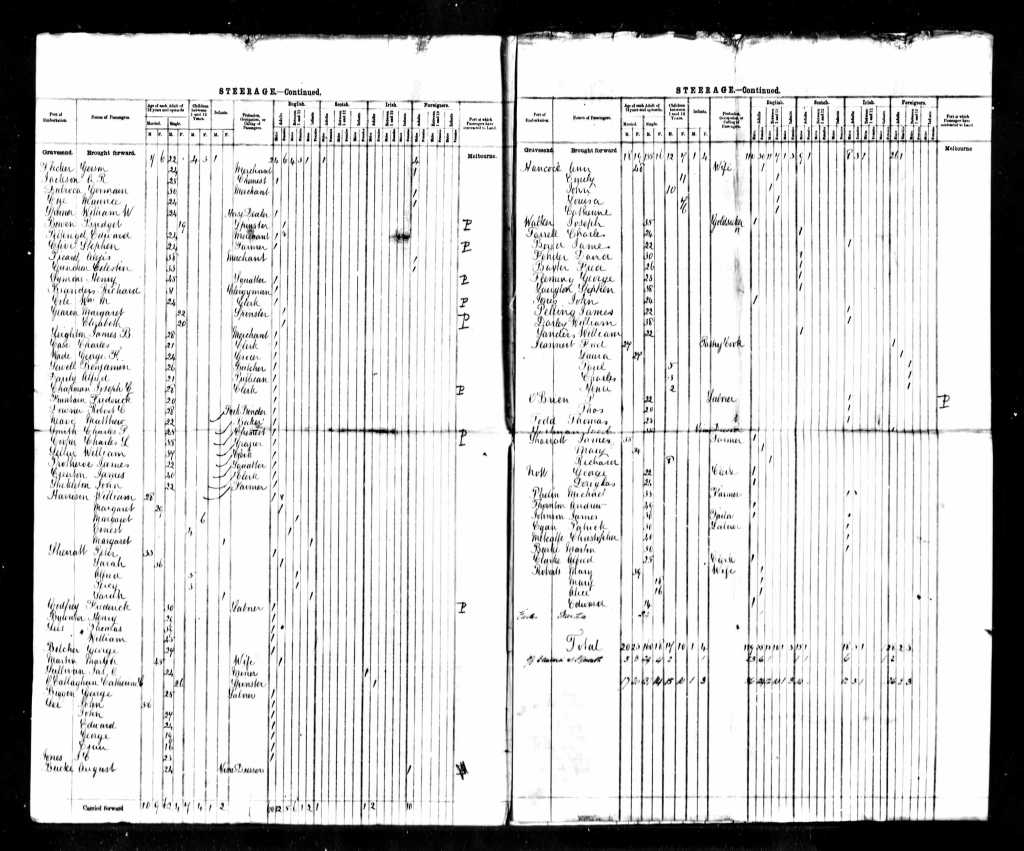

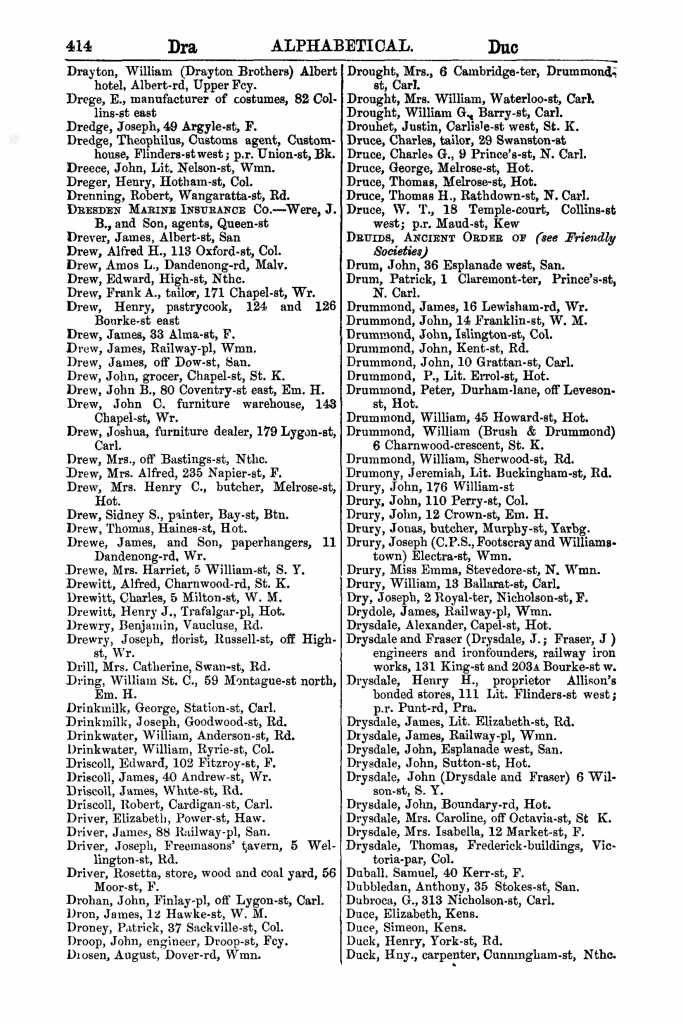
Germain Dubrocca’s passage to Melbourne, Dubrocca in the Sands Directories, 1881 and 1882.
SUSPECTS AND SPECULATION
Once John Rigney was released without a stain on his character, the trail went cold. The theories about the culprit were fairly consistent at first. One – the remorseless enemy had tracked the Frenchman down. Two – ‘the blacks’ – a group so frequently blamed for violence. Three – a robbery gone wrong, probably conducted by someone who mistook the hermit for a miser with a hoard of riches in his hut.
Then in 1892, two men already charged with murder, emerged as potential suspects in the eyes of newspaper and magazine readers.
Frederick Bailey Deeming
In March 1892, the Windsor Tragedy, as the newspapers called it, occupied the imagination of the public in Australia and Britain. Frederick Bailey Deeming was brought to Australia to face murder charges, and his career in the colonies in the 1880s was combed over. Perhaps there were more murders, beyond the six lives he was accused of taking? He had introduced himself in London as a businessman from Rockhampton.
Sir,—It has occurred to me that the murderer of Gabriel Dubrocca, at Sandgate, some two or three years ago, may have been Frederick Bayley Deeming. Dubrocca at one time had carried on a small jewellery establishment at Rockhampton, which was burglariously entered and robbed. Deeming, who at one time sojourned in Rockhampton, may have been the robber. Sometime subsequent to 1889, Deeming, to escape the shadowing of the Transvaal police, appears to have come to Brisbane by the Jumna. It is not unlikely that he would have visited Sandgate, and there have been recognised by Dubrocca. The latter may have charged him with the robbery, and Deeming, to silence an accusation—then particularly undesirable —and to gratify his bloodthirsty instincts, may have struck the blow that laid the old Italian low. Dubrocca had also, it will be remembered, resided in Melbourne, from which place I think Deeming was engaged by Williams Bros., of Rockhampton. At Sandgate Dubrocca had spoken of a secret enemy. That enemy may have been Deeming, whose animus, perhaps, may have been engendered prior to either proceeding to Rockhampton. My supposition, I daresay, will be thought very far-fetched, but I think it at least worthy of being looked into by the police department, who could very soon satisfy themselves as to its value.—I am, sir, &c., THEORIST. [xv]
Apart from mistaking the nationality of the murdered man, this theory does not relate to the timeline of Deeming’s activities in 1890. In February 1890, Deeming bigamously married a young woman named Helen Mathieson in England and spent a month honeymooning with her before his family discovered the marriage. After that, he met up with his other wife, Marie, in Birkenhead, then announced that he was leaving for South America. This hardly gave him time to travel to Queensland to track down and murder a French hermit at Sandgate in early April.
Francis Horrocks
On 9 April 1892, a young man from a respected family was arrested and charged with the murder of a German immigrant named Rudolf Weismuller at Moorarie (Murrarie). The German had been found dead in a paddock and had suffered terrible head injuries.
Francis Horrocks, then aged seventeen, was tried and convicted of the murder and was ordered to be executed on 26 September 1892. The reports of his execution include an account of the visit by the Colonial Secretary, Mr Tozer, to the condemned man. The CS had questions about the Sandgate murder, and the drowning of a child.

The Colonial Secretary, accompanied by Messrs. Crombie and Murray, M.L.A., visited Horrocks on Saturday, mainly with the object of seeing whether he had any communication to make, or whether there was anything that he required. Mr. Tozer put several questions to the prisoner with reference to the Sandgate murder and one or two other crimes, as to which it was supposed he might have knowledge. In inviting the confidence of the young murderer, Mr. Tozer pointed out that he had nothing to fear from any admissions which he might make, and that if he could give any information it might prevent innocent persons suffering. Horrocks received the questions in the reverse of an open manner, and proffered no information except in monosyllables. He said he knew nothing of the Sandgate murder, and that the boy who was drowned met his death through his own fault. Altogether the interview left an unfavourable impression upon Mr. Tozer. It did not appear to him that the youth was in any degree penitent for his crime. [xvi]
This is the first public information that connects Horrocks with inquiries into Dubrocca’s murder. There is no evidence to prove or refute the possibility that Horrocks had been in Sandgate on the day in question, but the idea must have been weighing on the minds of the police and government. The level of violence, the type of wounds and the remote paddock locations were similar. Horrocks had left school early to pursue a career as a bushman but would have been fifteen in April 1890.
If a known murderer also killed Germain Dubrocca, it is more likely to have been Horrocks. Something about his history had troubled the Colonial Secretary enough to request an interview at death’s door. The real murderer may well have been an itinerant worker who passed through the Sandgate area without raising suspicion and decided to see what the local hermit kept in that unkempt humpy in the bush, and became violent when discovered.
[i] Brisbane Courier (Qld.: 1864 – 1933), Monday 7 April 1890, page 5
[ii] ibid
[iii] Item 01: Box 1 Views of Brisbane, Ca. 1889-1901, 1889. State Library of New South Wales. Photographs of Germain Dubrocca and his house. (Mitchell Library, NSW).
[iv] Brisbane Courier (Qld. : 1864 – 1933), Monday 5 May 1890, page 5
[v] Brisbane Courier (Qld. : 1864 – 1933), Friday 9 May 1890, page 4
[vi] Brisbane Courier (Qld. : 1864 – 1933), Friday 23 May 1890, page 6
[vii] Queensland Times, Ipswich Herald and General Advertiser (Qld. : 1861 – 1908), Thursday 29 August 1889, page 5
[viii] Age (Melbourne, Vic. : 1854 – 1954), Tuesday 8 April 1890, page 6
[ix] Morning Bulletin (Rockhampton, Qld. : 1878 – 1954), Monday 14 April 1890, page 6
[x] Leader (Melbourne, Vic. : 1862 – 1918, 1935), Saturday 19 April 1890, page 25
[xi] Victoria, Australia Passenger Lists for the Somersetshire, 1879.
[xii] Australia City Directories 1845-1948 (Sands)
[xiii] Victoria, Australia, Police Gazettes, 1881
[xiv] Daily Standard (Brisbane, Qld.: 1912-1936), Saturday 9 December 1833, page 7
[xv] Brisbane Courier (Qld. : 1864 – 1933), Friday 25 March 1892, page 6
[xvi] Brisbane Courier (Qld. : 1864 – 1933), Tuesday 27 September 1892, page 5
 Moreton Bay and More