

October 8, 1866
From the Brisbane Courier.
GREAT FIRE IN THE CITY.
TWELVE HOUSES DESTROYED.
A FIRE, only surpassed in magnitude by the two great fires of a year or two ago, occurred in Queen-street last night, being the third great conflagration which has happened in the principal thoroughfare of the city. It took place in a block of buildings between Edward and Albert streets, on the opposite side of Queen-street to the site of the fire of April, 1864.
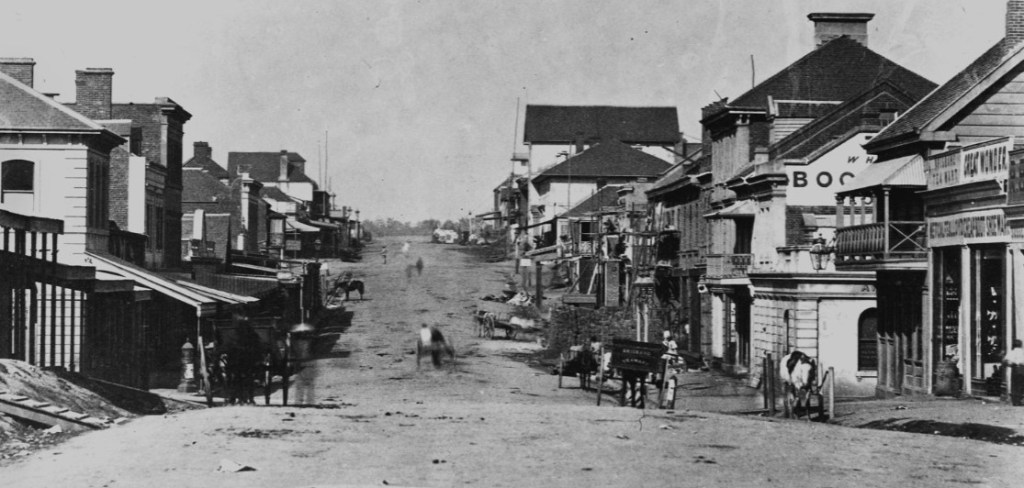
About 9 o’clock an alarm of fire was given, and in a few minutes the fire bell was rung. It was discovered in a shed at the rear of the grocery establishment of Messrs. E. and J Young. The shed contained a quantity of hay, empty cases, and some kerosine. At first the fire was small, and appeared as if it could be got under without difficulty; but in a second or two the inflammable goods were all in a blaze. A rush was made to clear out the shed, but all that was got out was a spring cart and harness.
By this time the police, in a large body under Inspector Lewis, came on the ground, and were followed by onlookers from all quarters. The right-of-way leading to the store was cleared of people, and the books, &c, of the establishment were rescued from a small building adjoining the shed, before the fire had gained much ground. Soon the entire shed and other road buildings were burning fiercely, and the flames quickly caught the roof of the brick part of the building. The fire brigades (C. V. F. B. and No. 1 Company) then arrived with their apparatus carriage, which was followed shortly after by the engine. The crowd at this time was great.

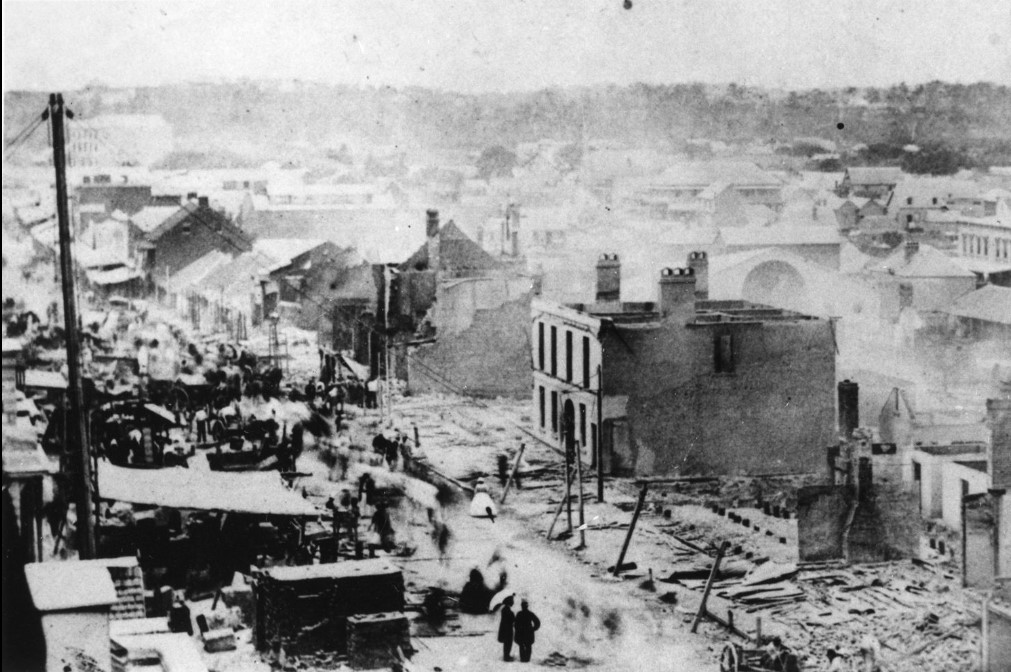
(This is one of three images from the 1864 Queen Street fire. The scenes described in October 1866 would have resembled these photos.)
A number of willing hands broke open the great door of the store, and commenced removing the goods to the other side of the street Gradually the fire extended at the rear, and ere long the whole building at the book was burning fiercely; the flames, too, had reached another shed at the end of the right of way, and contiguous to Standen and Piper’s (drapers) shop on the right. The fire brigades opened a fire plug in front of the premises, and attaching a hose to it began to play on the roof of the burning building. Their efforts were considerably hampered by the crowd, the confusion that prevailed, and the want of hose. For some minutes the water did but little good, and it was not until a second hose was at work, and the firemen had ascended the verandah of the building, that any effect was perceptible.
For a time, the roof in front was preserved, while below men were busy throwing out the goods from the store, and a large quantity was got out before the fire increased so much at the back as to compel the men to leave the shop. Attention had been devoted to the preservation of the adjacent store to the left (Messrs. Brabant and Co.’s, wine merchants), but as the buildings were close to one another, and shingle-roofed, the flames soon mastered the efforts of the firemen, and enveloped the second building in flames and smoke. Such of the goods as were handy to the front doors and windows were carried away. But there was less time to get out stuff here than from Young’s, the goods being more combustible. The crowd of spectators was great, and as they pressed round the burning buildings, the movements of the brigades, the police, and the helping hands were very much obstructed.
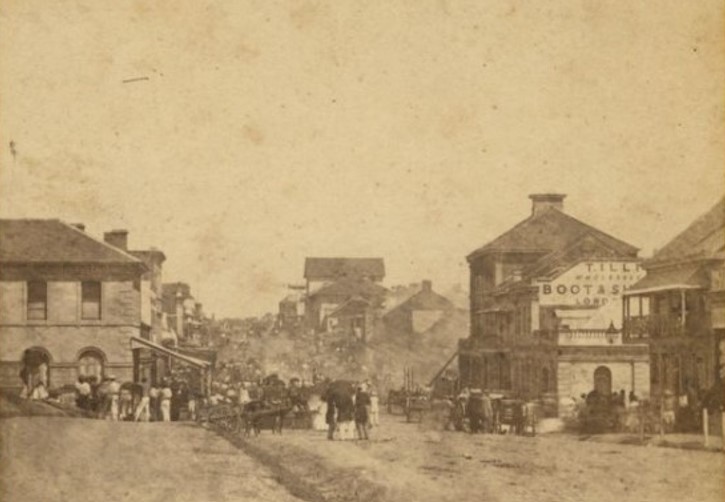
The police were then directed to put the crowd back; and, after considerable difficulty, the space in front of the premises was cleared of nearly all save those who were engaged with the fire. The brigade then went more coolly to work, and having lengthened their hose and set the engine going, a quantity of water was thrown on the fire. The streets presented a strange scene. Cases, sugar bags, furniture, fittings, pitched out anyhow, were collected in heaps on the road, jumbled one with another. The occupants of the shops on each side prepared to clear out their premises before they were mingled with the burning buildings.
The drapery shop lately occupied by Standen and Piper, where goods have been selling off for the last few weeks, was the first where gutting commenced. The drapery, in fact everything the place contained, was hurried out, and deposited at random in the street. The next place where the fire broke out was Randle’s, the boot and shoe shop, which adjoined Brabant’s. From this building little was saved and the roof was soon a sheet of flame. As there was no hope of getting the fire under in any of the three buildings, attention was then directed to Costin’s buildings, of brick, two stories high, on the right of Randle’s. Those in flames were only one storey high. The heat which came from the burning mass scorched the eaves of Costin’s shop, but a stream of water was kept upon it, and for a time the fire made no headway here.
On the left, Standen and Piper’s next become involved. It was separated by a right of way from Young’s, but the fire got to the building by means of the sheds at the rear. A hose had been playing on the roof for some time previously, but it was powerless to check the flames. The building both inside and out at the rear become a burning mass, and the fire spread towards the front. About three-quarters of an hour had now elapsed since the commencement of the conflagration, and it appeared to be at its height. The glare was strong, and the immediate neighbourhood was lighted up as clear as noon. The heat was also great, and slightly affected the buildings on the opposite side of the street. So powerful indeed was the heat that a spectator within sixty feet of the fire could not face it without shading his head. The shutters of the buildings just mentioned were constantly worked, as were the roofs of others adjacent, to prevent them becoming heated. At about ten minutes past 10 o’clock the roof of Costin’s buildings was ignited, and the hope of saving them was gone.
For a while a hose had been playing on the part nearest to Handles, and the flames were kept back, but at the rearward portion of the roof, which the water could not easily be brought to bear on, the flames had it all their own way. It seemed that if due care had been taken these buildings might have been preserved; but whether or not the fire got the upper hand there also, and penetrated the roof before many minutes had elapsed. Men with hose in their hands were standing on the verandah of the buildings and elsewhere, trying to stop the fire, but it burned fiercely and defied all their efforts. Luckily, there was not much in them to burn. In the other shops, there were goods of all kinds, both in the stores and in the cellars, which could not be removed in time, and they served as an excellent fuel; but from Costin’s everything had been taken out. The upper flat consisted of offices, the lower of shops (a chemist’s, a saddler’s, and a painter’s) and there was little except the beams, rafters, fittings, and doors to destroy. The high brick walls kept the fire confined, and the water prevented any further extension to the right.
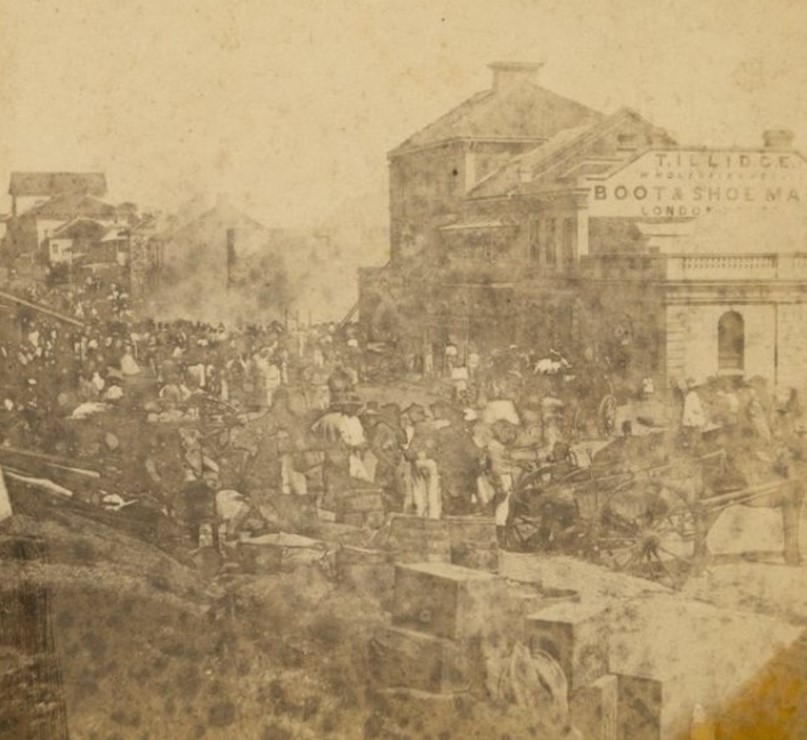
Between Costin’s and Mayne’s there were several low wooden buildings, which would have burned like tinder if they had once caught fire. But the flames never reached them. The smaller ones were pulled down, and a vigorous application of water kept the others from igniting. On the extreme left was Morwitch and Co.’s, pawnbrokers, a brick building, separated by a lane from Standen and Piper’s. The fire was also prevented from touching it, water being constantly thrown on the roof and walls. The burning mass was therefore confined to the five buildings we have mentioned, and slowly it was subdued. As the walls fell, the water was more effective, and the flames that raged in the cellars of Brabant’s and Young’s, where spirits and wines were stored, had to give way. The fire brigade went backwards and forwards from one spot to another as the flames reappeared, and deluged the buildings with water, till the flames were gradually got under. The walls of Costin’s buildings were uninjured, but the beams, no doubt, most of which were wood, were destroyed. All that remained of the others was a mass of smouldering ruins. By half-past eleven all danger was over. The crowd had been partially dispersed. It must have numbered at one time four or five thousand people, if not more. The approaches to the scene from Edward and Albert streets were completely blocked up.
The police deserve all praise for the manner in which they kept the space in front of the buildings comparatively clear, though, no doubt, much was owing to the orderly character of the spectators. The roadway was inches deep in slush, and the rescued goods were scattered loosely about, more or less damaged, not by the fire itself, but by the rough way in which they were handled. Of course, in the excitement of the moment things were ejected from the buildings without care or caution, and they became much knocked about. Of the goods that escaped the fire, a considerable proportion will prove worthless. A guard of soldiers was placed across the roadway to keep back such of the spectators as remained, and protect the goods. By half-past 12 the fire-brigade had finished their work, the conflagration was at an end, and the spectators had gone.
The two fire brigades and police were of great assistance throughout. Certainly, at first the former appeared excited and could not be got under control and it was some time before they could use their hose to any purpose. Notwithstanding, they acquitted themselves with credit for it must be obvious that skill in the performance of their duty is a thing only to be attained after considerable practice, and practice of a kind that only fires afford. They had only a small quantity of hose at their disposal. The Enoggera water was of great service.
The following is a detailed account of the buildings and property injured.
The buildings destroyed, in all, are twelve in number, and were nearly all occupied as shops and stores. Of the number seven were burnt down, and the others were either pulled down or so far injured as to render their ultimate removal a matter of necessity. All but three of the buildings consumed were one-storeyed erections. Commencing from the end nearest Edward-street they stand in this order. – A wooden store, formerly occupied by Messrs. Standen and Piper, drapers, but more recently by Messrs. Morwitch and Heilbron. At the rear of this was a small stone dwelling-house, which was also gutted. Next came the stores occupied by Messrs. E. and J. Young, grocers and Italian warehousemen; Messrs. Brabant and Co., wine and spirit and general merchants; and Mr. Lot Randle, boot and shoemaker. These three were one-storeyed erections, with brick walls and wooden roofs. After these came a block of three two-storey houses, known as Costin’s Buildings. They were tenanted by Mr. T. A. Costin, saddler and harness maker; Mr. B. B. Smith, chemist and druggist; and Mr. James Lang, painter and paperhanger.
Closely adjoining Mr. Long’s premises was a small wooden building occupied by Mr. J. Watson, the photographer, and next to that was an untenanted shop, formerly known as the Cafe Nationale. Mr. D. Penfold, hairdresser, Mr. London, hatter, and Mr. F. Murray, cabinet-maker, occupied the next houses. The four last mentioned were none of them more than one storey, and some of them are among the oldest buildings in that part of Queen-street. None of them were burnt, but they are all very much damaged by the efforts made to remove them to prevent the risk of the fire spreading. The value of the buildings destroyed by fire is estimated at about £6000.0
Messrs. Morwitch and Heilbron’s premises contained a considerable stock of drapery and fancy goods, a large quantity of which had only been unpacked yesterday. We were unable to ascertain what was the value of the stock, or whether it was insured, but we believe it was not. We should mention that a large portion of the stock was in the stone cottage at the rear of the store, whence it was removed to a place of safety.
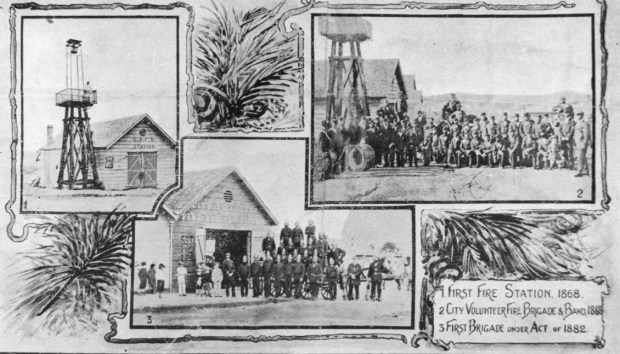
Poster commemorating the early years of Brisbane fire brigades. The picture on the upper left is the first-ever fire station.
Messrs. E. and J. Young had a large stock on hand, for in anticipation of the alteration of the tariff they had recently purchased large quantities of flour, sugar, and other goods. Its value is estimated at £3000. Nearly all the goods were removed from the shop into the street, and were thus saved, but must have been more or less damaged. The stock was insured in the Sydney Insurance Company for £1000, and in the Victorian Company for £500.
Messrs. Brabant and Co. also had a very heavy stock, chiefly consisting of wines and spirits. It was stated that there were upwards of 100 hogsheads of beer, and 100 quarter-casks of wines in the cellar, besides a large quantity of general merchandise. The value of the stock was put down at £8500, hardly a package of which was saved. The loss is only partially covered. So far as we could ascertain definitely, insurances for £2000 only have been affected, of which £1500 is in the Royal Insurance Company. We understand, however, that they are also insured in the Northern Insurance Company, but were unable to ascertain to what extent.
Mr. L. Randle’s stock had recently had additions made to it, and a part of it was saved. It was insured to the amount of £1000; one half in the Royal and the other in the Liverpool and London Insurance Companies.
Costin’s Buildings were completely gutted, but most of the stock was removed out of the shops before the fire reached them. The upper floors were occupied as offices by Mr. J. E. Garrick, solicitor; Mr. F. Cooper, barrister; Mr. L. F. Landsberg, surveyor, and one or two others. None of those gentlemen’s papers have we believe been destroyed, and the whole of the documents in Mr. Garrick’s office have been removed to a place of safety. Mr. T. A. Costin’s stock was valued at £1000, and it is covered by insurance to the extent of £800. Mr. B. B. Smith’s stock was insured, but we were unable to ascertain whether Mr. Lang’s stock was insured or not. Most of it was removed but a great part consisting of paper hangings, was badly damaged by water. The adjoining wooden buildings were hastily stripped of their contents, and the losses from removal must have been considerable. The only one we know of as having been insured was that occupied by Mr. Murray, the cabinetmaker. This, together with the stock of furniture, was insured in the Queensland Insurance Company for £400, but it is expected that their loss will not amount to so much, as the stock has not been much injured.
Except Murray’s shop and Costin’s Buildings we are not aware that a single building destroyed was insured. Costin’s Buildings were insured for £1500 in the Royal and £1000 in the United Insurance Companies. The policy of the Royal Insurance Company also includes Mr. Smith’s stock, which formerly belonged to Mr. Costin.
ANOTHER FIRE.
Shortly before 2 o’clock this morning a fire broke out at the “Little Wonder,” in Wickham street, Fortitude Valley. The building in question was a shop with dwelling attached, occupied by Mr. B. N. Levy, who carried on business as a grocer and general storekeeper. The fire was first discovered in the shop, and nothing but some portions of the household furniture were removed before the fire caught the roof of the dwelling-house. This, however, burnt rapidly, and as the water pipes do not extend to Wickham-street, there was little to be done by the firemen, except to prevent the fire spreading to some wooden cottages adjoining. Fortunately, the wind, which at times was a fresh breeze, was blowing away from the cottages, and thus aided their endeavours. A supply of water from a small creek at the rear enabled the firemen to keep blankets suspended on the gables of the wooden building constantly wet. By half-past 3 o’clock the “Little Wonder,” which was built of brick, was completely gutted and the fire had burnt down, so that there was very little chance of its being communicated to any of the houses in the vicinity. The building was insured, but we could not ascertain to what amount.
Brisbane Courier (Qld. : 1864 – 1933), Tuesday 9 October 1866, page 2
- Early View of Queen Street, c. 1864. John Oxley Library, State Library of Queensland.
- 30115 Stereoscopic views of the 1864 Brisbane fire. John Oxley Library, State Library of Queensland.
- 125754 Great fire in Queen Street, Brisbane, 1864. John Oxley Library, State Library of Queensland.
- First Brisbane Fire Stations, 1868-1882. John Oxley Library, State Library of Queensland.
 Moreton Bay and More