
Cooking in the EARLY YEARS OF THE colony
1840-1844
When the Moreton Bay establishment was first thrown open for free settlers, it was a rather grim prospect for those accustomed to shopping and cooking at Home or in Sydney. Here’s Tom Dowse on the state of Queen Street (the one real thoroughfare of Brisbane Town), circa 1842:
”No baker’s shop with its goodly display of soft tommy greets the eye in the leading thoroughfare of the settlement; no butcher’s shop held out its tempting joints to the hungry long face; no “lodgings to let” were displayed in the windows of the few houses and public edifices that constituted the town; the articles chiefly in stock at the provision depot of the settlement consisting of flour – not always of the first quality; salt beef, of the old horse tendency; tea, vulgarly called posts and rails; sugar of the blackest of the brown quality; milk, eggs, or butter not comeatable at any price, the settlement not having sufficiently advanced to presume in the production of such luxuries, except amongst a favoured few whose length of purse enabled them to occupy (under rental) some of the late civil servants’ residences.”[i]
“Mr. Moatry, who, for an annual rental of some £20, was permitted to supply her Majesty’s subjects residing in and about the settlement with flour, tea, sugar, tobacco, salt horse, and the compensating pickles and jams.”[ii]
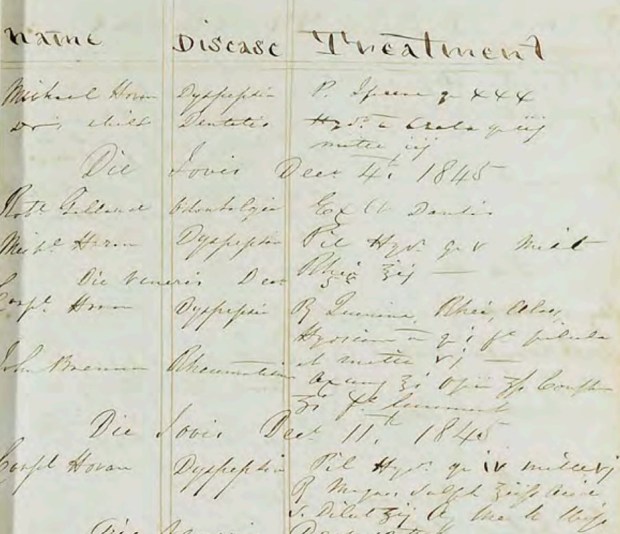
Dyspepsia was almost fashionable.
1844-1846
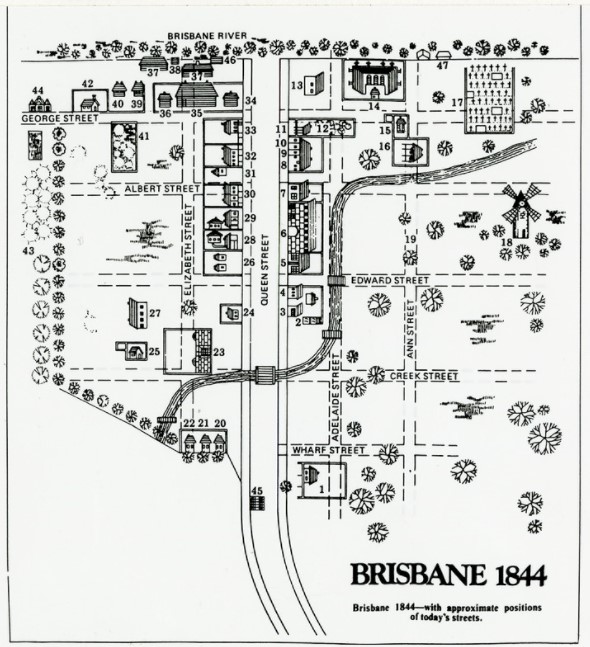
A modern interpretation of Gerler’s map.
By the time Gerler made his mud map of Brisbane, the township had a baker, two milkmen, a butcher and a general store. Henry Savary, the baker, was a French pastry chef who came free to Australia, and then blotted his copybook with a bit of embezzlement, and whose path to freedom culminated in opening his Queen Street bakery. He was quite successful, having the twin advantages of continental training and no competition. The butcher was George Edmonstone, a young Scotsman who saw an opportunity in the trade with the Darling Downs, and who eventually entered politics. He was frequently fined for public nuisance when his pigs and goats broke out of his yard in a desperate bid to avoid adorning the tables of Moreton Bay.
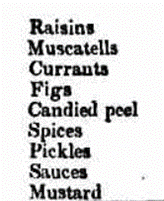
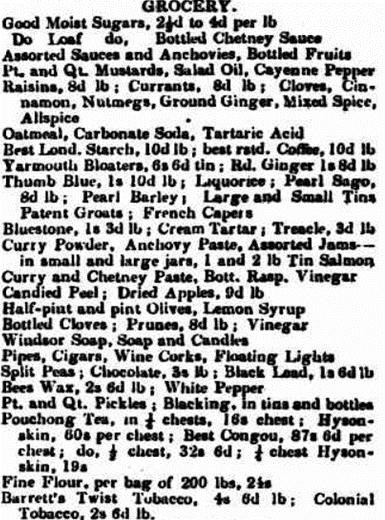
John Richardson opened the general store, selling “teas, sugars, flour, tobacco, salt and all other groceries” as well as a large stock of camping, gardening and haberdashery items. This was as close to a supermarket as 1840s Brisbane would get – the array of clothing and material was astonishing, but kitchen niceties were basic. That salt beef still loomed large on the menus of settlers is borne out by the pickles, spices, sauces and mustard on offer[iii]:
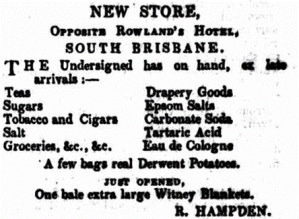
Just how lean the pickings were is illustrated by R. Hampden’s promise of “a few” bags of “real Derwent potatoes.” [iv]
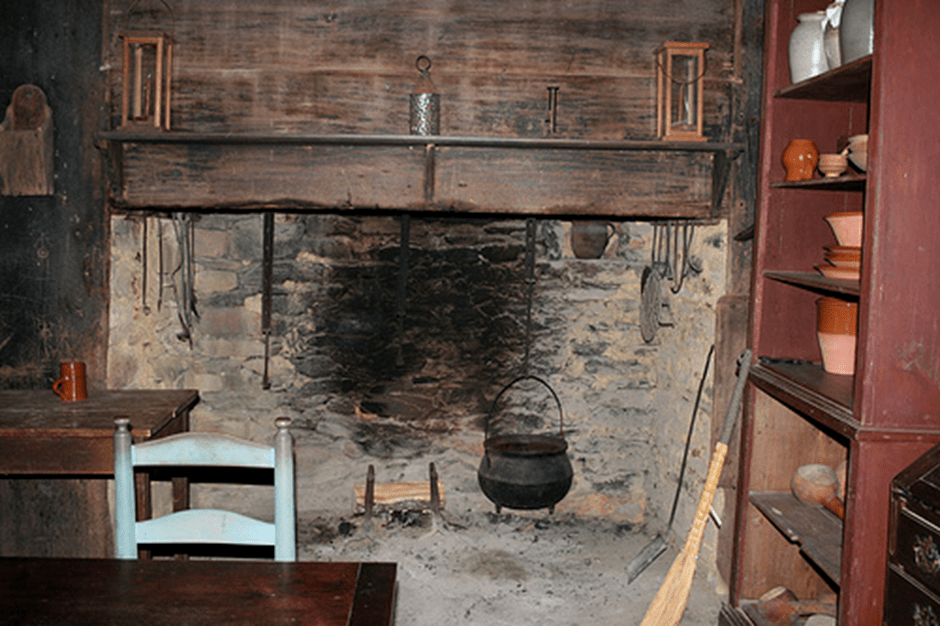
Even if one was to grab a few of those real potatoes for the table, kitchens were primitive, and food preservation was limited to salting, pickling, and drying. What couldn’t be preserved by those methods had to be consumed quickly and stored carefully to keep from spoiling. Shopping for fresh goods, if one could afford them, was a daily habit.
Cooking generally took place over a fire, the “range” or stove having been introduced in Europe in the 1820s being a rarity for the small wooden or brick cottages that dotted Queen Street and the surrounds. [v]
Fresh fruit and vegetables might be had at Richardson’s or Hampden’s, in limited quantity, and at a price. Depending on the availability of flour, a family could have home-baked bread. Those fortunate enough to have a decent yard might grow some vegetables or have a fowl-house for eggs.
In December 1846, the Moreton Bay Courier introduced its readers to the apparently novel concept of maize as a food for humans, substituting for wheat [vi]. Maize crops were well suited to the Australian climate, and it was seen as a way to feed families cheaply.
“It is the farinaceous food in general use in the rural districts of the United States. Upon it, children thrive, and adults labour, without the assistance of wheat. It is prepared in an infinite variety of ways—in cakes, in puddings, in the form of bread, &c., and possesses a superiority to barley in powers of sustenance, in flavour, and in expansibility during the process of cooking.”
Had the cook at the Queen’s Arms, Ipswich, been presented with maize and instructed to use it in recipes, he would have left his job sooner. As it was, John Doyle only lasted three days in the employ of Mr George Thorne, proprietor of that august establishment. Doyle left in a great huff, declaring that he was unable, as a professional man, to prepare decent cuisine when given only salt beef and potatoes to cook with. Mr Thorne was unwilling or unable to supply the essentials demanded by Mr Doyle – essence of cinnamon, pickles, mushroom ketchup and sauces – and expected his cook to wash dishes afterwards! John Doyle, described by the Moreton Bay Courier as “one of those bloated pocket editions of human nature rarely seen in a hot climate,”[vii] was sentenced to three months’ hard labour in Sydney gaol for absconding from hired service. Whether the meals at Darlinghurst Gaol were better than those at the Queen’s Arms, Ipswich, is debatable.
By the 1850s, quite a few of the flavour-enhancers longed for by Mr Thorne’s cook were available in Brisbane and Ipswich[viii]. Stoves were readily available for purchase, and proper housing was being built.
The residents of cities were fortunate. Those who made their way into the vast outback or remote coastal settlements had to live with conditions that Moreton Bay had developed beyond.
Bush Cookery (the horrors of).
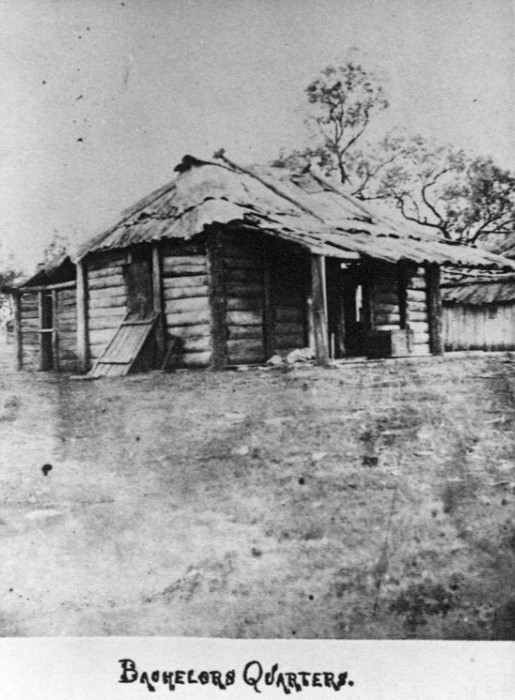
For those living in the bush, a grocer stocked with olives, lemon syrup and anchovy paste was a far-off dream. Station life had some comforts, but drovers and shepherds faced the challenge of food preparation in the open air or in huts of the quality pictured above. In England, a book written for prospective colonists[ix] outlined what one could expect, and be expected to do, when travelling the outback:
BUSH COOKERY.
Damper, or Bush Bread.
Cut a piece of bark off a gum tree for kneading trough about two feet square. Put in it two or three pannikins full of flour – one pannikin full is about one pound – add a small teaspoonful of salt to every pound of flour, gradually pour water into the centre and work it till it becomes a thick paste. The secret of a good damper depends upon the thorough working of this paste. Shape it into a round flat cake about two inches thick – it will be ready for cooking.
Your fire should be prepared some time before, so that you may have a large quantity of ashes. Rake out the ashes with a forked stick, level the ashes on the ground, which should be about two or three inches thick, rub your cake over with a little loose flour to prevent it sticking, and carefully place it on the ashes. Cover it all over with hot ashes about two or three inches deep.
It will be baked in 30 or 40 minutes, according to size. You can tell when it is done by uncovering it and striking it with your fingernails; if not done the sound is dull and dead; or stick your knife in, and if it draws out clean it is done. Knock off all the ashes with a green bough, stand it up to cool, and it is fit for use.
Johnny Cakes, or Leather Jackets.
Mix your dough as above. Break off a good pinch and spread it out into a thin cake, say as large as a plate, and half an inch thick.
Having raked out your ashes, gently place the cake on them, do not cover it, but after a few minutes turn it and do the other side. These are made in haste when there is no time to make a damper, or when the ground is too wet to bake one.
Cooking Meat.
You either carry a billy (a tin can that holds three or four quarts) to boil your meat in, or you cook it as under:
Carry a bush gridiron with you; it is made of a piece of any old hoop iron, bent zigzag, like the letter S, several times; this will broil a mutton chop or beef steak, pigeon or duck, and you will find it much more delicious than cooking it in a frying pan.
Bush Tea.
You carry your tea, say quarter pound, in one bag, and good brown sugar, two pounds in another. Your quart pot and pannikin are hung to your belt behind. Having made your fire, fill your quart pot with water and put it in front of the fire to boil, touching the sticks.
When boiling, put in a good pinch of tea and lift it off directly or it will boil over, cover the pot with your pannikin, and it will be ready for use in eight or ten minutes. Put a sufficiency of sugar in your pannikin, and mix it by pouring the tea on and off till the sugar is dissolved. The leaves will settle in a couple of minutes, and you can enjoy a beverage which you will find more refreshing than grog or any other stimulant.
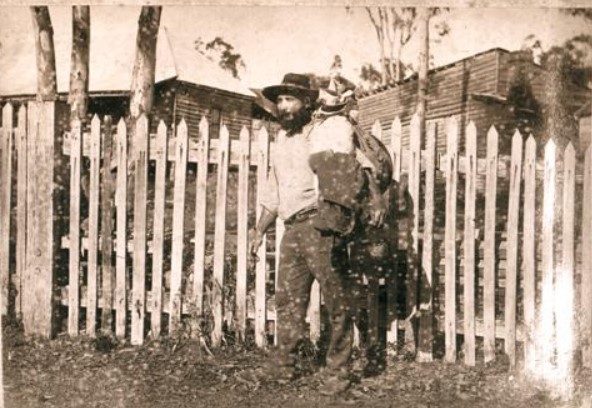
I don’t doubt that many would-be immigrants rethought their plans when considering the prospect of making bread in a pile of ashes and carrying their kitchen with them on their belts.
BUSH COOKING ON THE STATION
For those living on stations or in remote towns, necessity was the mother of many recipes, which the outback ladies of Queensland helpfully forwarded to the Queenslander for the edification of their peers. It seemed at times as if these correspondents, chiefly “F.K.”, “ECONOMY,” and “MOTHER,” were trying to outdo each other for thriftiness and invention. One worthy lady suggested ways of making parrot and cockatoo quite tasty, actually. Another advocated boiling rice for 2 hours to make rice pudding, to the horror of her contemporaries.
“ECONOMY” writes that a little baking powder improves paste made with suet, and that in boiled paste some breadcrumbs are an acquisition.
Should you happen to be doing a bit of slaughtering, there was good use to be made of all parts of an animal.
MINCE PIES. – When killing a pig, take the heart, tongue, and milt; boil them, and chop up fine. Take the same in weight of sugar, currants, raisins and applies, 8 oz. candied peel, a little nutmeg, and half a wineglassful of rum. Chop all together as fine as possible. Line some patty pans with paste, fill with the mixture, put on a lid, make a small hole at the top and back in a moderate oven. MOTHER.[x]
I was a tad confused until I realised that “paste” was pastry. “Economy” lived up to her name, and even found things to do with a roast that had visited the table more than once.
“No doubt many housekeepers have felt the extreme ugliness of a large joint of, say, ribs of beef, after it has been on the table once or twice. If they will try the following recipes they will find that they will be enabled to use it up to the best very presentably:
“Cut off as many slices as you can and serve cold; garnish with tomatoes or parsley; as many people are fond of cold beef. Three or four rib bones, with only as much meat as is left on them after doing so, will make very good soup for as many people; chopping them into manageable pieces, put to boil in plenty of water for some hours. Take the bones out and leave the soup to get cold, to enable you to take off the fat.
“I hope that your bush housekeepers will not think that, because the above do not mention a lot of extravagant materials, therefore they are makeshifts; they are really good. All those who have butter, &c., at their command can use them; for my part I have used nothing but rendered suet ever since I have been here for pound cakes and everything. I cannot quite succeed in making good pastry with it; can any housekeeper give me a recipe for that? and oblige ECONOMY.” [xi]
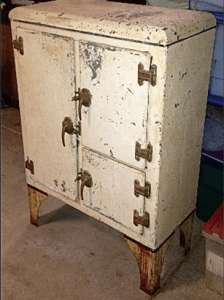
These redoubtable home economists of the 1870s were basically experiencing the conditions that settlers had survived in Moreton Bay in the 40s. If, for example, butter was available, it had to be kept in a small cupboard with dampened material as a door to try and preserve it. As “Economy,” a lady in the Herbert River region could attest, suet was the norm for baking. It was easier to obtain and keep.
Some comforts would be on the way for the redoubtable cooks in the bush. They could not be close to stores for easy grocery shopping or be able to pop into an oyster saloon for some refreshments, but food technology was slowly developing in the 19th century. Canning of foodstuffs was in popular use in the 1880s, having been invented to provide portable food for soldiers, decades earlier[xii]. Pasteurisation of milk was being introduced for use in America. Refrigeration was being experimented with, again in the US, but it would be nearly half a century before refrigerators became part of the ordinary Australian kitchen. And, as every advertiser in Pugh’s Almanac advised, every care was being taken by city retailers to prepare and send orders to the country quickly by the new railway system.
[i] OLD TIMES. By Old Tom. THE SETTLEMENT. – Continued. Brisbane Courier (Qld. : 1864 – 1933), Saturday 21 August 1869, page 7.
[ii] OLD TIMES. By Old Tom. THE SETTLEMENT.-(Continued). Queenslander (Brisbane, Qld. : 1866 – 1939), Saturday 14 August 1869, page 2.
[iii] Advertising – The Moreton Bay Courier (Brisbane, Qld. : 1846 – 1861)Saturday 27 June 1846 – Page 1
[iv] Advertising – The Moreton Bay Courier (Brisbane, Qld. : 1846 – 1861)Saturday 11 July 1846 – Page 1
[v] Cooking in the 1800s (from Tar Heel Junior Historian) | NCpedia
[vi] Moreton Bay Courier (Brisbane, Qld. : 1846 – 1861), Saturday 5 December 1846, page 2
[vii] Moreton Bay Courier (Brisbane, Qld. : 1846 – 1861), Saturday 2 January 1847, page 2
[viii] Advertising – The Moreton Bay Courier (Brisbane, Qld. : 1846 – 1861)Saturday 16 February 1850 – Page 3
[ix] Queensland the progressive! an account of the colony, its soil, climate, productions & capabilities, with a description of every phase of life and occupation, advice to emigrants, &c. by J.C. White. Book – 1870.
[x] The Queenslander (Brisbane, Qld.: 1866 – 1939) Sat 1 Nov 1879, Page 554 THE HOUSEKEEPER.
[xi] Queenslander (Brisbane, Qld. : 1866 – 1939), Saturday 18 October 1879, page 490 THE HOUSEKEEPER
[xii] The Food Timeline: history notes–pioneer, Civil War, cowboy & Victorian foods
 Moreton Bay and More