


Rants, scurrilous personal attacks, incoherent fury – colonial Queensland’s social media had it all. The medium was not the billionaire-owned, algorithm-powered app, but the Letters to the Editor column of the newspaper of your choice. One could put fountain pen to paper, pay one’s postage, and sit back in anticipation of one’s Views being broadcast to masses. If one’s missive was accepted for publication, that is.
The Editor and his deputies policed the correspondence that came their way for publication. Anonymous letters would not be accepted, although one could request a nom de plume for publication. Libelous matter, and those containing “excessive personalties” or downright rudeness, could not be given space. Over time, the gentle chiding of the Notice to Correspondence columns gave way to provocative and hilarious put-downs of would-be ranters.
[Those who wished to truly vent their spleen could also take out an advertisement headed “To the Editor,” but would have to pay for the advertising space. Publication of these advertisements was only limited by how far an individual wanted to expose themselves to the laws of libel.]
Providence, no doubt had some wise purpose in creating you, such as she had when she gave birth to cockroaches, worms, and other creeping things.
Scribble-cum-dash in the North Australian (the letter had been refused by the Courier)

Permit me to inform you, that low coarse ribaldry of expression is not wit – neither is a ridiculous, bombastic, rounding of periods good writing.
Looker-on, replying in the Moreton Bay Courier.
The Courier’s refusal to publish the “Scribble cum dash” letter was explained in a polite, somewhat pained, paragraph:
“THE letter signed “Scribble cum Dash,” in reply to “Looker-On,” is far too personal for our columns. The communication has too many adjectives in it; and insinuates too much against “Looker-On.” A joke we love, but we will never permit persons, under assumed names, to do “The Billingsgate” with the pretence of pietistic moral horror at the state of another correspondent.”
Many of the disputes upon which readers wished to pontificate arose from local issues, and I have divided the editorial ripostes into regions, for reasons that will become obvious when we come to the socio-political hotbed that was Drayton.
Notices to Correspondents
Brisbane Brawls

The long-suffering staff of the Brisbane Courier. (SLQ)
This refusal paragraph made me long to read the original correspondence, but alas…
“A NEW WAY TO MAKE LOVE.” -The writer of this paper is respectfully informed, that the paper he has sent us has reference to private life; and such it, by us, held sacred from newspaper interference.
“CULPEPER JUER.” – If we had set up “Paul Pry,’ to quiz the conduct of our neighbours, your letter might appear in print. We want facts and correspondence on important matters -not insinuations against a young lady, who for aught we know to the contrary, may be purer than her detractors. You and Septimus Smith had better settle matters by fighting a duel with “popguns.”
“QUID PRO QUESTION.” – Scurrilous even for an advertisement.
“HIBERNIAN JOHN.” – Your communication was published, shorn of its abuse.
The next begs the question – did “Painters” submit a quote for creating a painting of a lighthouse, only to find that the Portmaster had something else in mind? Or did he tender to paint an actual lighthouse? Enquiring minds want to know.
“PAINTERS.” Your letter is inadmissible. No doubt the affair was a bungle, but in calling attention to it there was no need for personalities. The next time the Portmaster advertises for painting he will learn that it is necessary to be more specific than to call for tenders for painting a lighthouse.
Those Darling, Darling Downs

The Drayton police station, a destination for those who sought “satisfaction” from their enemies.
The Darling Downs of the 19th century was a peaceful, semi-rural place that contained people who were anything but peaceful, particularly in Drayton. Drayton had been established in the early 1840s and was thought at the time to be the go-ahead township of the Downs.
Not far away (four miles roughly), another township named Toowoomba began to rise, and take on Drayton as the capital of the Downs. Drayton did not like that one little bit. Both localities demanded proper representation, particularly in the first Parliament after Separation.
The people of Drayton were even at war with each other – there was a famous incident in the 1870s when two men declared themselves the victor in the mayoral election. Doors to offices were barred and high words were exchanged.
The Darling Downs Gazette’s editorial staff had quite the time of it, trying to manage the hot-headed, bilious attacks on political and public figures that crowded their letterbox. What began as level-headed advice to would-be correspondents ended up as glorious farce.
“CORKER.” – Your rather stiff communication is deferred. It may be true that people who live in glass houses should not throw stones without looking at home, &c.; but we have since learnt, from the party referred to, that the statement attributed to him, and upon which you base your reflections, was not made use of. It may look “queer,” as you say, but you must satisfy us as to the authenticity of your informant before we can publish or spice your remarks.
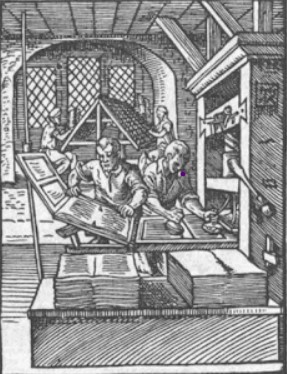
Actual devils. Printer’s devils, that is. Whether they also read Byron is lost to history.
“INEZ” – Send us something original, our Devil reads Byron.
“J. E. BOLAND.” – We have had quite enough of the election for Drayton and Toowoomba, and now it is over it would be better if you would try to make the best of it.
“FACT.” — See answer to J. E. Boland.
“OH SAVE ME.” – Your letter is libelous.
“DRAYTON ELECTOR.” – We cannot permit you to blow so very hot on one side until you consent to occupy the proper space in our advertising columns.
“MODIDEROO.”— Scurrilous doggerel; it is not in our line.
“INQUIRER.” – The publication of your letter would not tend to promote the peace of the fair town of Goondiwindi, and would probably involve the proprietor of this journal in two or three libel actions. The honour is declined.
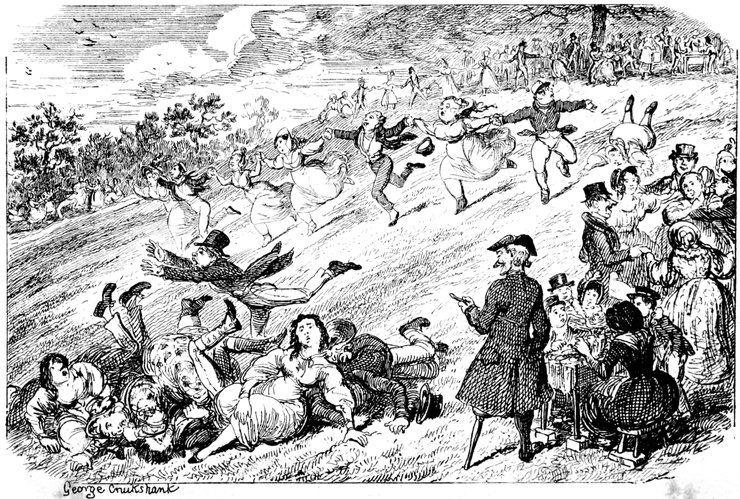
Local politics in the Downs of the 1860s. Possibly.
“R.J.B.” — We prefer to be ourselves the judge as to what we shall insert in the columns of our own journal, and as to what course will best conduce to that “spirit of justice and fair play,” on which you so pompously demand the insertion of your rejected effusion.
“ANNIE S.” — We believe that the Committee of the Darling Downs Jockey Club are not “dancing men,” and therefore there is very little hope that you will be permitted to “enjoy the pleasure of a race ball.” We dare say that you would be happy to take the judge as a partner.
“POET, GOONDIWINDI.” — You are not a poet, nor can we coincide with the concluding lines of stanza No. 11 of the “specimen” forwarded for our approval. It is as follows : —
“In future yet I may do very well,
As champion of your nights and Queensland greatest swell.”
“H.S.” -Twaddle.
“LOVER OF ORDER.” — This is not the proper time for the ventilation of little private jealousies. Arrange a private meeting and settle the question quietly. The “horrible tale of the dummying swell” requires pruning and dressing. Greater care might also have been exercised in the arrangement of the story, particularly that portion which refers to the “future of the ghosts.”
“A VOICE FROM THE SWAMPS.” – Very coarse and personal. Do not trouble us again. Learn to write decently and temperately.
“BORAX.” – You consider yourself “a friend to the old township.” Pity poor Drayton, for in our opinion she never encountered a more dangerous and subtle enemy.
“SUMMUM BONUM”. — Nonsense.
“LIBERTY, INGLEWOOD.” — We are compelled to decline the publication of your “comments on the recent proceedings in connection with the Inglewood pound.” Some of the passages are extremely bellicose, for instance: – “If that should not prove satisfactory enough to ‘Poundkeeper’ why not meet ‘Liberty’ at any time, and demand, like a man, satisfaction, for grievances received at ‘Liberty’s’ hands, who is not afraid to face him when and where he may choose.” We are favourably disposed to the cause (or, as the Premier would observe, we have a “hankering after”) liberty and justice, but unfortunately at the present moment our “fighting Editor” is absent on leave. Why not send a friend to the ‘Poundkeeper,’ and spare the Editor.
And from the North Australian, down the range in Ipswich:
“JUSTITIA”. This is certainly strong, but the provocation was undoubtedly great. Truly these men of Drayton, like the Hebrews of old, are a “peculiar people.”
“PERIPATETIC.”–Your letter cannot be admitted. The upsetting of Cobbs Coach with the Minister for Works and the railway staff was purely accidental. You are totally misinformed as to the facts of the case. The Ipswich members could not have been accessories, for Mr. George Thorn was certainly 100 miles away at the time, nor does the fact of Jack Richards capsizing a Minister necessarily qualify that gentleman for the leadership of the G.L.P., and we are by no means certain that Jack would accept the doubtful honour if it were offered to him.
The Gympie Times
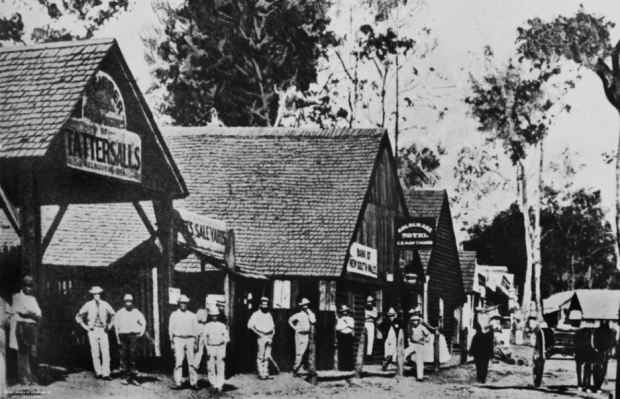
Mary Street, Gympie, 1860s.
Gympie in the 1860s and 1870s was growing rapidly in all directions, following a gold rush. The concerns of the locals were claim-jumping, Gold Commissioners and racing, apparently. They weren’t indignant about local politics or claims to be the premier township of the area. Some tried poetry, which was encouraged, but with some stern conditions.
“FAIR PLAY.” is advised to give up storekeeping if he cannot sell as low as his competitors. His letter is very absurd.
“A VICTIM.” – Your letter is inadmissible. Sly grog sellers know that they break the law when they sell liquors without a license, and though informers are not, as a rule, reputable samples of humanity, yet, in many cases, they prove very effective, in the same way that a certain ointment does for curing a common cutaneous disease-unpleasant in application, but effective in result.
“JUSTICE.” — We quite agree with you that the decisions of Commissioners on this goldfield passeth all human understanding. We can only say that we sympathise with you and hope for better things. It’s useless to bark when you cannot bite.
We have received some verses entitled “The Caledonian Jump,” which we do not insert, because they would take up too much space. When the writer acquires some knowledge of prosody and learns what is meant by the terms of “rhyme” and “rhythm,” we shall be happy to print any of his shorter poems.
“OLD JORROCK’S GHOST.” — Welcome back. You will see that your rather severe comments upon the apathy of the Gympie Turf Club are now rather stale, as the offenders have published their programme.
“M. C.” — We must decline to allow a controversy on the subject of the New York Riots to rage in our columns.
“O’SULLIVAN’S GHOST.” – The affair commenced in our advertising columns, and we decline to transplant it to the correspondence department, especially as it is personal, and of no interest to the general public.
“C.F. VAUGHAN.” — It is actionable to tell the truth of a person when it is not for the public good. He paid the printers; and a man is not altogether hardened when he’ll do that.
‘OMEO.’ — Your ‘P.S. — Avoid Libel’ — is best complied with by omitting the letter, we think.
And lastly, this precious gem:
‘CASSANDRA.’ — You will perceive the reason for withholding your letter, and we trust you are satisfied.
The advent of the Queenslander’s lively “Answers to Correspondents” page in the 70s would usher in a new world of fun and games, with readers querying and responding on all manner of arcane topics.

 Moreton Bay and More