
Dr. Cumming and Politics
Toowoomba and Mr. Groom
If there were factions in Ipswich society, they were completely outdone by the shenanigans taking place on the Darling Downs. Toowoomba and Drayton seethed at one another. Skirmishes took place in the correspondence pages of the Darling Downs Gazette, a new A.S. Lyons newspaper, which first issued forth from a wooden shanty in Toowoomba in July 1858.
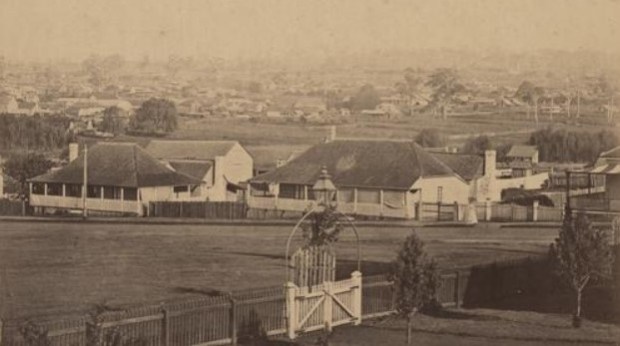
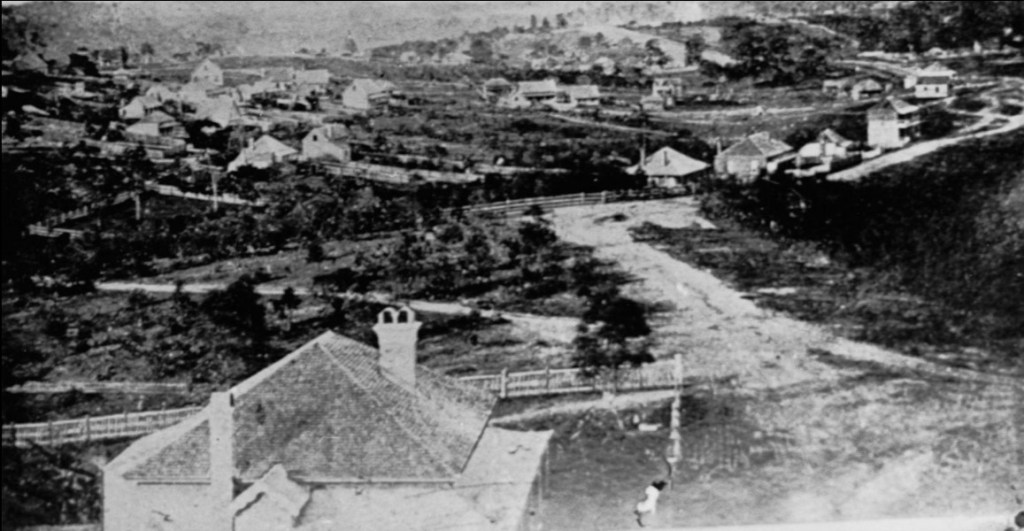
View of Toowoomba, 1870s (SLQ)
By 1858, Dr. Cumming had relocated to Toowoomba, and as was his custom, became interested in local affairs. The Challinor and hospital committee disputes had not taught him anything – he plunged into the turbulent Downs society with gusto.
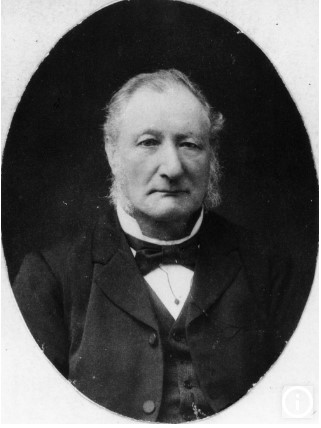
William Groom. (SLQ).
In December 1859, an address was given to the School of Arts by William Henry Groom, a comparative newcomer to Toowoomba, who had an interest in publishing and public life. He had been a reporter for the Darling Downs Gazette since its inception, and his topic was the “great advantages society derived from the newspaper Press.” At the conclusion of his lecture, the audience was invited to contribute any views and observations they might have on the topic.
Dr. Frederick Cumming was only too pleased to contribute to the lively discussion and put forth the idea that the commercial interests and/or personal grudges of some proprietors might influence the content of their publications. This did not go down well with the friends of Mr. Groom.
An attendee wrote a rather peevish account of proceedings in the Letters page of the Darling Downs Gazette, under the nom de plume “One Who Was Present.” [i]
“Dr. Cumming stepped forth, all smiles and blandishments, and took exception to the speaker’s remarks on the newspaper Press.” Calling Cumming’s remarks, a “bilious burst of grandiloquence,” the writer opined “that the example of Mr. Groom, so worthy of imitation,” would prevail in public life.
Them’s fighting words. And Dr. Cumming took the bait and fought – perhaps with too much eloquence and vigour. His 1668-word letter to the editor of the Darling Downs Gazette under the heading “Gallipot v. The Toowoomba Pet,”[ii] might have been longer still, but “The last paragraph in our correspondent’s letter is grossly libellous and cannot be inserted — ED. D.D.G.”
The Toowoomba Pet referred to was of course William Henry Groom, the presenter, as well as a journalist and auctioneer. He was on his way to becoming a cherished public figure on the Downs. In the near future, he would sit in the Queensland Parliament, and later the first Australian Parliament. He was also an ex-convict, transported to New South Wales for embezzlement, and then convicted of a similar offence (and imprisoned) in 1855 at Bathurst.
Dr. Cumming was not pleased to see a twice-convicted man held up as an example to society, and his mildest comment was:
“I must not conclude without saying that I decidedly reprobate, the policy or impolicy of holding up Mr. Groom to the working men of this locality as an example to be followed, or as one whose career they are to admire and follow.”
Mr. Groom decided to mark the end of 1858 by filing a criminal complaint for “wilful and malicious libel with intent” against Dr. Cumming, based on the Gallipot letter. [iii]
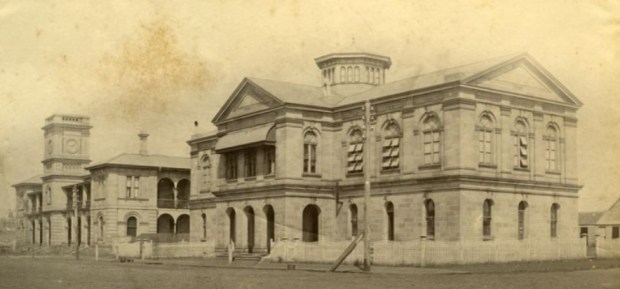
Toowoomba Courthouse, 1880s (SLQ)
The action was withdrawn in January due to informality in the wording, with leave to re-file. This doesn’t seem to have occurred, and Mr. Groom quietly resigned from the Gazette in February 1859 and set his sights on business and politics. [iv]
A quiet couple of months followed for Dr. Cumming. It may be that the dispute with the well-liked William Groom made Toowoomba residents seek health care from another doctor, because in April and May, Dr. Cumming was offering his property at Stuart Street for immediate sale.[v]
On May 12, Cumming wrote to the Editor of the Gazette, denying that he was a participant in a series of scurrilous letters to the newspapers in the region. (At that point, all manner of anonymous correspondence, of an increasingly vitriolic and personal nature, was being submitted under the pseudonyms Justitia, Philalethes, Observer, Looker-On, Scribble-cum-dash and Old Growl. Some letters seemed to have a similar tone and style to that employed by Dr. Cumming.) Dr. Cumming had a reputation to save now:
“A few days ago, I happened to meet acquaintance of mine who, being in a confidential humour, informed me that a report had been for some time in circulation, that I was the author of several anonymous letters which have appeared in the newspapers and that the impression produced was injuring me. I never heard of any such report before, but as my informant is a creditable one, I must content myself by complaining that “Some enemy hath done this,” but request that you will allow me space enough to state that no letter emanating from me has been sent to, or published in any newspaper since I came to Toowoomba, in March, 1858, without my signature attached to it. I am, Sir. Yours truly FREDERICK CUMMING. M.D.”[vi]
Later that week, the Doctor lost a civil suit filed by Edward Lord, a notable Drayton merchant, for the sum of £32 Is. 4d.[vii] Smaller civil suits had already been settled out of court. Time to relocate. Within a fortnight, Dr. Cumming had hung out his shingle at Roper’s Cottage in Fortitude Valley and announced that he was available for consultation at that address. [viii]
Fortitude Valley, Politics and Family
Life in Brisbane began on a hopeful note. Mrs. Cumming was safely delivered of a son on July 31, 1859. In that year of Separation, Dr. Cumming proudly named his boy Victor Albert Queensland Cumming.
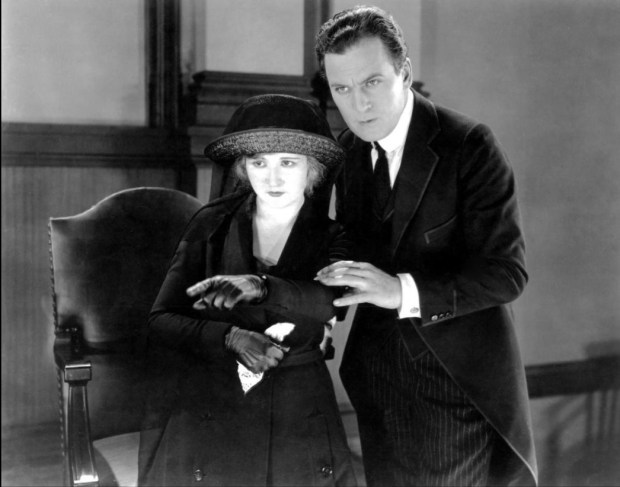
Dr. Cumming’s granddaughter, Dorothy Cumming in 1922’s Manslaughter (with Thomas Meighan). IMDB.
Ironically, Victor would become one of New South Wales‘ best-known land agents, and father of silent film actress Dorothy Cumming. Victor died in Hollywood in 1927 and is buried in the Hollywood Forever cemetery.
A few months after Victor’s arrival, the Doctor’s oldest son, Frederick, nearly fell victim to a brown snake lurking on the garden path but stepped back in time. The good Doctor loaded his pistol and killed the intruding reptile.
Dr. Cumming might have wished that he’d been packing a pistol at the meeting of the Queensland Liberal Association in December. He had begun to harbour political ambitions. After all, an ex-convict was seeking public office in Toowoomba, and he was a respectable surgeon with Views. A slightly disputatious past in the letters to the editor columns, but he was a Gentleman with Views nonetheless. The good folk of the Fortitude Valley Liberal Association would surely welcome him as a candidate.
In his enthusiasm, Dr. Cumming introduced himself to the meeting by announcing that he was intending to offer himself as a candidate for the Valley, and would like to secure the cooperation of the Association to that end. The Association didn’t mind his pursuit of a nomination but thought it might be a good idea to canvass the members to see if the issues he was concerned about were those that the members would support. [ix]
That’s when things became unfortunate. Dr. Cumming seemed to take the Association’s hesitancy as opposition or censorship and demanded a hearing. Dr. Cumming’s Views, it would appear, were heavily informed by his experience with the squatters in Ipswich and the Downs. He insisted on being heard; parts of the audience left. He wanted to make the Association understand him, and when it appeared to him that they didn’t, he made claims that the Association was not interested in having “useful” men on the ballot. Then he dramatically left to pursue his own course as an independent. A few of the remaining audience members cheered.
The Courier duly reported on the evening’s events, and Dr. Cumming duly took up his pen and wrote to the editor to dispute their account and explain his behaviour[x]. In 1200 words or slightly more, he made accusations against Charles Lilley, Charles Blakeney and Mr. E. King. I think Mr. King was “the buffoon Diogenes,” and Lilley “his flippant and shallow principal” in the letter. Blakeney was mentioned in passing, as having allegedly been ridiculed by Lilley when he offered his candidateship at an earlier meeting.
There was pushback – from the journalist, and from future Premier and Chief Justice Charles Lilley.[xi]
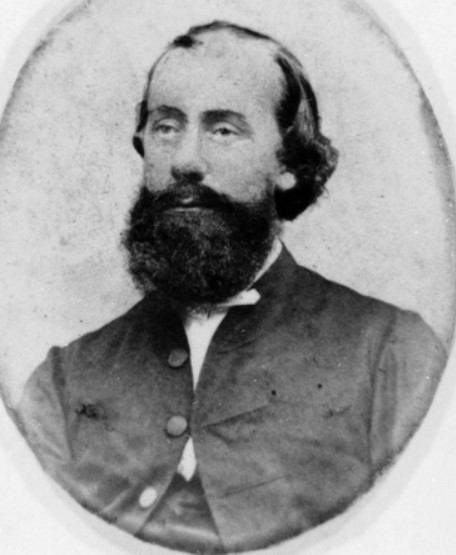
Charles Lilley,1858 (JOL)
First the reporter: “DR. CUMMING AND HIS TWADDLE. To the Editor of the Moreton Bay Courier. SIR-I am perfectly willing to abide by the opinion of those present at the Meeting as to the accuracy of the report given. All the rest of the letter is beneath notice. YOUR REPORTER.”[xii]
Then Charles Lilley: “This is not his first attempt at slander. Having failed to induce the public to take his pills, or listen to his doleful speeches, he has resorted to the abuse of other men as the means of notoriety.” [xiii]
A more cautious man might have refrained from responding. Dr. Cumming was not that kind of man. He restrained himself considerably, though. The response was a mere 721 words, contained only seven points, and no name-calling.[xiv] Still, Charles Lilley viewed him with lasting contempt, and he had become a political aspirant with no party backing.
May 1860 found Dr. Cumming warning prospective purchasers of the Roper house that he was the holder of a lease that would not expire until May 1861[xv]. He must have retained occupancy, because it was in that home that Mrs. Agnes Cumming gave birth to their daughter Emily Margaret in December.[xvi]
The Ipswich Nomination
The new year dawned quietly, and Dr. Cumming managed to attend a public meeting without incident. Well, without causing an incident – a Mr. Innes was the disruptive attendee on that occasion (the meeting was to agitate for a National School in the Valley).[xvii]
Almost eighteen months had passed since the Liberal Association debacle, and the little devil that sat on Dr. Cumming’s shoulder prodded him to make another foray into politics. In Ipswich. Against Arthur Macalister, the future Premier.
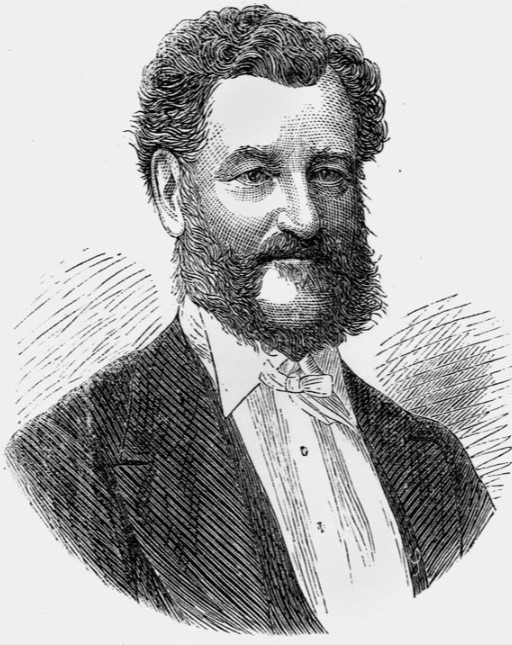
Mr Macalister, future Premier.
Dr. Cumming saw himself as being able to stand up for the rights of the people of Ipswich. Sadly, it appeared that his name was only proposed as a matter of form by Mr. Reeve. No-one thought the man would take up the nomination, travel to Ipswich and start making speeches. But he did, and when it was suggested to him that his cause was hopeless, he refused to withdraw.
“The nomination of Dr. Cumming, and the subsequent show of hands in his favour, must not be regarded with any degree of gravity, as he was brought forward more for “fun” than anything else.”[xviii]
At the nomination meeting, Dr. Cumming’s sheer persistence endeared him to the crowd, who became rowdy.
“During the whole of Dr. Cumming’s address, the conversation and fun had been growing to a height, which compelled the Returning Officer to rap for silence. This was responded to in a very extraordinary manner. Every word of Dr. Cumming’s concluding remarks was applauded to the echo, and when the Returning Officer called for a show of hands, he had to declare that the same was in favour of Dr. Cummings.” [xix]
It was enough to give a man confidence, and the doctor set about door-knocking about Ipswich in his “stiff and formal white choker.” The Courier’s reporter doubted his chances, bringing up his history of fiery correspondence, together with his sudden exits from Ipswich and Toowoomba[xx]. It sounded like everyone thought his campaign was a joke, except Dr. Cumming.
In the era before opinion polls, Dr. Cumming probably had very little idea of what was to come. On election day, “some few idlers were hanging about during the day, whose principal object appeared to be to make fun of Dr. Cumming.” [xxi] He lost to Arthur Macalister’s 198 votes, polling only 27 votes.
Naturally, Dr. Cumming took exception to the press coverage of his campaign. Naturally, he wrote a letter to the editor of the Courier.[xxii] This time, he didn’t thunder or hurl insults. He sounded, well, defeated. He gave an account of his motives in running for office and expressed his disappointment at his treatment.
Frederick Cumming waited nearly a decade before showing interest in political office again, by which time he had endured widowhood and a series of financial crises.
Part 3: Farewell to Queensland and Respect from New South Wales.
The Gallipot Letter
GALLlPOT v THE TOOWOOMBA PET. THE SCHOOL OF ARTS LECTURE.
Mr. EDITOR— In your paper of the 9th instant ‘One who was Present’ at Mr. Groom’s address or lecture in connection with our School of Arts, has taken it upon himself to give a second report of the circumstances which took place on the termination of that address, and of the observations which I made upon it, and also to add a string of personalities which are neither true nor applicable to the case, however excellent they may be as proofs that newspapers are frequently the vehicles of private malice, whoever may make such a charge against them.
Sir, on the conclusion of the address, the Chairman said that “he and the meeting would be glad to hear any observations that any one present might favor the meeting with on the lecture which we had just heard.” After waiting to give precedence to every other person, and no one having spoken, I rose and said — “Mr. Chairman, as you have invited any one present to make observations on the lecture just concluded, and particularly as the speaker has made a powerful appeal to us to do our duty, I think it is my duty to say that I differ from him in regard to the doctrine which he has held forth to us ‘That the newspapers which lie on our Reading room table are worthy of all admiration as being the vehicles of a pure, unsullied, crystalline stream of knowledge, calculated to raise, enlarge, and purify the mind; and I think it important that the members should not receive that doctrine without qualification, as it was well-known that newspapers were frequently established to advocate party interests in politics or religion, or as commercial speculations, with a view chiefly to the return to be obtained for the investment of capital in them, which latter class also frequently fall under the influence of persons who used them for partizan purposes, and that therefore we must examine, compare, and judge their contents, and not blindly believe that everything they contain is gospel, or everything is true that appeared in print” ‘ I never once mentioned “Private malice.”— perhaps the reporter of the meeting and “One who was present thought that was an important omission. Mr. “One who was Present” has done anything but honour to the Press by making it the vehicle of falsehood, misrepresentation, and the jumble of ignorance, and inconsistent trash contained in his letter. He feels folly convinced that there were few in the room, or indeed out of the room, but what believed in all Mr. Groom stated. The applause which followed the few remarks which I made, and which your correspondent calls a “Bilious burst of grandiloquence” was good evidence that the audience who had heard his address did not believe it to be all gospel— some I know believed it to be a disgusting tirade of ignorant impertinence, and hypocrisy; and I believe there are but few out of the room who would think Mr. Groom’s testimony in honour of the Press as capable of adding anything to that honour. I have not the pleasure of knowing anyone who so thinks.
Can the following jumble of epithets contained in the letter of “One” have any purpose but by any means maliciously to endeavour, by misrepresentation. to excite against me those to whom I am unknown, or in quarters where I may not have an opportunity of defending myself. ‘Dr. Cumming stepped forth all smiles and blandishments.” “How unmeaning! ” How full of sophistry?” ‘How much like childish ebullition of a schoolboy!” ‘ Dr. C’s bilious burst of grandiloquence.” After imparting to me expressions which I did not use—inferences that I did not draw—he proceeds in a vein of would-be deep sophistry to endeavour to enlist all the newspaper editors, and their various staffs, on the side of his friend, Mr. Groom, by informing them that he prayed fervently— most fervently—for, the mantle of William James Fox to fall on him, so that he could have vindicated in proud defiance the majesty of the Press. and the honour of Newspapers Poor fellow! he is, indeed, sadly in want of a cloak, for the “Fox’s brush” is easily seen poking out from beneath the “Lion’s skin,” which he is attempting to show-off in over his natural tegument. Charles James Fox’s won’t suit him; and he is not likely to lend it to Mr. “One,” as there is so little acquaintance between the parties, that “One” does not know correctly even Mr. Fox’s name! Editors and their staffs, are not so gluttonously fond of the argumentum ad hominem as to gulp down such a filthy proposition as is presented to them by Mr. ‘One’ in the following formula. “Dr. Cumming taken exception to Mr. W. H. Groom’s statement, “that all the contents of all newspapers are a pure crystalline, heavenly stream, of knowledge without qualification or exception; therefore, the said Dr. Cumming is the contemner of all newspapers and the enemy of all editors and their various staffs in general.” Alas, Mr. Fox! that is too rank: you do, indeed, sadly want a cloak!” Sir, l am so much enamoured of literature and friendly to editors and their various staffs, that I can sympathise with Burns, when he says— “A life of literary leisure, with a decent competence, is the summit of my wishes;” or with David Hume, the historian when he says—”Such a superiority do the pursuits of literature possess above every other occupation, that even he who attains but a mediocrity in them, merits the pre-eminence above those that excel the most in the common and vulgar professions.” And l esteem the Newspaper Press so highly, that I think it is most important, that its high position should be maintained in the integrity of its truth and justice, as well as its intellectual superiority, in its freedom from base members, and base matter; by its contempt for base flattery, and base flatterers who, with the proofs of impurity, rottenness, and have malignity before them, and perhaps afforded by their own productions, will cry out to the Press, which they pretend to worship, “Thou art altogether pure and spotless, and we are thy pure and spotless priests who minister at thy Altars, ” while they are as rottenous ——- of the deity that pretend to adore, or the —– which taints the blood of and taints the —-end, their victims—not their deity. From such enemies in the camp, however, the injured Press may one day free itself; and as it thrusts them from its dishonoured roof, literally exclaim:— “I brand the villain with eternal shame, Who eats my bread, yet tarnishes my name, Who foully slanders, and belies my friends, To suit his private, base, unmanly ends; Who wields my power in malice, hate, and spite, And rends my name for wisdom, justice, right Destroys my power to give as honest fame, And makes ‘The Press’ and ‘Villainy’ one name. Hence bastard cur, dis-Honour not my roof Out—forth to infamy— such my reproof,’ Sir, if it be as I have great reason to believe, that “One who was Present” it the same person who “used to figure before the public” as “Philalethes,” “Justitia,” &c. and who bewailed the cruelty of a “Drayton Subscriber” in throwing those misfortunes in his teeth, which the “Drayton Subscriber” said were “Crimes”, —and who was on February 9th, 1857, ”So young and inexperienced in the ways of the world” (poor dear!) —see “North Australian” 10 February 1857,— he may make himself comfortable in the assurance that I have Honoured the “Newspaper Press”‘ by communicating with it before he was born, unless his tender youth and inexperience extend to thirty years or thereby. On 9th February. 1857, he said he was convinced of the truthfulness of “Pope’s Couplet”— “Honour and shame from no condition rise, Act well your part there all the honour lies.” I hope I do the “Cockatoo Lamb” no injustice in saying that he would like the public to allow his young and inexperienced mind to alter the text a little — say thus, “Honour and shame from conduct do not rise, Act well your part, there all the honour lies, The “Pious dodge” when acted well— I’m right — can cleanse a Convict, make a negro-white! I must not conclude without saying that I decidedly reprobate, the policy or impolicy of holding up Mr. Groom to the working men of this locality as an example to be followed, or as one whose career they are to admire and follow. If his own forwardness and the injudicious countenance and backing afforded to him by one or two persons here, have brought him into a collision which is unpleasant to him, he must in future beware of calling upon or daring people to do their duty. He must also remember the nursery rhyme about . ” Humpty-Dumpty who had a great fall.” There is something, however, which we of Toowoomba may consider of more importance than any fall Mr. W. H. Groom may sustain, for by injudiciously thrusting forward men of his class, the “School of Arts” may also suffer such a fall as it may not recover from for many years, if the title “School of base arts”‘ shall justly become attached to it, “One who was present” must be ashamed of his name or he would affix it to his letter. It may be a privilege of “Editors” to write on public matters anonymously, but it is not, and ought not to be, a privilege of anyone who pleases to make and publish false reports of matters either public or private, and to misrepresent both the words and the meaning of an individual, naming him, and with evident malice trying to array against him not only public opinion, but that form of it which is so powerful that it has not unjustly acquired the name of the “Fourth Estate in our British Constitution.”
I am. Sir, Your obedient servant FREDERICK CUMMING, Toowoomba, 20th Dec., 1858.
[i] Darling Downs Gazette and General Advertiser (Toowoomba, Qld. : 1858 – 1880), Thursday 9 December 1858, page 4
[ii] Darling Downs Gazette and General Advertiser (Toowoomba, Qld. : 1858 – 1880), Thursday 23 December 1858, page 3
[iii] Darling Downs Gazette and General Advertiser (Toowoomba, Qld. : 1858 – 1880), Thursday 6 January 1859, page 3
[iv] Moreton Bay Courier (Brisbane, Qld. : 1846 – 1861), Saturday 5 February 1859, page 3
[v] Darling Downs Gazette and General Advertiser (Toowoomba, Qld. : 1858 – 1880), Thursday 12 May 1859, page 1
[vi] Darling Downs Gazette and General Advertiser (Toowoomba, Qld. : 1858 – 1880), Thursday 12 May 1859, page 3
[vii] Moreton Bay Courier (Brisbane, Qld. : 1846 – 1861), Wednesday 18 May 1859, page 2
[viii]Moreton Bay Courier (Brisbane, Qld. : 1846 – 1861), Saturday 4 June 1859, page 3
[ix] Moreton Bay Courier (Brisbane, Qld. : 1846 – 1861), Saturday 31 December 1859, page 2
[x] Moreton Bay Courier (Brisbane, Qld. : 1846 – 1861), Thursday 5 January 1860, page 2
[xi] Mr. Lilley – not unlike Mr. Groom’s involvement with the Gazette – had an interest in the Courier at that time.
[xii] Moreton Bay Courier (Brisbane, Qld. : 1846 – 1861), Thursday 5 January 1860, page 2
[xiii] Moreton Bay Courier (Brisbane, Qld. : 1846 – 1861), Saturday 7 January 1860, page 2
[xiv] Moreton Bay Courier (Brisbane, Qld. : 1846 – 1861), Thursday 12 January 1860, page 3
[xv] Moreton Bay Courier (Brisbane, Qld. : 1846 – 1861), Saturday 8 September 1860, page 6
[xvi] Moreton Bay Courier (Brisbane, Qld. : 1846 – 1861), Thursday 4 October 1860, page 2
[xvii] Moreton Bay Courier (Brisbane, Qld. : 1846 – 1861), Saturday 12 January 1861, page 2
[xviii] Article – The Courier (Brisbane, Qld. : 1861 – 1864)Saturday 15 June 1861 – Page 2
[xix] The Courier (Brisbane, Qld. : 1861 – 1864) Tue 18 Jun 1861, Page 3
[xx] The Courier (Brisbane, Qld. : 1861 – 1864) Tue 18 Jun 1861, Page 3
[xxi]North Australian, Ipswich and General Advertiser (Ipswich, Qld. : 1856 – 1862), Friday 21 June 1861, page 3
[xxii] Courier (Brisbane, Qld. : 1861 – 1864), Saturday 22 June 1861, page 4
 Moreton Bay and More