

On Wednesday 10 November 1852, the Moreton Bay Courier published a Supplement to its usual Saturday publications. The first item was this black-bordered notice:

This wasn’t just the death of a member of the legislature. The passing of Richard Jones, Esq., brought to end an astonishing career that began with his arrival in Australia in 1809. As a merchant, Richard Jones became one of the wealthiest and most influential people in New South Wales’ history. He built up an incredible fortune, owned vast pastoral properties, married well, mingled with the best in Sydney society, then lost it all in the financial crisis of 1841-1844. In 1843, insolvent, he relocated to Moreton Bay, and gradually began building up a portfolio of land. By 1850, he was a member of the legislature of New South Wales, commuting back and forth from Sydney to his home in New Farm.

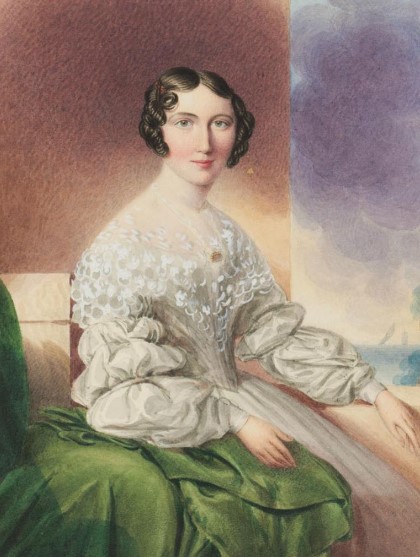
MERCHANT RICHARD JONES
An indication of the diversity of his business interests can be found in his advertising. Here he is in 1812, appointed to sell off the belongings of a man in the custody of the Curator of Insanity:

Three years later, he was instructed to sell Spirits to the various classes of Sydney Town, according to their annual allowances. Publicans seemed to get half the allowance of Civil Officers, which is odd. Perhaps His Excellency preferred to keep his military and civil infrastructure nicely pickled to prevent another Rum Rebellion.

By 1819, Lachlan Macquarie was peeved by the market domination of Jones & Riley, who had no real competition, and could mark up goods as they pleased. He complained of the “Sordid Rapacious House,” of Jones & Riley, no doubt wishing that he could run a rapacious house rather than a turbulent colony.
Property and position
In the early 1830s, Richard Jones purchased Bona Vista House on what was then known as Woolloomooloo Hill. He could gaze down at the city of Sydney or across the harbour to his whaling ships (five in all) as they went about what at the time was a perfectly respectable and highly profitable endeavour. Governor Darling renamed the area Darlinghurst, and Richard Jones thoughtfully renamed his property Darlinghurst House.
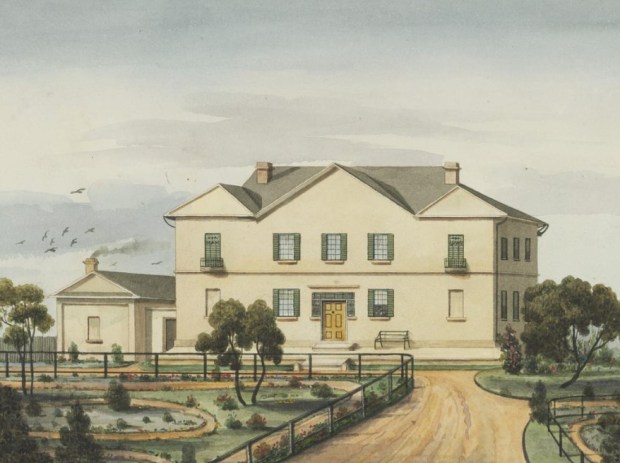
Bona Vista House, purchased by Richard Jones in 1834 and re-named Darlinghurst House. (Per Sunday Telegraph (Sydney) 27 November 2020.) I suspect that his Moreton Bay dwelling of the 40s and 50s was a mite humbler.
Richard Jones, Esq., Merchant, was so prominent in Sydney business and society that people even made paintings of his whaling ships.
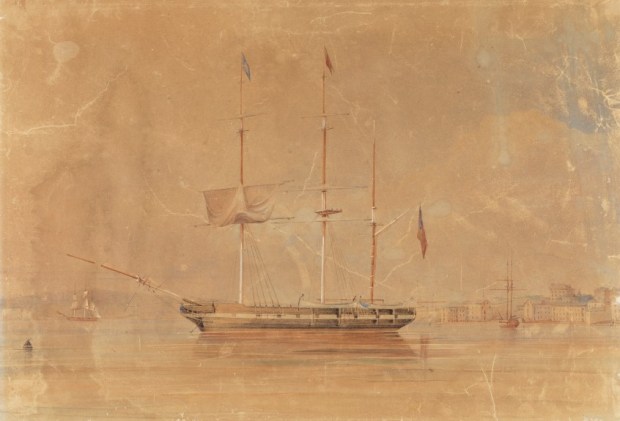
Whaling ship belonging to Richard Jones, probably the barque Nelson, lying at anchor in Sydney Harbour, c. 1835-1843. Watercolour by Frederick Garlin, State Library NSW.
When a gentleman merchant needed to conduct business in Town, there was always the elegant property at Pitt Street.

Richard Jones’ House, corner of Pitt and Hunter Streets, Sydney, c.1836. State Library of NSW.
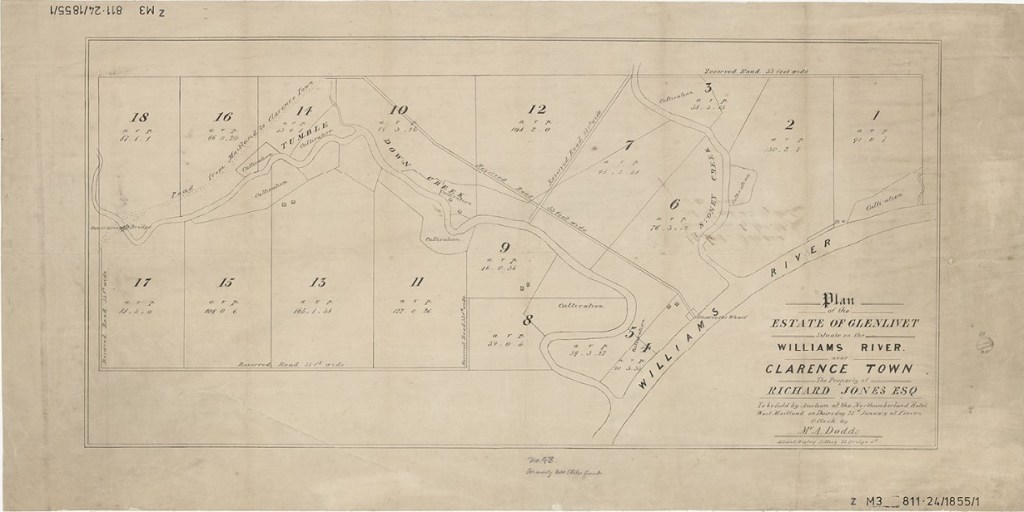
Richard Jones also owned a lot of rural property. Mercantile agency in the city was one thing, but he seemed to have hankered after the gentleman farmer life as early as 1823. Well, the gentleman farmer who owned just about everything that the Macarthurs and Macquaries didn’t own.
Jones owned 10,000 acres in the Hunter River region, as well as the original 2,000 acres Governor Brisbane granted him, and the 6,000 acres he purchased himself.

There were vineyards, dairy herds, poultry, and of course, the purebred Saxon sheep he introduced to Australia in 1825. His flocks produced the finest wool yet seen in Australia, adding to his staggering wealth and influence.
Old R Jones in Old Brisbane Town
An economic crisis between 1841-1843 saw Richard Jones become insolvent, and he ventured north to Moreton Bay, which had been opened to free settlers.
In 1844, he is shown in the Gerler Map, rather disrespectfully as “Old R. Jones” at no. 20 on the drawing.
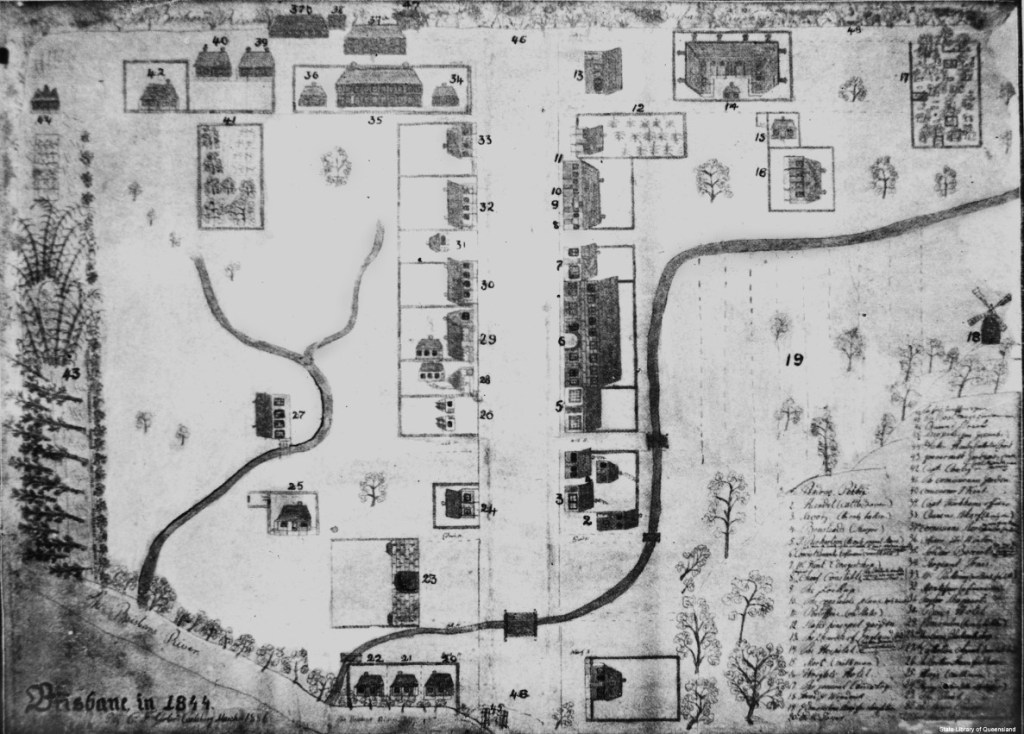
While he didn’t engage in any notable commercial ventures in Brisbane, he settled here, first on the riverside as shown on the map. Later, he moved to Kangaroo Point, and began to accumulate a portfolio of property in the new part of the Colony.
Whatever he may have felt about the loss of his businesses, the vast pastoral holdings and personal influence he enjoyed, he made no public complaint. He built his house, enjoyed considerable respect in the local community, and began to take an active interest in representing the interests of the township.
His politics were by nature conservative, although his opposition to the proposed resumption of transportation in the late 1840s made him veer a little more to the left. In his late 60s, he gamely steamed up and down the New South Wales coast, attending sittings in Sydney, then returning to his family home at New Farm.
In August 1852, his participation in a particularly vigorous debate led to him collapsing afterwards on the streets of Sydney. It was diagnosed as apoplexy, followed by paralysis. When he was able to travel, he went home to convalesce. His health had been improving until another “apoplectic fit” on 6 November 1852 made an end of him. A modern physician would say that he had suffered a serious stroke in Sydney, followed by a fatal one in Brisbane.
The Moreton Bay Courier paid tribute to Richard Jones in its edition of 13 November 1852. The obituary gets the year of his arrival wrong (it was 1809, not 1819), but gives a solid overview of his life and work, and the impact he had on Australia.
THE LATE RICHARD JONES, ESQ. (From the Moreton Bay Courier).
“In our Supplement of last Wednesday, we briefly noticed the demise of the lamented gentleman above named. Since his return from Sydney, having been seized with a paralytic fit while residing in that city for the purpose of attending to his duties in the Legislative Council, Mr. Jones had been confined to his house at New Farm. Latterly the reports of his health had given his friends cause to hope that he would recover from the effects of that attack; and on Saturday morning last there seemed every probability that this hope would be fulfilled. But subsequently he was seized with a fainting fit, and, becoming aware that his end was approaching, took an affectionate farewell of the members of his family present, and expired, apparently without pain, between ten and eleven o’clock A.M.
“At four o’clock on Sunday afternoon the remains of the deceased were brought up by water to the ferry wharf at North Brisbane, where nearly the whole of the inhabitants of Brisbane, of any note, were waiting to pay the last tribute of respect to their departed fellow colonist. Here the procession was formed, Messrs. Thomas Jones and J. S. Ferriter, and Messrs. Daniel Peterson and William Uhr, following immediately after the coffin, as chief mourners. The other gentlemen who were in mourning, consisting of persons of all classes of Religious and Political opinions, followed. Others joined the procession from time to time, and many ladies and children, belonging to the families of the townspeople, accompanied the body to the burial ground. Between three hundred and four hundred persons were present at the interment, and of those about two hundred were in mourning. It was remarked that the few persons of mark in Brisbane who were absent were the exceptions to the rule, and we believe that in each case such absence was accounted for by circumstances of necessity. In some instances, gentlemen who were suffering severely from ill health had made a point of attending; and we are informed that the Rev. James Hanly, Roman Catholic clergyman at Brisbane, announced from the altar in the morning that the afternoon service of his church would be performed at three o’clock, instead of the usual hour of four, in order to enable the members of his congregation to be present at the funeral. The last offices for the dead, according to the ritual of the Church of England, were read in an impressive manner by the Rev. H. O. Irwin, of St. John’s, Brisbane; and the body was consigned to the grave in the presence of a sorrowful and attentive assemblage. The inscription on the coffin stated that the deceased was 70 years of age.
“Mr. Richard Jones was a native of Wales and arrived in this colony in the year 1819. Having been engaged in commerce from an early period of his colonial career, he, in a short space of time, became one of the leading merchants of Sydney, and was for many years recognised as such. Very shortly after his arrival in the colony, he became a member of the Council then existing, and he continued to discharge the duties so imposed upon him until the first Elective Legislature was formed. He, subsequently, for a short time, sat in the new Legislative Council as a nominated member; but shortly afterwards commercial disasters made it necessary for him to retire from public life, and he fixed his residence at Moreton Bay. When the representation of the united counties of Gloucester Macquarie and Stanley became vacant, in 1850, Mr. Jones was placed in nomination, and was elected by a considerable majority. On the present Constitution Act coming into force, he was elected first member of the Legislative Council for the Stanley Boroughs, after an arduous contest, in which the gentleman opposed to him had the benefit of great and deserved popularity. This honourable office Mr. Jones retained up to the period of his death.
“In the year 1823, the late Mr. Jones was married to Miss Mary Louisa Peterson, by whom he had two sons and four daughters, namely, Richard, now a clergyman of the Church of England, and resident in that country; Mary Australia, married to W. B. O’Connell, J.P., son of the late Lieutenant-General Sir Maurice C. O’Connell, K.C.H.; Louisa, married to R. R. Mackenzie, Esq., J.P., son of Sir George Mackenzie, Bart., of Coul, Scotland; and Elizabeth, Thomas, and Frances, unmarried.
“Mr. Jones’ political opinions were well known. He was a sincere and ardent opponent to the proposed resumption of transportation; and to that cause he devoted his services at a period of his life when he might well have claimed a right to retirement.
“In concluding this notice of an old and valued colonist, now departed from amongst us, the reflection naturally suggests itself that, however deeply individual feelings may be wounded, there is much less real cause for sorrow than on many occasions of this kind. After a long and useful career, in which the duties of a good husband, a good parent, a good citizen, and a good subject, have been faithfully fulfilled, and after having attained the utmost limit to which, according to the warrant of scripture, the life of man may be expected to extend, he who retires, amidst the dutiful consolations of a pious and virtuous family, from a world which, at the best, is but a scene of affliction, is more to be envied than to be regretted.”
 Moreton Bay and More