
Hostile takeover of verandah, 1846
BREACH OF THE POLICE ACT. — At the Police-office, on Tuesday, three of the inhabitants of South Brisbane were summoned to answer informations for suffering goats to stray about the public streets. They were fined 5s. each and costs. The informations had been laid at the instance of Mr. Orr, to whom the animals had become a serious nuisance, in consequence of their congregating under the verandah of his house, at nighttime, during the wet weather.
Mr. Orr was about ascending the steps of his house a few evenings since, when a huge Billy-goat disputed possession of the premises and rushing at him knocked him head over heels on to the ground. Not relishing this kind of treatment, he proceeded forthwith to eject the intruder, which was accomplished after some little difficulty. The Chief Constable, we understand, is about to file informations against “all and sundry” who do not keep their goats tied up on their own premises.


The first stone, 1858
THURSDAY, AUGUST 25th, 1858.
Alexander Cheuters was charged with using insulting language likely to lead to a breach of the peace towards Mrs. Hartley. Mr. Chubb appeared for the defendant.
Constable Dunn deposed to apprehending defendant on a warrant. Defendant denied the language charged.
Jane Hartley sworn: On Sunday evening about 5 o’clock she was bringing back a goat and two kids to her premises adjoining defendant’s. Defendant called to his dogs and set them on the goats. He was standing on his verandah. Witness was in the street. Defendant called her a d- d- and threw a stone at her and said that he would split her head open.
Mr. Chubb called his worship’s attention to the clause in the Act under which the information was laid. Defendant appeared to have been on his verandah when the act complained of, if committed, was done. That was not a public thoroughfare, a street. It was part of defendant’s dwelling house.
The Court held the objection fatal and dismissed the case. Complainant then applied to exhibit articles of the peace.
DENIAL OF GOAT OWNERSHIP, 1862
Thomas Grenier, summoned by, constable Maloney for having permitted a brown billy-goat, his property, to stray about the streets, pleaded not guilty, and alleged that the goat was not his property. However, constables Maloney and McKiernan having sworn that that the defendant had admitted that he was the owner of the goat, and that he had promised to tie it up, he was fined 10s. and 3s. 6d. costs and on demurring somewhat at the decision of the Police Magistrate, was informed that if he did not hold his tongue, it was very probable that he might be sent to gaol for contempt of court.
A solicitor with a gun, 1863
CHAMOIS HUNTING. — Sydney Dick, solicitor of the Supreme Court, was charged with cruelty, and unlawfully ill-treating a certain animal, to wit, a goat, the property of E. S. Rutherford. Mr. Dick defended himself.
The Bench: How do you plead Mr. Dick?
Mr. Dick: I plead the Goat Act. (Laughter.)
Mr. Dick defended himself by stating that he had shot the goats on his premises as they were a nuisance, so much a nuisance in fact, that his neighbour, Mr. Bellas, had offered him £5 to shoot the Billy. Mr. Dick, personally, had shot the maternal ancestress of the family, and according to Mr. Rutherford had severely wounded several others, which now limped through the streets. A witness called on behalf of Mr. Rutherford had seen nothing except the death of the goat, after it was shot.
The Bench dismissed the case.
FIRING IN THE TOWN BOUNDARIES. — Sydney Dick, solicitor of the same Court, was then arraigned before the Court on a second charge as above, and in defence again pleaded the Goat Act, contending that the necessity of destroying those destructive ruminants afforded sufficient ” lawful cause.”
This case, also, was dismissed, in spite of a solicitation on the part of defendant for adjournment.
The Bench recommended Mr Rutherford to watch Mr. Dick until he fired without a goat in the way, and that in that case Mr. Dick would be fined £5 the same as anyone else.
Whose goat is it anyway? 1866
James Morgan was brought up charged with stealing a goat, the property of John Murphy.
Sergeant Manton deposed that he searched the prisoner’s premises on the 19th by virtue of the warrant produced, and found a black and white goat in a skillion attached to the house; it was identified by the prosecutor as his property; prisoner said, “I did not steal the goat, it followed a servant girl of Mrs. Davidson’s to my place; she is now cook of the Grammar School; I spoke to Mr. Murphy before, and he said he would send a servant for it, and when the servant came my wife wanted 10s. for taking care of it;” he also said when he was taken, that that was nice compensation for taking care of the goat, that his wife had often followed it and brought it back from the park.

John Murphy deposed that he was the owner of the goat outside the court, which he missed two or three weeks ago; it was generally dept at the back of his premises in Brisbane-street, but sometimes strayed out; heard it was in prisoner’s yard, and went to him and claimed it; sent a person for it but did not receive it; believed it was stolen; got a search warrant issued and saw the goat found on prisoner’s premises; did not give any person leave to take or keep the goat.
Timothy Glennie, a servant in the employ of last witness, deposed that he went to prisoner’s premises, with instructions to get possession of the goat in question; asked prisoner for it, and he said he would not like to part with it, that he would sooner buy it, and had 10s. against it; did not get the goat and went away; prisoner said he would not give up the goat unless he got the 10s., that he had a great deal of trouble in keeping it.
The prisoner denied having any intention to steal the goat, but said it followed a party to his house and would not go away. He called Catherine Hall, who deposed that the goat followed her and another person to the prisoner’s house and would not go away; turned it out once and it came back so he took it in, and afterwards finding out whom it belonged to, he took care of it.
The bench acquitted the prisoner of the larceny but said that there was evidently an intent on his part to extort money.
A goat and a dropped cock, 1866
Henrietta Marles charged by Wm. Farrahar with stealing a fowl. Farrahar deposed that, on Wednesday night, about 8 o’clock, he and his wife were sitting in the hut when they heard the dogs bark and a goat bleating; and about half-an-hour afterwards hearing the dogs bark again, and footsteps outside, he rushed out as one of the fowls screeched, and his wife said someone was stealing the fowls.
On going outside, he saw defendant, about 30 yards away, running along with a goat tied by a long string. He called out —” You may as well stop, for I shall follow and catch you.” Upon which, Farrahar alleges the defendant dropped the cock, and said — ” She was Mrs. Marles,” in reply to plaintiff’s question.
After some words and blows (the subject of an action for assault as follows) defendant went to her residence, which was about 200 yards away. Mrs. Farrahar stated that the fowls were roosting within six or seven yards of the door, in some firewood, and that Farrahar was quite close to Mrs. Marles before she saw the cock dropped.
Mrs. Marles, in defence, stated that she keeps a goat, and on the night in question went by Farrahar’s house to look for it, that being the nearest road; and having found the goat she was running home as fast as she could as the night was cold. She was leading the goat with a cord, and as she passed the firewood at Farrahar’s one of the fowls started off its roost, and rushed on in front of her, when Farrahar came out and violently assaulted her.—The Bench decided that it was scarcely probable that a thief looking for fowls would go out on a bright moon-light night and take a goat with her to a hut where four dogs were loose and the fowls kept within six or seven yards of the door to commit a theft of this kind ; and as Mrs. Marles’s statement carried upon the face of it every appearance of truth, he dismissed the case.

Come on, even the goats are laughing at you two.
William Farrahar, charged by Mrs. Henrietta Marles, with assault and battery. After the fowl affair previously recorded, Mrs. Marles swore that Farrahar struck her a violent blow on the shoulder and knocked her down. She returned to Farrahar’s hut with a Mrs. Edgar, who is residing in the same hut with her, and after some words Farrahar kicked her on the small of her back with a thick soled boot, and again on her left knee, to which assault Mrs. Edgar bore testimony.
Mr. McDonald, wife of the Lock-up Keeper, deposed to having examined Mrs. Marles’s person, on which there was a bruise on the back and another on the knee, both of them recently inflicted.
For the defence, a man named Edward Johnson was put into the witness box. This man had a particular objection to kiss the Bible on being sworn—at first, he kissed his thumb; and on being told to kiss the book, he put his tongue to it. After a severe reprimand from the Police Magistrate, he swore that he was asleep when the row first commenced, and on rising to see what was the matter he opened the door of his hut, situated about thirty yards from the scene of action. He saw Farrahar and a woman scolding each other and saw the woman fall, although he saw no blows struck. This witness gave his evidence very reluctantly, after having been made to take a proper oath.
The Bench commented very severely upon the prisoner— a man six feet high, and strong in proportion— striking and kicking a little woman. He considered the charge fully proved and having read over to the prisoner clause 41 of 29 Vic. No. 11, Offences against the Person Act, the prisoner was sentenced to pay a fine of £10- or two-months’ imprisonment in gaol, and to find sureties to keep the peace for six months— self in £50, and two sureties in £25 each.
A goat and the contents of a chamber pot 1868
There were two cases between Henry Musgrave and Isabella Arundell. In the one, the former charged the latter with assault, and in the other, Mrs. Arundell charged Mr. Musgrave with making use of indecent language to her, on the same date. From the evidence adduced in the cases, it appeared that some of Mrs. Arundell’s goats got into Musgrave’s paddock.
While he was turning them out an altercation ensued, and the man stated in his evidence that the woman threw the unsavoury contents of a certain useful, but unmentionable, bedroom utensil over him. The evidence for Mr. Musgrave, however, went to prove that the only assault that occurred had been committed by Arundell. The first case was dismissed, and the latter went against Arundell.
“You rotten cat!” 1868
Jane Black was charged with assaulting a girl aged thirteen years, named Ellen Athenbury. Complainant stated that she was in Archer-street, near the Range, on Tuesday last; she was carrying a child, when the defendant came up to her, accused her of milking her goat, called her a rotten cat, and struck her on the side of the face with her first.
Name-calling at Petrie Terrace, 1870

INDECENT LANGUAGE. – Frederick Muller was summoned by Thomas Harding for making use of indecent language, at Petrie-terrace, on the 26th instant. The prosecutor deposed that he was a storekeeper residing on Petrie-terrace, saw defendant on the morning in question between 7 and 8 o’clock, standing opposite witness’s shop with a big stick, which he was brandishing over a man’s head; he said, “you b- b-, I will knock you down;” he said this five or six times; the man’s wife came up and interposed, and he threatened to treat her in the same way.
The defendant stated that he was employed by the Municipal Council to extirpate the stray goats in the neighbourhood, and the man whom he was charged with abusing, had given him a great deal of trouble, and called him a dirty German and other bad names. The Police Magistrate fined him 10s, and 4s 6d costs.
New phase of the goat question, 1873
New Phase of the Goat Question. – Henry Evans, an elderly man, was summoned by John Cannon, a corporation labourer, for insulting him on the 21st of December. Mr Cooke appeared for the complainant; and Mr. Handy, instructed by Mr. Bunton, defended. Mr. Cooke said his client had been employed to destroy stray goats, and on several occasions subsequently defendant, when he met him, sang out “goaty” and “bah,” challenged him to fight, and threatened to punch his head. Cannon, having given evidence to this effect, was cross-examined at some length by Mr. Handy, and deposed: I was at the corner of Wharf and Queen Streets; he made a noise like a goat, and challenged me to fight; he has done so on several occasions. The following amusing colloquy then took place between Mr. Handy and the witness: –
Q. “What did he say?”
A. “He called me ‘goaty,’ and made a noise like a goat, if you know what that is; he also asked me to fight.”
Q. “Give us his exact words; what did he say to you?”
A. “He pointed to a spot on the road and said, ‘Come on.'”
Q. “Is that all he said?”
A. “The first thing he done was to call out ‘bah,’ and ‘holloo, goaty;’ then he challenged me to a fight; I said I would give him a cooling or something like that, meaning that I would summons him.”
Q. “Is ‘goaty’ your name?”
A. “No, I was christened lawfully.”
Q. “What else did he say?”
A. “He pointed to a spot on the road, and said come on, and challenged me to box him.”
Q. “Did he say, ‘Come on,’ and challenged you to box him?”
A. “Yes.” (Laughter.)
Mr. Handy, addressing the Bench, said he could not get at the exact words used, and he did not believe that His Worship would be more successful.
Timothy Rock, a Corporation labourer, was called in support of the case, but it turned out that he was not present on this particular occasion.
Mr. Handy submitted that there was no case; the first word uttered by defendant was “goaty,” then he cried “bah,” and there were several persons present; Cannon replied, “I will give you a cooling;” and the other merely pointed to a place on the road and said, “come on,” then went away “bahing.”

“Who are you calling Goaty?”
Mr. Cooke said the man had to put up with insults from the women whose goats he killed, and repeated annoyance from this man was out of the question. His Worship ruled that the language used was of an insulting nature; and Harm Ward and John Bradshaw were called for the defence. Both witnesses heard the defendant say “bah,” but not “goaty;” Cannon replied by threatening to kick him, and defendant said, “Come out on the road and take two penn’orth.” (Loud laughter.) Bradshaw, in reply to Mr. Cooke, said, “I never had a goat, and never lost one; none of my friends ever had any – I have no friends.” (Laughter.) Defendant was fined 5s. and 4s. 6d. costs; and His Worship said, “Don’t do it again, because if you do you won’t get off so easily.”
Professor Dingle catches a goat, 1891
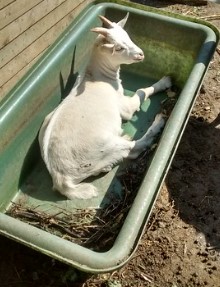
Beside Mr. Edward F. Dingle, professor of music, there lives one John Hinch who has a fancy for keeping goats. There is a fence between the properties, but, goatlike, Mr. Hinch’s goats lost never an opportunity of investigating the garden and the premises of Mr. Dingle whenever the gate was left open or unfastened. Mr. Dingle had remonstrated and complained, but in vain. On the night of November 18, when he returned home at about 7 o’clock, he found two goats on the premises, and succeeding in impounding one of them in the bathroom, he had an interview with Mr. Hinch, and after intimating he was going to send it to the pound, went out again.
When he returned later on, he found the goat gone, and was informed that Mr. Hinch had been with a constable and taken the goat away. All the constable did in the matter was, however, to tell Mrs. Dingle she might be summoned for detention of the goat. The sequel to this was a summons issued on the information of Mr. Dingle, charging Mr. Hinch with trespass. The case was fought out today. Hinch contended that he offered to pay all damages, but this was denied by Mr. Dingle. Hinch was fined 20s., with costs amounting to £1 6s., or in default 14 days’ imprisonment.


 Moreton Bay and More