

On 31 March 1865, the clipper Fiery Star sailed from Moreton Bay, bound for London. She had brought over 500 immigrants to Queensland on 20 November 1864, but her return journey would be a rather less crowded affair – eight in Saloon, eight in Second Cabin, and twenty-one steerage passengers.
She would also be taking an inordinate amount of fine colonial produce back to England, chiefly wool and tallow, and that cargo would ultimately destroy her, and take the lives of most of the people on board.
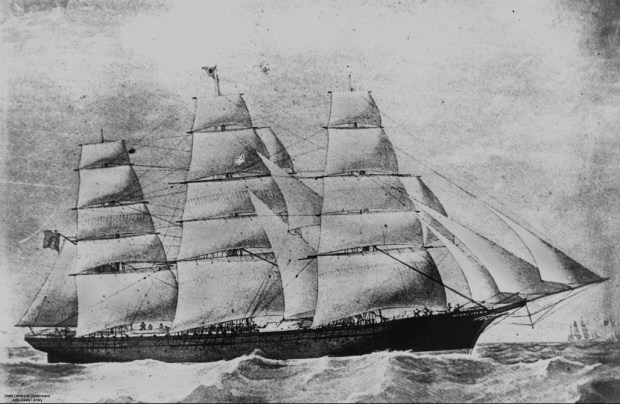
The Fiery Star (John Oxley Library)
January and February 1865
It took nearly three months to load the Fiery Star for the trip to London. Hides, tallow and over 2000 bales of wool soaked in arsenic were crammed into the hold, while passages were advertised in the Courier.
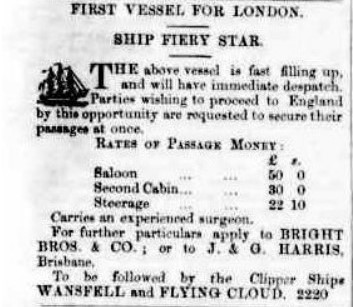
The Courier, March 2, 1865.
Captain W. Hunter Yule, rather a celebrity due to the safe landing of the immigrants the previous year, had taken lodgings in Brisbane. Our fair city offered the usual diversions that Brisbane in the 1860s was famous for – petty larceny and celebratory dinners.
On 19 January 1865, Captain Yule interrupted his ship-loading and socialising duties to attend as the complainant in the case of Edward Mangan, who had been a passenger of the Fiery Star on the previous voyage. The Captain had left a gold ring on his dresser before going out for the evening. When he returned, it was missing. The culprit was identified by Yule, a detective and a pawnbroker. The Brisbane Bench ignored the Captain’s recommendation to leniency, and put Mr. Mangan in gaol for four months’ hard labour.
After that bit of unpleasantness, the crew of the Fiery Star garnered laurels for rescuing a near-drowned man in the Bay, and Captain Yule was the guest of honour at a “very recherché” dinner with some saloon passengers from the last go-round. I do wonder what the Courier was implying – recherché can mean rare and exotic, but it can also mean affected and pretentious. I suspect the latter. Still, the attendees enjoyed themselves, and in true Brisbane fashion, a £20-a-side bet was made on the result of a race between Mr Bower’s horse Paris and the Hon. H.F. A’Court’s Juanita. Paris and Mr Bower won the purse, and “the race caused considerable amusement to the parties by whom it was projected.” Jolly good.
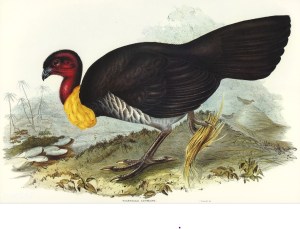
As February dawned, it was reported that the Fiery Star had nearly finished loading. That report was a little optimistic, and Captain Yule whiled away the time by writing to the Acclimatisation Society, offering to take charge of any animals the Society might want to ship to England via the Fiery Star. He was taking some emus and kangaroos himself, and he still had room.
A vote was taken by the Society, and Captain Yule’s offer was accepted with thanks. A shipment of talegallas was thought to be a capital idea. There were a few in England, but the French Society was short a talegalla or two, so they could be sent there via England. Yep, scrub turkeys.
THE MANIFEST OF THE FIERY STAR
On March 23, 1865, the manifest of the Fiery Star was published. The passengers were:
Saloon
Mrs. H. Bell, Dr. Plowman, Miss Line, Miss Dodwell, Mr. and Mrs. Cameron, Mrs. A. Slaughter, Mrs. A. McKay. Several of the Saloon passengers were quite well-known in Brisbane, and some biographical details are supplied for them.
Mrs. H Bell was the wife of Dr. Hugh Bell. She was born Letitia Catherine Rutherford in Lincolnshire around 1832, and married Dr. Bell in 1851 at St. Mary, Lambeth. The Bell family arrived in Brisbane in 1855. Mrs Bell was travelling as chaperone to Caroline Dodwell.
Caroline Elizabeth Harriette Dodwell, the six-year-old daughter of a former civil servant, Arthur Edward Dodwell. Arthur Dodwell had been the Under-Secretary to the Treasury until 1862. In January of that year, he suffered near-fatal head injuries in a racetrack incident, and while he recuperated, correspondence and negotiable money orders relating to publicans’ licences were found in his safe. Dodwell was investigated, and eventually dismissed and permitted to leave the colony. Caroline was under the care of Mrs Bell on her journey to her family in Hammersmith.
Dr. William Taunton Plowman was returning Home after a spell in Brisbane, during which he set up rooms at Clifton-Ville Cottage, Queen’s Park. He was kind enough to offer “Advice, Gratis from Nine to Ten on Monday and Thursday Mornings,” to those who couldn’t manage fees. He was married and was father to a little girl. When the Fiery Star was lost, he was 34 years old.
Mr and Mrs Cameron were an interesting couple. George John Arnold McKenzie Cameron was a former officer of the 11th Regiment, and had married Mrs Maria Feeney, who had inherited the Prince of Wales Hotel in Brisbane from her late husband, Principal Gaoler Martin Feeney. Their relationship would be central to a lengthy court case nearly fifteen years later.
Mrs A Slaughter was the second wife of Alfred Slaughter, a Fortitude emigrant and businessman. Mr Slaughter had lost his wife in childbirth on the journey out in 1849. Emma De Fraine, neé Thompson, came to Brisbane with her husband and son (both named William) in 1862. In 1863, she was widowed, and married Alfred Slaughter. She was 43 when she was lost.
Second Cabin
Miss Ida Wheeler and servant (C. Johns), Miss Russell, Messrs. Peter Hartley, J. Robinson, M. Goddard, H. Latour, D. McKay.
Steerage
Mrs. Bignall, Mr. and Mrs. Steib, Mrs. M’Callum, Mrs. Boughton, Rev. W. Rikey, Mrs. H. Murphy, Messrs. J. Omand (saved), D. A. Dugan, Immerschmidt, E. Edwards, J. P. Plumb, W. H. Watson, C. Messenger, P. Englemen, Christian Meisfer, August Landof, W. Beal, J. Pollock, and Mr. and Mrs. Augusta Hoppe.
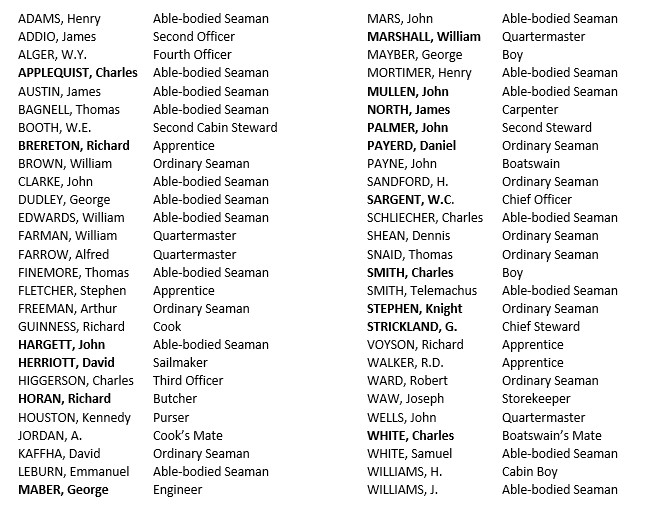
The Crew
The crew members who survived are highlighted in bold type.
The crew nearly had a very diverting addition. One Sarah Johnston disguised herself as a sailor and shipped on the Fiery Star. Perhaps something about her attire failed to convince Captain Yule of her seaworthiness, and the police were called to remove her before she could contribute to the moral delinquency of the crew.
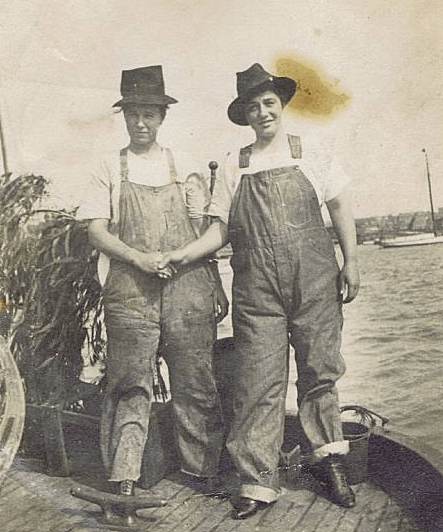
Some young ladies dressed as young gentlemen. Might Sarah have looked like this? (SFGate.)
Miss Johnston resisted arrest quite forcefully. The crew were also having none of it – one very large sailor clobbered Sergeant White, and another kicked Constable McKinnon “senseless” before being overpowered.
The violent sailor was arrested first, and Sarah Johnston was transported to the lock-up in a cart. The Bench gave Miss Johnston two months’ hard labour in Brisbane Gaol. Considering what happened to her temporary shipmates, it was a lucky escape for her.
The Cargo
Wool: 2041 bales 3 bags. Tallow: 134 casks. Cotton: 15 bales 2 bags. Hides: 1519. Horns: 9013. 6 cases arrowroot, and sundry packages. Included in the sundry packages were the Acclimatisation Society’s Talegallas, botanical specimens prepared by Mr Hill at the Botanical Gardens, and Captain Yule’s kangaroos and emus.

The Fiery Star was last sighted from here. The Moreton Bay Signal Station (SLQ).
On Saturday, the Diamond was despatched to the Fiery Star to convey to her a portion of the crew, Mr. Sargent, the chief officer, and some of the passengers. A party of ladies and gentlemen also went down to bid their friends farewell.
The Brisbane Courier, Monday 27 March 1865
On April 1st, it was reported that the Fiery Star was distant, but still visible to the east, as she made her way out into the Pacific Ocean. That was the last that was heard of her until May 27, when the news of her destruction broke in Brisbane.
Related post: The Burning of the Fiery Star
 Moreton Bay and More
1 Comment