

Part 1 – the professor of the comb and scissors
19th century Queensland was a place where a person could change their fortune and make a new life. In some cases, people completely reinvented their lives. An ambitious hospitality worker married her way up to the squattocracy, not troubling herself with the messy and expensive business of divorce as she did so. A clerk with a tendency to repeatedly forge and utter in law offices gave a preposterously inflated account of himself when he entered the Benevolent Asylum at Dunwich, and was largely believed. A Fortitude immigrant decided that he was the one true (Plantagenet) King of England and liked to be addressed as “Lord.” He didn’t hurt others, so nobody minded. A piano tuner prone to fraud married just about every eligible lady he met and used a variety of aristocratic aliases to separate gullible colonials from their money.
Few had quite as peculiar a career as “Professor” Russell. He went from “personal hairdresser to His Excellency,” to gas thief, to bankrupt, to fake Baronet, to prisoner in two colonies, to hairdresser again, before dying in Goulburn in his mid-forties.
Professor Russell in Brisbane 1868 – 1875
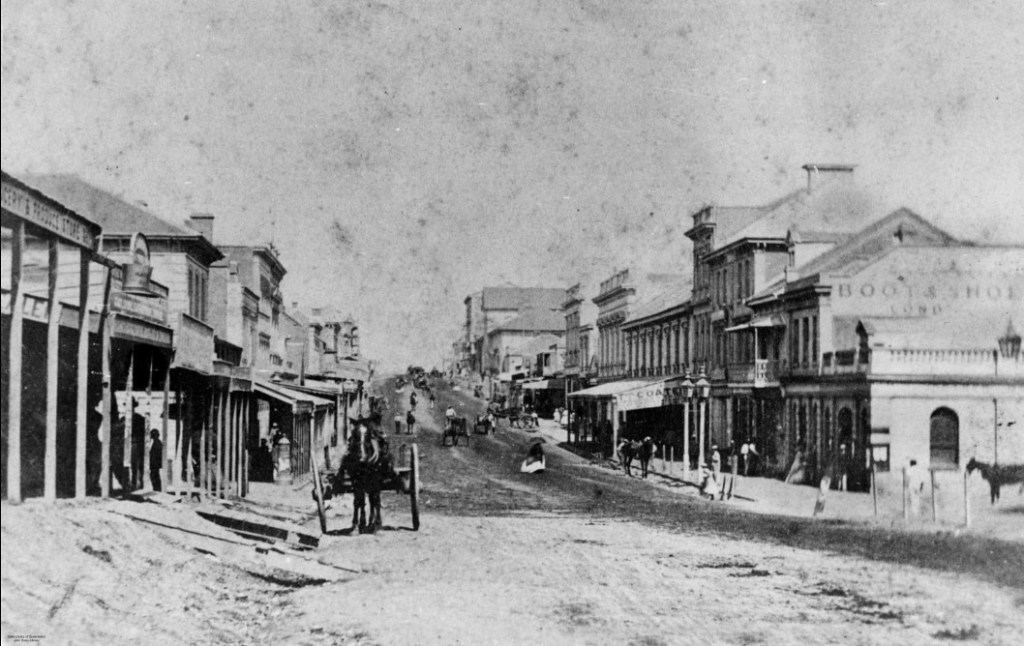
Professor Russell arrived in Brisbane and set up a hairdressing salon in Queen Street his wife. Their first advertisement invited the ladies of Brisbane to have their hair dressed for a ball on September 7, 1868. The couple met with success immediately.
Hairdressing salons in those days bore little resemblance to their modern counterparts. Ladies grew their hair very long and wore it in complicated styles for social occasions. The emphasis was on glossy, full hair for both sexes, with oils and lotions applied to achieve this look. The idea of being shepherded to a basin, and having jets of steaming hot water and cleaning products applied to one’s hair would have sent a 19th century lady into a swoon.
Professor and Mrs Russell promised their personal attendance on those who required it (competent assistants were lamentably hard to come by, according to the Professor), and the establishment boasted chignon pads, extra hair (wiglets), and “brushing machines.”
These intriguing machines have not stood the test of time and survive only as the subject of some alarming-looking illustrations in the British Library. Just how a person with long hair would survive an encounter with these monstrosities is hard to imagine.
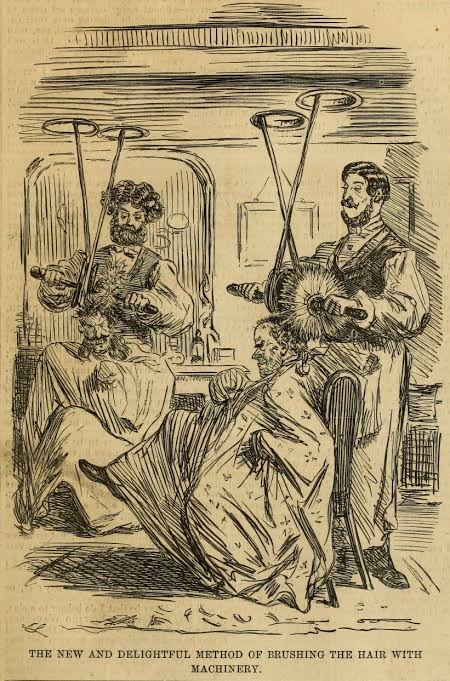
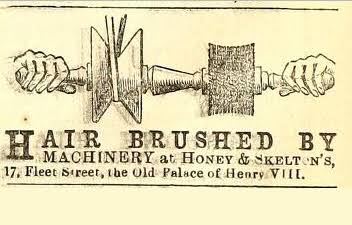
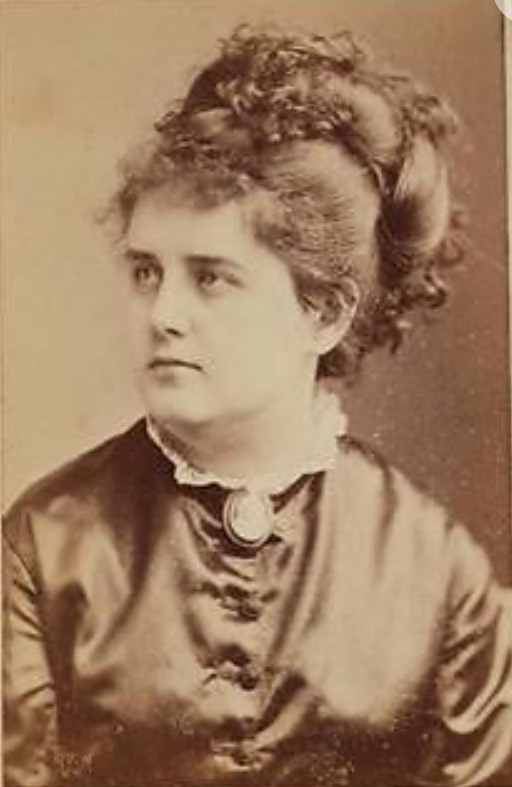
Pictured: Hair brushing machines, and the crowning glory of one Carlotta Grossi, an opera singer of the 1870s. Clearly this was a look for a quiet night in.
The Russells were quite the thing in Brisbane in 1869. They even hosted a Quadrille Ball and Supper in June 1869, featuring one James King as Master of Ceremonies. A good time was had by all, particularly those who managed to part company with their possessions. These items weren’t stolen, but rather left about the ballroom by careless good-time-havers and were advertised as available for collection at Professor Russell’s establishment or that of Mr King (they comprised a silver-mounted cane, cameo brooch, meerschaum pipe, ladies’ pearl ring, two overcoats and three hats).
The Professor had a little bit of a sideline going in the horse-racing business, or rather the betting business. A harmless interest at first, but one that would contribute to his downfall in the coming years.
Professor Russell busied himself in an apparently never-ending search for a reliable youth who could read, write and make himself generally useful (“no lazy fellow need apply”), not to mention advertising and travelling far and wide for a skilled hairdressing assistant.
There were small setbacks. His shop window was “wantonly destroyed” – possibly by larrikins, and his red and white parrot flew away; but until 1870, business was booming, and required a transformation of his shop space by Lewis the Swift, and the creation of a Ladies’ Room.
Trouble on and off the field
In1869, Professor Russell advertised in the Courier, seeking to purchase a publican’s licence. None was immediately forthcoming, but in December 1869, the North Australian Hotel was offered for sale. Russell went to work on expanding his business interests.
SPORTING. I perceive that the old North Australian Hotel, in Adelaide Street, has been thoroughly renovated, and reopened under the title of Tattersall’s. Professor Russell is the proprietor, and he appears to have spared no expense to make it a first-class establishment. Brisbane Courier, 15 October 1870.
1870 was a pivotal year for Professor Russell in Brisbane. In June, his wife met with an accident while driving in his buggy in Queen Street. The buggy collided with a spring van on the corner of Eagle Street, and she was thrown from the vehicle and struck her head.
In August, there was some unpleasantness at the Gympie Race Meeting. Russell had been taking bets on the Maiden Plate and dishonoured bets of £50 as the result of a scratching. He sought the protection of the stewards. Mr WH Kent had scratched his mare from the race, and Professor Russell said that he didn’t know that this had occurred. A Mr McDermott claimed that Russell had paid Kent to scratch the mare, and that all bets were off. Things became uncomfortable, until Kent dispatched a clerk to visit the stewards and swear that Russell was unaware of the scratching, and that no money had changed hands between Kent and Russell.
The hotel business also turned out to be more complicated than opening a hair dressing salon. Russell advertised frantically for everything from cooks to French Polishers in October 1870, but by January 1871, he was selling off everything he owned.
“We have at present in Brisbane Gaol a melancholy barber called Russell, or “Professor Russell,” as he styles himself. He was doing a good business in his legitimate walk, when he suddenly started a public-house, with a free and easy dancing and singing room attached, blazed forth in all the glory of flaring advertisements for a few weeks, as suddenly collapsed as he burst forth, was sold off in hotel, singing hall, and barber’s shop by resistless creditors, and finally marched off to gaol.” Brisbane Courier, February 28, 1871.
Russell was released in March, and declared:
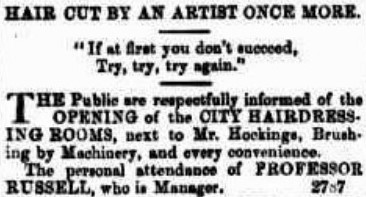
Burdened by debt and with his reputation tarnished, the Professor lasted a few months at the barbering trade in Brisbane until that June, when he “regretted to inconvenience his Patrons by discontinuing Business for the present.” The rent, he declared, was ruinous, and he would “resume Business in a more select style, as soon as suitable Premises offer. G.A.N. Russell.”
The Townsville Post Office Robberies
The next Brisbane heard of Professor Russell was an article reprinted in the Courier from the Ravenswood Miner. Professor Russell had relocated to Townsville.
“On the evening of the 16th of August, the quiet folks of Townsville were startled by hearing the report of two shots evidently fired within the township. A few minutes after, ‘Professor’ Russell rushed into the bar at Evans’, threw himself on the floor and exclaimed that he had been robbed. On becoming calm he stated that when hear the Telegraph-office he had been ‘stuck up’ by a number of men, robbed of his money, watch and other valuables, his coat torn, and himself rolled in the mire; in fact, the only thing of any value he retained was his revolver, which he had gallantly discharged at his foes. Inspector Clohesy, on hearing of the outrage, proceeded to the scene of the ‘sticking up,’ but owing perhaps to the cloudy weather was unable to discover any traces of the struggle. We mingle our tears with those of the Professor’s supporters on the Townsville racecourse.”
As 1871 came to a close, Townsville locals began to notice that their mail had been pilfered with. Amounts of cash and orders were not enclosed with their covering letters. Letters were going missing. All of this seemed to be occurring out of hours. Strange.
On January 12, 1872, police at Townsville arrested one George Albert Norton Russell alias George Brown, alias Professor Russell, for the thefts at the post office. Professor Russell had used a skeleton key to get into the post office at night, and his wife’s dainty hands allegedly extracted the goods from the letters. Mrs Emma Russell and Thomas Harris were also arrested. Mrs Russell was questioned, and made certain admissions, but the charges were eventually dropped. Mr Harris had his charges dismissed but was re-arrested almost immediately afterwards.
On January 20, at the Townsville lock-up, Sergeant Higgins became suspicious of certain activities in the Professor’s cell. A thorough search yielded a small saw and a heart-rending letter intended for Mrs. Russell.
“My own loved wife, – Don’t think too badly of me for the trouble I have brought you into. It will not last long, my dear one; the law does not allow you to be convicted. I write this on Saturday, January 20. I have waiting this long, expecting and hoping you would arrive per Black Swan, when I would have you freed at any cost; but finding you are not coming up, I have determined not to wait unless compelled or brought back. I made arrangements to leave three weeks ago, as soon as you came up, but waited to clear you till I find you are not coming. Should you eventually come up, make no statement yourself, but send for a lawyer; don’t say anything at all in regard to your case, but tell the lawyer the exact particulars. Get Norris if he is up or send to Brisbane or Rockhampton for one; only have Macnish as a very last resource. I am speaking of course in the event of my not being here. Beware of Barry; don’t believe a word he says in my case, and don’t speak of the case to anyone; talk on any subject but that.
Once clear away, you may depend on hearing from me. I’ll find means for you to join me at the earliest moment. You will likely think what I am going to say is cruel, but in saying it I think only of your happiness, for I would not have life without you. If you think I have brought upon you enough of misery, write to ‘father’ and tell him so, and that you will not join me again. Though my heart rises to my throat and nearly chokes me as I think of it, I will not murmur at the sentence, for I deserve it for the misery my thoughtlessness has caused you; but I will lie down quietly and die, only wishing it might be with my head on your heart, the one hope I have had all through life. Had you come by the steamer, were you freed or otherwise, we would have had a fortnight’s happiness going to and from Rockhampton, then I should have received a sentence you could have accompanied me to Brisbane in the steamer, and on entering the river at Brisbane I could have returned my soul to God happy and contented, knowing that through life I have struggled to carry out the dictates of a good and true heart, though necessity compelled me to break the laws.
I have simply gambled my life and happiness against death, and I have lost, so it’s no use to repine; and, my darling, you would approve my choice of death, for, after a short period of sorrow, the world would proclaim you a free woman. How much better this than having a husband a burden on you for years and years, and your heart always longing for him – for while there is life there is hope of happiness – and those hopes, sometimes too delusive, cause much misery; and so, pet, if I am in existence free, at your wish, I’ll soon find a way for you to join me; if a prisoner convicted, strive all you know to let me die peaceably with my head on your dear, dear heart, and perhaps save me a death of torture. The police have £48 6s of mine, and all the other things, which you must claim in any case. If you have a lawyer, he must apply for payment out of it. The money does not belong to the case – money received from Roberts, auctioneer’s account sale, £29; Barney, horse, £8; Miss Kennedy, machine £6; private sale of goods and furniture, about £10; within three days of arrest. The names mentioned can of course prove this. Mr. Allom, auctioneer, Ravenswood, has to pay me £6, the horse sold. Mr Richards has orders for some amounts.”
There was another escape attempt to come. In March, he used (another?) small saw to cut a hole in the floor of his cell but was detected before he could make proper use of it. Both the post office and the lock-up at Townsville clearly needed some security upgrades.
Russell was convicted of receiving stolen goods, and sentenced to four years’ imprisonment in Brisbane Gaol. The suicidal intention referred to in his letter to his wife was very nearly carried out, but, like his escape attempts, failed miserably.
“The prisoners came down under the charge of Sub-Inspector Coward, and on the way, the Professor seized an opportunity to swallow a quantity of opium, which he obtained from a Chinaman passenger. The drug, however, which was apparently taken with a suicidal intent, simply acted as a soporific, and the Professor arrived little the worse for wear.”
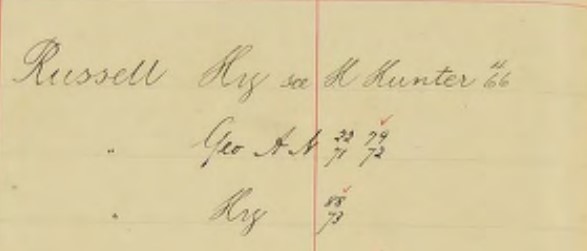
Professor Russell was released from custody on July 24, 1875. On 29 July, he advertised that “Professor Russell, Criniculturist, will Re-commence Business about the 14th of August.” A criniculturist is a fancy name for a hairdresser, apparently. He didn’t recommence business, possibly because his patrons were too aware that his most recent address was the Petrie Terrace Gaol.
coming Next: Part 2 – The Professor in New South Wales: 1876 – 1884
 Moreton Bay and More
1 Comment