
The colonies in the 19th century provided a delightful playground for any number of bounders, rogues, rascals, and cads. All one really needed was an English accent and an air of authority, and the far-flung, gullible colonials would open their pocketbooks and parlours.
An Englishman who liked to pose as an aristocrat married a good portion of the eligible young ladies of rural New South Wales and Queensland, quite a few of them at the same time. A hairdresser with few formal qualifications appointed himself “Professor” Russell, and experienced all the highs and lows that young Australia had to offer – holding an elegant ball in one city, running brothels in another, and doing rather a lot of prison time in between.
One of the more puzzling cases was that of Samuel Aynsley Norman. Or possibly Samuel Abraham, or Professor Abraham, or Dr Hope, or Doctor Norman, or Dr Guy Aynsley Hope. The aliases of Martin and Hunter were also recorded by the Crown Prosecutor in Queensland but are hard to trace without the given names he used with them.
I first became acquainted with him through the Crown Prosecutor’s Deposition Books for 1878. I wondered how a Doctor, admittedly one with a few aliases, came to be charged with murder at Aramac.
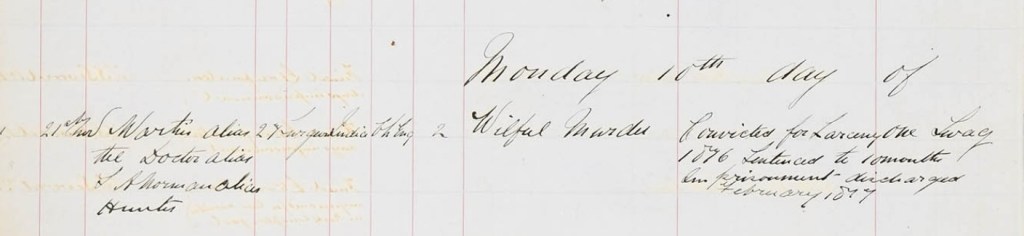
It turned out that murder was the one charge of which he was clearly not guilty. Searches for Dr Norman came up with a passing reference to his other identity as a phrenologist named Dr Hope who had entertained the citizens of Cooma, New South Wales, a year before. This gentleman, it turned out, was a Mr Samuel Abraham, originally of London. And he was a newly released prisoner at the time of assuming the mantle of Dr Hope.
The background information he supplied to the police and prison authorities was scant. He said that had been born in London in 1844 and had arrived in New South Wales by the Silver Eagle in 1868. That ship did not make a stop in Australia that year, but a Samuel Abraham can be found in the 1870 passenger manifests of the Silver Eagle, travelling ignominiously in steerage.
Professor Abrahams.
1873 – Southern Queensland and Northern New South Wales
What Mr Abraham, if that is indeed his real name, was doing until 1873 is not clear. But in March 1873, he ventured into the Darling Downs as “Professor” Abrahams, a celebrated phrenologist. He started with a bang.
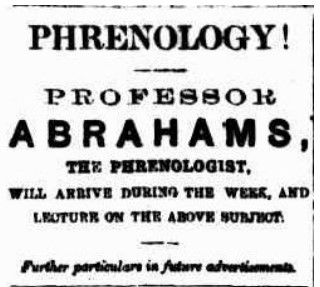
This was followed shortly afterwards by:
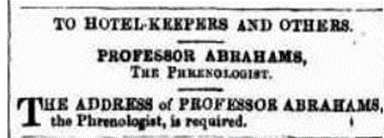
And then, in Brisbane in April:
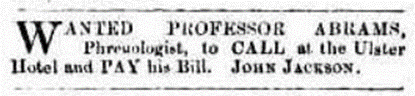
Oh well. Perhaps Professor Abrahams’ unique talents might be better suited to the Clarence River District of New South Wales, which is where he fetched up in June 1873:
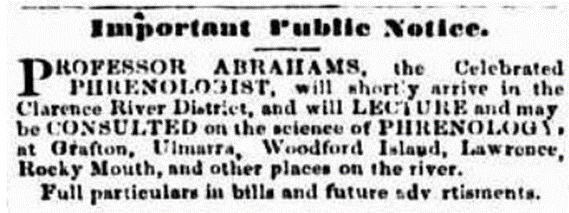
The New England region lapped up his lectures, if the advertisement of 24 June 1873 is any guide:
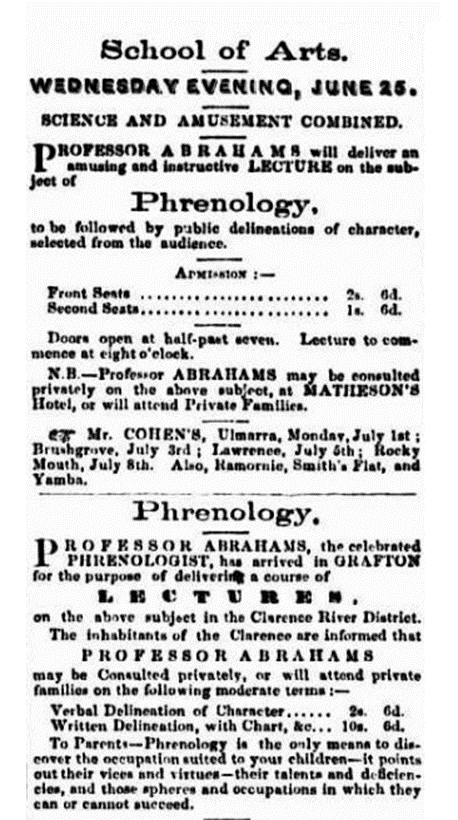
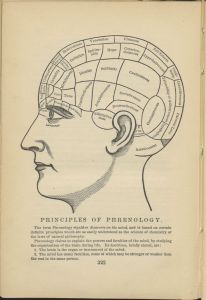
Phrenology is a now-debunked study of the shape of the human head that purported to explain the character traits, abilities and even destinies, of an individual. It was a field that lent itself to public lectures and audience participation, to entertainment rather than science. Judging by his reviews over the years, Abrahams was a genial and entertaining lecturer, and might have had a more glorious career (under only one name, perhaps) were it not for his rather loose approach to hospitality payments and horse ownership.
Samuel Abraham.
A career in jeopardy.
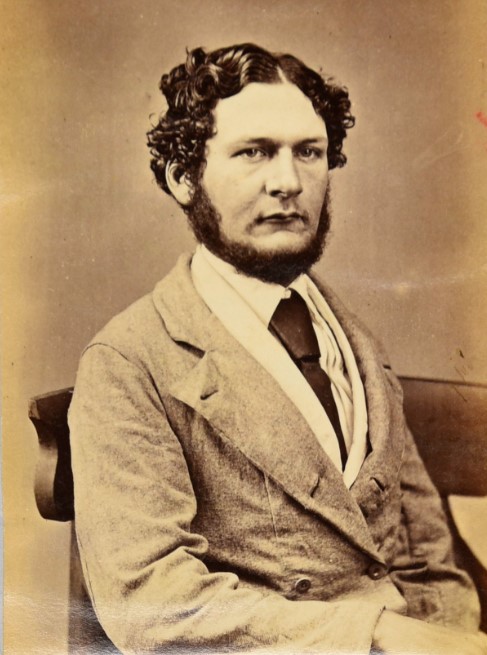
In September 1873, one William Drury loaned a chestnut mare to one Samuel Abrahams, known professionally as Dr Hope, for six weeks. Hope needed it to travel about the district on his lecture tour. It would be some time before Mr Drury would see his mare again, and by then it had been sold to a Mr Robert Gollan. A warrant was issued for Abrahams’ arrest, and he found himself before the Grafton Quarter Sessions in March 1874, rather the worse for spending three months in pre-trial custody. He had meant to pay for the horse. Really. He blamed the drink. The Judge gave Abrahams six months for larceny as a bailee, despite the defendant’s pleas that any more gaol time would ruin his career as a phrenologist and lecturer. To add insult to injury, Grafton gaol was full, and the Professor was rerouted to Darlinghurst, which is where this gaol photograph was taken.
Doctor Hope.
1874
On 2 September 1874, Samuel Abrahams’ release from Darlinghurst Gaol was published in the Government Gazette. On 7 September 1874, a gentleman phrenologist named Dr Hope arrived in Goulburn, and explained the origins and methodology of his discipline to “rather small though very attentive audiences.”
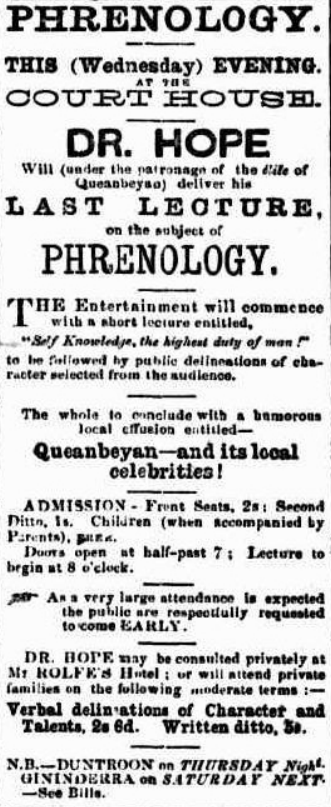
The Queanbeyan Age extolled the success of the visit, and noted that Cooma and other parts of Manaro would soon be experiencing a professional visitation.
Do not make fun of the local aristocracy.
Altogether, Dr Hope is a good speaker; his lectures are short, simple, and amusing; he is humorous and witty; and his lectures are interspersed with appropriate anecdotes. In short, he is well worth hearing.
The Manaro Mercury
The first mistake Dr Hope made in Cooma was to disparage his doubters – people who he proclaimed the “paper-collar aristocracy.” While a line like that made his audience roar with knowing laughter, some of the said aristocrats were mortally offended.
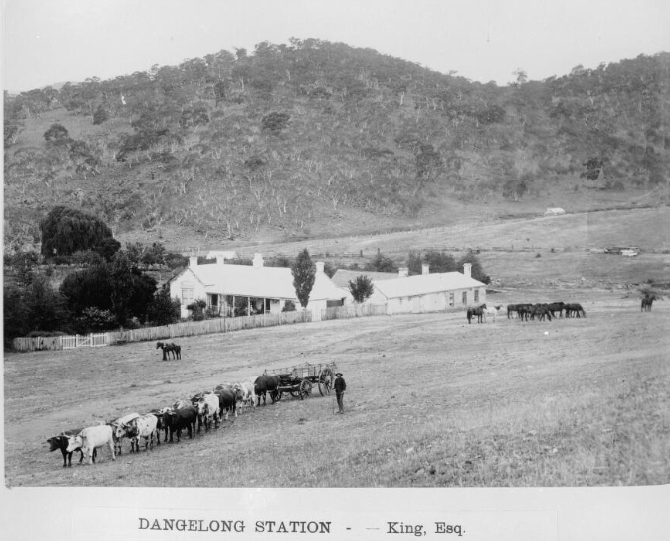
The second mistake Dr Hope made in Cooma was to play a prank on a passed-out drunk. Hope and a companion found a local man named Thomas Ward (better known as “Copper Tom”) passed out on a sofa at a hotel. They decided to play noughts and crosses on his face with ink. Then one of them used a stick of a substance that turned out to be caustic. Whoever wielded the caustic stick apparently did not realise the consequences, and Copper Tom woke up the following morning in agony. Dr Hope was arrested, and Copper Tom’s faced burnt and peeled. The matter was heard at Cooma, and the charge was dismissed.
The third mistake Dr Hope made in Cooma was to borrow a horse from Mr John Ward (hopefully not a relation to Copper Tom) and fail to return it. Mr Ward had a warrant was issued for the arrest of Samuel Abraham. Dr Hope was picked up in Seymour and remanded to Cooma that December. This charge was also dismissed. At least one newspaper thought that the “paper-collar aristocracy” was persecuting the Doctor.
As public journalists, it is our duty to support the cause of law and order, and we shall at times do so; but our duty to the public at large also calls upon us to denounce anything like hounding a man down.
The Manaro Mercury
In early 1875, Dr Hope ventured deeper into regional New South Wales, garnering some lukewarm reviews:
Dr Hope had a good attendance at Mr Johnson’s Hotel, when he lectured on the “bumps.” Whether the Dr found sense or not in Araluen bumps I do not know, but he had sense enough not to stop too long, so off he went, I suppose to take his place amongst the other exhibits at the agricultural show in Sydney. What class they will put him in I do not know, possibly in the fowl department amongst the geese.
Moruya Examiner
In April, Dr Hope was bound for Goulburn. I wonder if anyone recognised Dr Hope as Professor Abraham? At any rate, Dr Hope disappears from our narrative at the end of May 1875.
Dr Norman.
1876 – from the Downs to the Bay.
In late 1875, Dr Hope and his dwindling prospects in New South Wales transformed into Dr Norman, a medical man in Queensland. His return to the Darling Downs got off to an inglorious start, but at least no-one seemed to connect him with that bane of all hoteliers, Professor Abrahams.
A Dr. Norman – whoever he may chance to be, for we have so many doctors and baronets out here that we don’t know what to do with them except lock them up – got a month’s imprisonment for obtaining a saddle from one Katchler of St. George, by means of false pretences.
The Darling Downs Gazette, March 1876
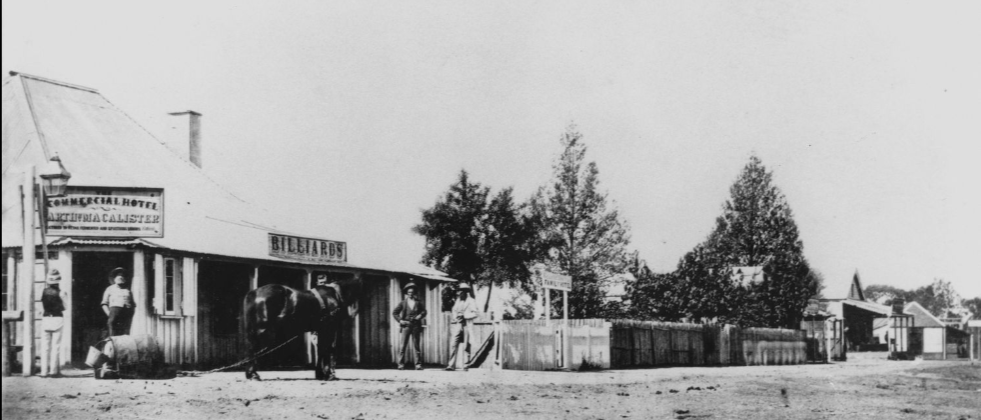
Worse was to come. In April 1876, Dr Norman was charged with larceny as a bailee at St. George District Court, having borrowed a bay gelding from Mr Payne, ridden it about, then taken a Mr Luckman’s mare in exchange for it. He was charged as Samuel A Norman, and it was his first offence for horse stealing, Your Honour.
I would have paid good money to see this:
The horse now before the court is my horse.
Stephen Payne
Dr Norman’s address in defence was a theatrical tour-de-force. Over 2000 passionately delivered words of glorious fiction, setting out a long and hapless journey for a job interview at Roma, diverted by an outbreak of disease at Burenda, the prospect of perishing in the bush on the way there if he didn’t have a better steed, a hasty swap, and an intention to make things right if God didn’t keep sending things to try him. (I will copy out his defence and make it a separate post – it’s the greatest “dog ate my homework” speech I’ve ever seen.)
The jury didn’t buy it. The judge thought that Norman was a respectable, well-educated young man who had clearly never been charged with horse stealing before, and there had been a lengthy stay in pre-sentence custody. He gave Dr Norman a year in Brisbane gaol, with a discount of two months.


The Manaro Mercury wasn’t going to be fooled again:
“DR HOPE” At St. George (Queensland) District Court, Samuel A. Norman (who, we believe, is the phrenologist that visited Cooma some time back), was put on his trial for horse stealing and found guilty.
Dr Norman spent the rest of 1876 at St. Helena. A brief appearance before the Brisbane Bench in February 1877 for obtaining goods by false pretences didn’t lead anywhere, and soon Dr Norman was on his way to practice medicine at Mitchell. Where he hoped, no doubt, that no-one received the Darling Downs or Brisbane papers.
1877 – the new medical man at Mitchell.
From April 1877 to August 1878, a new Doctor set up his shingle in the town of Mitchell, a good 270 miles west of Toowoomba, but not as far west as Charleville, the scene of his first Queensland charges. He seems to have won the confidence of the locals, industriously setting broken limbs and attending to concussions, and even the victims of bull-gorings.
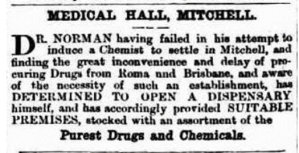
Between August and November 1877, Dr Norman disappears from Mitchell, and the following is posted in the Rockhampton Bulletin on 24 November 1877:
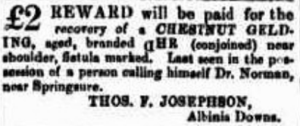
What the person calling himself Dr. Norman was doing was making himself scarce, because in early November, a man with whom he’d had a fight at Aramac, died. Norman was charged with murder, and was apprehended and locked up at Aramac in November 1877:
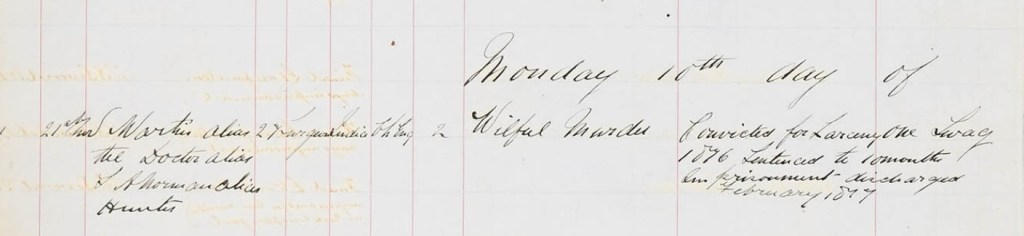
1878 – Murder charges and more horse theft.
An Incurable. — Some time ago we referred to a man named Martin, alias Dr. Norman, who stabbed a man near Aramac, fled from the district, but was subsequently captured by the police. A few particulars have been supplied to us about this person which are instructive in their way. It appears that this gentleman has been an inmate of more than one gaol in the colonies; but some time ago settled down as a ‘doctor’ in Mitchell, on the Maranoa. Here, we understand, he might have done very well, but drink was his besetting sin, and so he went from bad to worse. On his card appeared the interesting letters F.R.C.S.E., but in his case these proved to be a F.A.R.C.E.; for a squatter near Mitchell made written enquiries, and news reached him by late mail from England that the name of no such person was on the list of gentlemen entitled to use these letters. The Telegraph (Brisbane).
Doctor Norman was now very well-known and for all of the wrong reasons. He was committed for trial at Rockhampton in April 1878. The Crown had downgraded the charge of murder to manslaughter, but went on with the prosecution nonetheless.
What happened was this. On 14 October 1877, Dr Norman, now using the name Martin, but also answering to “the Doctor,” had a drunken scuffle with a man named Alexander Jaffrey. Jaffrey was cut on the left arm above the elbow and had a scratch on his chest. Dr Norman had a knife.
The following day, Jaffrey was complaining of pain in his arm, but the men made up their quarrel and went their own ways. Jaffrey received first aid from Norman and was treated at the Scarbury Hotel before going off to work in the bush.
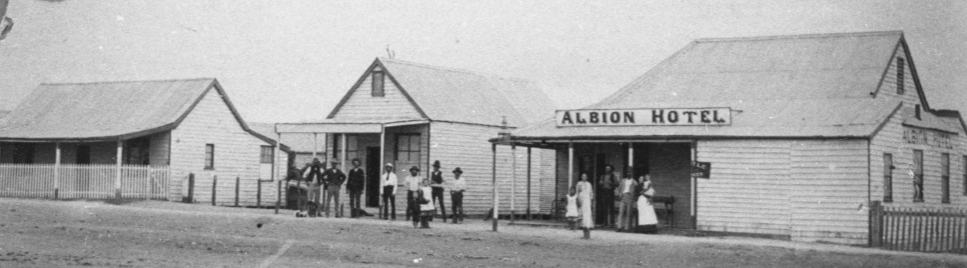
Ten days later, Jaffrey was returned to the hotel, delirious and dying. He passed away on November 9. At a post mortem, Dr Benjamin Poulton deposed that the cut on Jaffrey’s arm was not a serious one, but he had died from blood poisoning that had developed in the time he was out in the bush. Had Jaffrey remained in town and had proper medical care, he would have survived (this was long before the discovery of antibiotics). Norman was undefended, and addressed the jury in a manner that was described as “ingenious and well-delivered.” He was found not guilty of manslaughter.
But wait – wasn’t there still a horse stealing charge? Yes there was, and an adjournment was sought, and reluctantly granted, as was bail.
In October 1878, Samuel Ainsley Norman, as he was calling himself, again fronted the Rockhampton Circuit Court, and was tried and found not guilty of horse stealing. By this stage, the Crown Prosecutor must have been grinding his teeth – making out charges of murder and horse stealing for a year, and nothing to show for it.
1879 – Dr S A Norman, Surgeon and Accoucheur, Emerald
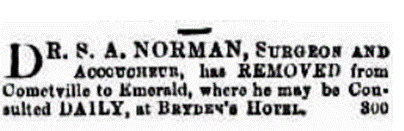
Restored, a bit, to respectability – or at least not sitting in a gaol cell, Dr Norman sought fresh challenges. He spent some time in Cometville in 1879 before removing to Emerald, where he showed his skill at setting broken bones, and campaigned at a public meeting for a hospital to be established at Emerald. Emerald, he felt, was a coming place – there were several stores already, twenty-three shanties, and three public houses. A wag in the audience asked if he had visited every one of them. No, he replied. He had not. (Clearly a sore spot.)
Not long after this meeting, he became unwell. Years of drinking, self-inflicted legal troubles, and representing himself to be someone he wasn’t, took their toll.
S.A. Norman, alias Dr. Norman was charged with being of unsound mind. Upon the evidence of Dr. McNeely, Railway medical officer, and Sergeant Carey, the prisoner was sentenced to one month in the Rockhampton Lunatic Reception House for medical care and treatment.
Daily Northern Argus, 26 April 1879.
Once care and treatment had been administered, Norman found himself at a loose end with few options for employment. Labouring or clerical work clearly did not appeal or occur to him. He turned up at Gayndah and was charged with passing valueless cheques. The trial in October 1879 resulted in eighteen months’ imprisonment, and he again entered the St Helena Island prison. He was released in early 1881 but St Helena had not rehabilitated him. Not by a long shot.
1881 Dr Guy Ansley Hope and no true bills.
Shortly after leaving St Helena, he turned up in Goondiwindi, calling himself Dr Guy Aynsley Hope. The local chemist was fooled and was as a result not paid for the goods and services he supplied to the aristocratic-sounding new arrival. The authorities were not fooled, however, and Dr Hope was remanded to Toowoomba District Court for practicing medicine without proper authority, and false pretences.
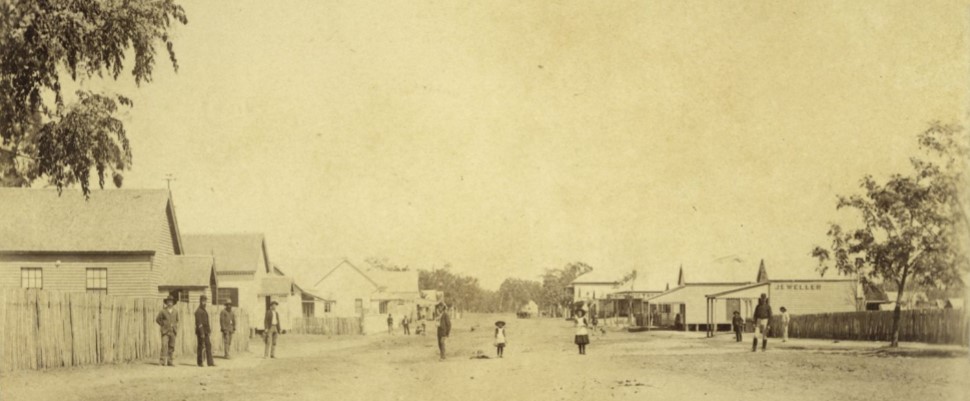
Fortune smiled on Dr Norman, or Hope, or whoever he was, because the Crown offered no true bill at sittings of the District Court in May and August 1881. (A careful perusal of the Gazettes shows that no-one of any of those names was gazetted as a medical practitioner in Queensland in the 1870s or 1880s.)
And that’s where the story, as far as I can tell, ends. None of his aliases, or variations of them, appear in the press after that date. Perhaps he found himself a new identity, and his past didn’t come back to haunt him. Perhaps he died. Perhaps he left the colonies.
There is one more reference to a travelling phrenologist, although the man’s name was not given, the tale has all the hallmarks of Professor/Doctor Abrahams/Hope/Norman. It first appeared in the Sydney Morning Herald in 1884. I like to think that it’s him:
OUR SUGAR LANDS III.-THE TWEED RIVER DISTRICT.
(BY OUR SPECIAL COMMISSIONER.)
“Whilst at the river I witnessed an amusing instance of the difficulty travelers experience in leaving the Tweed, A professor of mind-reading and feeler of bumps – about the last man one would expect to meet in this isolated spot – had been on a visit the district and wished to go on to Lismore. For a week he tried in various directions to get horses for himself and a companion, but without success.
Finally, he wrote to Lismore, and a person there offered to send up a horse by the mailman to take him over the hills. The charge was to be £5. The professor wanted the man to “take it out” in character charts of his family but as he refused this offer, the phrenologist determined to seek elsewhere for horses. At last he got them, and this is how the professor and his manager got out on their journey south.
First, of course, in the procession came the seer and bump manipulator. He was mounted on a horse whose points were discernible even to the amateur. A corn sack across the back of the animal which animal, by-the-bye, had a cold and sneezed violently – served as saddle, and a halter twisted loosely round his nose answered the purpose of a bridle, A number of small boys gathered about slyly tickled the professor’s horse with straws. The brute kicked, and the professor straddled out on the animal’s neck, and grasped his ears. The horse, however, sneezing, he was knocked back again on the cornsack. The professor looked a very sorry picture.
On the previous evening he had entertained a parlourful of rustics with anecdotes of his genius, his wit, and his accomplishments, relating how he had discovered, by the occult science of “mind-reading,” a priceless gem about the size of a rook’s egg, which Lady Fitzmuggins had concealed in the toe of her jeweled slipper, and how Sir Finnigan Fitzmuggins had said, “Professor, dear boy, you are a genius. Pray let me introduce you to Prince Krakapovskoff the renowned Russian diplomat,” and so on.
The professor’s agent, whose acquaintance with horse riding appeared to have been strictly limited to carpeted seat at the circus, followed his chief. He had a saddle with one stirrup-iron and guided his animal with a combination bridle – partly leather, partly string. Whether they ever accomplished the journey they set out on I have not been able to ascertain.
 Moreton Bay and More