
[For the uninitiated, Wikipedia explains why the name Dag or Dagg might amuse an Australian: “Originally a word meaning the dried faeces left dangling from the wool on a sheep’s rear end, the word dag is more commonly used in colloquial Australian English to refer to someone’s unfashionable, often eccentric or idiosyncratic style or demeanor together with poor social skills and amusing manner.”]
At first, it sounded like a fatal brawl over a lady’s affections. The Darling Downs Gazette reported that a young man named Arthur Hall, working at Reid’s Hotel in Roma, had fought with another man over the attentions he paid to a servant girl there. The other man, named as Henry Dagg, threw a bottle at the other’s head, and Mr Hall died two days later.
Just about everything about that report turned out to be inaccurate, but it was true that Henry Dagg was arrested and charged with murder and sent to Toowoomba on trial for his life. After the Crown Prosecutor received the depositions, the charge was reduced to manslaughter and proceeded to trial.
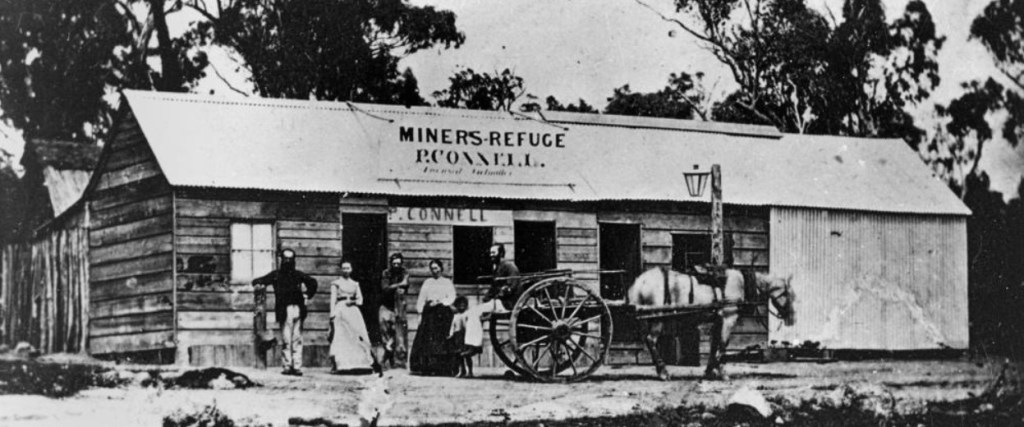
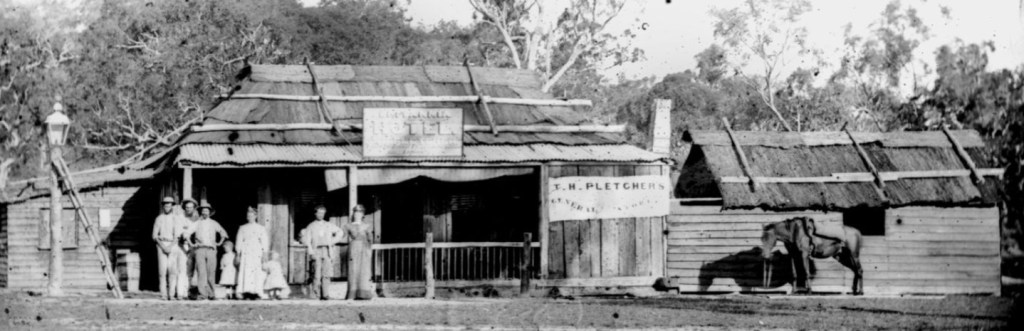
These Stanthorpe hotels would be of the type and era of Reid’s hotel in Roma in 1864 (State Library of Queensland).
On 14 May 1864, between 9 and 10 pm, four men were sitting in the parlour of Reid’s hotel, waiting for their supper. They were Arthur Hall, John Moorehead, George Elliott and Mr C.G.H. A’Court.
The parlour of Reid’s hotel had an indoor window to a bedroom, which in turn had a window looking into the yard. Both bedroom windows were open.
Before supper could be served, a sardine tin was thrown through the internal window into the parlour, striking Mr Hall and Mr A’Court. Unsure whether the sardine tin originated from the bedroom or outside, and rather annoyed to be the target of a random sardine case attack, Hall got a candle and investigated. A’Court and Moorehead held up the rear as Hall went to the door.
Upon reaching the door, a broken ale bottle was hurled with some force from the yard outside, through the window from the yard. The bottle struck Hall on the temple, causing a great deal of bleeding. Hall had to be placed on a sofa to recover.
The following morning, an injured Hall set out for Benangoo Station, a journey of twenty miles, which he undertook over two days.
Hall saw Dr Moran on 25 May, some 10 days after being hit by the bottle. He declined in health, and stayed under the care of the doctor until his death on 2 June.
On making a post-mortem, matter from the injury was found under the injured part of the skull (whether this matter was fragmented glass or splinters of the fractured skull was not specified). This had caused death. Dr Moran believed that if Hall had received medical treatment at the time of the injury, he could well have lived.
Who had thrown the broken bottle and with what intent? There were others at the Reid hotel that night, including Henry Dagg, a labourer from New South Wales, and two German men, Frederick Grossland and William Schaffer.
The Germans said that they had seen Henry Dagg throw the sardine can into the parlour, and something else. They could not say what the second item was. That was enough for the police, who located Henry Dagg and charged him with murder.
The trial, held in Toowoomba in July 1864, featured some legal stars of the time. Charles Blakeney, future District Court judge, who would have a tumultuous relationship with Roma in the coming decades, prosecuted. John Gore Jones, future politician, defended Henry Dagg.
The wily Mr Blakeney pointed out that the only evidence pointing to Henry Dagg was that of the two Germans, who might have colluded to blame an Englishman (being dashed foreigners and all).
In summing up the facts for the jury, the Judge pointed out that manslaughter had occurred, but there was nothing to say who had actually thrown the bottle. Henry Dagg or the two Germans?
The jury found Henry Dagg not guilty of manslaughter, and he left the court a free man, with the words of the Judge ringing in his ears – “You have had a very narrow escape. I hope that I shall not see you again on a similar charge.”
Enough said. Henry Dagg rid his life of flying projectiles and the authorities. If he is the Henry Dagg I think he is, he went to Victoria and New South Wales, married, and eventually passed away in 1907.
The Darling Downs Gazette and General Advertiser (Toowoomba, Qld.: 1858-1880) Thursday 23 June 1864.
Queensland Times, Ipswich Herald, and General Advertiser (Qld.: 1861-1908) Tuesday 19 July 1864.
 Moreton Bay and More