
Part 4 – Forgery, a murder charge and Dunwich.
The enduring allure of Springsure.
Wikipedia helpfully informs its readers that Springsure is a town of around 950 people in the Central Highlands of Queensland. It boasts cattle farms, and plantations of sunflowers, sorghum, wheat, and chickpeas. It is close to a couple of coal mines, has several historic buildings and is overlooked by the striking Virgin Rock, a large cliff face in the ranges nearby.
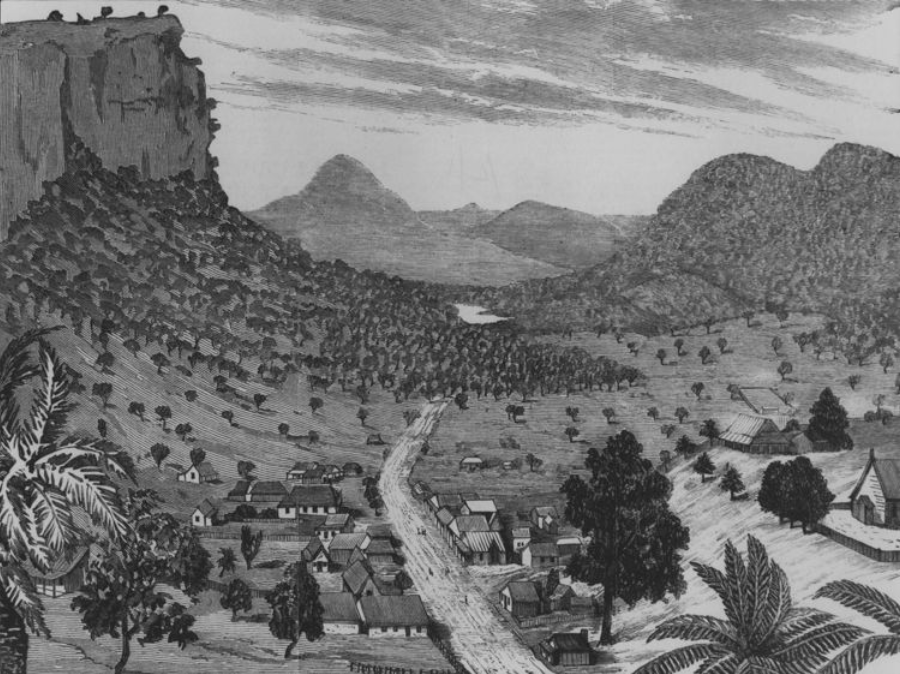
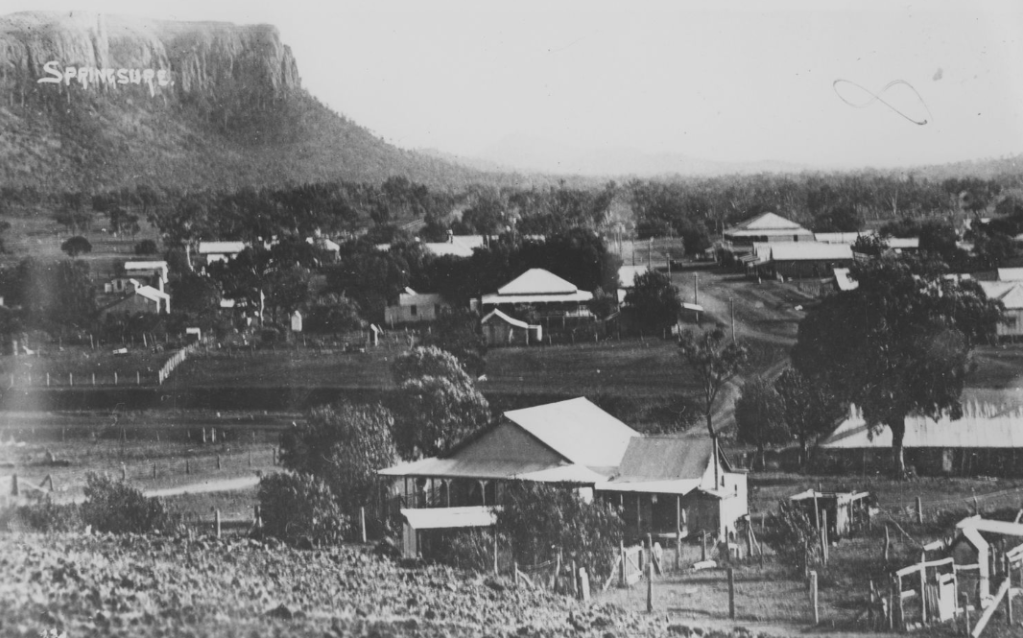
There were two very unhappy events in its history. The Cullin-La-Ringo massacre occurred nearby in October 1861, when nineteen members of Horatio Wills’ party of new settlers were killed by indigenous people (following the shooting by a white person of an indigenous man and followed in turn by a series of vigilante killings of indigenous people). In 1943, a Douglas C-47A Skytrain crashed nearby in a thunderstorm, killing nineteen American and Australian armed forces personnel.
The Snob, who came to the region a year or two after Cullin-La-Ringo and its aftermath, seemed unable to resist the district. Perhaps it was the local creeks, with their permanent water springs. Perhaps he loved the surrounding mountain range, vast tracts of untouched bushland, or perhaps it was the small bush hotels where a man could pass a forged cheque or two and still get clear away before sundown. One is tempted to think it was a sentimental attachment to the watchhouse he’d broken out of so famously in the mid-1860s.
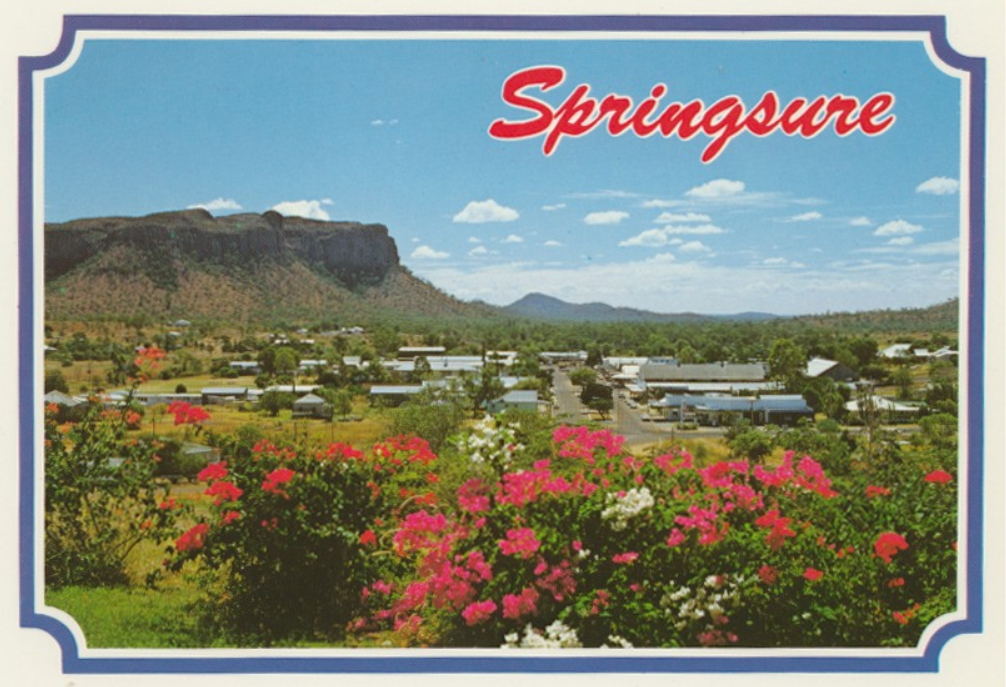
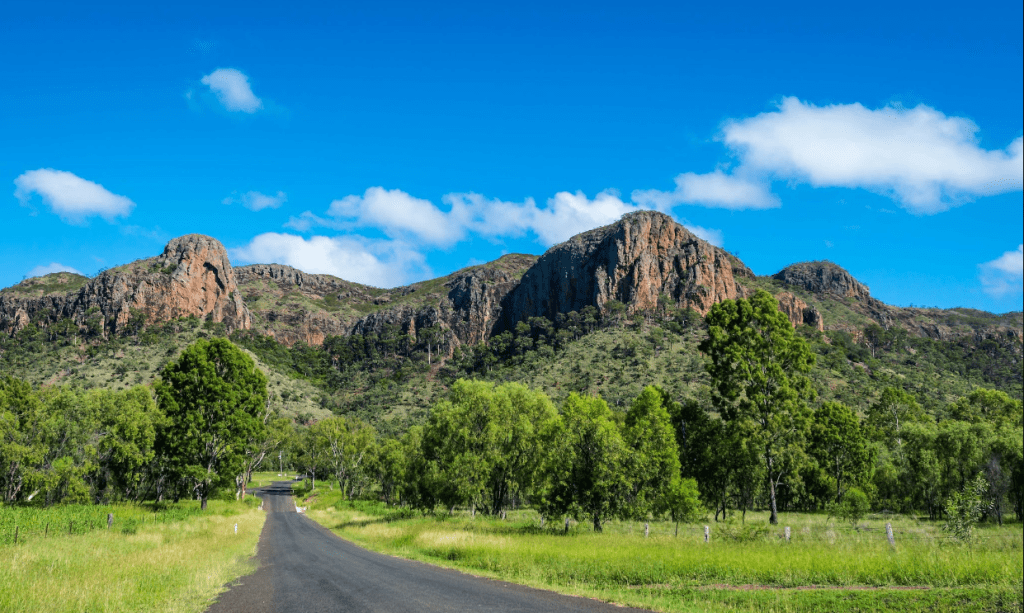
After more than a decade of captivity, and now in his fifties, Hartigan returned to the Central Highlands. He used the names Walter Cahill and Thomas Stanton and drove a dray about the district for a living. He worked hard, and honestly, under those aliases for the better part of a year, then made the mistake of going to Rockhampton and getting on the grog again. In no time, a publican in Rockhampton found himself with a valueless cheque on his hands.
Long-serving police had no trouble recognising Hartigan. One had known him, in a professional capacity, for 24 years. Another recognised the Snob by the sound of his voice, issuing forth from an adjoining room.
“A large batch of lunatics and criminals.” Rockhampton, June 1888.
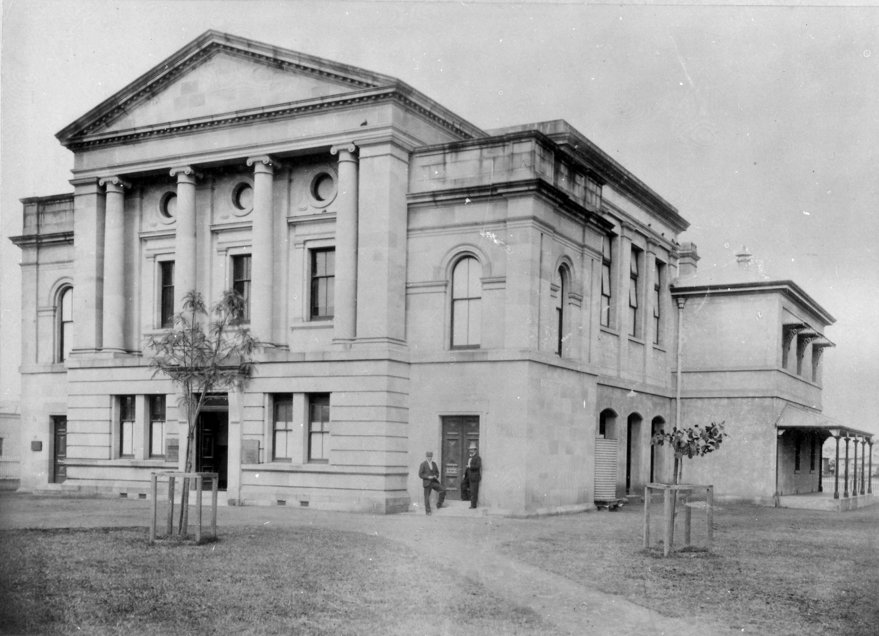
Most of the fight had gone from the Snob, it seemed. At Rockhampton District Court, he pleaded guilty to uttering the forged cheque, and that was acceptable to the prosecution. He blamed his fall from grace on getting on the drink. He had no recollection of giving the publican a cheque. He hoped that His Honour would take his advancing years into consideration and be merciful. The judge obliged, taking into account his pre-sentence custody (some of it in the Springsure lockup yet again), and gave him 21 months at Brisbane. Hartigan politely thanked His Honour and was put on the steamer Fitzroy to Brisbane with another convict, George Tremain, and five people who were bound for Woogaroo. The journey was described by the Rockhampton Bulletin as one conveying “a large batch of lunatics and criminals.”
The Springsure Assizes.
In February 1894, Hartigan was arrested again, and committed from Rockhampton to Springsure for trial. Springsure was now worthy of its own Circuit Court sittings, and at them, the Snob received 23 months for forgery and uttering. The best that could be said of the experience was that he didn’t have to face Rockhampton Court on that occasion. He was sent to Brisbane and admitted to the Brisbane Gaol at Boggo Road, aged 59.
Alpha, just for a change.
1896 saw Edward Hartigan move his interests further west than Springsure. He was charged, as usual, with forging and uttering a cheque at Alpha. He decided to plead guilty at the first opportunity and was to be remanded for sentence. That was, until the Judge read through the depositions, and found that the Alpha police had not put the brief of evidence together in such a way that Hartigan could be charged, let alone plead guilty. There were no witnesses, not even a complainant to support the charges. The Crown offered no true bill, and for the third, but last, time in his life, Hartigan was rearrested before he could leave the courtroom.
The police used the remand time to get their evidence in order, and Hartigan was at tried at Barcaldine, where he was found guilty by a jury. The Judge, aware of Hartigan’s age, gave the Snob 17 months. He was admitted at Boggo Road, and served his time at St Helena where another prison photo was taken, showing just how much the years of penal servitude and roughing it in the outback had aged him. He is barely recognisable.
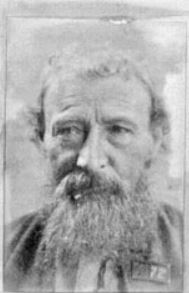
On 17 December 1897, he was a free man again, ready to leave St Helena. Until he went to set foot on the barge back to Brisbane, where he was met by Acting Sergeant King with a warrant charging him with murder.
Murder on the road to Aramac.
On 22 July 1897, Richard Eades was riding on the Clermont Road at Greyrock outside Aramac. He was going to set up camp there, when he discovered what looked like human bones mixed in the ashes of a long-extinguished fire. Inspector Brannelly and the Aramac police set about making enquiries.
These enquiries became fixed upon two men who had been seen on 20 June 1896 around Ravensbath station. One was an older Irishman, who discussed the gold claims nearby, and pointed out a fence he had helped build in 1893. The other was a younger man – English, about 35, thin, sallow complexioned, and with a long face accentuated by a long thin scraggly beard.
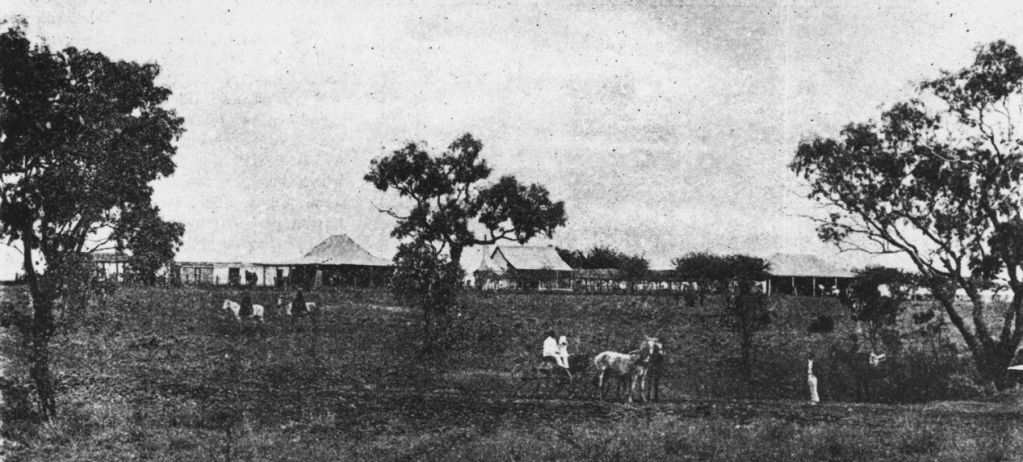
Some months later, the Clermont police arrested Hartigan on another charge, and in the process, entertained suspicions about some property in the Snob’s possession. Certain items were traced through local merchants to a man named John Daniel Ackroyd, a labourer in the Banana district. Ackroyd was an Englishman of fairly peculiar appearance – knock-kneed and long-faced, with a scraggly beard. He used to speak endlessly of his time in Argentina – to the extent that he was nicknamed Argentine Jack. No-one had seen Argentine Jack in ages, come to think of it.
Ackroyd owned a sandy-red dog named “Dearie Me.” She was a hardy little working dog who would move the horses along and could manage sheep herding with ease. Ackroyd had also owned four distinctive horses and equipment.
On 19 June 1896, Malcolm Hallam, a selector who lived near Ravensbath, met the two men on the road, then passed their campsite the following day, noticing their horses and saddles, but no people. That night, Hallam heard a series of gunshots as he camped in the bush – they sounded like they came from a revolver.
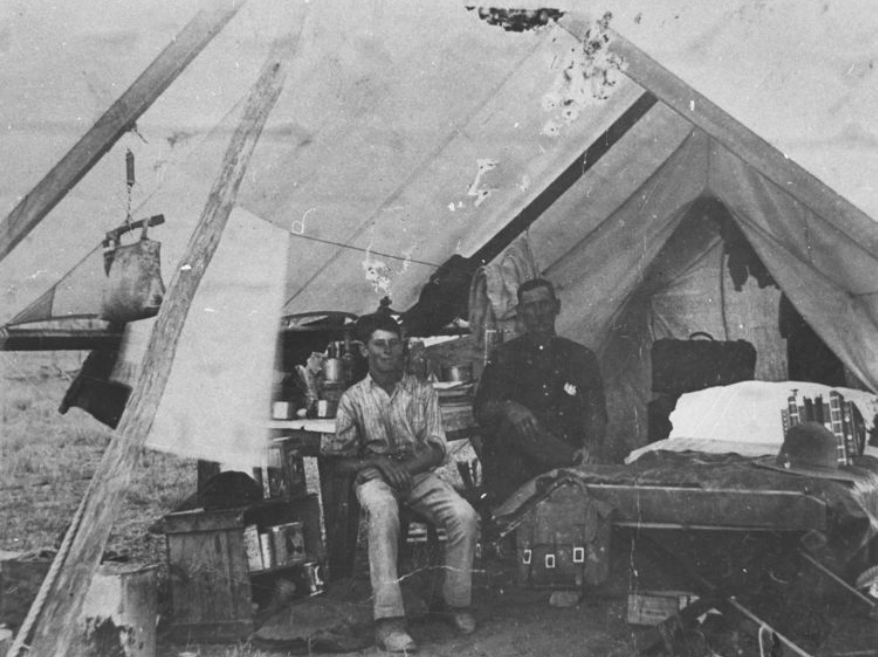
The next morning, Hallam saw Hartigan riding a horse and driving others that appeared to have belonged to the Englishman. He also had the little red dog. They chatted a bit, and Hartigan said he was going to get a job as a boundary rider. Neither Hartigan nor Hallam mentioned the other man. “I thought it looked suspicious his having his mate’s horses and dog and not him,” said Hallam.
Forensic analysis of the burned bones and the campfire turned up some items that may well have belonged to Ackroyd. The forensics would horrify a true-crime fan of today – physical evidence was partially removed, some bones were left in situ, other bone fragments were washed in a river, things were put in a bag and taken to a chemist, who was going to get a doctor to look at them at some point. There was no way of identifying to whom the bones belonged; all that could be said was they were “taken to be” human bones and had marks of a cutting instrument on them.
John Daniel Ackroyd had not been seen or heard from since June 1896. Edward Hartigan was charged with his murder.
No True Bill.
At the committal hearing in January 1898, the very patient little dog, Dearie Me, was brought endlessly in and out of the courtroom to be identified by various witnesses. Hartigan was remanded to take his trial, but it never took place. The Crown reviewed the evidence, and, apart from having property not his own, there was nothing there to convict Hartigan of murder. No true bill was offered. Dearie Me was adopted by the watchhouse keeper of Aramac, grew a little plump, and lived happily in retirement.
The Snob was free of the murder charge but continued his favourite way to make a living – deceit. He was nicked at Alpha in August 1898 for forgery of a cheque and pleaded guilty to it at Clermont in October. He got another 23 months.
The new century, and a Commonwealth remission.
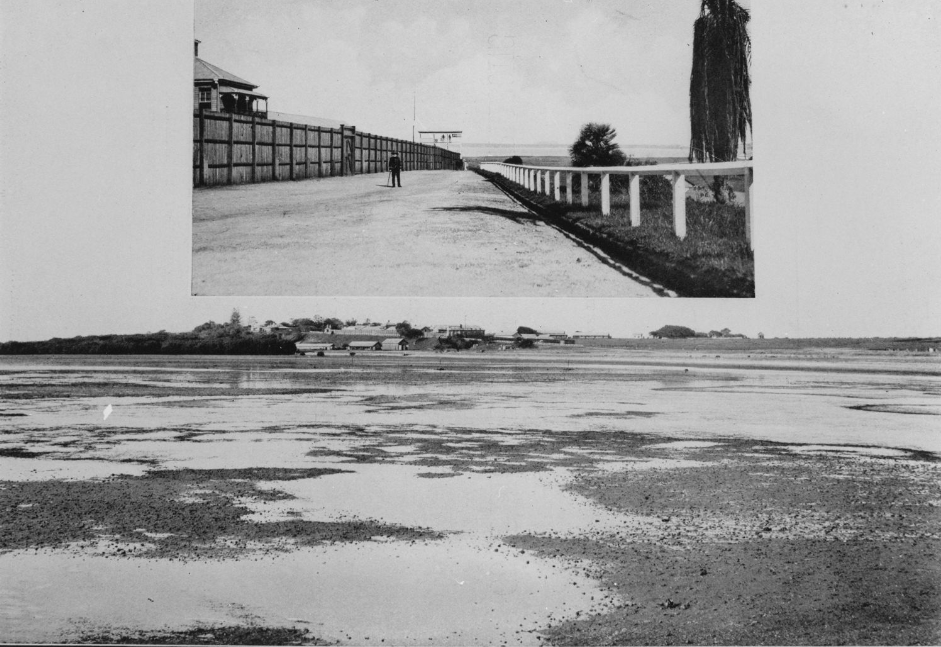
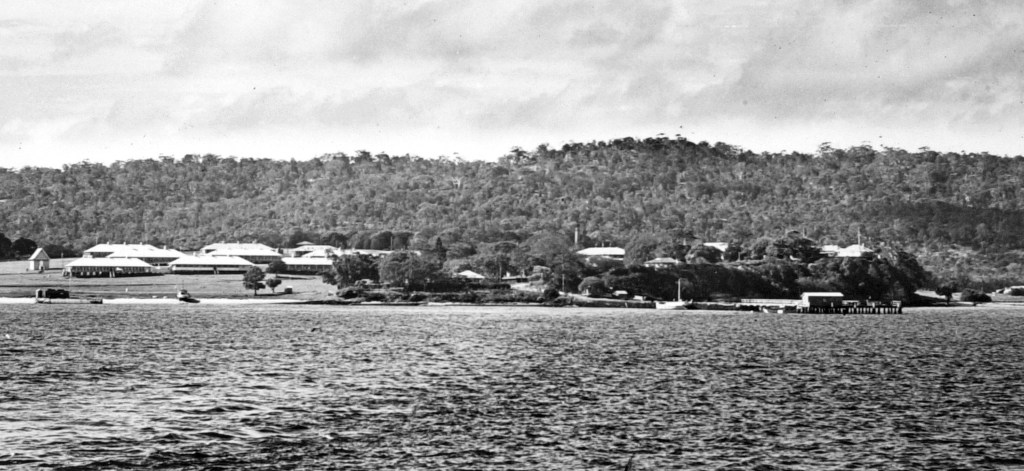
In February 1901, two weeks after the death of Queen Victoria, Hartigan was sentenced at Rockhampton District Court to 22 months’ imprisonment for uttering a forged cheque. It would be his final appearance before that bench, nearly 40 years since his first. His entry in the St Helena admission book states his age as 66, and birth date as 1835. He only had one breach of discipline – “disorderly conduct by quarrelling,” for which he was cautioned.
He was given a special remission due to the formation of the Commonwealth of Australia, and left the Island, for good, on 15 August 1902.
The following year, Hartigan made the news for being sent to Dunwich Benevolent Asylum. The Truth profiled his career – managing to get his name wrong in a different way in nearly every paragraph in the process – stating that the Snob wished to end his days at Dunwich. He did stay there for a couple of months, suffering from Bright’s Disease, a now-obsolete medical term for symptoms associated with kidney diseases. His entrance record rather tactfully omitted any hint of his extensive criminal history. He might have been any old bushie taking his rest at Dunwich, not the infamous Snob.
In 1908, Edward Hartigan died at Granville, New South Wales. He is buried in Rookwood Cemetery. He had some relatives in New South Wales, whom he probably hadn’t seen for nearly 50 years, so I imagine he made his way to see them after leaving Dunwich.
In 1900, John Daniel Ackroyd was legally declared presumed dead in the probate courts of London:
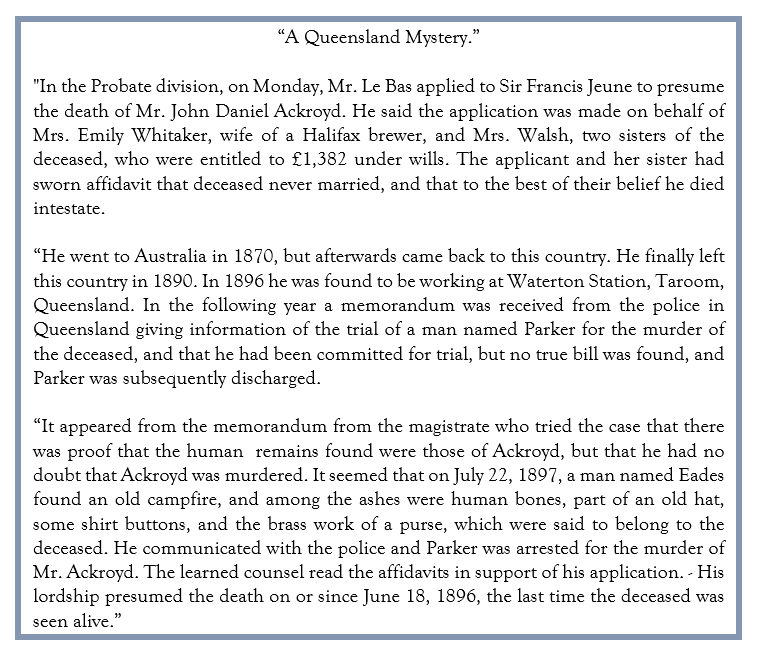
Did Hartigan steal from Ackroyd? Definitely. Did Hartigan murder him? I don’t think so. Although Ackroyd was presumed dead for the purposes of awarding his estate to his family, it is not certain when or how he died. There was no technology available to identify the bones and bone fragments as belonging to Ackroyd, and no evidence of firearms having been used to kill the person whose remains were found in the campfire. There was also no direct evidence that Hartigan was responsible for the death.
Murder doesn’t seem like the Snob’s style. He had spent years on the road with a pistol for protection and had never used it in committing his crimes. Only at St Helena, under some provocation, did he use violence with a weapon. The two men he cut with his knife were attempting to disarm him before he could do any real damage. And that was nearly 30 years before the Aramac incident. If Hartigan had wanted the horses, saddles, and Dearie Me, he would have either conned Ackroyd out of them, or just nicked off with them. Also, Hartigan was no longer young in 1896. Cutting up and disposing of a body in a fire would have taken a lot of effort. Opportunistic fraud was more his style.
Did Hartigan have, as the Truth implied in 1903, a pathological compulsion to forge documents? No, he was just a crook who liked to diddle people out of a pair of boots or some free accommodation. And it looks like he didn’t do it well enough to avoid detection for any length of time.
Nonetheless, his remains an extraordinary career. He never learned a lesson from his 35 years in custody. His career began with the foundation of the colony of Queensland, and lasted until Federation made it a State of a new nation.
 Moreton Bay and More