
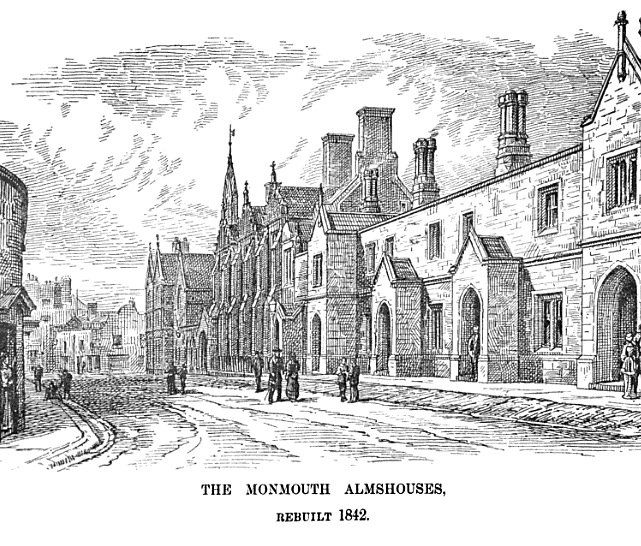
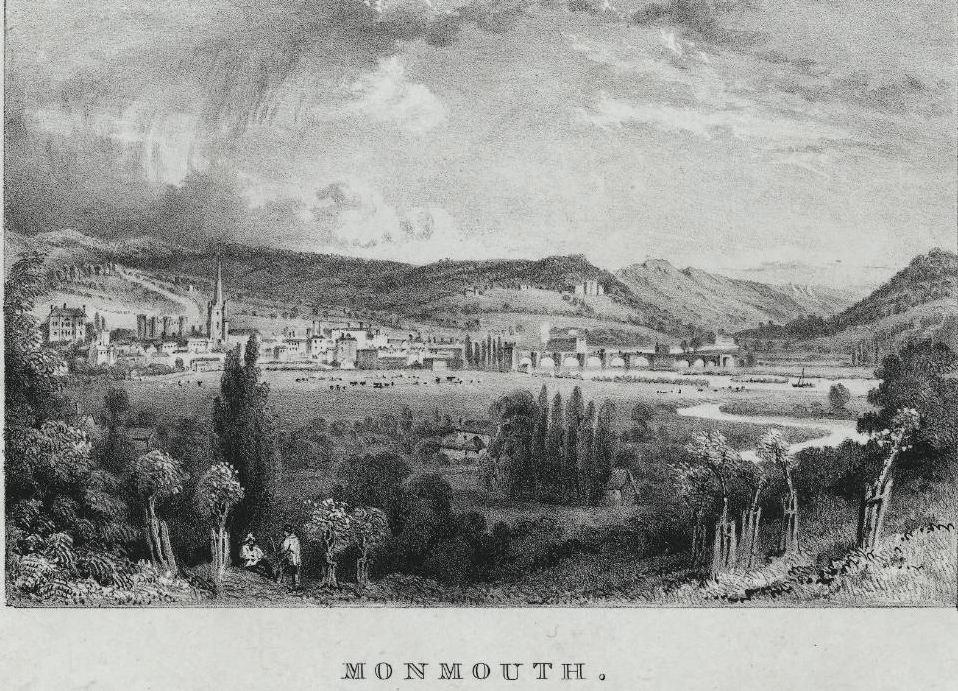
Contemporary views of Monmouth, Wikimedia Commons.
Morgan Edwards was a native of Monmouth, who had been born around 1800. On 10 August 1822, at the age of 22, he was convicted at the Monmouth Assizes of Sheep Stealing and was ordered to be transported for life. After a spell in the prison hulks, he was sent to Hobart Town, Van Diemen’s Land aboard the Competitor, which arrived on 3 August 1823.
The prisoners per ship Competitor were landed yesterday and inspected by the Lieutenant Governor. Their appearance was orderly and generally healthy, although some scurvy had appeared amongst them, which led to the ship’s touching at the Cape of Good Hope; three died on the passage, and three in hospital since landing. The Surgeon superintendent, Clayton, we are sorry to say, died at sea, on the 8th July. Considering this unfortunate circumstance, the prisoners have suffered as little as could possibly be expected; no deaths amongst them having occurred subsequently, until their arrival in port.
Hobart Town Gazette 1823.
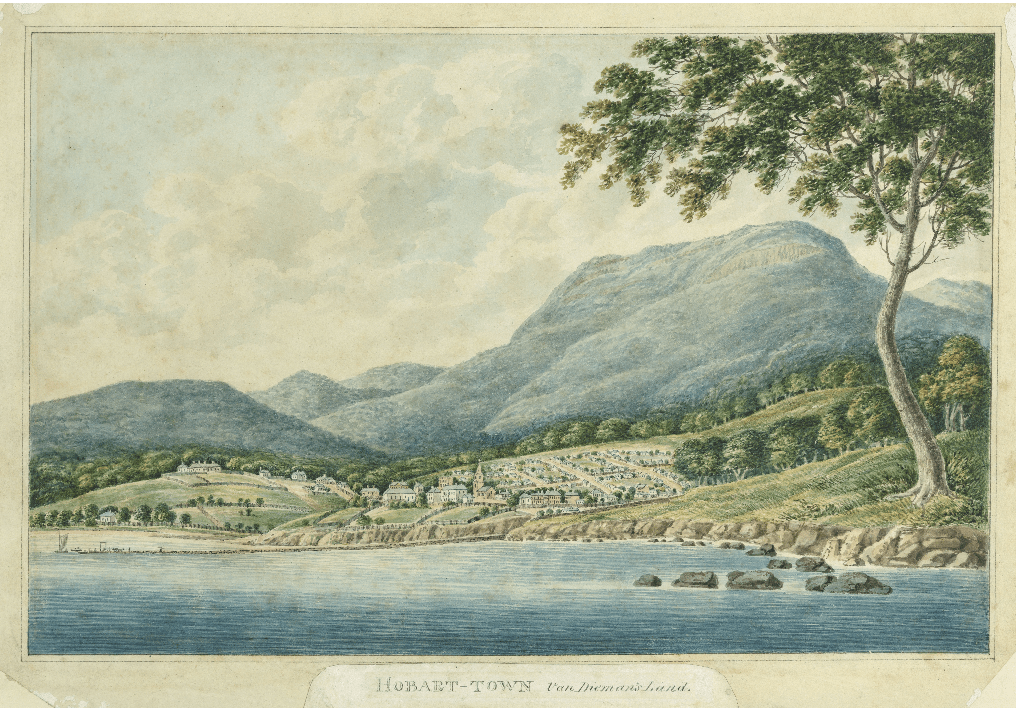
At 5 feet 8 ½ inches, Morgan Edwards was a tall man for the early 1800s (the average height of convicts seems to have been around 5 feet 4). He had dark brown hair, a fair complexion and blue-grey eyes.
Edwards had a turbulent time in Van Diemen’s Land, largely due to his devotion to his chosen career – theft. On 29 November 1823, he was convicted of stealing 2 casks of lime the property of the Government and received 100 lashes and three months on the Gaol Gang. On 21 May 1824, he was convicted of stealing a gun valued at 20 s/- and received three years at Macquarie Harbour.
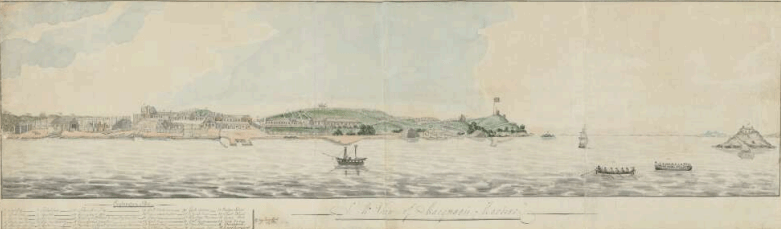
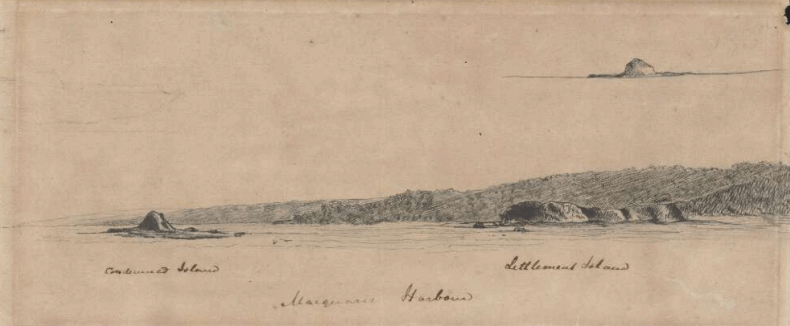
Contemporary Macquarie Harbour Sketches, National Library of Australia Digital Collections.
He remained at Macquarie Harbour until the following September, when he was arrested and charged with the murder of his overseer, James Richardson.
The Government brig Duke of York brings the melancholy news of the barbarous murder, at Macquarie Harbour, of James Richardson, constable, and overseer of the brickmakers. The unfortunate deceased was on the main with his gang, and several others employed in their respective occupations, on the morning of the 13th ultimo. Having set his people to work, he went to the top of an adjoining hill, but returned in great haste, saying he had seen two men whom he suspected to be bushrangers, and having procured a light, proceeded to the point from where his signals are usually made to the settlement. In his way he was seen, with the lighted rag in his hand, closely followed by a prisoner named Morgan Edwards, soliciting him not to make the signal. No signal was made, and Richardson was no more seen. Morgan has since been apprehended and confessed the murder, describing the spot where the body would be found, which has accordingly been done and interred.
Hobart Town Gazette, 1825.
It appears that Richardson drowned, and that Morgan may not have made a full confession as was reported. He was brought before the Criminal Court and tried on 18 November 1825, and was found not guilty of the murder. (He was due to be tried the day before, but he was not brought before the court that day, as the doodle on the Judge’s notebook shows.)
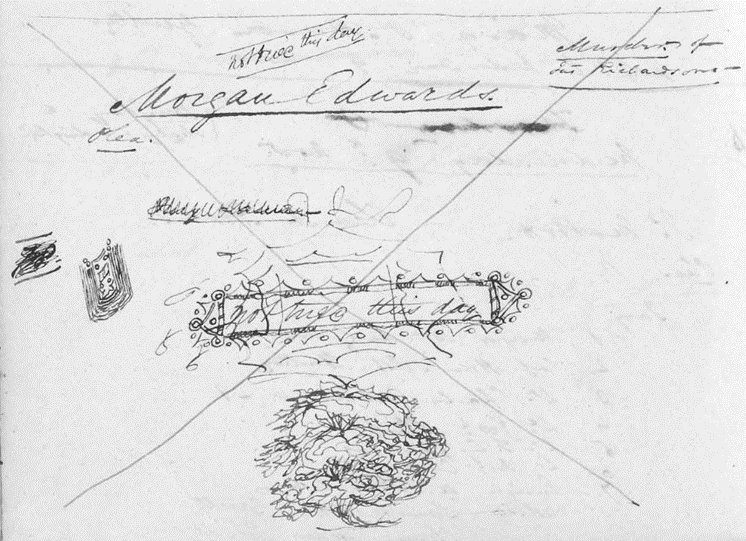

(It’s somehow comforting to know that the rather bleak individuals who doled out justice in that far-flung penal colony could doodle so creatively and enthusiastically.)
Morgan Edwards may not have been guilty of his overseer’s murder at law, but he was still on a life sentence for sheep stealing. What was to be done with him? How about Moreton Bay as a venue for the remainder of his sentence? It would get the troublesome Welshman out of everyone’s hair, and sending him to that hot, desolate place north of Sydney would be enough punishment, even if the law couldn’t find him guilty. He was transported “on strong suspicion of having murdered his overseer.” Not exactly a second conviction, but enough, apparently, to send the man north.
Edwards arrived at Moreton Bay aboard the Isabella on 2 June 1826. His shipmates included quite a few future convict runaways, notably the absconder extraordinaire, Shiek Brown. Edwards tried his hand at disappearing a few weeks later but was quickly caught. After receiving punishment, he grudgingly stuck around.
In 1834, Edwards petitioned the Governor to be removed to Tasmania, giving details of the drowning of James Richardson by way of explanation of his alleged involvement. The Colonial Secretary sought the records from Van Diemen’s Land that gave details of the murder of James Richardson. His Excellency commanded the Colonial Secretary to request that Captain Clunie would inform Morgan Edwards that His Excellency saw nothing in his case to induce him to mitigate the life sentence (or give indulgences like going back to temperate Tasmania). So much nicer than just saying “Sod off.”
Edwards would wait a long time for the issue of a Ticket of Leave or Pardon, far longer than was usual, even for a lifer, indicates that the death of James Richardson was still considered to be the work of Morgan Edwards.
In 1835, Edwards returned to his first love, nicking things. He was charged with another prisoner, John Greenhalgh, with robbing the Stores.
Private D Coghlan, 17th Regiment was making his rounds when he noticed Morgan Edwards and John Greenhalgh, two lifers, standing near each other in the poultry yard. Spotting Coghlan, they quickly separated, and Edwards found a spot of shade. That was odd. Edwards had no business being in the fowl yard – he was attached to the stores yard. Then Coghlan smelt rum where Edwards and Coghlan had been spotted.
Coghlan was already suspicious that Greenhalgh, who had the keys to the fowl house, was helping himself to the eggs. Coghlan inspected the fowl house – what it may have lacked in eggs, it made up for in rum. Coghlan found two bottles nestled in the straw.
The two prisoners were brought before Captain Clunie. Edwards was charged with robbing the Commissariat Store, and Greenhalgh with robbing the Property Store.
Greenhalgh denied having anything to do with robbing either store and Edwards backed his mate up. He took the blame, admitting that he had the Commissariat Store keys on him when he was working in the yard, and had waited until the clerk was writing at his desk to sneak in and steal some rum. He also admitted that he had previously nicked small quantities of sugar by the same method. Both men received 100 lashes.

The Commissary Officer then swore to the Court that the military had inspected the rum that remained in the cask, and “it was the opinion of all of the Officers who have tasted it, that it has been mixed with salt water.” Presumably the Officers had a fine time carefully testing and checking samples of the rum.
Three years later, Edwards was found, sitting at a fire, wasting (eating) corn. He was supposed to be guarding the maize fields. He received 50 lashes.
In 1839, Morgan Edwards was attached to Mr James Warner’s survey party. On the evening of 13 May that year, Morgan Edwards was very drunk. And in possession of Surveyor Warner’s sword.
In his cups, Edwards decided that he needed to protect the quarters of Mr Andrew Petrie from all comers. When Chief Constable Fray, 28th Regiment, approached and tried to bring him into custody, Edwards roared, “If you advance, I will run you through the body!” Edwards then banged at Petrie’s door, and asked Petrie to accompany him to the Commandant because “I am badly used by the Chief Constable.” Petrie shut his door and left Fray to arrest the daft creature.
The following morning, James Warner admitted that Morgan Edwards was his servant, and had no business being away from the survey tent, much less in possession of Warner’s sword. Edwards got yet another 100 lashes, which presumably didn’t mix well with his hangover.
Surveyor Warner forgave Edwards his transgressions, and in September 1839, made a formal request that Edwards be re-assigned to his boat party. He was a particularly useful man in boat surveys. The following year, Commandant Gorman requested that Morgan’s life sentence be remitted to allow him to continue working in the Pilot Boat’s crew at Moreton Bay.
In 1843, twenty years after his arrival in Van Diemen’s land, Morgan Edwards was granted a Ticket of Leave, allowing him to remain in the Moreton Bay District. His particulars were the same, although his brown hair was turning grey.
On 24 December 1849, he was given a Conditional Pardon, valid in every country of the world except in the United Kingdom of Great Britain and Ireland. If was to go home, his pardon “would become wholly void.”
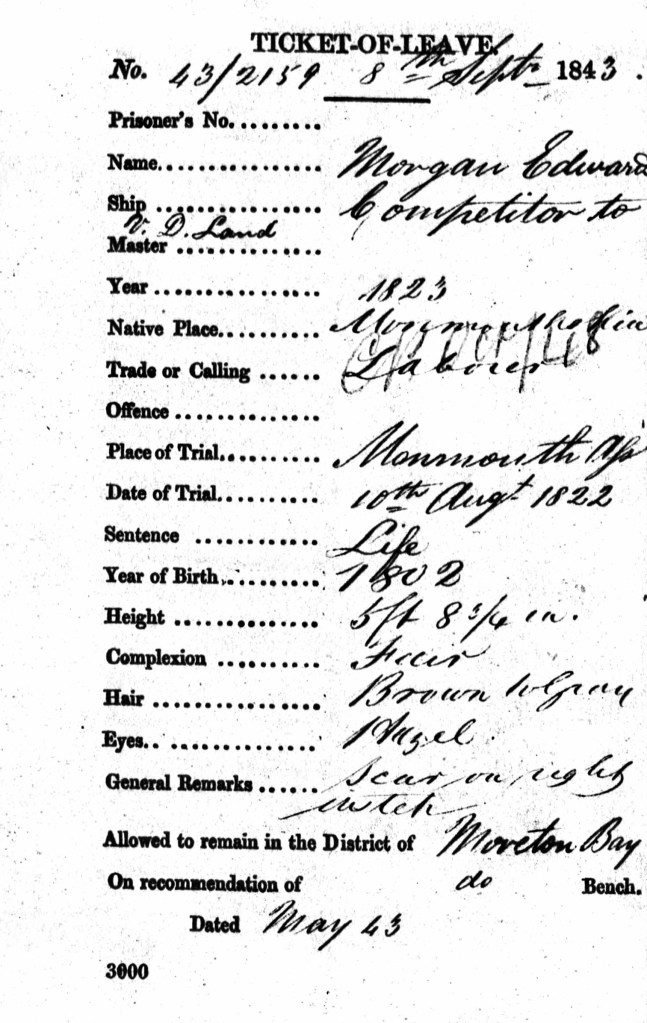
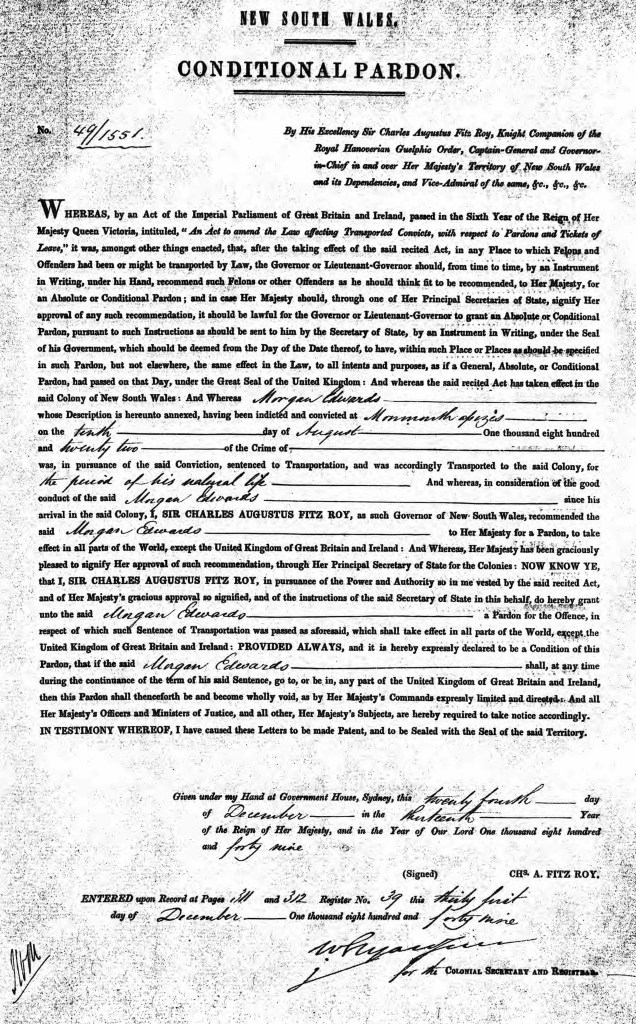
Edwards only had six years to enjoy his grant of freedom. On 15 December 1855, he was working in the employ of Edmund Owens at the Jockey Club Public House on the Drayton Road, outside Ipswich, when he fell dead on his way to the water cask. He was 55 years old. The inquest, held at the Police Office the following day, brought down a verdict of “visitation of God.” Morgan Edwards is buried in the Ipswich Cemetery in a Church of England plot.
Sources:
- England & Wales, Criminal Registers 1791-1892. Summer 1822 Monmouthshire, England.
- UK, Prison Hulk Registers and Letter Books, 1802-1849. 1822: Woolwich.
- Hobart Town Gazette (Tas.: 1825 – 1833), Saturday 29 October 1825, page 2
- State Archives of Tasmania Indexes.
- Australian Convict Transportation Registers – Other Fleets and Ships, 1791-1868.
- NSW, Australia, Convict Ship Muster Rolls and Related Records, 1790-1849.
- Tasmania, Australia, Convict Court and Selected Records, 1800-1899.
- Chronological Register of Convicts at Moreton Bay, 14 September 1824 – 15 November 1839. Queensland State Archives, ITM 869689.
- Book of Trials held at Moreton Bay Penal Settlement, 1 July 1835 – 28 February 1842. Queensland State Archives, ITM 869682.
- NSW, Australia, Colonial Secretary’s Papers, 1788-1856 (12 August 1834, April 1840, 7 July 1840)
- NSW Australia, Tickets of Leave, 1810-1869. 8 September 1843, NSW.
- NSW Australia, Convict Registers of Conditional and Absolute Pardons, 1788-1870. 24 December 1849, NSW.
- Maitland Mercury and Hunter River General Advertiser (NSW: 1843 – 1893), Thursday 31 January 1850, page 4.
- Australia, Death Index, 1787-1985. 15 December 1855, Queensland. Bu0352, P4299.
- New South Wales, Australia, Registers of Coroner’s Inquests 1821-1937.
 Moreton Bay and More