
Berkshire and London.
William Mattingly (sometimes spelled Mattingley) was born on 11 September 1875 in Uffington, to James and Ann Mattingly. He lived most of his time in the parish of Uffington, and nearby parishes of Baulking and Kingstone Lisle. (Since 1974, this part of Berkshire was absorbed into Oxfordshire, an idea that would probably have appalled Mattingly).


Mattingly tried his hand at a few trades in his 20s and 30s – grocer, baker, chapman, horse dealer. Business success eluded him. In 1816, William Mattingly and Benjamin and William Kent of Abingdon, Berkshire, were declared bankrupt. After this, he spent some time as a parish overseer.
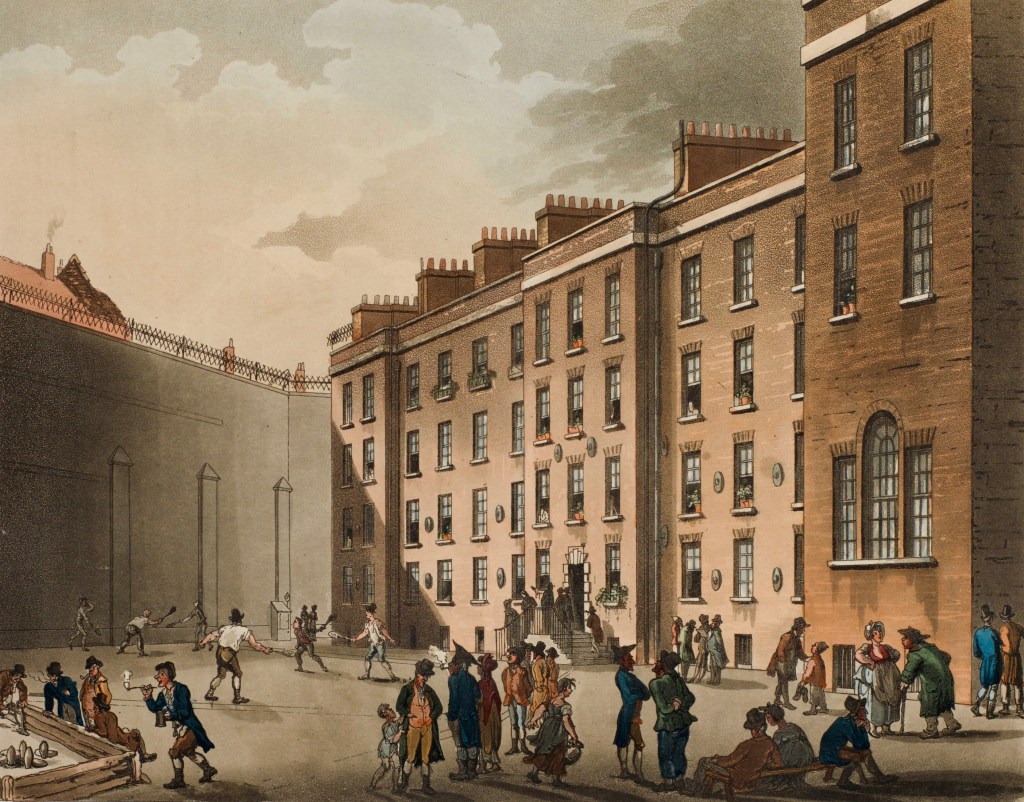
Mattingly found himself in Fleet Prison for a time. The Fleet Prison was used to house debtors and bankrupts. Some prisoners brought their families to live with them, some came and went (paying a fee to the gaoler of course), others lived in uncomfortable squalor in cramped cells. Mattingly was released in time to return to Berkshire and marry Mary Ann Keats in October 1818.
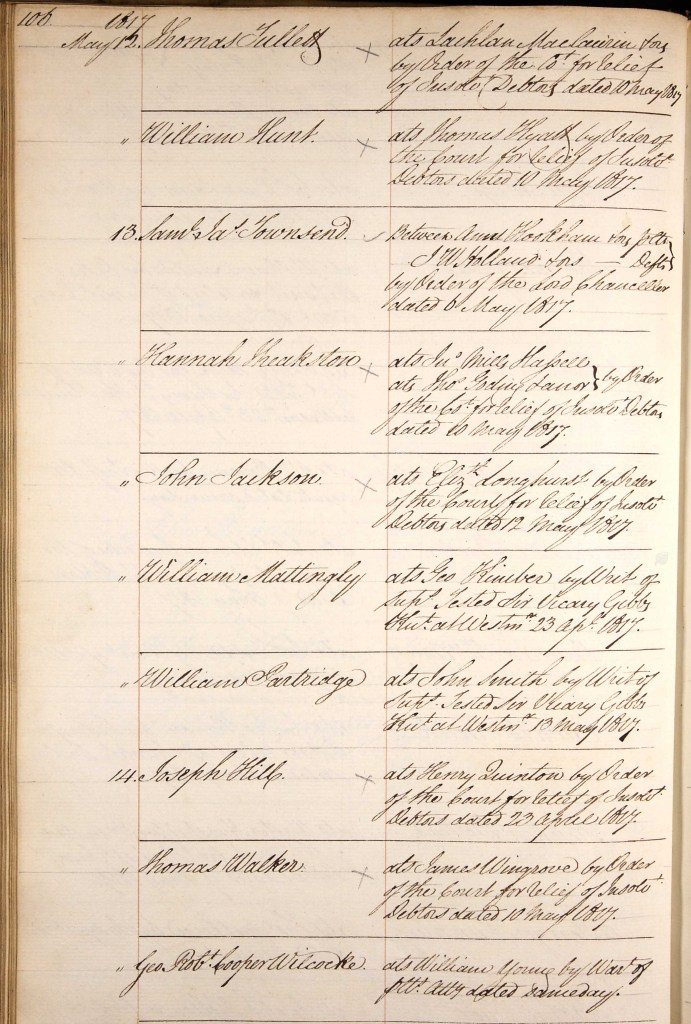
A newly married man in his 30s, with a lot of unsatisfied debt, Mattingly needed money. He turned to crime, which found him on trial before the Old Bailey less than two months after his wedding.
On the 3 November 1818, stablemen at two properties in Wiltshire came to work to find their stables had been opened, and a gelding taken from each. The following day, the very Georgian-sounding John Weldale Knollys, Esq., met William Mattingly on the road to Uxbridge, and rather fancied one of the horses he had. A friend named Norton, travelling with Knollys, became suspicious of Mattingly’s story and behaviour, and asked whether the horses were stolen. Mattingly bluffed a bit, and offered to go with the men to make a transaction. And then loosed one horse and rode off on the other. Mr Knollys was able to overtake the fugitive and give him in charge. The grooms identified the horses, and knew of Mattingly, who had been at the Wiltshire properties recently.
At the Old Bailey on 2 December 1818, Willam Mattingly was tried and found guilty of horse stealing and sentenced to death, with a recommendation to mercy.

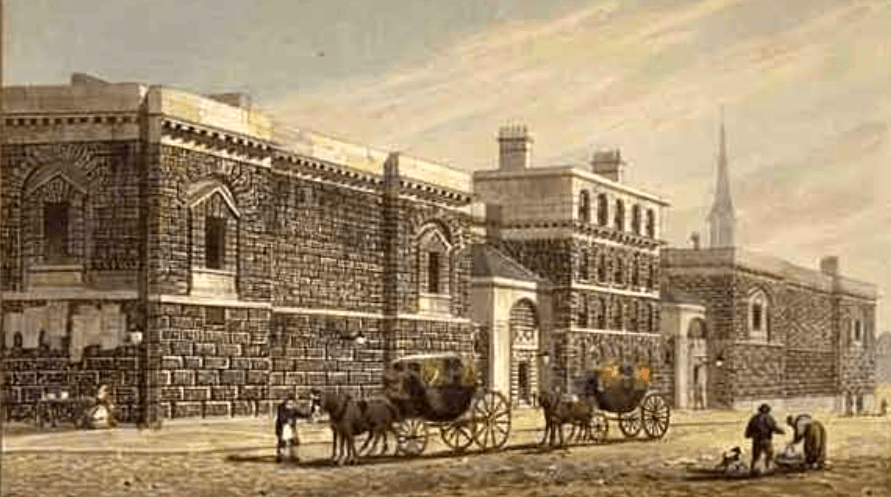
Mattingly was sent to Newgate to await the decision of His Majesty the King as to whether he would hang. Here we are given the first description of him. He was aged 33 years, stood 5 feet 6 inches, and was “stoutish made.” His complexion was florid, his hair brown and his eyes were grey.
In January 1819, Mattingly was given clemency, and in March was removed from Newgate to the Hulk Leviathan at Portsea to await transportation to the Colony of New South Wales.
Mattingly was sent to New South Wales on the ship John Barry, which departed in April 1819 and arrived in Sydney town that September.
Dr Bowman and Sydney Town

Mattingly was a mature man who presented well and worked hard. He became Overseer of the Sydney Hospital almost immediately. The Surgeon Superintendent, Dr Bowman, liked and trusted Mattingly, and their working relationship was harmonious for over six years. Mattingly routinely made purchases on behalf of the Hospital in Dr Bowman’s name, using cash supplied to him by Bowman. At some point around the beginning of 1826, Mattingly decided to make those purchases on credit, using the Doctor’s name. He kept the cash for his own use.
Things may have been getting a bit hot for Mattingly around June 1826. He would be waiting for the merchants of Sydney Town to start submitting their accounts to Bowman, and when they did, Mattingly would be in serious trouble. Bowman’s loyal and trusted servant failed to turn up to work from 5 July 1826, and Bowman had no choice but to report it to the Superintendent of Convicts – Mattingly was still under sentence for his 1818 theft.
Once the news spread that the Hospital Overseer had disappeared, Dr Bowman found himself hearing from rather a lot of businessmen about items that he thought he had paid for in cash given to Mattingly.
“Amongst the number were Mr. Harper, butcher, 84 legs of pork, amounting to £21 19s 9d. Mr. David Kelly, butcher, meat to the amount of £37 and upwards. Mr Wm. McDonald, gunmaker, for muskets and pistols £15 or £16. A person, named Williams, for lard £7 or £8, &c. &c.”
Sydney Gazette.
The total of the bills above in today’s Australian dollars would be around $10,000.[1]
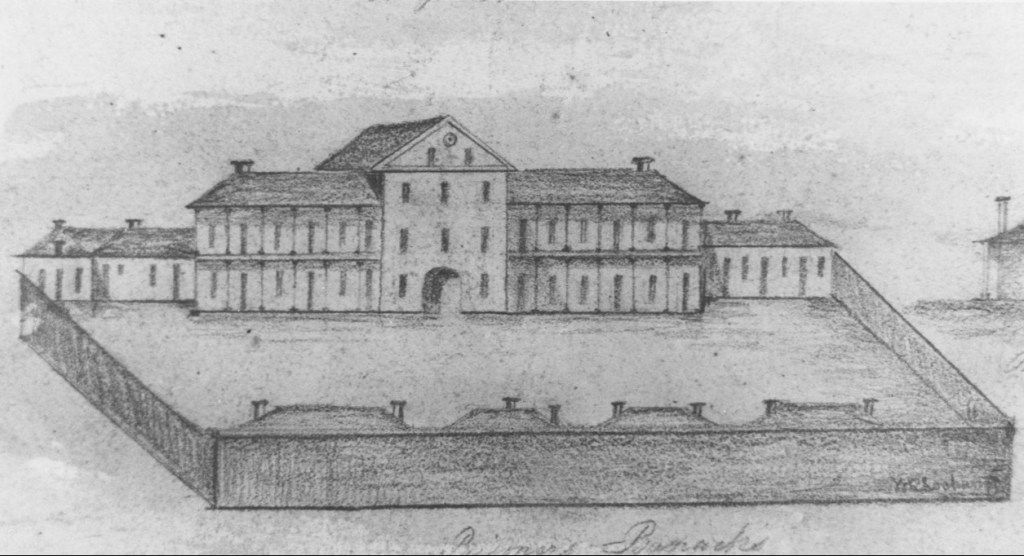
Mr Mattingly was discovered hiding on board the brig Anne before she set sail, having arranged through a third party to be dropped off on the shore at Timor. He was ordered to be sent to a penal colony for three years, which would have meant the recently reopened Norfolk Island or the new place at Moreton Bay.

Lodged in Sydney Gaol and waiting to be assigned to a hulk for eventual transfer to a penal colony, Mattingly played his final card. He sent for Captain Rossi and gave information about two men who were running a counterfeiting operation, producing fake Treasury Bills. Those men were named Thomas Redfern and William Wells. According to Mattingly, Wells had offered him some exquisitely rendered Treasury Bills as repayment for a cash loan. Redfern, who was a patient at Sydney Hospital, could forge the Commissary-General’s signature, for a small fee. Mattingly could prove the crime took place, he said. The bills he had hoped to leave the Colony with were still sitting in a hiding-place aboard the Anne. All they had to do was wait for the Anne to return to port (which she eventually did, with those very documents on board).
Wells and Redfern were put on trial, with Mattingly as a star witness, in August 1827. The counsel for the defendants put Mattingly through first a voir dire, then a searing cross-examination, then produced a string of character witnesses who all opined that they wouldn’t trust Mattingly if he told them the sky was blue. The defendants were found not guilty and were discharged by proclamation. William Mattingly was forwarded to the Hulk, then to Moreton Bay on the Isabella on 17 December 1827.
Absconded from Moreton Bay.
In January 1828, William Mattingly, together with Dr Cowper, gave evidence at a trial before Captain Logan against Henry Greenwood and William Mortimer.
Then on 15 May, Superintendent of Convicts, Peter Spicer, recorded in his Book of Public Labour:
15 May 1828: Absconded yesterday afternoon (14 May 1828),
John Falkner (Adamant), William Mattingley (Jno Barry).
They were never to return. If there was a record of finding their remains, it does not appear in the surviving records of the settlement. The two men were recorded in the Chronological Register as “Run” with no return date.
However, someone who had returned to Sydney from Moreton Bay between April and December 1828 gave this information to the Sydney Gazette, which was published on 10 January 1829:
“A man named Mattingly, well known in Sydney, who was convicted some twelve or fifteen months ago of several frauds on Dr. Bowman, died lately at Moreton Bay. The unfortunate man, it is said, absconded from the place where he was employed, and was found dead in the bush, having perished, it is supposed, for want of food.”
[1] Historical Currency Converter, UK National Archives.
 Moreton Bay and More