
Four men escaped from Moreton Bay in October 1825 – did they really commit murder, and leave five drowned comrades?
Runaway 3 – William Smith
There were 501 convicts transported to Australia with the first name William and the surname Smith. One of these William Smiths was an 18-year-old bootmaker who had been convicted of nicking a mirror in July 1817 and sentenced to be transported to New South Wales for seven years.
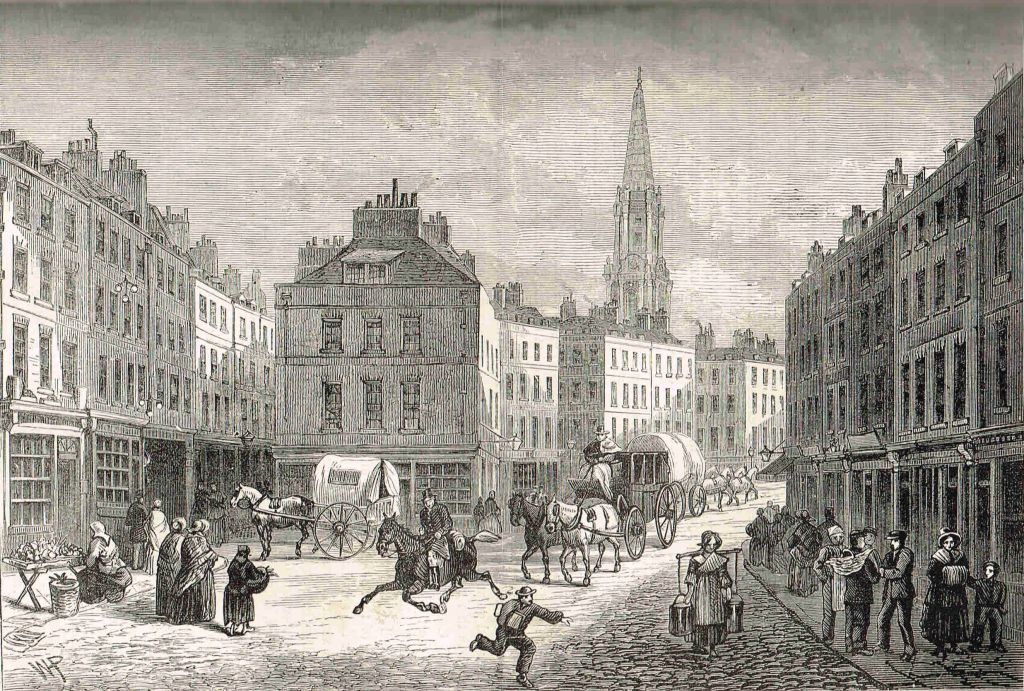
St Giles
St Giles, in the West End of London, boasted many things – a Saxon-era place of worship, a charitable hospital, a refuge for persecuted Huguenot silk weavers, the seeding place of the 1665 plague, and a notorious slum area called the Rookery, which dated back to the time of Queen Anne, and which had not been removed at the time William Smith got into hot water.

William Smith was a native of Windsor, whose family had relocated to St Giles in London. He walked into a coffee shop in Middle Street with a mirror under his arm and straight into the waiting arms of a constable named Joseph Berry. He stopped the youth and enquired where the mirror had come from. Smith replied that it belonged to his mum, and he was taking it to George Street. Berry then took the mirror to one James Barnes, who identified it as the one that had previously hung over the door in his shop. (Presumably Barnes had made a complaint about his missing mirror, otherwise a new ground for arrest would have to be invented – entering a coffee shop with a mirror whilst adolescent.)
Smith was convicted at the Old Bailey and given a seven-year sentence of transportation. (Mirror-stealing was taken much more lightly than the theft of a handkerchief, which could get you the gallows on a bad day.) It took over a year to get him on the Lord Sidmouth, then a further six months to arrive at Botany Bay, on 11 March 1819. By this time William Smith had served nearly two years of his original sentence. Smith was by then almost 20, five feet four inches, with brown hair and hazel eyes.
Liverpool and Newcastle and a Certificate
The first assignment was to Thomas Moore, Esq., at Liverpool, where William Smith blotted his colonial copybook with a couple of thefts (of chickens), which earned him a two-year colonial sentence, and a trip to Newcastle on board the Lady Nelson. It must have boggled the minds of new arrivals to these places named after prominent cities in England. Instead of familiar cities, these places were arid, sparsely populated prison camps run by redcoats.
In 1822, William Smith was sent to Sydney for suspected housebreaking, and Darcy Wentworth sent him right back to Newcastle for the rest of his sentence.

On 5 July 1824, Smith was issued with a Certificate of Freedom (41/2316). His original sentence had been served in full. The general remarks on the Certificate acknowledged his colonial convictions (repeated thefts and housebreaking), for which he had served his term. He was a free man for the time being.
Then, on 19 May 1825, the Certificate of Freedom (85/3709) was issued in lieu of his 1824 certificate, which had been “mutilated and cancelled.” He was by then 25 years of age, and the fresh complexion he had arrived with had become “ruddy.”
If only his criminal career had ended there. On 29 August 1825, William Smith was found guilty of stealing “divers articles, the property of Mr E Redman” and ordered to be transported to a penal settlement for three years. In 1825, transportation usually meant Moreton Bay, which is where William Smith fetched up in the Mermaid cutter on 14 September 1825.
Clearly the sub-tropics were not to Smith’s taste, and he joined John Longbottom, John Welsh and Thomas Mills in their escape on 23 October 1825.
Port Macquarie 18th Nov. 1825
Sir,
I have the honour to inform you, that four Crown Prisoners (as per margin) arrived in the morning who state themselves to be deserters from the settlement at Moreton Bay.
They assert that they have been five weeks on the journey which they made nearly the whole way, within a few miles of the sea beach. They mention they crossed two very large rivers, besides many smaller ones; and over some very large plains many miles in length, thus they give an account of their excursion, however my opinion is that they have made their escape in a boat. I have therefore sent a black constable with a soldier as far to the north as Trial Bay in hopes of being able to secure the boat if they have made their escape in the manner I suppose.
I am glad in taking this opportunity of informing you for the information of His Excellency, that bushranging at this stated has entirely ceased; the few who have absented themselves, to avoid work, being generally apprehended in a few days, lurking about to the Northern end of the settlement.
I have the honour to be, Sir, your most obedient servant, H. Gillman, Commandant.
To: The Colonial Secretary.
Names in the margin: William Smith, Thomas Mills, John Longbottom, John Welsh.
Windsor?
On 18 November 1825, William Smith per the Lord Sidmouth was in custody at Port Macquarie. He didn’t enter Sydney Gaol until July 16, 1826. Perhaps he stayed at Port Macquarie in the interim, but that would hardly explain a report that had Smith turning up at Windsor, ragged and half-starved, in the beginning of July 1826. Perhaps he had absconded from Port Macquarie, some 250 miles distant, but the records as we have them don’t contain information about that. Here’s his tale, per the Sydney Gazette of 22 July 1826:
“William Smith, ship Lord Sidmouth, a runaway who had absconded from Moreton-bay, was last week brought before the Windsor Bench. He stated of himself that he had been convicted of fowl stealing and had received a three-year term of banishment. If it be proper to take the certificate of freedom from one under a colonial conviction, neglect in that had arisen in some quarter, and having this appendage of freedom still in his possession, it was viewed, from time to time, with the eagerness of a miser eyeing his cash. In slavery the picture of liberty must necessarily augment the misery of a bondman. The prisoner, with others, decamped. On their passage they were intercepted by natives, some of whom could speak English; one fancied a hat, another the trowsers, and so on, till foodless and naked, they were left in the desolate bush. One native, looking upon the certificate of freedom, said, “What that?” The prisoner conceiving that the natives were friendly with the Government at least, he said “That a letter to Commandant, I am a constable.” “Letter no good; Commandant no good,” said the blackfellow, and burnt the certificate, in his presence. In this unprotected condition, the prisoner aforenamed travelled, using every subterfuge in his power to avoid being apprehended; to some he said, “I am free, and going to get my certificate renewed;” and strange to say, this story was sufficient for his purpose. At length he arrived at the First Branch of the Hawkesbury, where, in a state of starvation, he applied to a poor farmer for work. The condition of the man bespoke something uncommon, and he was recommended to another poor man, having a large family, who probably might give him a job; thither the unfortunate object hied, and having told his story, he was immediately apprehended, the said latter poor man being a district constable of known integrity, struggling to support a family of 9 children. And be it known that this said district constable had to convey this said prisoner 31 miles, before he could lodge him in the custody of the gaoler at Windsor, that distance being, for the most part, a bad road, over rocks, through the bush, and crossing the river twice. The prisoner was ordered to be returned via Sydney.“
Smith was ordered to be returned to Moreton Bay “to be dealt with.” One can be sure he was well and truly dealt with, because something significant had happened at Moreton Bay in the intervening ten months, and that something was Captain Patrick Logan, disciplinarian extraordinaire.
Paperwork Galore
Smith’s subsequent record at Moreton Bay is a little confusing, because he was given a separate number and entry each time he turned up. His initial appearance in the Chronological Register at Moreton Bay, on page 2, does not assign him a convict number, but has him noted as having run on 23 October 1825, but “returned via Sydney on 31 July 1827.”
Another entry has him on page 6 as prisoner no. 855, arriving on 04 November 1826 with four other Moreton Bay runaways, and the Register is noted, sternly, “These five men are runaways from Moreton Bay, where they are now to remain ‘till the expiration of their original or Colonial sentences, which of the two may happen to be the longest period.”
He escaped again from Moreton Bay on 21 January 1827, and must have been picked up and sent to Sydney right speedily, because he was in Sydney Gaol by 13 February 1827. He spent a short time there before being sent off to Moreton Bay “to be dealt with.” On his return, he was given another new entry, on page 12, as convict 1060, having returned on 31 July 1827 per the Alligator.
Smith remained at Moreton Bay until his discharge from the settlement on 25 August 1828, when all of his time had been served. He returned to Sydney to receive his Certificates of Freedom – one for his original sentence of seven years from the Old Bailey, the other for his colonial convictions. It’s not hard to imagine that he held onto these two documents for dear life.
And that’s where this William Smith disappears from the convict records – a free man, he presumably went and sinned no more. And/or died somewhere in the following months or years. He no longer had to be identified by his ship of arrival, and so he became elusive amongst the hundreds of other William Smiths in the Colony.

 Moreton Bay and More