
On this day – January 27, 1842. Word reaches Moreton Bay that it is to be thrown open for free settlement.
On this day in 1842, the inhabitants of Moreton Bay found out that the area was to become a free settlement. The convict settlement had been gradually dismantled with this end in mind. Only the convict-built buildings remained, and these were in a poor condition after years of neglect.
The Hunter River Gazette published a portion of a letter from an overland settler, describing Moreton Bay to an audience who knew nothing about it. For years the settlement had been surrounded by an exclusion zone, and the only accounts of the place came from Government figures and ex-convicts. Here’s what the writer saw:


“Moreton Bay, December 13, 1841.
“I do not know how to describe to you the beauty of this place. The settlement is situated about twenty-five miles from the extremity of the bay, and fifty miles from the sea, occupying a delightful position on the north side of a beautiful river, much larger than the Hunter after its junction with the Williams.

“It is my opinion, as well as the opinion of many others, that here, will be the most flourishing town in New South Wales. When it is thrown open you will see what a rush there will be to this side. I have just read a letter from Mr. — of Windsor, wherein he states, that he has let the most of his lands with the intention of coming here himself to reside. In fact, it is the intention of a great number of gentlemen to do so.

“When we consider that Moreton Bay is the outlet to an immense tract of country, the greater part of which is available, and that the produce of its wide-spreading district must be brought for shipment to this port, there cannot be a doubt that it must become a great place. Mr. —, who is noted all over the country for a shrewd man, says that in three years’ time it will be as large as Maitland. Small shipping can come up a distance of one hundred miles.

“You would be surprised to see the traffic that is here already, bound up as the place is from its being a penal settlement. In coming over from the Downs we met and passed seventeen drays, about twenty thousand sheep, one hundred men, and one hundred and thirty bullocks. In fact, all the settlers seem flocking here as fast as they can.
“Mr. —-‘s people are just behind us with sixteen thousand sheep, and other stock; and where there are so many coming, there must be some traffic at the bay. I have told you enough.
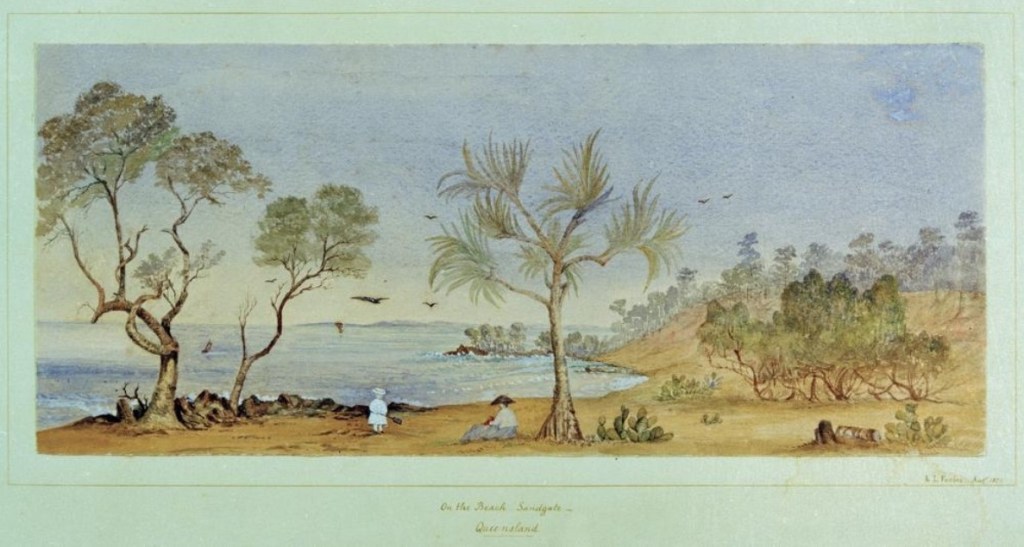
“The country is the finest I have ever seen, either for grass or cultivation. There is always a refreshing sea breeze about noon, but it is very hot in the forenoon and evening.”

Hunter River Gazette; and Journal of Agriculture, Commerce, Politics, and News (West Maitland, NSW : 1841 – 1842), Saturday 5 February 1842, page 2.

 Moreton Bay and More