
On this day – 10 February 1850 – Proclamation of the Circuit Court.
From the introduction of free settlement in 1842 until the Gaol and Circuit Court opened for business in 1850, Moreton Bay had no place to hold trials or accommodate prisoners. There was only a Court of Petty Sessions, which was empowered to commit serious offenders to the Court at Sydney for trial.
Curiously, for a place that had not long before been exclusively populated by convicted criminals, there was no gaol. A lockup that could barely accommodate a couple of drunks was annexed to the police office. Offenders sentenced to as little as fourteen days by the local Magistrate had to be sent to Sydney by steamer to do their time.

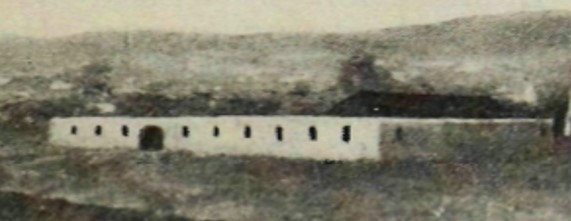
Captain Wickham spent several years writing to the Colonial Secretary, imploring His Excellency for permission to convert the derelict Female Factory in Queen Street into a gaol. At length, a small sum was grudgingly approved, a contractor was assigned, and the work proceeded in a majestically slow fashion until its proclamation in late December 1849.
The Judicial Party arrives.
On 10 February 1850, a Circuit Court for Moreton Bay was proclaimed by His Excellency, and in May, the steamer Eagle made a slightly delayed entry into Brisbane Town with its judicial party.
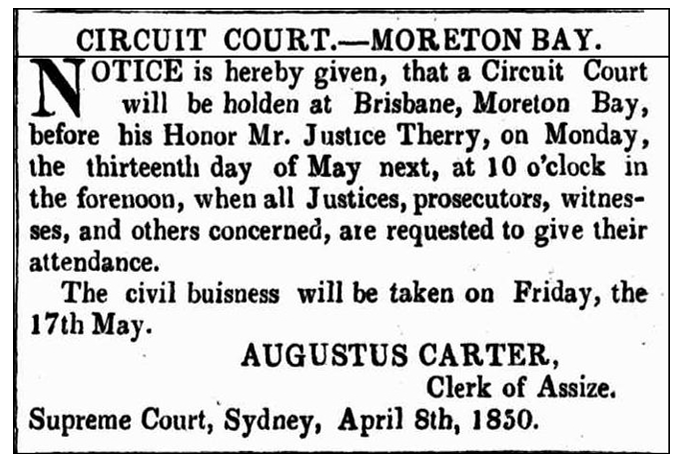
IN consequence of the steam-packet Eagle having grounded in the Hunter River, while making an intermediate trip to Morpeth, she was detained beyond the time fixed for her departure for this port, and did not arrive in the bay until Sunday last, at too late an hour to come up the river.
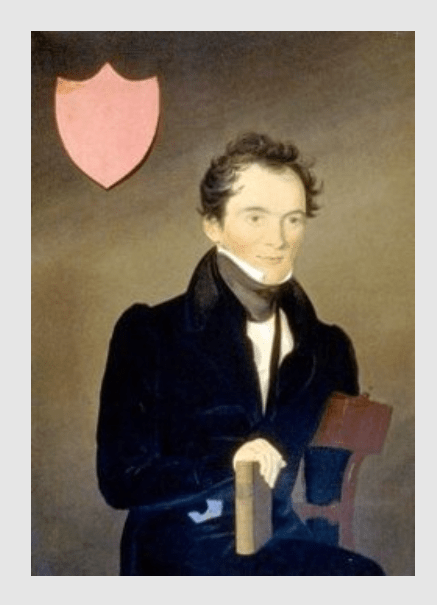
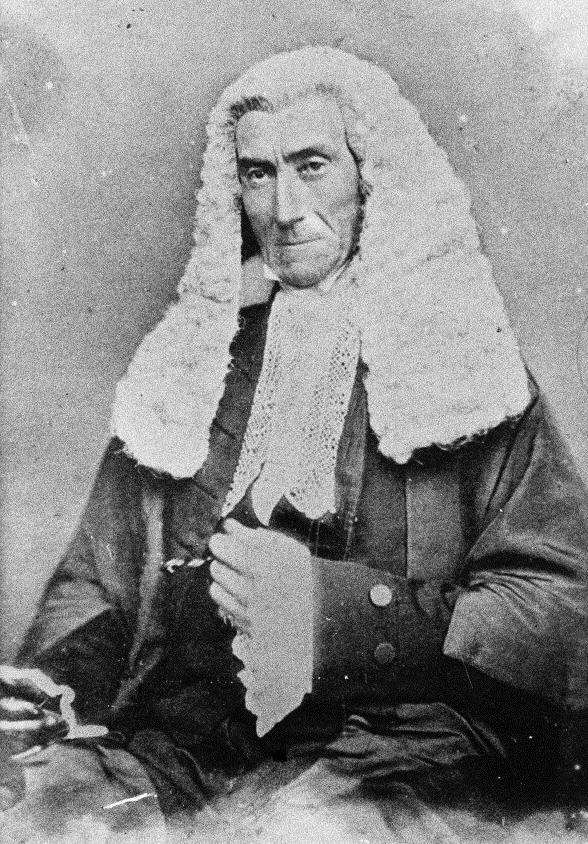
His Honour, Mr. Justice Therry[i], the honourable the Attorney-General[ii], the Criminal Crown Solicitor[iii], and other officers of the Judge’s Court, were brought to town by Captain Murphy in the steamer’s boat, on Sunday evening.[iv]
The Moreton Bay Courier
Judge Therry made a remarkable, learned and very lengthy address to those present for the opening of the Circuit Court. The burghers of Brisbane would have needed to brush up on their Latin, or at the very least, their sage nods.
The Business of the Court.
William Stanley – stealing and having stolen goods in possession.
William Stanley, a ticket-of-leave prisoner was indicted for having stolen money orders from publican Thomas Grenier, and of having stolen chattels from storekeeper Albert Hockings, both of South Brisbane.
Thomas Grenier had left the bar in his wife’s charge and went to have a lie down. His wife had to leave the till momentarily, and came back to discover that it was open, and its contents interfered with. She noticed William Stanley near the till with his hand in his pocket and demanded that he return the orders to the till. Stanley fingered another man for the theft, but that man had left the premises earlier.
His nap rudely interrupted, Grenier located Stanley and demanded his money back. Stanley produced some papers, saying that he had received them from Mr Hockings. (Here Grenier identified the orders in Court – they were for 3 shillings, sixpence and three shillings, fivepence respectively.) Albert Hockings swore that he had not given those orders to Stanley, although Stanley was in his shop that day. The Attorney-General noticed a problem with those orders though – they contravened a law passed in 1826 that forbade the issuing of money orders for any amount under 20 shillings.
When Judge Therry summed up the case for the jury, and two local customs had captured his attention – dealing in money orders for illegal amounts, and treating customers to a drink if they came in to buy goods.
“His Honour, in putting the case to the jury, made some strong observations upon the alleged custom of storekeepers in this district to treat their customers with drink. He said that if such a practice were really in existence, it was a temptation for persons to go from place to place, under pretense of buying goods, but in reality, to intoxicate themselves. It might, besides, very naturally lead to extensive sales of spirits without license, and he thought that, as well for the morality of the place as the safety of those who indulged in such practices, they had better be abandoned.”
Judge Therry
Oh, and Mr Stanley was found guilty and given three years’ hard labour on the roads or public works on each charge. Consecutively.
McGuinness, Collins, Carrol, Ricketts, Page and Maud – Warehousing-breaking and larceny.
The next case was that of Thomas McGuiness, Michael Collins, Morris Carrol, Joseph Ricketts, George Page, and Daniel Maud. The men were labourers at Killarney at Canning Downs Station, owned by the redoubtable Leslie Brothers.

It had been harvest time at the station, and the storekeeper there had given the workers some wine for their hard work. Once the drinks had been distributed, the storekeeper locked up the storehouse. Later that evening, he noticed that the workers were a bit more intoxicated than they should have been, given the amount of wine they’d been allocated. He went to the storehouse and found that the store had been broken into, and a large wine cask had been the object of some ardent attention.
“In summing up, his Honour remarked that there seemed to be a very loose system of management with regard to drinking on the station, which, he felt satisfied, could not be known to the respectable gentlemen who owned it. This case was another instance of the evils of drink.”
Judge Therry
Ricketts, Collins and McGuinness were found guilty of warehouse-breaking and larceny, and Carrol, Page and Maud guilty of larceny.
McGuiness was given five years’ hard labour on the roads, recommended to be reduced to three. Collins and Rickets were given three months and Page, Carroll and Maud to one month apiece.
John Daniel Mactaggart – assault.
John Daniel Mactaggart was charged with assaulting John Carne Bidwell, by horsewhipping him. Mr Bidwell was the Commissioner for Crown Lands and a Magistrate, and may be the first, but was certainly not the last, Magistrate to be publicly horsewhipped in the colony.
The dispute was a private matter between two gentlemen who each considered the other to be anything but. Bidwell considered Mactaggart “beyond the pale of his notice,” but probably started paying attention when the horsewhipping began.

“His Honour, in passing sentence, again commented severely upon the custom of dueling.”
Judge Therry
Mactaggart was given one week in Brisbane Gaol.
Wagner and Fitzgerald – murder.
The next case was that of Jacob Wagner and Patrick Fitzgerald, two shepherds charged with murdering James Marsden also known as Charles Martin, at Wide Bay. It was a particularly distressing murder, involving beating, shooting, and stabbing. There was too much serious evidence presented to be summarised lightly here.
Both men were found guilty and received the death penalty, becoming the first men to be executed at the Brisbane Gaol. (Two convicts had been executed at the old penal establishment in 1830 and two indigenous men had been executed at the Windmill in 1841.)
“His Honour proceeded with his charge, which altogether lasted about three hours, and left it to the jury to decide upon a case which he declared to be one of greater anxiety and importance than he had ever before been engaged in.”
William Butler – horse stealing.
William Butler was charged with stealing a horse from Richard Lovell at Ipswich. Mr Lovell had turned his horse out to pasture and did not see it again for six months, when he saw it being ridden by an Edward Moss. He identified the horse by its appearance and brands. Sometime earlier, Moss had exchanged horses with a man named Butler, whom he had never met before.
“His Honour commented upon the indiscretion of witness dealing with a perfect stranger.”
Butler was found guilty and sentenced to five years’ hard labour on the roads or public works.
Smith McDonald – stealing.
Smith McDonald was indicted for stealing splitting tools from Mr Berry at Ipswich. Mr Berry missed his tools (wedges, maul, auger, cross-cut saw), and noticed them in the use of a group of bushmen a couple of days later. When the police came to see the workmen, McDonald was not there, but turned up later and cheerfully identified the tools as his property. The auger had a peculiar mark on it, and Berry was able to identify it that way.

McDonald attempted to place the guilt on a man known as Gooseberry (real name – Thomas Tasker), but Gooseberry denied having ever met the prisoner, let alone having given him any tools.
“His Honour, in his address to the jury, called their attention to the fact of the prisoner voluntarily telling the Chief Constable where to find the auger, the only tool which could be positively identified. “
McDonald was found guilty and sentenced to three years’ hard labour on the roads or public works. His sentence might have been lighter had he not tried to incriminate Gooseberry.
Bartholomew Corfield – forging and uttering.
Bartholomew Corfield was charged forgery and uttering of a money order for L2 3s, drawn on R Towns (the R Towns in question being Captain Towns, who would later start up the sugar trade in Queensland, as well as the trade in pacific island labour). Corfield admitted to passing the order but could not recall how he had come by it. He denied knowing it to be forged.
“The learned Judge, in putting the case to the jury, remarked upon the necessity of protecting persons who, as he learned that time was no bank in Brisbane, were compelled to draw orders on Sydney merchants.”
The jury found Corfield guilty of uttering but not forgery. He was given hard labour on the roads or public works for five years.
Thomas Denham – stealing.
Thomas Denham was charged with stealing rakes, cross-cut saws and kitchen utilities from Mr John Petrie. Denham did not speak in court, and his manner was sufficiently odd to lead to questions about his state of mind.
John Petrie gave evidence that Denham was an eccentric, but harmless, employee. If not given another person to work with, Denham would lie down and sleep. He had to be forcibly washed and shaved at times. Things went missing sometimes in Denham’s general vicinity.

When the police were called, Denham, nicknamed “Cranky Tom,” was seen to be emerging from the river, covered in dirty water.
“The Judge summed up and explained at considerable length the nature of the law, which, while it exempted from punishment such persons as were irresistibly hurried by madness into the commission of crime, did not shelter criminality merely because the criminal was otherwise silly or eccentric.”
The jury found him guilty but recommended him to mercy because of his weak mind. He was given three months’ hard labour in Brisbane Gaol, and Judge Therry recommended that “the labour would be adapted to his capacity to bear it.”
George Crosby and James Lane – stealing and receiving.
George Crosby and James Lane were charged with stealing, and alternately receiving, property taken from the house of John Bishop. The case against George Crosby was strong, but there was nothing very incriminating against James Lane. Crosby was found guilty and given seven years’ hard labour on the roads or public works, for having robbed a poor man of his hard earnings. Lane was set free and told to rethink his friendship circle.
William Rust – stealing.
William Rust was charged with stealing a bundle of personal items belonging to James Sparks. Sparks was the worse for liquor at Grenier’s public house and could not find his bundle. Mr Grenier, himself a recent victim of crime, located William Rust in possession of it. Mr Sparks got his socks and other unmentionables back. William Rust was convicted and sentenced to three months’ hard labour in Brisbane Gaol.
Cairns, Bambrick and Regennick – shooting with intent to do grievous bodily harm.
The last case on the roster was an unusual one. Three private soldiers of the 11th Regiment, stationed at Brisbane, were charged with having shot at an indigenous man at York’s Hollow on 28 November 1849. William Cairns, William Bambrick and James Regennick were charged with shooting with intent to do grievous bodily harm.

That night, a report was made that the indigenous people living at York’s Hollow had stolen, or were killing, cattle. The then Chief Constable referred the matter on to a Magistrate. The troops came out and entered the York’s Hollow camp. Henry Bulgin noted that, “The blacks seemed to be astonished at the approach of the military.” Shots were fired. Three indigenous people reported to Dr Cannan at the Hospital, suffering from gunshot wounds, mercifully not fatal ones.
The jury found Bambrick and Regennick not guilty, and Cairns guilty of common assault. Cairns was sentenced to six months in Sydney Gaol.
While expressing his horror at seeing men in the uniform of the British soldier in the dock of a courtroom, the Attorney-General expressed some fairly 21st century ideas about the case:
“A black man’s camp is as much his castle as a white man’s house, and if he found it invaded, at night by an armed and hostile force, he would be justified in throwing a boomerang. But it would be shown, moreover, that the soldiers fired without orders.”
Attorney-General Plunkett
And,
“If offences like these could be committed upon the black with impunity, it must be conceded that an armed military force might be called out to any place where large numbers of white people were assembled; —to the racecourse for instance — into one of the tents, where numbers of people might be assembled, drinking, and perhaps intoxicated, and that they might fire upon those people.”
A-G Plunkett
One can imagine the looks of bewilderment in the precincts of the Court at the idea that white people might be treated in the same manner as black people.
Any labouring on the roads and public works must be done in Sydney.
And so ended the Circuit Court. Judge Therry gave Brisbane a charmingly positive review on his parting[v], and all the prisoners he had sentenced to public labour were sent to Sydney to serve their time. Brisbane may have a Gaol and it may have a Circuit Court, but public labour had been withdrawn from the district because of the expense of managing gangs. As the Courier pointed out, maintenance and infrastructure works were desperately needed in the town, and losing this much public labour was regrettable.[vi]
[i] 1800-1874. Irish-born, sometimes controversial, decidedly Catholic, and an enemy to all drunkards.
[ii] John Plunkett (1802-1869), Irish-born, impartial and determined to promote equality in the colony.
[iii] John Moore Dillon.
[iv] Moreton Bay Courier (Brisbane, Qld. : 1846 – 1861), Saturday 18 May 1850, page 2
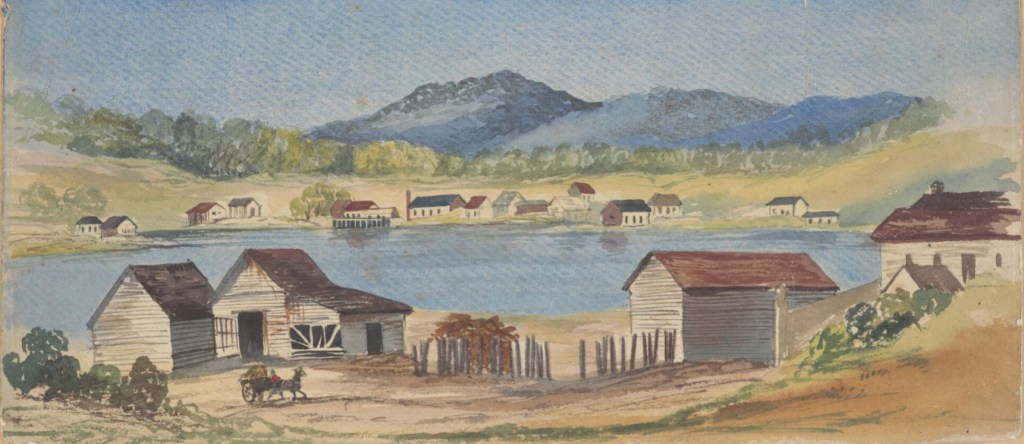
[v] “When from an eminence I behold the noble river that encircles Brisbane — the rich and fertile tongue of land stretching into its waters — the beautiful bend of the shaded banks that enclose its broad and deep current just above your town — and the bluff range of wood-covered hills rising in varied and graceful elevation in the distance — as if placed there by nature to decorate the whole view,— I feel that I am in the presence of a scene that cannot be excelled in the loveliness of its landscape; and when I am further assured, that your district abounds in views quite as magnificent, I feel that I tread a soil as beautiful and fertile as its climate is salubrious and healthful, and that I am justified in exclaiming.
— A lovelier land
Our Sovereign hath not at her command.”
[vi] Moreton Bay Courier (Brisbane, Qld.: 1846 – 1861), Saturday 1 June 1850, page 2
Brisbane Gaol Records of Circuit Court Defendants:
Of the eighteen men in custody at the Circuit sessions, only three had not been transported to Australia as convicts.
William Stanley per Eden (1840), Born c. 1819. On 2 March 1840 at the Old Bailey, Stanley was transported for 10 years for pickpocketing. Brisbane Gaol handed Stanley over to Brisbane Police on 22 May 1850 for escort to Sydney Gaol. His behaviour was orderly.
Thomas McGuinness per Lady McNaughten (1835). Born in Dublin City. Brisbane Gaol handed McGuinness over to Brisbane Police on 22 May 1850 for escort to Sydney Gaol. His behaviour was orderly.
Michael Collins alias Cain per Waterloo (1836). Born in County Tipperary, 1808. Originally convicted at Tipperary of stealing a pig. He was married with one son. Brisbane Gaol discharged him on 18 August 1850. His behaviour was orderly.
Morris Carrol per Lady McNaughten (1835). Born at Mullingar, Labourer. Brisbane Gaol discharged him on 18 June 1850. His behaviour was orderly.
Joseph (also Robert) Ricketts per Bengal Merchant (1836). Born at Warwick, Weaver. Brisbane Gaol discharged him on 18 August 1850. His behaviour was orderly.
George Page per Susan (1834). Born in Bedfordshire. Brisbane Gaol discharged him on 18 August 1850. His behaviour was orderly.
Daniel Maud per Lord Melville (1830). He was born in Yorkshire and was a bargeman. Brisbane Gaol discharged him on 18 June 1850. His behaviour was orderly.
John Daniel Mactaggart, Gentleman, arrived free to Australia. He was from Scotland and his occupation was Squatter. Brisbane Gaol discharged him on 21 May 1850. His behaviour had been good.
Jacob Wagner per Henry (1823), of Edinburgh. Executed.
Patrick Fitzgerald per Havering (1849), of Tipperary. Executed.
William Butler, born in Windsor NSW, Groom. Brisbane Gaol handed him over to Brisbane Police for escort to Sydney on 22 May 1850. His behaviour had been disorderly.
Smith McDonald per Andromeda (1829), of Fifeshire, sawyer. Brisbane Gaol handed him over to Brisbane Police for escort to Sydney on 22 May 1850. His behaviour had been disorderly.
Bartholomew Corfield (properly Caulfield) per Clorinda (1836), of Limerick. A soldier in the 97th Regt, he was convicted of rape at Colombo and transported to New South Wales. Brisbane Gaol handed him over to Brisbane Police for escort to Sydney on 22 May 1850. His behaviour had been orderly.
Thomas Denham per Waterloo (1836) of Dublin. Brisbane Gaol discharged him on 18 August 1850. His behaviour had been disorderly.
George Crosby per Asia (1837), of London, Waterman. Brisbane Gaol handed him over to Brisbane Police for escort to Sydney on 22 May 1850. His behaviour had been orderly.
James Lane per John Barry (1839), of Cambridge, a cook and sawyer. Brisbane Gaol discharged him on 13 May 1850. His behaviour had been orderly.
William Rust per Aurora (1833), of Wiltshire. Brisbane Gaol discharged him on 18 August 1850. His behaviour had been orderly.
William Cairns (Properly Kearns) Private Soldier 11th Regt, Armagh. Tailor and Soldier. Brisbane Gaol handed him over to Brisbane Police for escort to Sydney on 22 May 1850. His behaviour was orderly.
 Moreton Bay and More