
A small detachment of police had been searching for a murder suspect through bushland around Toowoomba for nearly two months.
The man they were hunting was John Alexander Herrlich, a German man in his fifties, who was wanted for the murder of Martin Klein on February 12. Herrlich had shot and killed the man for taking some cedar logs on his property and had been on the run in the bush ever since.
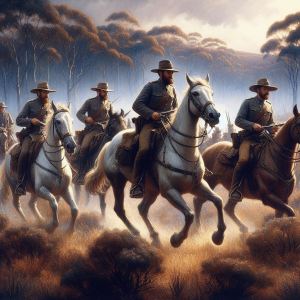
The search party consisted of Sub-Inspector McCarthy, Sergeant Shea, Trooper Quinn, and Indigenous Trooper Nathy. They had been following tracks and campsites through dense scrub, rocky outcrops, deep gullies and vine-covered forest land. They had ridden, walked and crawled.
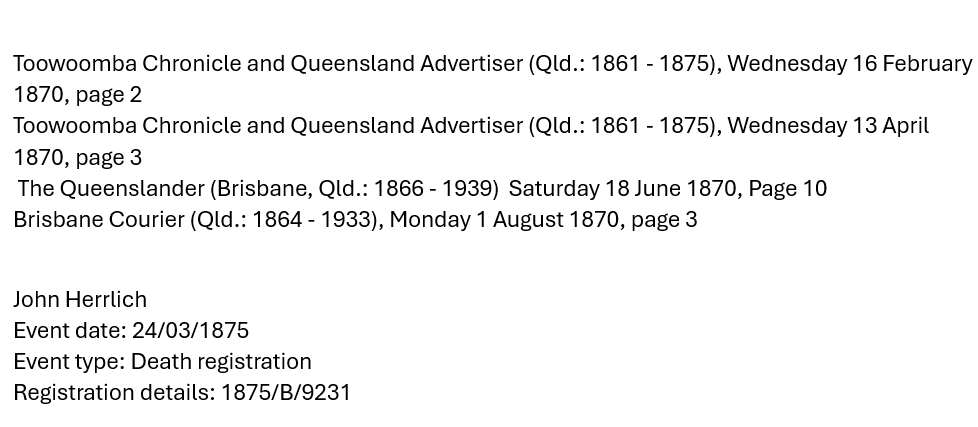
The search party wore their uniforms to shreds several times, forcing them to return, near nude, to Toowoomba for fresh clothing. The troopers sometimes went hungry rather than break cover and alert their quarry to their presence. They faced the prospect of chasing down a desperate well-armed man, who had already shown that he was prepared to kill. Indeed, “it is stated on good authority that Herrlich, many years ago, shot the Burgomaster (or Mayor) of Frankfurt-on-the-Maine, when, owing to the interception of powerful friends, he was only punished by banishment.”[1]
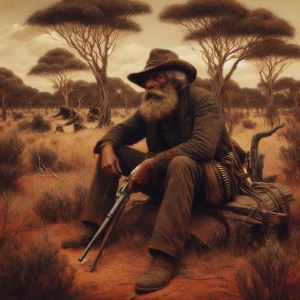
Indigenous Trooper Nathy was especially skilled at finding and following Herrlich’s tracks in the bush, and locating improvised shelters and campsites used by the wanted man. They were never too far from their quarry.
The search party began to suspect that some of the German settlers around the Downs had been harbouring Herrlich, offering a night here and there, or some passing some supplies to him.
On 8 April 1870, the search party closed in on a house belonging to a German man named Joseph Kohler. Kohler was alerted to the approach of the troopers by his dog barking furiously on the verandah.
Kohler came out of his house and informed the police that only his wife was inside, quietly reading. Troopers Quinn and Nathy went to the rear of the house, and McCarthy and Shea pushed Kohler aside and entered the house. They found four men seated at a table. One was John Alexander Herrlich.
One of Herrlich’s friends at the table claimed that he had been given a message that Herrlich had wanted to give himself up by the morning, or he would cut his own throat. Herrlich, claimed the man, was already in the custody of the men at the table.
Sub-Inspector McCarthy offered Herrlich’s friend the option of getting out of his way or being shot, and arrested Herrlich at gunpoint.
Herrlich was taken to Toowoomba under police escort to be charged. Kohler and his three other guests started agitating for a share of the large reward the Colonial Secretary had offered for the capture of Herrlich. That reward was eventually divided up – £80 to Sub-Inspector McCarthy, £10 to Sergeant Shea, £20 to Trooper Quinn. And Indigenous Trooper Nathy? Not even mentioned.
John Alexander Herrlich, rather sickly after nearly two months of sleeping rough, was charged with murder. As his case moved towards a committal hearing (examination of witnesses), a rumour circulated about the Downs that Herrlich was in fact minding a gold seam, causing a minor gold rush to the area. Pickings turned out to be slim.
Herrlich’s trial took place at Toowoomba in August 1870, and after some issues with one eye-witness’s account of the series of events that led to the gunshot, a verdict of manslaughter was returned by the jury. His Honour Judge Lutwyche thought the jury “had taken the most favourable view of the case,” and gave Herrlich 15 years’ penal servitude.
Saint Helena Island Penal Establishment received John Alexander Herrlich on 29 September 1870. He was 59 years of age, 5 feet 7 inches in height, of slight build, with a sallow complexion and grey hair. He died in 1875.
[1] Surely if his friends had been that powerful, he might have been banished to somewhere less arduous than the Australian bush. At any rate, this entertaining rumour was only brought up once.
Both images are generated by AI.
 Moreton Bay and More