
The Amity Convicts.
A parade, a crowd and a picked pocket.
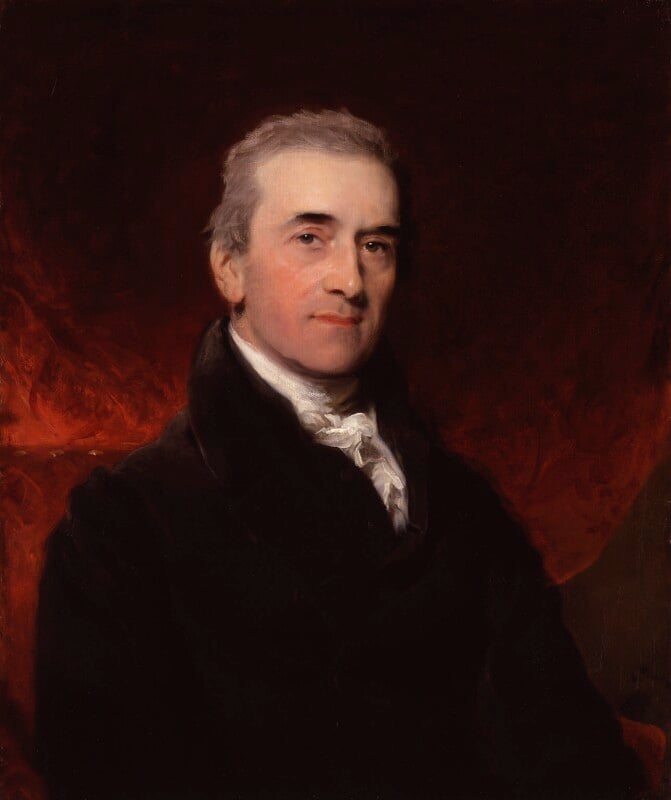
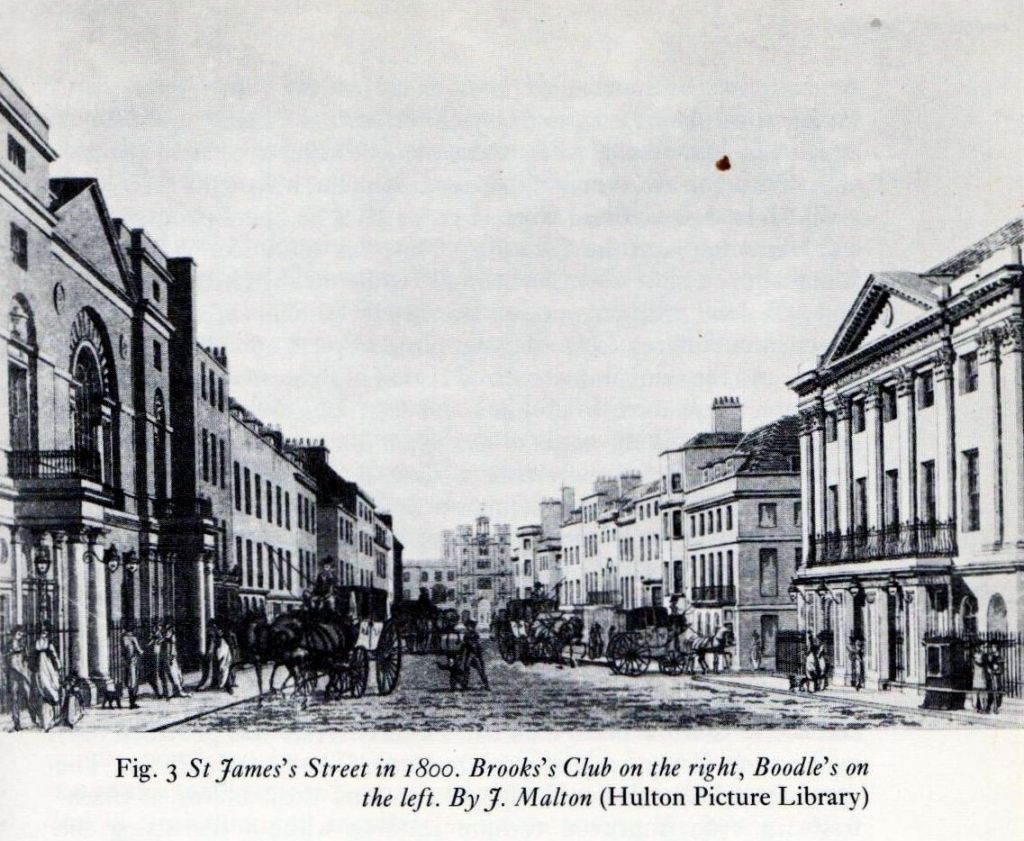
On 4 July 1818, a distinguished lawyer and reformer named Sir Samuel Romilly was being conveyed about the City of Westminster in triumph, having been returned first in the poll. It was an uncommonly fine day, and Sir Samuel rose frequently to bow and offer his heartfelt thanks to his constituents as his carriage procession passed St James’ Street.
In the crowd, someone bumped heavily into a blacksmith named William Summers. Summers felt his watch being pulled from him, and he turned around and grabbed hold of a tall, dark-haired youth, who promptly dropped his loot. Constable Pace saw Summers collar the young man, and intervened to charge Thomas Billington, baker, aged 21, with theft.
For his felonious, but decidedly temporary, taking possession of the watch, Thomas Billington was sentenced to transportation to New South Wales for life.
On 3 October 1818, Thomas Billington was received on board the ominously named Hulk Retribution. He spent just shy of two months undergoing retribution before being transported to New South Wales on the Baring. The journey was unusually long – a full seven months.
Sydney Town.


Upon arrival on 26 June 1819, Thomas was assigned to the service of Captain William Minchin , who had settled in New South Wales after his military career, becoming a merchant and Magistrate of Police. Thomas’ service with Minchin appears to have been harmonious, and he obtained a Ticket of Leave during it.
Minchin passed away unexpectedly in 1821, and Thomas Billington seems to have kept his nose clean until he decided that he wouldn’t mind a trip home.
The Midas advertised itself as a “fine, fast-sailing, first-class ship” with “the most superior accommodations.” Better yet, the voyage was direct to London. Midas would sail in mid-July 1824, and Thomas Billington, unable to afford a superior accommodation, stowed away. And was, of course, captured. His Ticket of Leave was cancelled, and he was ordered to gaol to await transportation to the convict settlement at Port Macquarie for two years.
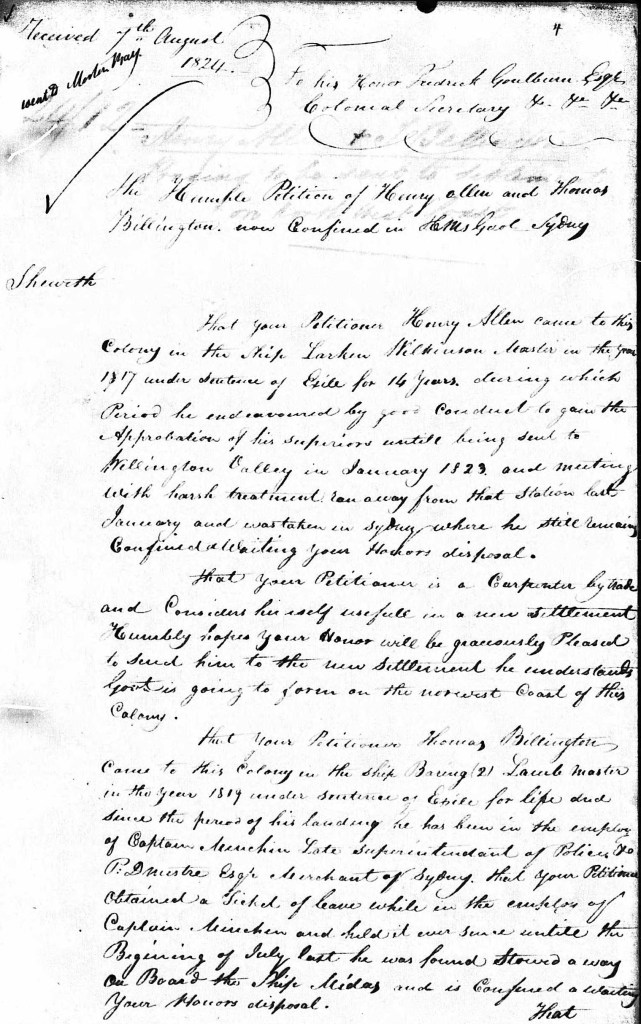
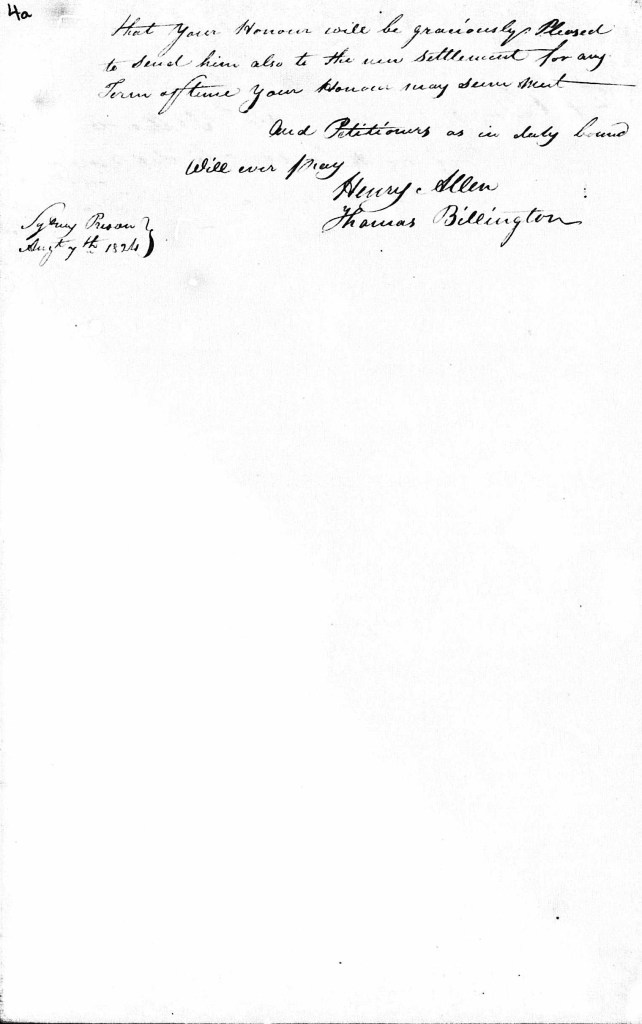
Sitting in Sydney Gaol with Henry Allen, who had run away from a harsh master, the two men heard of a paradisical new convict settlement on the “Norwest coast of the Colony.[i]” Both prisoners offered their services to the Governor most humbly for “any Term of time Your Honour may see meet.” His Honour, or His Honour’s delegate, made a brief marginal note “sent to Moreton Bay.”
Moreton Bay per the Amity.
On 14 September 1824, the brig Amity, loaded with supplies, soldiers and 29 arrived at Moreton Bay to set up the new penal colony. Thomas Billington had the dubious honour of being recorded as Prisoner #1 on the Register of Convicts at Moreton Bay.
Faced with the physical labour of setting up a settlement – erecting stores and buildings, seeking out fresh water, planting – Thomas Billington must have regretted bitterly his humble petition to His Excellency. At least at Port Macquarie, the damned buildings were up. To make things worse, the Amity Point location was found to be unsuitable, and plans were afoot to move inland.
During his two-year term at Moreton Bay, Thomas Billington was appointed as a constable, and oversaw lime burning. Burning limestone for building materials would have been a particularly unpleasant activity in the sub-tropical heat, and although Billington received extra supplies and rations because of his office, he would have been utterly delighted to embark for Sydney Town on 9 October 1826. To his credit, he did not abscond, and avoided summary punishment at the settlement.
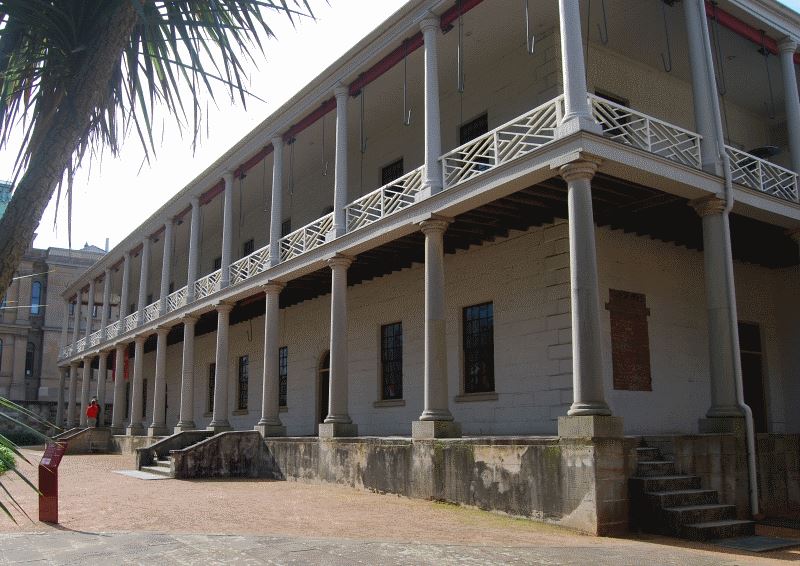
Back in Sydney, free of Captain Logan, sandflies, lime burning and humidity, Thomas Billington was assigned to work at the Hospital. In March 1828, he attended work “drunk and insolent,” and earned himself a year in an iron gang. Precisely six months later, he had absconded from his gang. He was sent to another gang.
Windsor.
That would be the end of any mischief. Billington was in his thirties, and his fairly minor criminal activities had already earned him a one-way ticket to the other side of the planet, two years in a sandfly-ridden outpost, and time on a chain gang. Henceforth, he would follow the rules.
In October 1833, Billington applied for permission to marry Catharine Hughes, aged 26. The request initially appeared on the “granted” list, but was promptly transferred to the “refused” list because Catharine Hughes already had a husband.
If at first you don’t succeed, try again the following year. This time, Thomas Billington found himself a single young lady – Grace Gallocher, aged 19, per the Buffalo. Both were ex-convicts on bond, and there is a note on the application to the effect that Billington’s master was willing to keep both prisoners in his employment until Billington was able to obtain a Ticket of Leave. This time, His Excellency was pleased to grant the application, and off the couple went to the Rev. William Cowper to make their vows.
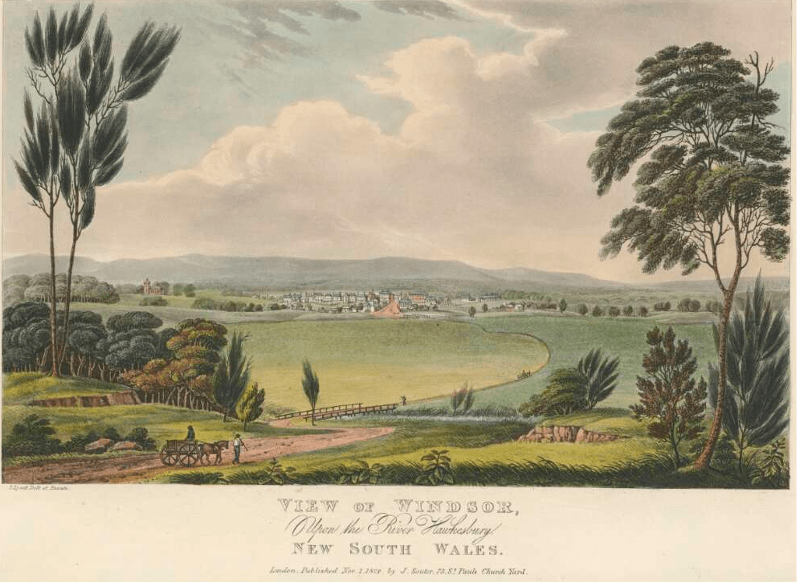
After obtaining his Ticket of Leave, Thomas Billington was permitted to remain in the district of Windsor. Thomas was very careful with this new ticket. In 1839, 1840 and 1841, he applied for and was granted, variations to his ticket conditions to make sure that he was able to travel to other towns to make deliveries.
Thomas Billington was still living and working in Windsor, New South Wales, in November 1845 when he took a swim in the Hawkesbury River. Perhaps it was a particularly warm day. Sadly, Thomas became entangled in weeds in the river, and drowned. A passer-by, who had not assisted out of concerns for his own safety was harshly criticized by the press.
[i] There was no north-west coast of New South Wales, but never mind.
 Moreton Bay and More