
They meant well. They probably did some good, they undoubtedly caused some harm.
Content warning – this article discusses children who were separated from their biological parents, as well as some words used at the time to describe children of different developmental levels. In the period 1865 – April 1867 that this article covers, there were no children of Aboriginal or Torres Strait Islander heritage at the Orphan School. I note that this situation changed shortly after the Courier’s article was written. I acknowledge the pain has been suffered down the generations by those affected by removal from biological families, particularly in First Nations Communities. If you would like to connect with a support organisation that deals with the experiences of, and provides support for, people and families affected by experiences in non-family care, I suggest CLAN (Care Leavers Australia Network) as a good starting-place.
“For many years we must look upon the State as the friend of the poor children who, deserted by their natural protectors, are dependent upon those who are by law placed in the position of affording them aid and support.”
Brisbane Courier
This was a novel idea for the 19th century, and one that the person writing the series “Our Charitable Institutions” was perhaps not entirely comfortable with. Care of the helpless started (in Queensland) with the Benevolent Asylum, which operated out of the General Hospital before being moved to Dunwich on Stradbroke Island in the 1860s.
Housing young children in a fairly remote island establishment that was meant for the infirm and aged proved unmanageable, and a Mrs Douglas petitioned for the opening of an Orphanage, then called the Orphan School, in Brisbane. The school was run as a charitable institution and did not come under formal Government management until 1879.
The school opened in Roma Street in 1865, occupying wooden buildings that used to be the separate Fever Wards when the General Hospital was in George Street before 1860. The Courier’s correspondent visited there in April 1867, when it had been a going concern for 18 months.
The writer expended nearly 400 words on the vexed question of how much a child should be allowed to eat, and what it cost, and whether that was realistic. He (undoubtedly it was a he) came to the conclusion that the scarce pennies were being pinched most ingeniously, and the children were quite well off.
The writer was taken on a tour of the school at Roma Street, and the Wickham Terrace property where infant orphans were being cared for. No doubt for this the children were scrubbed up, and On Their Very Best Behaviour, but they passed muster beautifully.
“It was, indeed, a pleasant sight to watch some fifty or sixty children – sturdy-looking children – engaged in their various tasks. Around one, whom I took to be a monitor, was arranged a small circle of neatly dressed boys, to whom he was imparting the secrets of knowledge of which he himself was, as I was informed, only a few weeks ago almost profoundly ignorant. The eager eyes of his listeners were fastened upon him as he was explaining to them the road by which they could lessen the labours of study. Then, again, there were the classes – some engaged with their writing-books, and others, who had, not so far progressed, watching, with astonishment, the letters written on a black board by their teacher.”
Brisbane Courier
There was a bathroom with water piped in from Enoggera Reservoir, a large refectory and kitchen, producing “attractive-smelling” stew and “huge” potatoes. The children were given 5 hours of study each day, and “made themselves useful” about the place at other times. They were allowed some play time. Probably not much.
The Infant home was visited, with its room full of cradles for the babies, and stretchers for the toddlers and upwards. There were no sick children when the writer visited, and he was rewarded with the charming sight of the infants playing and singing. There had, he added proudly, been only two deaths in the last quarter. Oh, and the Matron of the Infant Home was named Miss Mitten. You couldn’t make that up.
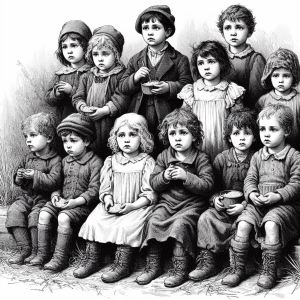
Entering the School.
“Poor little houseless wanderers, how different would have been their position had they not met with a kind hand to introduce them to a comfortable, though temporary home.”
Brisbane Courier
All of this benevolence, and I have no doubt benevolence was the aim of the Orphan School, is counterpointed by the mid-Victorian outlook of the people in charge. There was a class system, even for admissions:
“The orphans received into the Asylum are divided into four classes, as follows: –
- The real orphans, or those whose natural protectors it has pleased Providence to take from them,
- deserted children,
- the children of prisoners (of which, I may say, there is a very large proportion), and
- the children of those who, from want, are compelled to go into either the ordinary or Lying-in, Hospital.”
The very early records of the Orphanage are a little haphazard – there are some children whose details or outcomes are barely recorded – but a rough count indicates:
Seven “real orphans” were admitted from 1865-1877, four children were deserted by their surviving parents, fourteen children of prisoners, and fifteen children of those in hospital.
Something that wasn’t recorded by the writer was the effect of one parent dying. Most admissions were caused by the mother dying and the father being left poverty-stricken (35), or widows in service and unable to have the children with them (25).
Some of the stories painted by the brief admission records are tragic – “both parents died on voyage out,” “father in Gaol, mother in hospital.” Then there are those that speak of judgment – “this child is illegitimate,” announces one, “father dead, child imbecile,” states another. The illegitimate infant girl died at the school just after the article was written. The second child may have been an “imbecile,” whatever that means exactly, but it was a Roman Catholic one, and was able to be sent on the Sisters of Mercy.
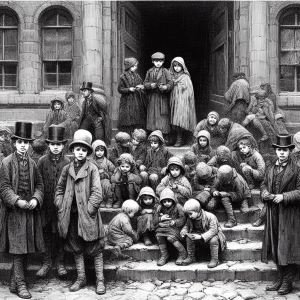
Leaving the School
Children were usually hired out to “some person in the country of known respectability” on leaving the school. (I’m guessing that it was the person who was of known respectability, not the country.)
Up to the visit of the Courier’s correspondent, 33 children – some barely nine years old – had been sent into service. Eleven-year-old German “imbecile” John Bruin was sent to Dr Canaan’s service at Woogaroo Asylum, where hopefully he met with humane treatment. Several children were sent to service at distant country places like The Gap and Bald Hills (now suburbs of Brisbane).
The relief the Orphan School felt when the Sisters of Mercy were able to set up a Roman Catholic Orphanage is quite genuine. Catholic orphans (at least 50) were sent there, quite quickly one imagines, often without much detail of who they were and when they left. One little girl was adopted by the Bingham family in Fortitude Valley during that time. Two children ran away from the school.
The saddest part of the Register is the “died at the school” notation. An extraordinary number of children (23) had died there by that time – mostly babies and very young children. Some were children of mothers who had died giving birth to them, and who were sent along to the school by the Lying-in (maternity) Hospital. A few died on the day of admission to the school, or within a few days. Edward Jackson and Bridget Jackson were born in July 1866 were admitted a month later. Their mother was in hospital in a very bad way. Their father was “in great poverty.” Both children died at the Orphanage.
It’s hard to know what impact the Orphan School had on the lives of the children – presumably those whose parents had been in distress were given accommodation, food and a little education. Some may well have learned a trade and been quite happy in their service. Others, it’s not hard to imagine, would have been treated as slave labour.
“Who can foretell what may be the future of any? Fortunately for many of them, they are little acquainted with the past.”
Brisbane Courier
Admission register to Diamantina Orphanage and Receiving Depot – part 1 of 9. Queensland State Archives item DR29897.
Brisbane Courier (Qld.: 1864 – 1933), Thursday 11 April 1867, page 2.
Images used in this post have been AI generated.
 Moreton Bay and More