
Or, how Moreton Bay dealt with the Servant Problem in the early years.
Tackling the subject of the 19th century “servant problem” conjures up ideas of exacting upper- and middle-class ladies bemoaning a few specks of dust left on the mantelpiece.
In our first years of free settlement, a servant could be a shepherd, labourer, or a domestic servant. There were two classes of servant – ticket of leave convicts, and free men and women hired as servants. And they were all quite, quite unsatisfactory.
In 1842, only ticket of leave convicts remained around Brisbane Town, and they were assigned to public works like the survey expeditions, pilot boat crews, the hospital and gaol.
As squatters and settlers headed out to take traditional lands to establish stations, grow crops and raise herds of sheep and cattle, they required labourers. Inexpensive labourers, mind you, to ensure that their ventures ran to a profit.
There were more situations vacant than situations sought. Servants found that they were able to negotiate better pay and more advantageous terms. If servants were dismissed, they could find other work quite quickly. And masters weren’t happy.
“Instead of performing their duties better, as they ought to do when they are highly remunerated, we find them careless and insolent—idle and knavish—bolting from the stations in every direction—knowing well, as they do, that hitherto there has been but little chance of competition in the labour market. The higher the wages, the more troublesome the men become, and the less regard they have for character.”
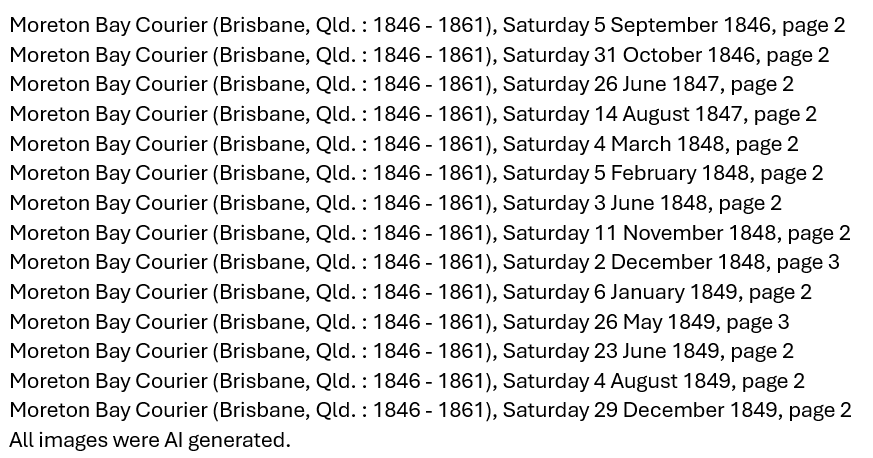
Moreton Bay Courier, 1846
At first, the Courier thought that a return to transportation might be the best way of getting some cheap labour – the Home Government having apparently ruled out direct emigration to such a sparsely populated and remote part of New South Wales. “We believe that the evils of the forced labour situation have been greatly exaggerated.” After all, the moral decline that might result from a lot of convicts being put to work couldn’t be much worse than the situation as it stood. Could it?
At the Police-office, yesterday, Henry Burbidge, and Elizabeth his wife, were convicted of disobedience of orders, as well as indecent and violent conduct towards Mrs. Warner of Kangaroo Point, during the absence of Mr. Warner on official duty for a period of three months. So gross a case had never before been entertained by the Bench.
Long before one such case is forgotten, we have plenty more to keep alive in our minds the recollection of our helpless situation, and the plebeian tyranny to which a certain submission appears for a time to be unavoidable. How are we to release ourselves from this odious state of thralldom – this condition at once irritating, inconvenient, and humiliating?
Moreton Bay Courier, 1847
How indeed? The odious thralldom continued through 1847 and 1848, and the Moreton Bay Courts of Petty Sessions spent an inordinate amount of time dealing with disputes under the Masters and Servants’ Act.
Indignant masters took insolent, shiftless or drunken servants before Captain Wickham in Brisbane and Dr Dorsey in Ipswich, seeking a termination of their hire contracts. Indignant servants took masters to the same forum, seeking proper payment of wages. One servant, Mary Evans, took Mrs Smith to court for assault for “throwing a jug of water over her, and then sending the jug after the water.” Mrs Smith copped a fine, and Miss Evans found herself a better situation.


Still, the horror continued:
A cook at one establishment was, a short time since, receiving such high wages, that he actually appointed a deputy, and paid him twelve shillings a week out of his salary to do the work, himself pocketing the balance, namely, nine shillings per week, and enjoying the otium sine dignitate[i] with a bevy of black beauties, who were constantly employed cutting up tobacco, filling his pipe, anticipating and supplying his most trifling wants.
Moreton Bay Courier, 1848
In late 1848, salvation seemed at hand. The Artemisia, with actual British immigrants on board, was about to land in Moreton Bay. Dr Lang was agitating for direct immigration by upstanding Protestant artisans. Was the thralldom at an end?
In January, 1849, the Courier was pleased to note the arrival of the Artemisia and its precious manifest – “a class of persons generally very superior to those usually dispatched to these shores.” None were over 45, there were families, single young men, and single young women. (One of these single women was Anne M Kelly, who, as Anna Maria Powell, Queen of the Artemisia, would reign graciously over the holding cells and court docks for more than a decade.)


Land purchase was prohibitively expensive for the Artemisia immigrants, a situation bemoaned by the Courier, but altogether the arrangements were excellent. Those of the servant class were taken up immediately, probably with cries of gratitude.
Having secured a precious shipload of viable servants, with promises of more to come[ii], Moreton Bay was collectively horrified to find that the Home Government cared so much about their situation that they decided to transport convicts out to Moreton Bay. Directly. The Courier abandoned its qualified support for “forced labour,” and now dwelt bleakly on the moral degradation that transportation would surely bring.
A group of convicts from the Hashemy, which had landed in Sydney, were brought to Moreton Bay in June 1849. They seemed alright. The world didn’t end. Nor did the demand for labour.
In August, a carefully selected and painstakingly chaperoned group of immigrant “orphan girls” were introduced to Brisbane. The only people who could approach the orphan girls were doctors or clergymen. Not prospective employers. Every precaution was taken with the girls, except the rather basic one of finding them somewhere to sleep. And beds. And bedding.
Once they were temporarily housed, and settlers were able to approach them, with the written authority of a Magistrate of course, the orphan girls were quickly engaged. Often rather quickly engaged in the marital sense, too.
In fact, there is a perpetual demand for female servants, in consequence of the Benedictine[iii] propensities of the male population.
Moreton Bay Courier, 1848
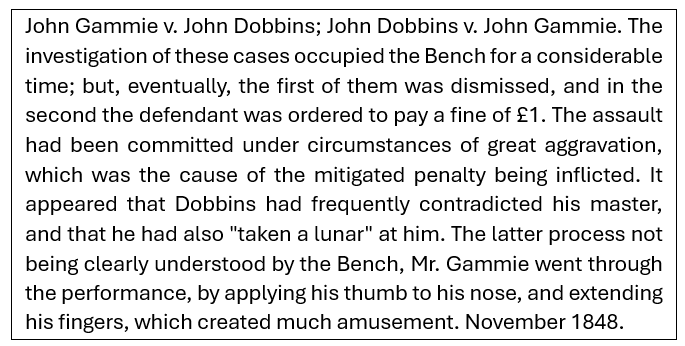
The servant question still left a lot to be desired. A Mr John Gammie and his labour relations issues occupied the Ipswich Bench almost exclusively. Although there were now immigrants, more labour was required.
Then, on 1 November 1849, the Mountstuart Elphinstone landed at Moreton Bay, and unleashed the first directly transported convicts on the free settlement of Brisbane Town. There were many characters on board who would reform and contribute to Queensland – Josiah Milstead and Isaac Cooper, for example. But quite a few of the men exhausted the police and magistracy of Brisbane and Ipswich in December 1849. To the extent that only one more ship was sent to Moreton Bay – the Bangalore in April 1850.
The 1850s saw population growth, immigration, expansion and settlement. Gradually, the demand for labour died down, and the Servant Problem returned, happily, to the pages of humorous weeklies.
[i] Leisure without dignity.
[ii] Weeks later, the first of the Lang immigration vessels, the Fortitude arrived. The Chasely and the Lima rounded out the year. The Lang immigrants were chosen to be settlers rather than servants, people who could bring skills and character to the colony.
[iii] The Benedictine Rule integrated prayer, manual labour, and study into a well-rounded daily routine. I suspect that the men who settled on the Downs prayed as much as they felt would suffice, increasing the quantity when the rector came calling, worked like the devil, and studied, if anything, stock books.
Masters and Servants Act 1845 9 Vic No. 27 (rep 1973 No. 1 s 2 sch)
Masters and Servants Act 1847 11 Vic No. 9 (rep 1973 No. 1 s 2 sch)
 Moreton Bay and More