
The cases before the Magistrates, translated from the original Moreton Bay Courier,1850.
IPSWICH. Tuesday, 23rd July.
Two of the genus homo, named respectively Arnold and Tasker, the latter commonly called “Gooseberry,” appeared on warrant this morning, before our resident Magistrate, to answer the complaints of Mrs Deborah Grocott, alias Howell, or Howard, and her friend Mrs. Stevens, alias Sarah Brown.
It appeared that Arnold and Grocott had had a very extensive commercial transaction by the sale of a filly, which the former, after having sacrificed far too freely at the shrine of Bacchus,[i] had disposed of to the complainant for the serious amount of five shillings.
Subsequently, however, the prisoner, after having enjoyed a siesta and laved his throbbing temples in the rippling brook, appeared perfectly oblivious of past events, and seeing his filly in Deborah’s enclosure, laid claim thereto, which the fair damsel, with a pugnacity truly astonishing in one of the softer sex, stoutly resisted.
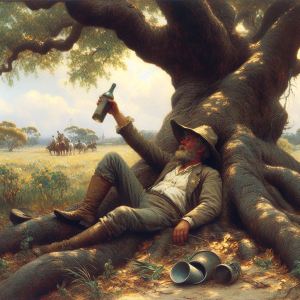
The namesake of the American renegade[ii], however, after first tendering the five bob, succeeded by a cunning ruse in recovering the disputed nag, in consequence of which the present prosecution was instituted.
Now as to the unlucky Gooseberry’s predicament, it turned out that he was present at the foregoing discussion, which took place outside the domicile of the complainant; meanwhile a friend, acquaintance, or companion of his named Henry Martin, alias Morgan, a well-known character, who had accompanied him, not having sufficiently studied the law of meam et tuam,[iii] quietly abstracted sundry articles of wearing apparel from Sally’s stock-in-trade; after which he made a moonlight flit, leaving not a trace behind[iv].
Under all the circumstances of the case, his Worship did not consider it necessary to trouble twelve good men and true, so dismissed the prisoners, with a salutary caution against inebriety and bad company.
Basically, a drunk man sold his horse for 5 shillings, slept it off, forgot the sale, got his horse back after a fight, and was charged. Meanwhile, his mate watched the fight, while a mate of his nicked some goods. The Magistrate didn’t think it was worth sending to a jury. I think.
After the foregoing cases were disposed of, Daniel Sullivan, an exile, appeared on the boards to answer the charge of his master, Mr. Harris, the bricklayer. It was adduced in evidence that Dan, for the sake of a spell, “gammoned sick.[v]” After being kindly treated for that supposed cause, he walked off, and after some hours returned pot-valiant[vi], and, on being mildly expostulated with, immediately declared his intention of consigning to eternal oblivion sundry members of his employer’s family[vii]; and, as a commencement, he hit a visitor with all his force. A constable, however, being sent for, the scamp was secured. As a warning to him, and to cool the ardour of his combative propensities[viii], his Worship sentenced him to enjoy the fruits of solitude for seven days in the Ipswich cells.

Worker pretended to be sick, took a sickie, got drunk, and swore and punched someone.
Michael Christie v. Hugh Maxwell, for nine days’ wages for his wife. In evidence it appeared that Christie married Maxwell’s servant-girl shortly after she entered service, and the present claim, which only amounted to five shillings, arose out of several fracas which subsequently to the terrible – I mean to say indissoluble knot[ix] being tied, the present belligerents had relative to claims and counterclaims for wedding dinners, dresses, &c.
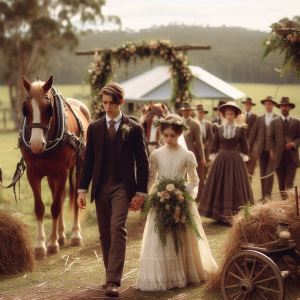
In this case the defendant put in a set-off of four shillings, passage-money which he swore he had paid to the agent of the Raven; at the same time a Mrs. Ford declared that the plaintiff’s wife had paid her own passage to Captain Coutts. Several other claims were also put in by the defendant, which the Bench would not permit to be brought against wages. They therefore gave a verdict for the amount claimed, and costs.
The boss sacked a girl for getting married, her new hubby took him to court.
Mrs Jane Doway, a late importation of the ferret-like species, was marched in a solemn-like procession, from Connor’s retreat, in which she had been incarcerated a short time before, to the “convincing ground”[x] before their Worships, then and there to exhibit her sharp and battered visage, and to answer the complaint of one of the hard-hearted officials, who would not allow Jane to indulge her favourite propensity of sending to the shades below vi et armes[xi], and in language unfit for ears polite[xii], against the form of the statute in that case made and provided, commonly called the Vagrants Act, all and sundry of her neighbours.

The straightforward hitting of the constable so thoroughly convinced the stern dispenser of the law’s behests who presided, that poor Jane, notwithstanding an impassioned defence, was sentenced to pay, for the benefit of those whom it may concern, the sum of £2 10s., or the alternative of passing six weeks for the benefit of her health, under the paternal care of Mr Feeney, at Brisbane[xiii]; some of her kind friends, however, soon dub’d up[xiv], ergo, Jane is herself again.
Neighbour from hell.
Moreton Bay Courier (Brisbane, Qld.: 1846 – 1861), Saturday 27 July 1850, page 2
Images are AI generated, and then painstakingly selected from the often quite bizarre search results for the least unlikely representations.
[i] Having had too much to drink. Way too much.
[ii] Benedict Arnold.
[iii] Mine and yours.
[iv] Gooseberry was accused of being the lookout for a thief. Morgan alias Martin had been tried, but acquitted of stealing in Ipswich the year before.
[v] Feigned illness in order to get some rest.
[vi] Brave only as a result of being drunk.
[vii] “You and your family can all go to the devil,” I imagine.
[viii] Calm him the hell down.
[ix] The bond of marriage.
[x] Used in Australia at the time to describe an arena for sporting contests.
[xi] With force and arms.
[xii] Her habit of cursing at and threatening them. She sounds like a real peach.
[xiii] Brisbane Gaol, where Mr Feeney was Head Gaoler.
[xiv] Paid the fine for her.
 Moreton Bay and More