
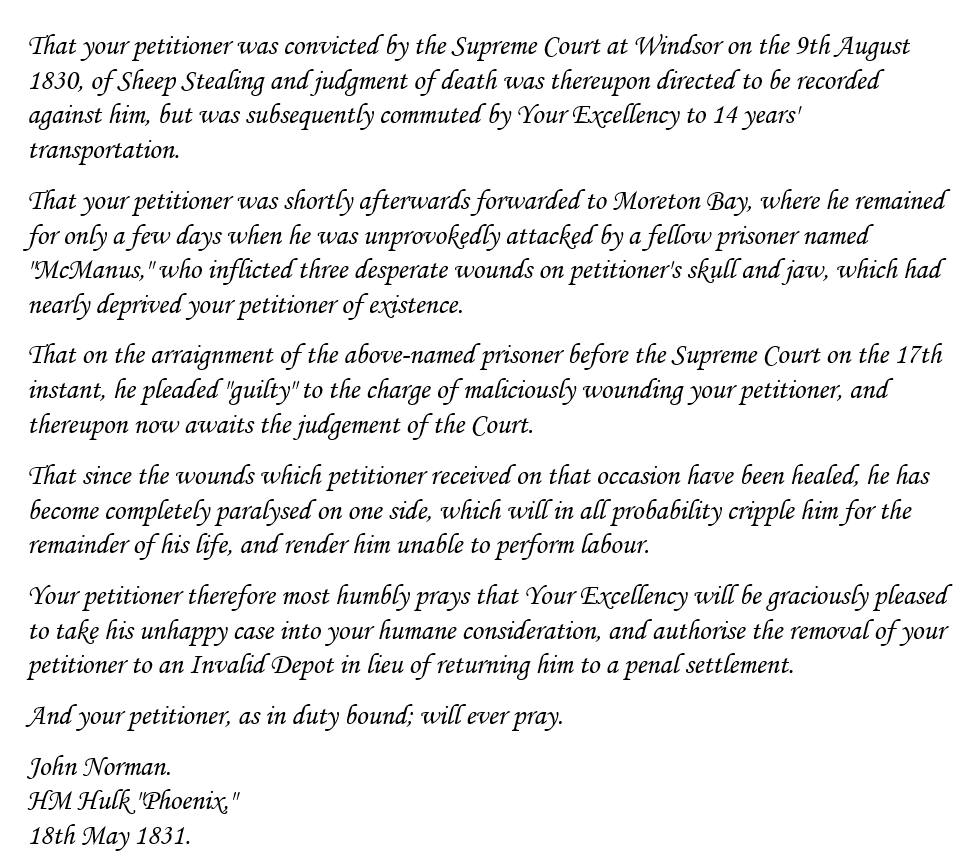
The petition was written in an elegant hand, with exquisite flourishes in the lines addressing it to His Excellency, Lieutenant-General Ralph Darling, Governor in Chief of New South Wales. A few, but not too many, flourishes adorned the body of the petition. Enough to be respectful and formal, not enough to be overly ornate.
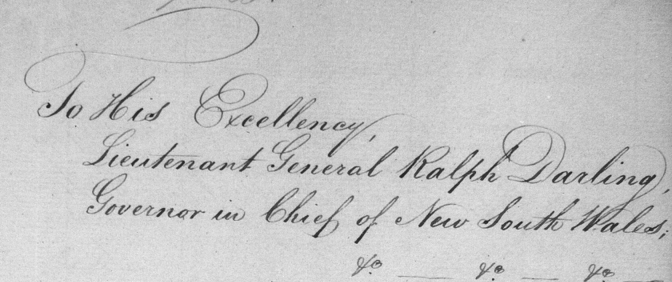
The document was either haphazardly pasted into the Colonial Secretary’s Correspondence register, or haphazardly scanned. It tilts to the right, threatening to obscure the letters on the left margin.
It was extremely unlikely that the petitioner wrote the letter himself. He was a labouring man, twice convicted and transported. The text of the petition reveals how badly the man had been injured, as did the endorsement of Assistant Surgeon Henry Cowper.
The petitioner was John Norman, aged 28 years, and it was penned while he was on board the Hulk Phoenix at Sydney Town in 1831, where he was lodged after being called as a witness in the case of the man tried with almost killing him.
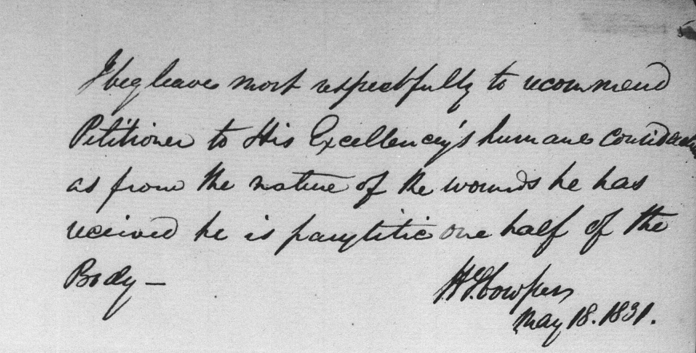
[I beg leave most respectfully to recommend petitioner to His Excellency’s humane consideration as from the nature of the wounds he has received he is paralytic one half of the body. H. Cowper May 18, 1831.]
Biographical sketch of John Norman.
John Norman was born at Lincoln c. 1800, worked as a labourer, and was sentenced to 7 years’ transportation at Lincoln in 1819 (aged 19 years). He was transported on the Atlas 4. On arrival, he was described as “5 feet 7 ½ inches, ruddy complexion, black hair and hazel eyes.”
Norman was sent to Windsor, then Richmond. He married fellow convict Mary Harding in 1825 at Richmond. The couple were living in Newcastle in 1829, when Mary passed away. Norman had been made free by servitude in 1828.
John Norman and John Greenhatch were indicted for stealing on 10th May last, at Richmond, 3 sheep the property of Isaac Cornwall. The prisoners were found guilty and sentenced of death recorded against them.
(Sydney Gazette, 1830)
John Norman was convicted of sheep stealing at Windsor in 1830, and transported to Moreton Bay for 14 years after the death sentence was respited. Yes, you could die for stealing three sheep in 1830.
Grievously wounded at Moreton Bay, and sent to the Invalid Depot in Port Macquarie in 1831. Norman received a Ticket of Leave in 1841, permitting him to remain in the district of Port Macquarie, and a Certificate of Freedom in 1847. On his Certificate he was described as “5 feet 7 ½ inches, dark ruddy complexion, with dark brown hair mixed with grey. He had lost three front teeth on his upper jaw. A large scar extended from the left nostril to the left jaw. Disabled in right arm and leg.”
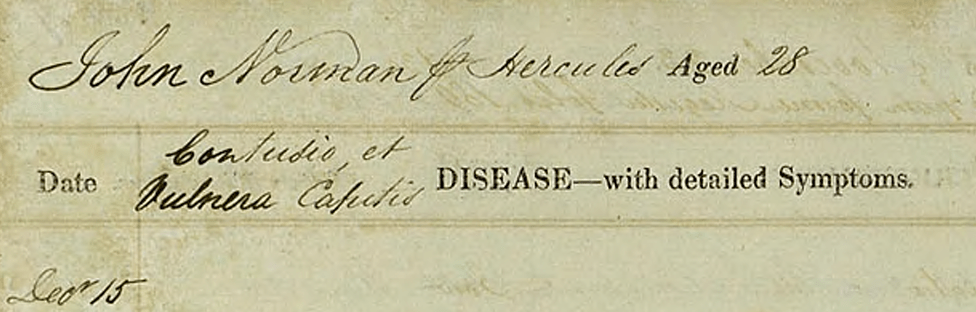
The Attack at Moreton Bay.
Charles McManus probably couldn’t have explained why he attacked and very nearly killed John Norman. He didn’t know him very well – Norman was a new arrival at Moreton Bay. It was theorised by the press that McManus was “tired of life” at Moreton Bay, and wanted to be sent to Sydney to be executed. A rather permanent solution to a temporary problem, and one that came at the expense of another human being’s life and health. Here’s all that could be gleaned by the Courts:
“CRIMINAL SIDE. Thursday, July 7.— Before Judge Stephen, and the usual Commission.
“Charles McManus was indicted for assaulting John Norman with a hoe, with intent in so doing, to kill and murder him, at Moreton Bay, on the 22nd October last. The second count charged the offence with intent to do some grievous bodily harm.
“Our readers may remember that this prisoner when put upon his trial on a former occasion pleaded guilty, but which plea he subsequently withdrew on being brought up for judgment, and entered that of not guilty.
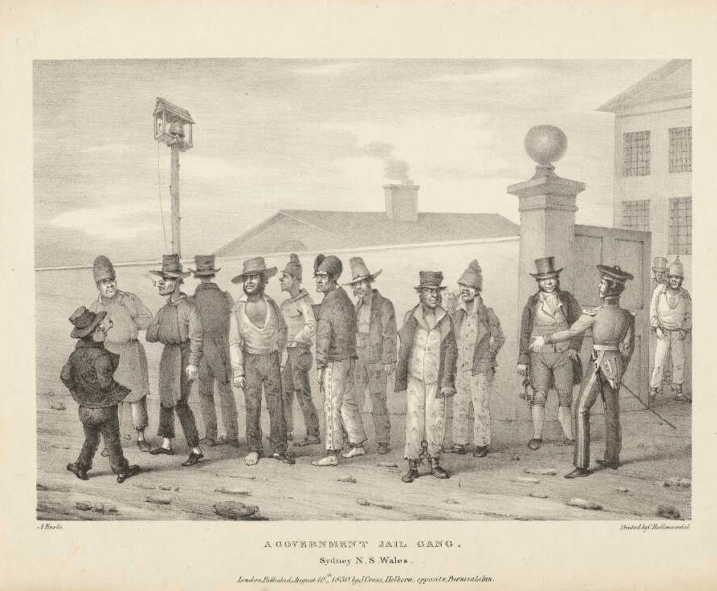

“It appeared, that as the gangs were going to their labour on the morning of the day in question, the prisoner who was walking alongside Norman, struck him a blow over the head, which felled him, he then struck him twice on the face; the wounds were so severe that the Surgeon, Mr. Cowper, expressed his surprise at his recovery. The prisoner was found guilty, and sentence of death was passed upon him.”
Sydney Herald, 1831.
(McManus was executed in Sydney on 11 July 1831.)
View from the summit of Mount York looking towards Bathurst Plains convicts breaking stones c 1826 Augustus Earle National Library of Australia.
A Government Gaol Gang Sydney NSW Augustus Earle National Library of Australia.
19th Century Lincoln, Rare Old Prints
 Moreton Bay and More