
I have known Robert Harvey for some time and believe him to be a sober, honest and industrious character and as such recommend him.
Henry Cowper.
I do hereby certify that Robert Harvey has conducted himself much to my satisfaction, and I received from Lt. Miller a most excellent character of his behaviour at the settlement.
Peter Bishop.
He has conducted himself with the strictest propriety and honesty and has always been active and vigilant in his duty.
Peter Spicer.
He is a man I have had the highest opinion of – sober, honest and always obedient to commandant.
Thomas Bainbrigge.
I know him to be an honest, persevering, sober and vigilant individual, meriting confidence and protection, and I therefore beg to recommend him accordingly.
Patrick Logan.
Who was this paragon of virtue, and what was he doing at the Moreton Bay penal settlement? Was he a military man? An untiring member of the Colonial Government? Surely, he couldn’t be a convict – could he?
The paragon was indeed a convict. He was an Irishman who had arrived by the Asia in 1825 under sentence of life for manslaughter, and within weeks of arrival had volunteered his services to help set up Moreton Bay.
The Queens County Police.
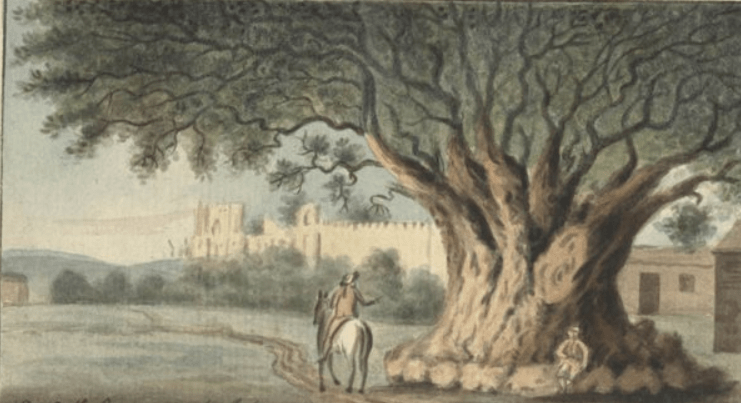
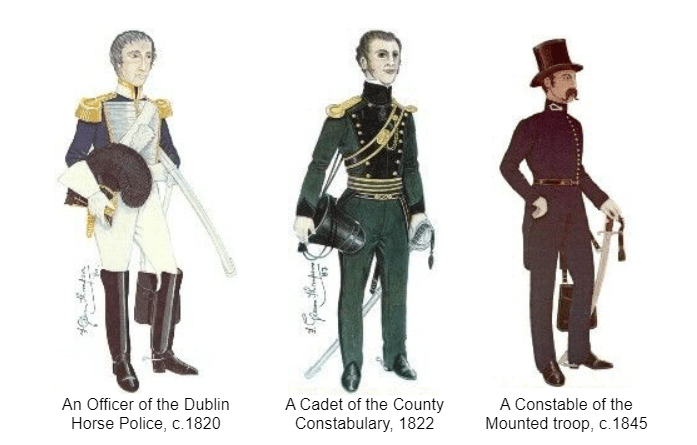
Harvey was one of six Irish policemen who had been convicted of manslaughter at Queen’s County on 25 March 1824. It was an arrest that had gone horribly, fatally wrong in a time when police officers carried bayonets and swords. (On reflection, it does seem a rather over-rigorous enforcement of pub closing regulations…).
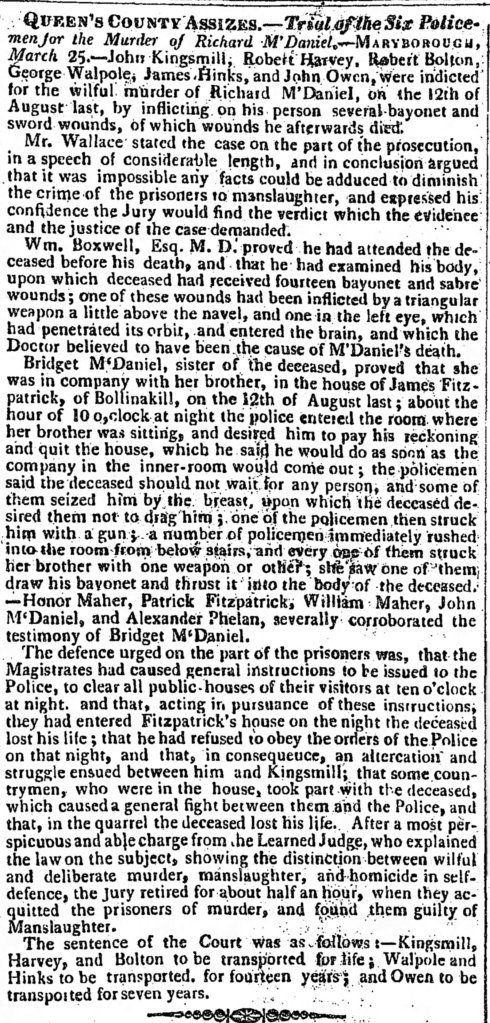
All the defendants, apart from Bolton, it appears, were transported on the Asia.[i] Robert Harvey and John Owens volunteered their services as overseers to help set up the Moreton Bay convict settlement, arriving on 19 April 1825 to what would prove to be the temporary settlement at Redcliffe.[ii] Owens left in 1826, and Robert Harvey toiled on at Moreton Bay, being largely responsible for organising the relocation to the Brisbane Town site down river.
Moreton Bay.
Convict overseers were not particularly well-liked by their charges, but there are no recorded complaints against Robert Harvey. No doubt it was a miserable task, trying to set up two settlements, work their charges, and please their military masters. Food was scarce and shelter was rudimentary. The weather, flora and fauna would have astonished a man who had a few months earlier lived in the cool temperate climate of Ireland.
Robert Harvey was in his mid-thirties when he arrived at Moreton Bay.[iii] He had been married to Catherine for ten years, and had three young sons. His petition suggests that his family might have been with him for some of his time at Moreton Bay, or that their arrival was imminent, because he mentioned the effect of the climate on his health and that of his family. Catherine had made her own way to New South Wales with their children, and Harvey sought to be assigned to her in Sydney.
By 1828, Robert Harvey had had enough. He submitted a petition to His Excellency, and was in the unusual position of having several glowing references to accompany it.
Petition
That your Excellency’s humble Petitioner came to New South Wales in the Ship Asia the 3rd in February 1825, that in March following he volunteered as principal Overseer to this settlement, at which he has experienced much hardship, having had the direction of the removal of the settlement from the place at which it was originally established, is prepared to demonstrate to your Excellency that his conduct has been invariably correct, having a wife and three children to support, prays that he may be assigned to and accompany his wife and family to Sydney, particularly as this Climate is prejudicial to his health and that of his family, and petitioner as in duty bound shall ever pray, Robert Harvey.
The Governor noted: “I wish you to report on this man’s case – and state whether his services can be dispensed with on the settlement – I think he is one of the Irish Police – His wife I take for granted came out free. RD. June 19th.”
Overseer Harvey was returned to Sydney, despite some concern in the Colonial Secretary’s Office that such a useful man could hardly be spared at the settlement.

Conditional Pardon.
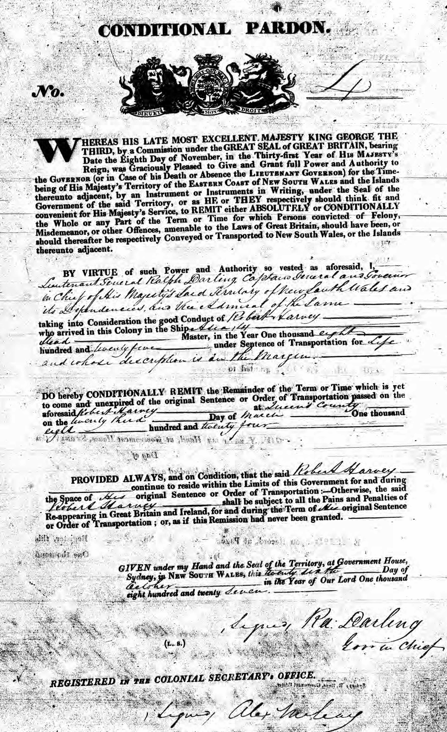
The Irish police convicts all received conditional pardons in 1828, due to their exceptional good conduct. It seems that they were aware of just how poorly they had handled a simple pub closing, and regretted the death of Richard McDaniel. They didn’t want to lose the chance of a second start. Plus, their previous station in life was no doubt of interest to colonial administrators.
Robert Harvey would add two daughters to his family after his Moreton Bay service. He lived and worked in Sydney – and for some years held a publican’s licence – until his death in 1864.
Sources – Documents and Images:
Robert Harvey in the New South Wales, Australia, Convict Registers of Conditional and Absolute Pardons, 1788-1870.
33054, Colonial Secretary’s papers 1822-1877, John Oxley Library, State Library of Queensland.
The Exeter Flying Post or Trewman’s Plymouth and Cornish Advertiser, 8 April 1824.
Lea Castle, Queens County, Ireland Lowcountry Digital Library.
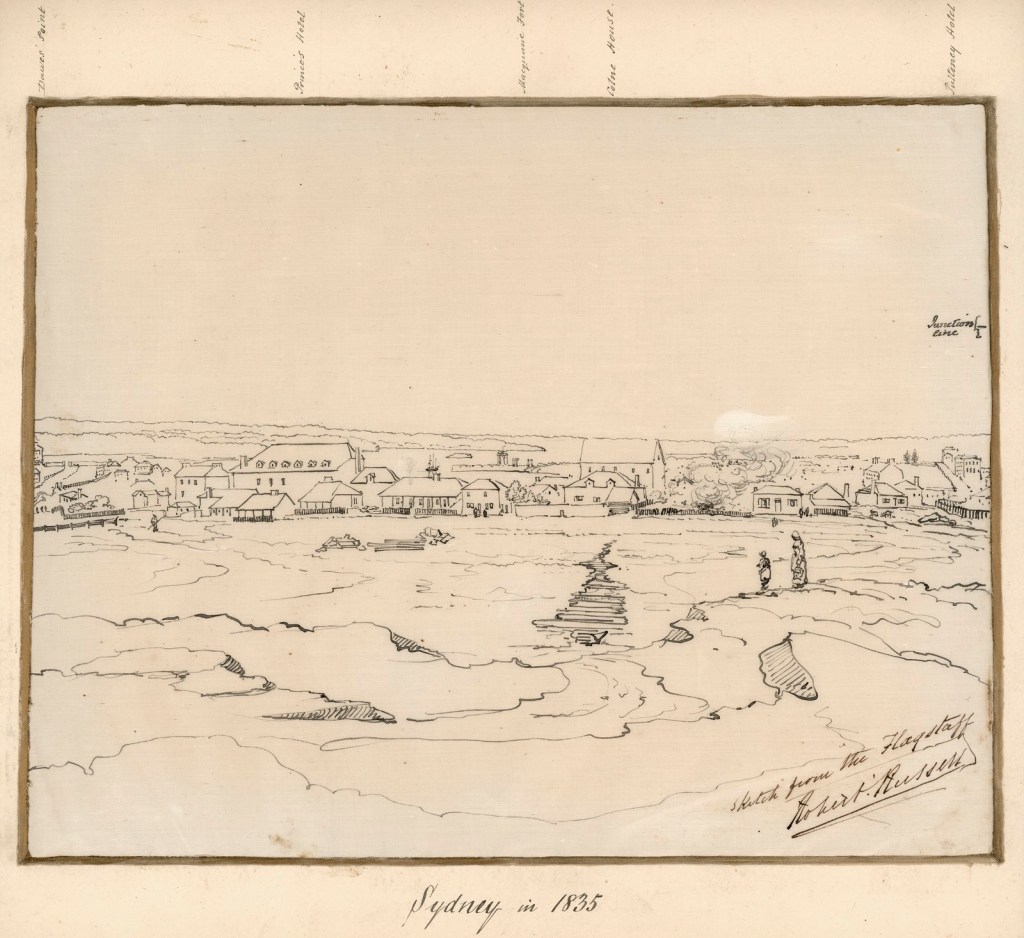
Sydney in 1835 by Robert Russell 1808-1900, State Library of Victoria.
Sydney from Hyde Park 1829 drawn and engraved by J Carmichael, National Library of Australia.
Police uniforms: PoliceHistory.com (Garda Siochána Historical Society Irish Police History)
[i] The remaining Queens County police convicts were granted conditional pardons in 1828. They had been exceptionally well-behaved on the Asia voyage, and had worked commendably in their colonial servitude. George Walpole died in 1878, John Owen in 1850, John Kingsmill in 1869, James Hinks in 1837 and Robert Harvey in 1864.
[ii] Owens would return to Sydney in June 1826, after his wife died on her voyage to New South Wales. Commandant Logan granted him leave to return to Sydney to make arrangements for his children, and Owens was later employed at Carter’s Barracks.
[iii] His date of birth is generally recorded as around 1788. At Moreton Bay, he was described as 5 feet 7 ½ with fair hair and complexion and grey eyes. On his pardon, he was the same height, but with reddish-brown hair, blue eyes and a brown (presumably tanned) complexion.
 Moreton Bay and More