
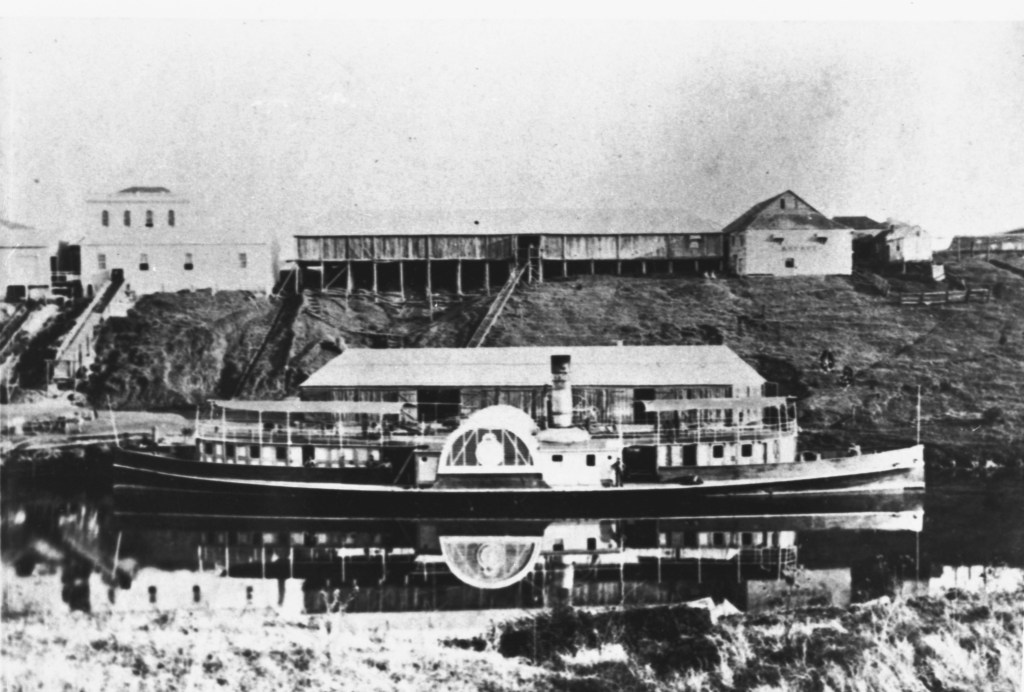
Before railways and paved roads, the best way to travel between Ipswich and Brisbane was by river. Steamers plied the river, carrying passengers and cargo at what would be to modern eyes, a rather stately pace.
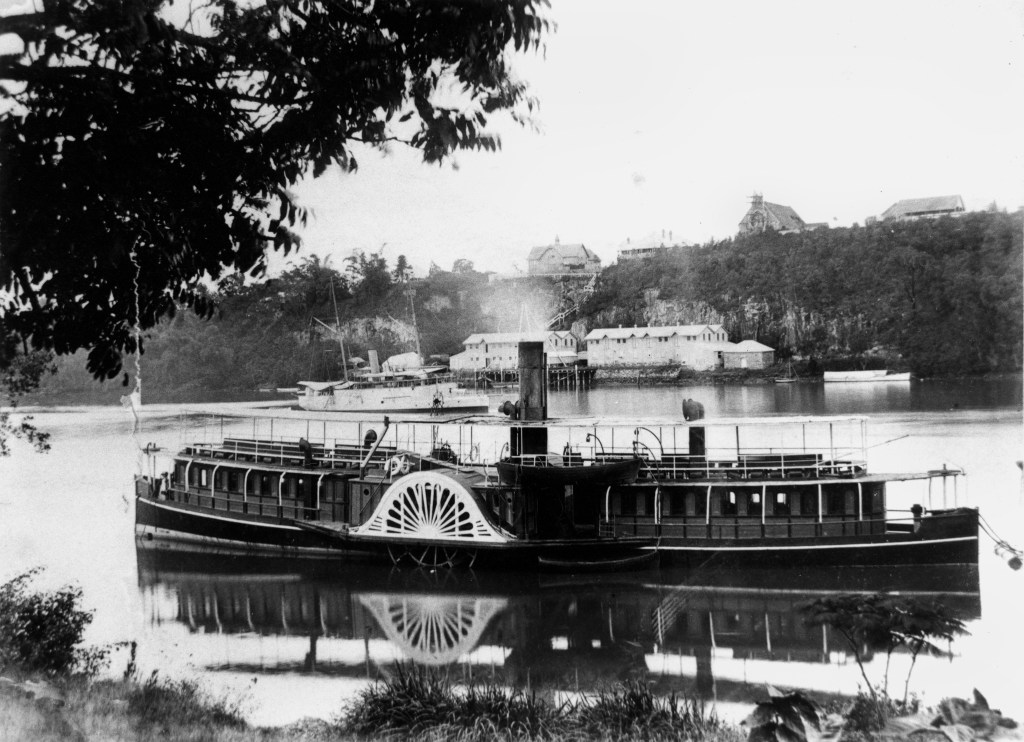
Class divides were inescapable. Steamers offered saloons for the better-off, and steerage for the working class. Formal dinners and luncheons were served to saloon passengers, with the Master heading the dining table. Steerage passengers were only permitted to dine in the cabin if they were “respectable,” and if there was room. Alcohol was served and consumed with the meals, but it was not expected that anyone would over-indulge and behave poorly. It simply wasn’t done.
On Monday 27 August 1866, some 40 passengers lined up at Ipswich to board the steamer Settler for a routine trip to Brisbane. William Domane, a large, strongly built blacksmith, was heard to mutter that he would throw a certain chap overboard if he got the chance. Very odd thing to say, but the man was clearly steerage. They wouldn’t need to have anything to do with him, hopefully. The person who was apparently the target of this remark was William Sewell, a slightly built man of about 21, and clearly a saloon passenger. Perhaps it was just a bit of class feeling.
At 1 pm, dinner was being served. There was room at the table for some steerage passengers, and so William Domane and four of his party were allowed to dine in the cabin. Presumably they were respectable enough on this occasion. Seated next to Domane was young William Sewell.
Waiters brought food and drink and attended to their guests as the Master, Alexander Rooney, dined with his passengers. The meal began pleasantly enough, but suddenly William Domane raised his voice at William Sewell. “You have no right to throw your trash into my glass!”
Sewell said, “I am helping you to some ale,” and Domane retorted, “I don’t want any of your trash, and can buy drink if I want it.” It seemed that Domane believed Sewell had tipped the remnants of his glass of beer into Domane’s. Sewell asserted that the beer had come from his beer bottle.
“High words” followed the exchange, and the Master remonstrated with the men and called them to order. The men rose to their feet and apologised. The meal proceeded civilly after that, although the Settler’s steward, John Duggins, was sure that he heard Domane use the word “overboard.” He heard Sewell reply, “Would you, would you, Sir,” and then mutter, “You’d better not.”
On deck.
After dinner, Sewell was one of the last to leave the cabin. Another passenger, who rejoiced in the name of John Waterloo Bull[i], noticed Sewell because he had conversed with the young man for some time before lunch. Bull hadn’t dined in the cabin, and was unaware of the disagreement at the table.
Bull noticed that Domane was on deck, staring out over the bulwarks, and that young Sewell walked up to him. Bull turned his back briefly, and overheard one of the men – he couldn’t say which – utter the words, “Why shouldn’t I do it?” It sounded a bit ominous, and as Bull turned towards the pair, Domane picked William Sewell up, “as if he had been a child,” and pitched the astonished young man out into the river.
It all happened so suddenly. Robert Scholes of Toowoomba didn’t hear any conflict, or see any interaction between the men. He looked up to see a young man falling to the water, five feet away from the boat. Sewell’s head and shoulders hit the water first as he landed on his back. He tried to float on his back for a few second, tried to swim a few strokes, and then sank quickly. He did not resurface.
Captain Rooney ordered a boat be lowered to search for Sewell, but no trace was found. William Domane was given into custody on the Settler’s arrival at Raff’s wharf in Brisbane, and he was charged with murder. There was quite a lot of money about his person – more than one would expect a blacksmith to possess. He was pale and quiet, and said that what happened was in a moment of excitement, and that he would take the consequences.
On Tuesday 28 August 1866, a search of the river at the Twelve-Mile Reach yielded up the body of a young man, in whose pockets were items that identified him as William R Sewell. Dr Bancroft performed a postmortem, confirming that the man had drowned, and that there was a slight injury under the scalp that may have been caused by a scuffle.
John Menzies of the Union Hotel formally identified the body as William R. Sewell, a young man who had been staying at his hotel before making the trip to Ipswich. Sewell was a quiet young man, who indulged in a drink occasionally, but never to intoxication, and who at times indulged in a little “harmless chaff.” Menzies thought he recognised the face of William Domane, but did not believe that he had ever been a guest of his hotel.
Archibald McGilchrist also identified the deceased at the Morgue. William Ronaldson Sewell had been an acquaintance of McGilchrist’s “at home” (England) and the men had travelled (saloon, of course) on the same ship to Australia, the Great Pacific. Sewell had been a steady man, not quarrelsome in any way, and he had no trade or occupation (other than being a gentleman).[ii] McGilchrist did not know, or recollect having ever seen, William Domane.
Trial and sentence.
The matter came to trial in Brisbane on 19 November 1866, before Justice Lutwyche. Charles Lilley, the Attorney-General prosecuted, and Ratcliffe Pring, the past and future Attorney-General (it’s Queensland) acted for William Domane’s defence. The witnesses gave evidence about the dispute at the dinner table, and what they saw of the interactions on deck afterwards.
Ratcliffe Pring submitted for the defence that there was no malice prepense[iii]. The Courier reported Pring as declaring that “the evidence showed that the deceased was annoying the prisoner, and he ‘chucked’ him overboard to get a wet jacket —to get rid of him, as he might of a soldier-ant or a mosquito.”
The jury returned a verdict of guilty to manslaughter. When the court resumed for sentencing the following morning, Domane submitted that he had been provoked and insulted, and he had “used every means” to prevent any altercation until the insults became too great to bear, and he threw Sewell overboard. Justice Lutwyche, in sentencing Domane to only one year in gaol, referred to the “considerable provocation” Domane had received, and determined that he had not intended to take Sewell’s life.
Nothing about the evidence reported suggests that Sewell was provoking Domane to the point of losing control of his behaviour. If serious provocation had occurred in front of witnesses, or been asserted by the defence, it didn’t make it into print. The fact that Domane was making comments about throwing Sewell overboard when they had not yet boarded the Settler suggests that some interaction had taken place, either just before then, or at some point during Sewell’s stay at Ipswich. The hotelkeeper at Brisbane finding Domane’s face familiar suggests that the men were at least passing acquaintances before the steamer journey.
And the argument about brushing off an annoying man like a mosquito, and getting Sewell a wet jacket? For mere annoyance, a quick kick in the shins would have been about the upper limit of reasonable physical response.
The sentence caused a brief, but intense, reaction in the Queensland press. The Queenslander said, “The death of a human being was the all-but inevitable result of the prisoner’s act. Surely twelve months’ imprisonment is but a small penalty for such a crime. It is out of all proportion to the sentences usually inflicted for comparatively minor offences.”
A person using the nom de plume “Justice,” and who claimed to know both men, wrote to the Editor of the Courier.
THE LATE TRIAL FOR MURDER. TO THE EDITOR OF THE BRISBANE COURIER.
SIR,—Will you allow me space in your highly prized paper to make a few remarks on the character of the late William R. Sewell, the young man who recently met an untimely end under very melancholy circumstances. Death pays all our earthly accounts; and now that he has departed, it is truly a shame that people in a Christian land should attempt to slur and throw scandal on him in the manner they have done.
I knew the prisoner and his victim equally, and of the two the deceased alone will bear the appellation of a man. He was a gentleman by birth, manners, and accomplishments; he was affable and kind-hearted; and by this last quality he forfeited his life.
By an attempt to confer a kindness on a man whose heart was callous to and knew not such acts of civility, your contemporary says he learns that he was a dissipated and worthless character. As he only speaks from hearsay there is no use charging him with inhumanity for this probably unmeant statement. I know and learn from good authority that such was not the case, and the testimony of the dissecting surgeon goes far to establish this fact, he being according to this gentleman’s knowledge as healthy and untainted a subject as ever misfortune brought under this painful operation.
The evidence adduced by the steward relating to the quantity of drink which was supplied to deceased, does not show that he drank it himself. No, he paid for it, and others consumed it, and for offering half of a small bottle of beer to Domane, the monster turned on him and threatened to throw him overboard, which threat he subsequently executed. If his intentions were not to take away life, why did he not, on discovering his mistake, leap into the river and rescue the drowning man? Domane, being an able swimmer, and possessing a powerful physical frame, would very probably have been able to support his light victim till further aid arrived; but no, he looked on with hardened indifference. And for this felonious act he gets the lenient punishment of twelve calendar months’ hard labour. No doubt the two hundred pounds taken into consideration had a very beneficial effect. We may be advanced in mechanical philosophy and the theory of moral philosophy, but the practical application of the latter is as yet but looming in the distance.— I am, yours, JUSTICE.
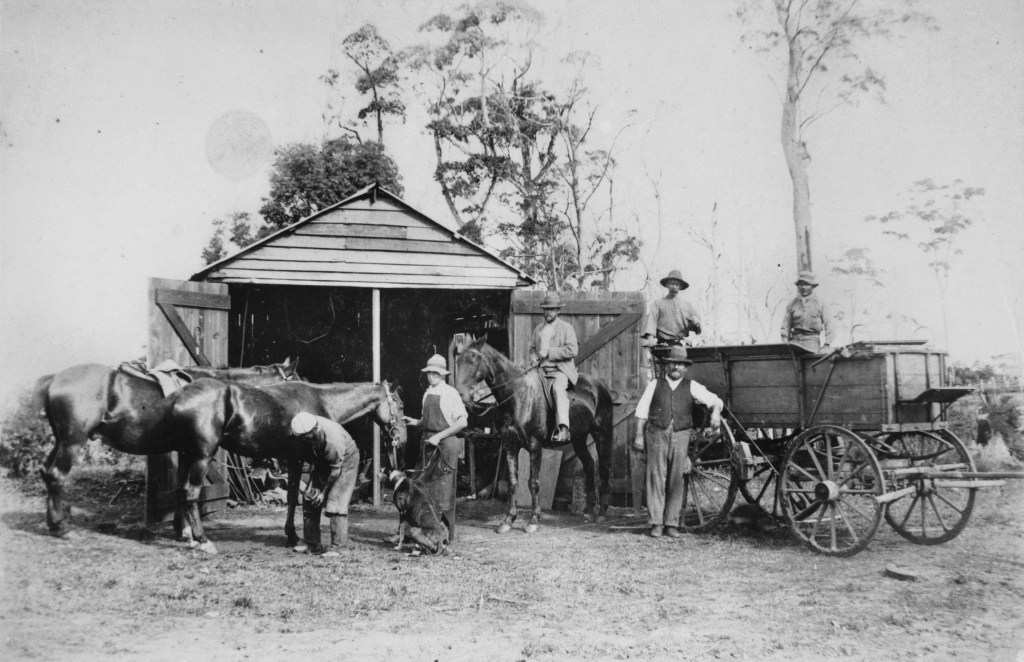
We know very little about William Domane, beyond what was recorded in the Admission Registers for Brisbane Gaol and St Helena Island. Domane was a free emigrant, a blacksmith originally from England. He gave his birth year as 1835, making him 31 at the time of the offence. He was 5 feet 8 ½ with a medium build. He had brown hair, sandy whiskers, and hazel eyes. His complexion was fresh, but marked by two scars near his left eye – one on the eyebrow was described as a deep scar. He was described as orderly in Brisbane Gaol. He was sent to the Hulk Proserpine, and was then forwarded to the brand-new penal establishment at St Helena. He did his time, had no disciplinary record in custody, finished his sentence, and left.
[i] The man with that quintessentially 19th century English name was the butler to Sir Joshua Peter Bell, a politician who had, until a month before, been Treasurer of Queensland.
[ii] Sewell’s death registration in Queensland was a William Ronaldson Sewell. He may in fact have been William Randelson Sewell of Brampton, Cumberland. If so, he was born in May 1845 , and baptised in April 1846 at Brampton. On the Sewell family headstone, he was said to have died “at sea” in Queensland in 1866. It would be an incredible coincidence if it wasn’t the same young man.
[iii] Premeditated and deliberate commission.
 Moreton Bay and More
1 Comment