
Who was John Anderson?
The very first entry in the Chronological Register of Convicts at Moreton Bay is that of John Anderson, per Baring 2, making him (technically) the first Moreton Bay convict.
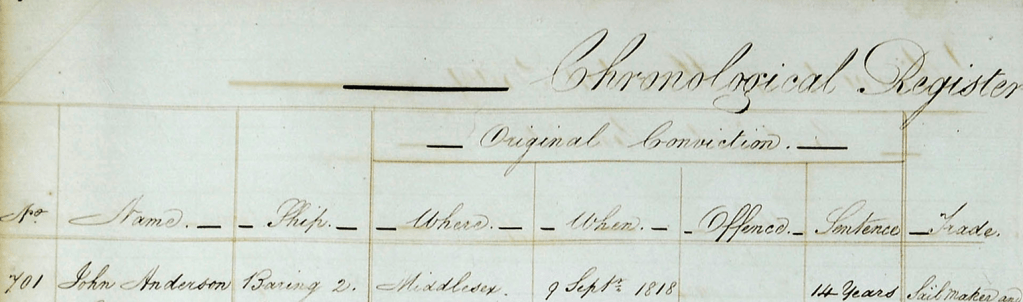
John Anderson was described in the Moreton Bay records as being 23 years old, a sailor and sailmaker who hailed from Leeds. He arrived at Moreton Bay in the Amity almost exactly 200 years ago, and helped set up the initial convict settlement at Redcliffe. At Brisbane, he worked as an acting constable, scourger and watchman, and was returned to Sydney on 6 January 1827.
Strangely, he also seems to have been at Port Macquarie at that time.
According to the one part of the Colonial Secretary’s correspondence, John Anderson per Baring 2 arrived at Moreton Bay on the brig Amity on 14 September 1824.

However, on 24 September 1824, the commandant at Port Macquarie had the (undoubtedly) “painful duty” to report to the Colonial Secretary that a group of convicts had seized a boat at that settlement and had escaped to parts unknown. One of those convicts was John Anderson, per Baring 2.
Perhaps an epic administrative error had taken place somewhere along the line. Which John Anderson did they have at each place? Only the convict indents give some clue, in faint, barely legible pencil markings over the original ink entries.
John Anderson per Baring 2.
The answer seems to be that the John Anderson from Leeds, per Baring 2, was the man who took away the boat Isabella at Port Macquarie in September 1824.
Anderson had been convicted at the Old Bailey in September 1818 for having forged bank notes in his possession, and given 14 years and a ticket to New South Wales. The Baring arrived in Sydney in June 1819. Anderson was around 5 feet, 7 inches in height. He had a ruddy complexion, with dark brown hair and eyes. He was a sailor and sailmaker.
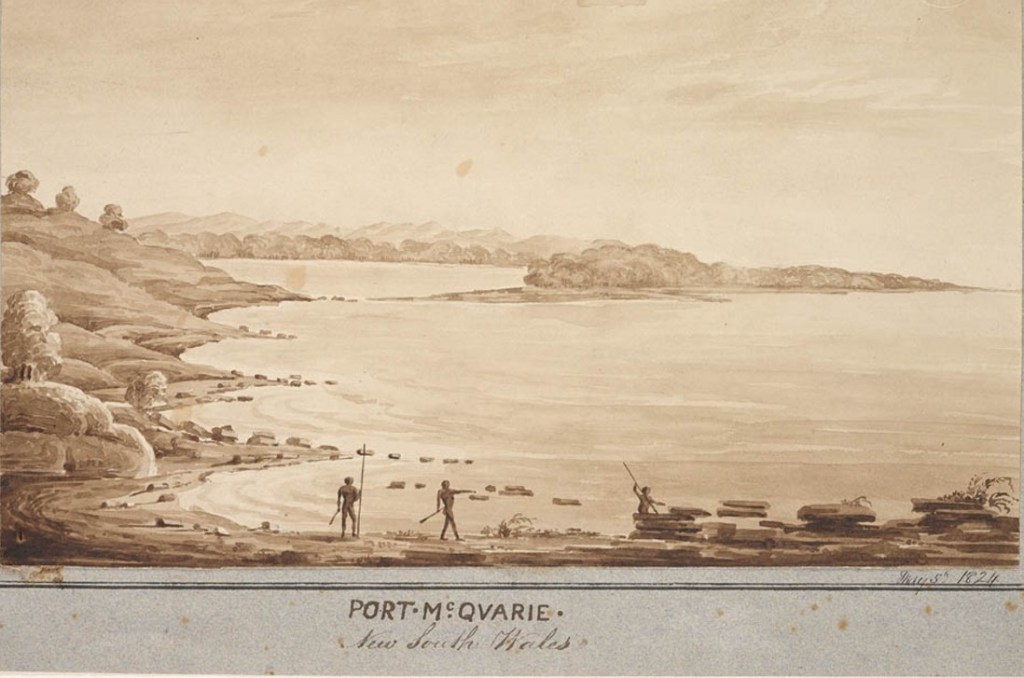
In February 1824, he was given a five-year colonial sentence by the Bench at Parramatta, and was transported to Port Macquarie on the Lady Nelson. There, Anderson was described as “well-conducted,” and was trusted to work on the Pilot’s Boat Crew. He absconded with six other prisoners on a small boat named the Isabella in September 1824. Nothing about the men appeared in the official records or in the press after that. It seems likely that the pirates didn’t last too long in the open water.
“There was on board the sloop about fifteen gallons of water, one and a half gallon of oil, one compass, and one anchor and cable, no fuel, no nautical book, instrument, nor chart, so that with the greatest care they can scarcely escape being wrecked.”
Australian, October 1824.
The Other Anderson
There was another prisoner named Anderson at Port Macquarie when John Anderson arrived in February 1824. The other Mr Anderson – Joseph – was three years younger, but answered to the same general description – height and colouring being almost identical.
Joseph Anderson was a London native, born in 1800, and convicted at the Old Bailey in December 1818 for picking pockets. Anderson was transported for life on board Canada, arriving in September 1819. Joseph was around 5 feet 6, with a ruddy complexion, black hair and dark eyes. He arrived in Australia just three months after John Anderson.
Joseph Anderson was sent to Newcastle in 1820, and absented himself from Captain Brooks’ clearing party in June 1822. He was recaptured, and appeared in the September 1822 Census on a town gang at Liverpool. By December 1822, he had absconded again.
In January 1823, Joseph Anderson was sent to Port Macquarie per the Sally. He didn’t seem to like the situation there, and absconded, only to find himself in Sydney Gaol in August 1824. He was put on the list of prisoners to Moreton Bay per Amity, under the name of John Anderson per Baring 2.

Perhaps it was an administrative error and Joseph Anderson chose not to correct it. Perhaps it was a deliberate impersonation, and if so, how long did it go undetected? And why take on another man’s sentence?
Joseph spent just over two years at the settlement as John, and was recorded as being employed as a watchman and scourger by Captain Logan. That last job must have been exhausting, given the Commandant’s reputation for zealous infliction of corporal punishment.
Joseph Anderson returned to Sydney in 1827, and to his career in crime. Convicted of stealing clothing in 1832, he was sent to … Moreton Bay. That must have been interesting. Very few of the convicts of the 1824-1826 era remained at the Bay, but one or two old hands were about. Did they recognise the former scourger?
Joseph spent three years at Brisbane, and was returned to Sydney on board the Isabella (a different Isabella to the one the real John Anderson sailed off with). He continued to pay frequent visits to the penal establishments of Sydney for nearly a decade, before finally earning a Ticket of Leave for Parramatta in 1843. That ticket was cancelled in 1845.
What the authorities made of all this is shown in the men’s convict indents.
Joseph Anderson’s Convict Indent stated:
“This man was transported to Port Macquarie whence he ran and was removed to Moreton Bay but in the name of John Anderson per Baring (2).”
John Anderson’s Convict Indent stated:
“Joseph Anderson per Canada (5) attempted to personate this man, he was removed to Moreton Bay in his name as a runway from Port Macquarie, and reported that he was told John Anderson escaped with a boat from the latter place.”
Strange. Joseph Anderson was already in Moreton Bay at the time John Anderson stole the boat at Port Macquarie. But then, if you find yourself in a penal colony under the name of another convict, and don’t clarify that record, fibbing about where you were when you heard about the theft of a boat seems in character. The only explanation that seems plausible is that John Anderson had a 14-year sentence. Joseph Anderson was a prisoner for life. Perhaps Joseph thought he’d be free sooner.

 Moreton Bay and More