
William Saunders or Sanders was born in Birmingham around 1795, and was a seaman and smith by trade. At the Surrey Quarter Sessions of March 1817, Saunders was convicted of “robbing Bleachgreen”, and sentenced to be transported for fourteen years.
Thief.
Saunders arrived in Sydney on the Larkins on 22 November 1817. He was 5 feet 2 ¼ inches , with a pale, pock-pitted complexion, flaxen hair and grey eyes. It only took two months for him to be facing a death sentence. He was convicted in February 1818 of robbing the house of Mr Cooper of Toongabbie.
“His Honour the Judge Advocate in a long and pathetic admonition called the attention of the unhappy men to their present deplorable condition; which made a considerable impression upon the prisoners; and drew from a numerous auditory their looks of commiseration while man must ever feel for man when hopelessly entoiled in the last sad stayes of human suffering.”
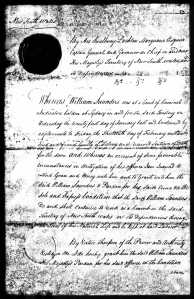
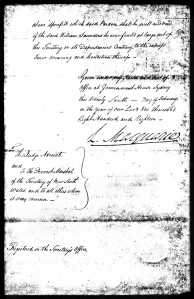
The Commutation Warrant for William Saunders, 1818
The Governor commuted his death sentence, and sentenced him to remain a prisoner in the colony for the rest of his natural life. Saunders was transported to Newcastle in March 1818, “to be wrought in irons for some time.” The following year, he was punished at Newcastle for stealing provisions (25 lashes).


In 1823, Saunders was one of the prisoners removed from Newcastle to Port Macquarie. It’s fair to say he didn’t like it much, and he absconded. Recaptured, and sitting in Sydney Gaol, he was drafted to Moreton Bay on the Amity.
At some point before arriving at Moreton Bay, the word “THIEF” was tattooed on his forehead in blue ink.[i] If Saunders didn’t want to be branded as a thief for life in the most public way, and one presumes that he didn’t, it would have taken a lot of effort to inflict this tattoo. His head, arms and legs would have needed to be immobilised in order to write the word with the tattooing needle.
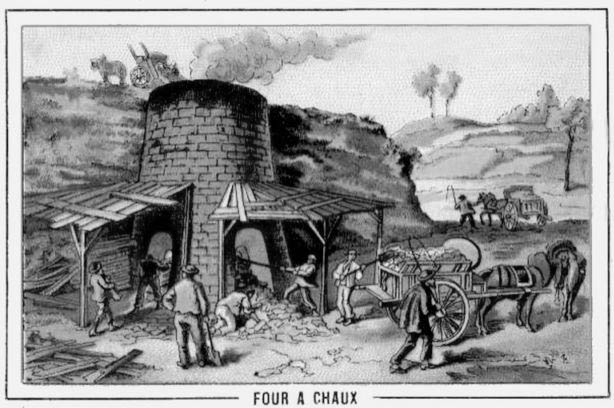
Saunders stayed quiet at Moreton Bay for a couple of years, working in the lime burners’ gang, crushing and burning shells to make lime for brick mortar. A retaining wall near Queen’s Wharf still has an example of the shell-based lime mortar from the convict settlement era. It might be Saunders’ work.

Notorious Runaway.
Prisoners absconding from the Moreton Bay settlement was becoming a problem for Commandants. There had been two group escapes already, and most of the captured escapees had been returned to Moreton Bay.
William Saunders waited for three years before heading into the bush on 5 September 1827. He might well have heard of travel routes and survival tips from returned absconders, and he had his own experience of running away from Port Macquarie.
Saunders had company on the day he absconded – John Lawson. Three other convicts left within a day or two of Saunders. Saunders would be out for 152 days, returning on 4 February 1828. He made another escape on 11 November 1828, returning on 15 January 1829.
In the 1830s, he absconded three more times, the longest time being between September 1836 and April 1837, or 217 days. In all, William Saunders spent 518 days out of custody. He must have known bushcraft, and how to communicate with the indigenous groups of the region.
On 6 April 1837, Moreton Bay Commandant Captain Foster Fyans was visited by four indigenous people “from Bribey’s Tribe[ii].” The visitors gave Fyans information about four convict runaways “committing great depredations” in their country. The delegation agreed to accompany Lieutenant Otter and the Boat’s crew, to help secure the scoundrels.
The fact that four representatives of an indigenous group came into a convict settlement governed by the British army to request that the four runaways be recaptured, strongly suggests that the men had been misbehaving – badly – with the women and girls of their clan or tribe.

Within five days, the runaways – William Saunders, James Ando, George Brown and Sheik Brown – were back in Brisbane and being punished. Fyans looked over Saunders’ record at Moreton Bay, and wrote to the Colonial Secretary.
“I beg to state for His Excellency’s information that in my opinion one of the Prisoners should be removed to Norfolk Island, being a radically and infamous character, William Saunders per Larkins.”
Fyans’ wish was His Excellency’s command, and on 21 July 1837, William Saunders departed for Norfolk Island. And there he remained, until January 1842, when His Excellency was pleased to remit the remainder of his sentence and grant him a Certificate of Freedom.
Saunders was 47, and had spent the past 25 years as a prisoner of the Crown. His Certificate described him as “a little deaf,” missing most of his upper front teeth, sallow and pock-pitted, and still with that blue ink tattoo on his forehead, “THIEF.”
[i] According to a letter from Foster Fyans in 1837
[ii] A group of people living on what is now Bribie Island, off the Sunshine Coast.
 Moreton Bay and More