
A repost of an earlier account of a convict absconder, to mark the anniversary of the Amity’s landing.
John Welsh
Forbidden from Society.

John Welsh was born in the historic port and garrison city of Waterford around 1799. Unsurprisingly, he became a sailor. How he got to Nottingham, and committed a robbery, is unclear, but it earned him a death sentence at the Nottingham Lent Assizes of 16 March 1821. His sentence was commuted to transportation for life, and he arrived on the Minerva on 16 December 1821.
He was 23 years old when he landed in Sydney, a short and stocky man with a ruddy face, dark hair and grey eyes. His occupation was given as sailor, although later in life he would take up shoemaking, perhaps a legacy of convict work assignments.
He was sent to Windsor to work under William Cox, Esq., where he remained until June 1823. Welsh was charged and convicted with attempting to commit an unnatural crime (this was 19th century code for sodomy) and was sentenced to serve out the rest of his sentence. Elsewhere.
Absconding in Port Macquarie and Moreton Bay
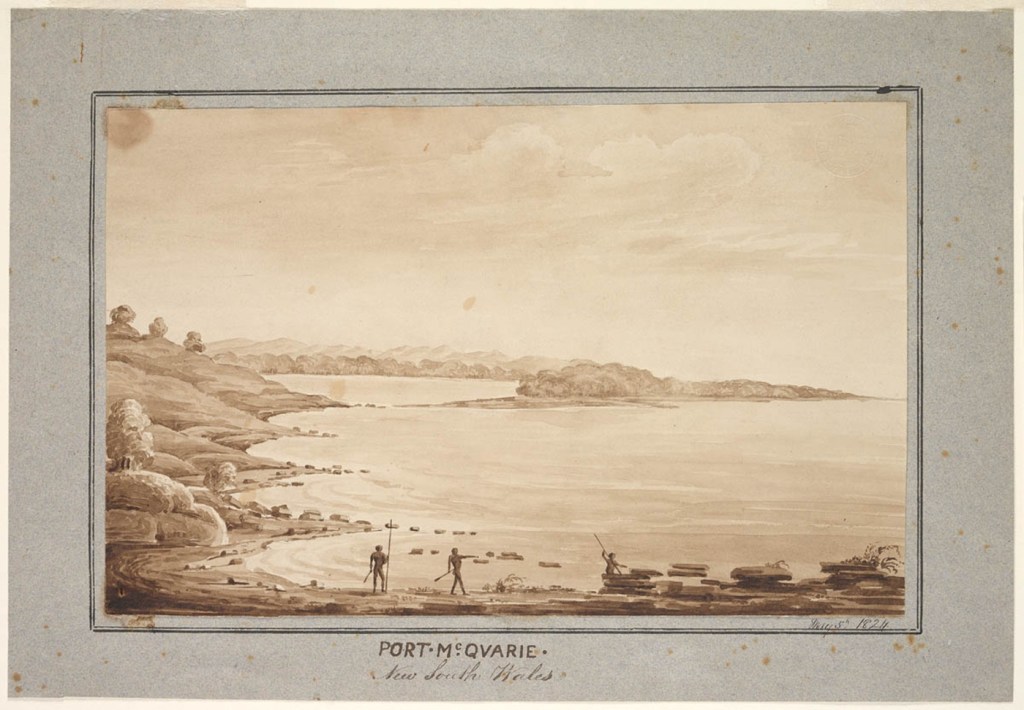
Welsh was put on board the Sally and forwarded to Port Macquarie to serve out his sentences. He looked around, considered his options, and absconded. When caught, he was forwarded to Moreton Bay by the Amity, fetching up there on September 14, 1824.
After toiling to set up the settlement at Redcliffe, and then toiling to move the whole deal to Brisbane, he must have been in the mood for a change. Moreton Bay was hotter, more humid and even more remote than Port Macquarie, so he took part in a group desertion with John Longbottom, William Smith and Thomas Mills on 23 October 1825.
The runaways fetched up at Port Macquarie less than a month later, telling tales of variously, a five-week journey overland, and a murderous uprising and barge escape with drownings. He turned up in Sydney Gaol in 1826, and was sent right back to Moreton Bay to meet the new Commandant, Captain Logan.
Unlike his fellow escapees, Welsh remained at Moreton Bay for years. He must have kept his head down during his time there because he appeared very infrequently in the records of the settlement.
Forbidden from Society
In 1832, Welsh petitioned the Governor to allow him to serve his sentence in Sydney. His Excellency directed the Colonial Secretary to advise the Commandant of Moreton Bay to inform the prisoner thus:
“The prisoner named in the margin (John Welsh per Minerva), having applied for permission to return to Sydney, I am directed to request that you will apprise him that the offence for which he has been sentenced is of a character that forbids his return to Society. “
Ouch.
To the rescue of Eliza Fraser (sort of)
In 1836, the fortunes of several prisoners changed, thanks to a tragic shipwreck. The brig Stirling Castle was wrecked off a large sandy island north of Brisbane Town on 22 May 1836. Seven people died in the accident, and the survivors split into two groups to try and find help. One of the groups managed to make contact with Lieutenant Otter, who was shooting wildlife in the Bribie Island area, and he organised some boats crews to set out in search of the other survivors.

Those survivors were found, and included one Mrs Eliza Fraser, who had been living (most unwillingly) with a local indigenous group. Those Stirling Castle castaways who were still alive were rescued and brought back to Brisbane Town by sea.

All of the men involved were commended by the Commandant of Moreton Bay, Captain Foster Fyans, who wrote to the Governor, seeking remissions for two in particular: John Graham, who used his indigenous language skills to find and secure Mrs Fraser, and John Welsh, who had conducted himself manfully in the boats’ crew under Lt. Otter.
When presented with Fyans’ recommendation, His Excellency directed the Colonial Secretary to inform Fyans that “from the manner of this man’s conviction, and the nature of the sentence, he does not come under the regulated scale of remission, and that he may therefore be returned to Hyde Park Barrack for assignment if you consider him worthy of such an indulgence.”
Fyans considered him worthy – the man had been at Moreton Bay for a decade and had not been overly troublesome. Graham and Welsh were sent to Sydney per order of His Excellency in December 1836.
Sydney and Port Macquarie
Perhaps His Excellency was right to have doubts about Welsh. Two years later, John Welsh was back in Sydney Gaol. He was imprisoned twice in 1840, and again in 1843. In 1846, Welsh was in Darlinghurst Gaol, from where he was forwarded to Port Macquarie.
Walsh was granted a Ticket of Leave, then a Pardon in 1847. After that, he disappeared from the records, probably dying in New South Wales around 1860 (there were several men of this name, or similar, who entered Asylums and/or passed away around this time).
 Moreton Bay and More