
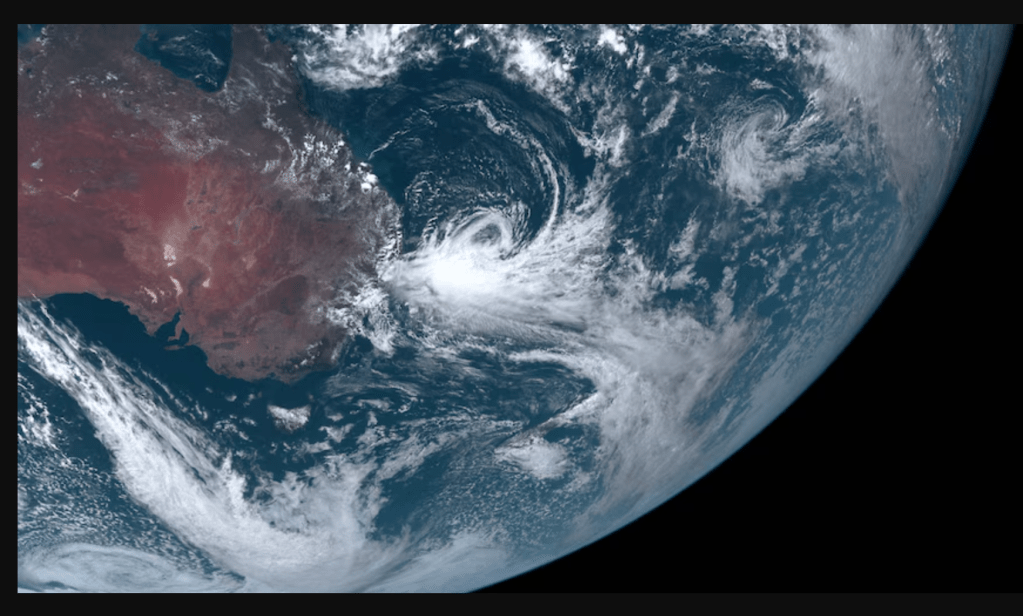
On this day in March 1864, a violent weather event hit Brisbane and south-east Queensland. It may have been a tropical cyclone, or ex-tropical cyclone – the vocabulary of extreme weather events had not developed. But the account of the storm and its aftermath, as reported in the Courier, bears a striking resemblance to Tropical Cyclone Alfred, which tore through southern Queensland and Northern New South Wales a week ago.
There were no satellites and radars to show the position, intensity and direction of the storm. There was no mass communication to warn of it. There was no concept of disaster coordination – no emergency alert system, no State Emergency Service, no evacuation shelters. The only mercy, perhaps, was that there was no power grid to destroy.
THE LATE GALE AND THE FLOOD.
“Very seldom indeed is the neighbourhood of Brisbane visited by a gale of wind of so lengthy a duration and of so violent a character as that which commenced on Thursday night last and terminated on Saturday. It was throughout accompanied by heavy and continuous rains, which beat into the windows of the best protected houses and did a great deal of damage generally. Between the hours of 9 a.m. on Friday until 9 a.m. on Saturday, no less than 6.720 inches of rain fell; and in such a manner as to defy every effort made to subvert its penetrating power. Out of doors umbrellas were useless; and indoors the rain made its way under eaves, through crevices in shingles—in fact, it came in every conceivable way.
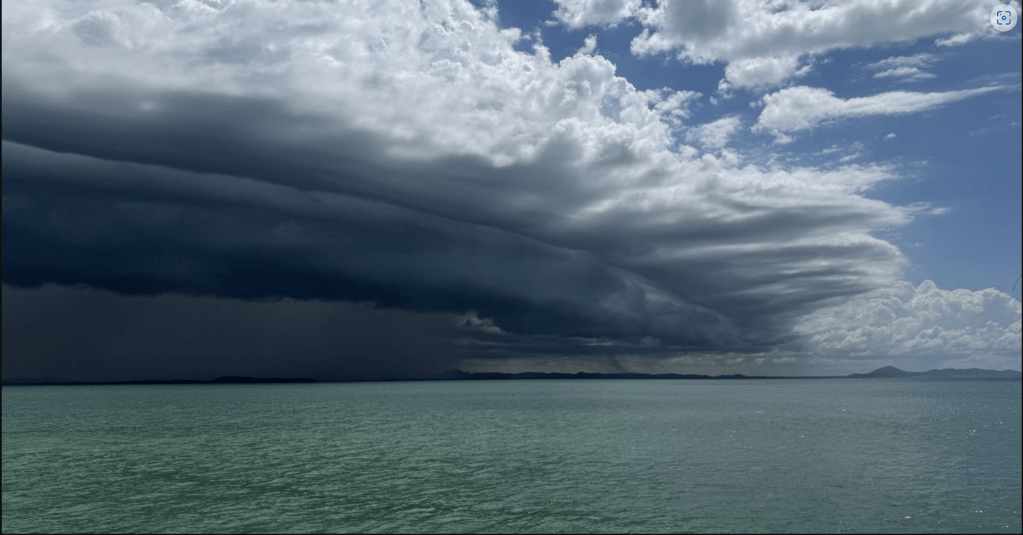
“With reference to the gale more especially, we have heard of a large series of disasters occasioned by it too numerous to record. Finished and unfinished houses, stores, and sheds have succumbed to its devastating influence; roofs, and portions of roofs, have been carried away; awnings and signboards have been sacrificed; trees and plants of every size and description have been blown down and destroyed; and gardens which previous to the gale presented an attractive appearance, have been rendered pictures of desolation. The quantity of banana plants which are broken must be enormous, for, turn in whichever direction we may, numbers of crippled vestiges of that plant, the culture of which is so very popular in Brisbane, are to be observed.
“Early on Saturday morning, the awning in front of Mr. Campen’s shop was carried away; a new wooden house on Petrie Terrace was blown down at about the same time; and at South Brisbane, a store belonging to Mr. Hockings shared a similar fate. Several unfinished structures in different portions of the town have completely disappeared, and the only proof that they ever existed is a heap of prepared timber, a great deal of which is broken.
“Roofs innumerable have suffered, neither shingles, galvanised iron, slates, or tiles having been proof against the violence of the storm. The fastenings of a portion of the galvanised iron roof which covers the ferry-house were burst, and one of the sheets of iron was literally doubled over. Many minor disasters have occurred, and had the old-fashioned chimney pots been much in vogue in Brisbane the majority of them would doubtless have vanished like chaff before the wind. Fences which latterly have shown signs of age and consequent weakness have been thrown down in the most remorseless manner and have been rendered quite useless for any other purpose than firewood. It has been estimated by competent authorities that at the time the gale was at its height, its force was about half of that of a hurricane.
“The damage done to property generally by the gale has been much exceeded by the disasters occasioned by the flood, of which we are at present enabled to give but a meagre account. Previous to the very heavy rain on Friday night the appearance of the river gave no indication of a flood, although an ordinary fresh was observable.
“Early on Saturday morning, however, apprehensions were entertained that a heavy flood would take place and towards the afternoon the state of the river showed that those apprehensions were not groundless, and precautions were taken by the owners of several of the stores on the banks of the river to prevent any loss. Goods were removed to higher ground, and the agent of the Australasian Steam Navigation Company wisely placed a large quantity of the goods in the Company’s store on board the Brisbane steamer. As the night advanced, the height of the river rapidly increased, and by daylight on Sunday morning it was evident that the flood would be of such an extent as to cause a great deal of damage to property.
“Advices were received from Ipswich, to the effect that on Saturday, at six o’clock p m., the telegraph posts at the One Mile Creek Bridge, which had been raised twenty feet higher than they were at the time of the flood in February, 1863, were swept away, although they had been let into the ground to the depth of nine feet, and were otherwise sup-ported by struts. It was also found necessary to remove the goods from Messrs. Wienholt and Walker’s new stores, Bremer-street, which was built much higher than it was supposed a flood could reach. The water was at the foot of Dr. Rowland’s stable. Oxley Creek was also as wide as the Brisbane River generally is at Brisbane.
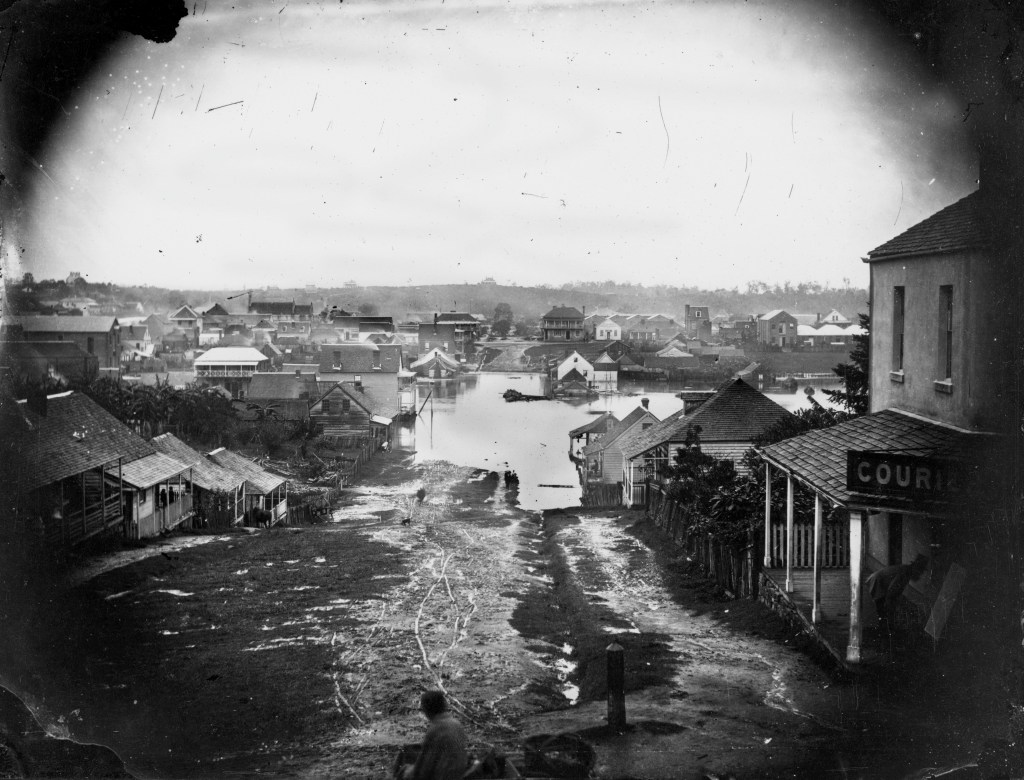
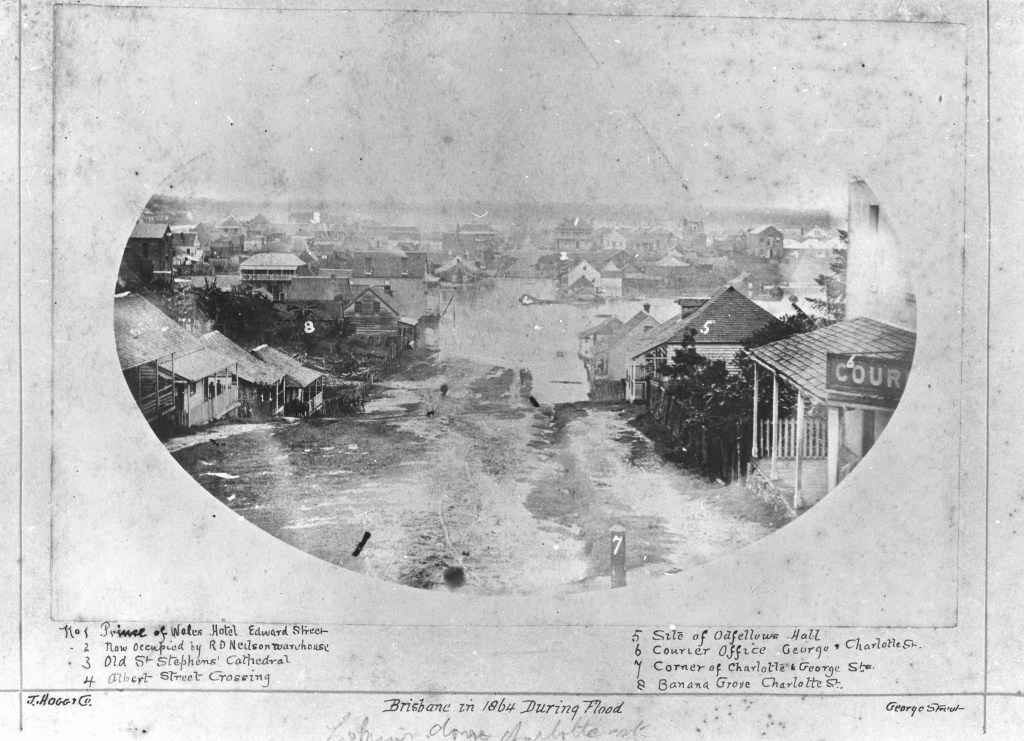
“In Brisbane the water gradually rose throughout the whole of yesterday; and, at 4 o’clock in the afternoon Albert-street, from Alice-street to Charlotte-street, was totally impassable, and many of the residents in Frog’s Hollow were compelled to leave their houses and furniture to the mercy of the devastating element. Two men were seen swimming after an erratic table in the hollow between Charlotte and Mary streets; in various other low-lying localities of the town, similar scenes were enacted.
“At Raff’s wharf the water was about eight inches higher than at the previous flood, about five feet over the wharf, and it was only by strong efforts that the steamer Settler was prevented from drifting on to it. As far as we can learn, but little damage was done in that locality. At Harris’s wharf it was reckoned that the water was about twelve inches higher than on the former occasion, but in consequence of the necessary precautions having been taken by the removal of the goods in the store, no damage of moment occurred.
“At Forrest’s wharf it was found necessary to remove a large quantity of sugar and other goods into the adjacent immigration depot, and at the ferry house the water was about seven feet above the floor. Towns’s wharf was quite submerged, and the water was within eighteen inches of the eaves of the wharf sheds. The water went as far up Russell-street as Mr. Kinchela’s store, and much loss has been sustained by the householders in that street. In the suburbs of the town, damage to an enormous extent has been done.
“At the Three-mile Scrub we are informed that the water rapidly rose twenty-five feet above the ordinary level and remained so for ten hours. The whole of the crops in that locality are, of course, completely destroyed. The water was seven foot over the floor of Mr. Smythe’s house, and the inmates barely escaped with their lives. The furniture has been either destroyed or washed away, together with the whole of the outbuildings, except the stable.
“At Milton much damage has been done, and last evening the whole of the cemeteries were under water. It is quite impossible to arrive at anything like an accurate conclusion as to the amount of loss which has been sustained by the sudden rising of the water. We have every reason to believe that the loss of life and property occasioned by the present flood will exceed that of 1863.”
Courier (Brisbane, Qld. : 1861 – 1864), Monday 21 March 1864, page 2
 Moreton Bay and More