
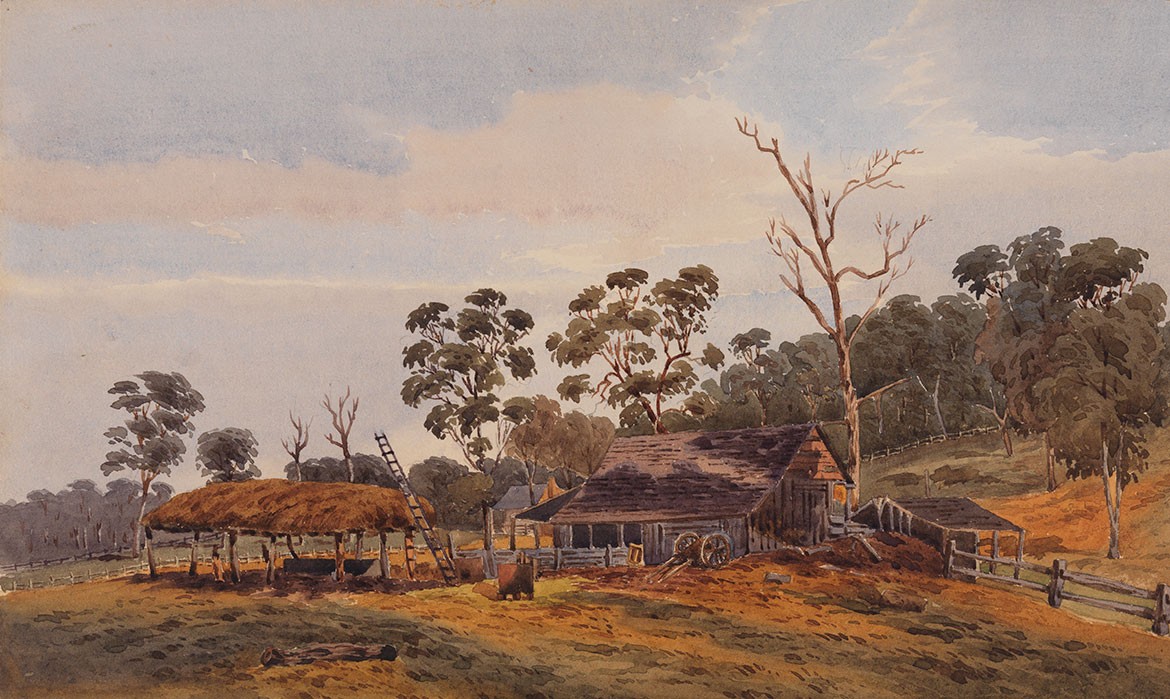
The Indooroopilly Murder.

Elizabeth Lansfield was 25, and life had been hard. She’d come out to Queensland with her husband William and their two little ones in 1875. William junior had died on the voyage. While still on board, she gave birth to Winefred, named after the ship the family travelled in. Her new baby died three weeks after William junior.
Her husband didn’t take well to the new country. When they argued, which wasn’t too often, he would blame her for forcing him to come to Australia. He couldn’t work in this place. It would kill him.
Things looked up for Elizabeth when the couple were employed by Thomas Edwin Bonney at Caboolture. William didn’t like Bonney, but Elizabeth did, and the feeling was mutual. She fell into the habit of calling Bonney “our Tom,” which was hardly proper for a servant. Bonney, in turn, was heard to say that if Elizabeth was single, “he would marry her before any other woman in the world.”
When the Lansfields argued, it was usually about money. Once, Elizabeth told a friend that if William “had any of his games out here” she would poison his tea, not to kill him, but to frighten him. The couple stopped working at Bonney’s and found a place out in the bush at Moggill, but Elizabeth kept in touch with Thomas Bonney. Letters flew back and forth to the Indooroopilly post office. A publican noticed that Bonney had his arm around Elizabeth’s waist.
On 24 May 1876, William Lansfield had been splitting timbers for a fencing job and went home to have lunch. When he returned to work, he began to feel very ill and couldn’t move his arms or legs. His boss, Thomas Duggan, took William home to his hut. Elizabeth had gone out to the store (quite a long walk in the country), but the remains of lunch were still on the table. William died in agony minutes after reaching home. Duggan notified the police, giving some potatoes from the table to the dog on his way out. When he returned, the dog had died.
When Elizabeth returned home with her daughter Rose, the hut was full of fencing workers and curious locals. She wasn’t allowed to go inside, and didn’t officially find out that she was a widow until the following morning.
It didn’t take long for Elizabeth to be arrested for murdering her husband. Three doctors were consulted – Mullen, Staiger and Hobbs – and together they performed some experiments on a very unlucky frog. They proved that strychnine had killed William Lansfield.
Elizabeth was committed to stand trial for murder, with Thomas Bonney as an accessory before the fact. No strychnine was found in the family home, but Bonney had kept quite a supply on hand at Caboolture, which had been used for eradicating dingoes.
On 30 August 1876, there was only one place to be in Brisbane town, and that was the public gallery of the Supreme Court. Dinner tables in high and low life buzzed with gossip about the scandalous woman, her swain, and her poor, murdered husband.
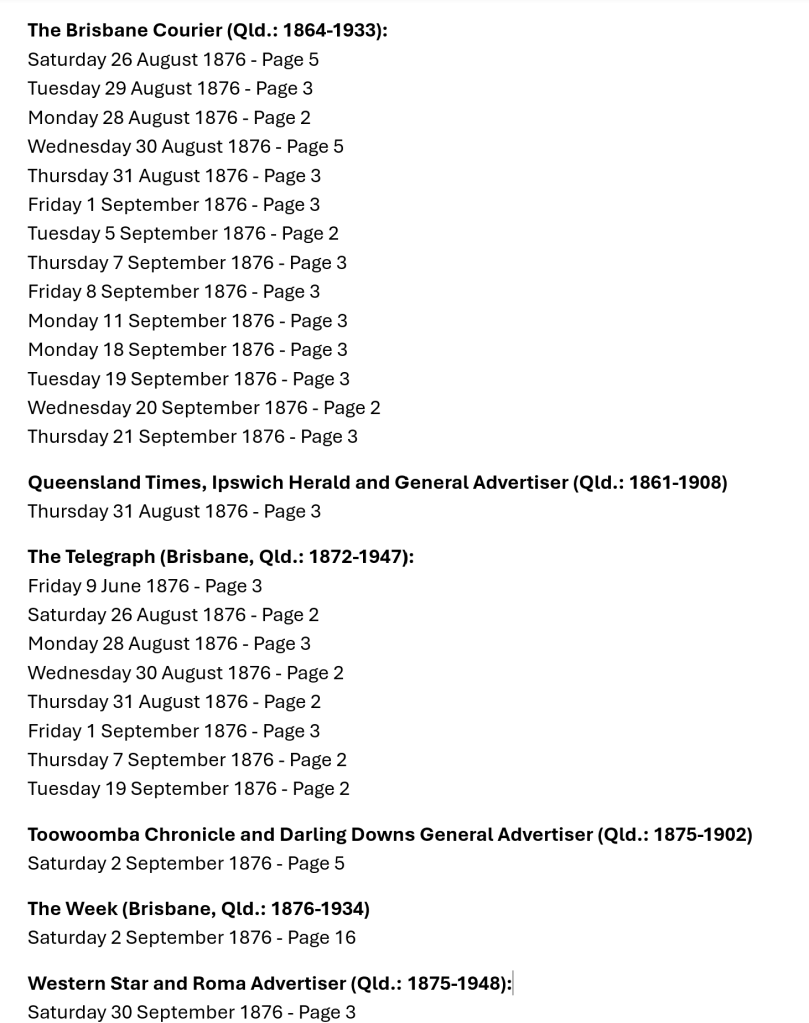
The gallery was duly scandalised by the evidence, including that of Mrs Blaney, matron of Toowoomba Gaol, who deposed that Mrs Lansfield was delivered of a baby girl while on remand.[1]
Elizabeth remained stoic during the trial, which must have taken some effort for a woman who had just given birth and was facing the possibility of the death penalty. The relationship with her husband, her movements on the day of his death, and her liaison with Thomas Bonney were recounted by friends, former friends, associates, mailmen and publicans. She chose not to give evidence for her defence.
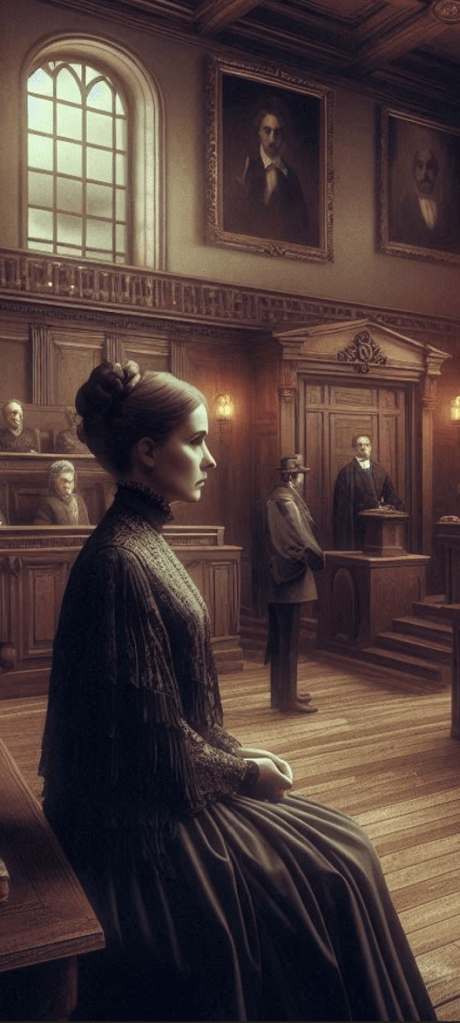
The common jury could not reach a verdict. She was immediately tried again, before a special jury (including such luminaries as Albert John Hockings and Reuben Nicklin). Arguments centred on whether William Lansfield had put the strychnine in the potatoes himself [2], or whether Elizabeth had done the deed herself.
The prosecution contended that no poison had been found in the house, and that there was no evidence as to who put the poison in the potatoes.
The defence put forth a scenario in which Elizabeth hatched a scheme to rid herself of her husband and asked the jury to consider the “respective pecuniary and social positions” that Lansfield and Bonney held. Much was made of Elizabeth’s over-familiarity with her employer, the use of the name “our Tom,” and Bonney’s remark that he would have married her, had she been single.
Justice Lutwyche instructed the special jury at considerable length. The packed gallery was agog. The special jury retired for just over an hour, returning “not guilty” verdicts for both defendants. Mrs Elizabeth Lansfield was a free woman and was escorted from the precincts of the court before the adjournment, probably for her own safety. Thomas Bonney had been suffering from a mental breakdown and was admitted to what was brutally known as “the Lunatic Reception House.”
The Western Star’s correspondent[3] claimed that the special jury had been unanimous against Mrs Lansfield, and eleven to one as to Bonney’s guilt. “They imagined that they must find both prisoners guilty, or not guilty, and if they only had the sense to come into court and ask the Judge if they could find one guilty without the other, Mrs Lansfield would be in Toowoomba Gaol probably by this time.”
Elizabeth Lansfield left the Court as the single mother of two surviving children – daughters Rose and Elizabeth. Society was particularly judgmental in the 1870s, and Elizabeth Lansfield was a suspected murderer and adulterer. Her reputation, the main currency for a woman at the time, was ruined. Thomas Bonney, resting in the hands of medical practitioners, did not have to face the scorn of the public for some time.
[1] Elizabeth Alice Lansfield (also at times spelled Lancefield) was born on 8 August 1876. Her parents are listed as Elizabeth Hopkins and William Lansfield.
[2] Either by accident, or in an attempt at suicide.
[3] Whether that particular rural journalist had special access to the deliberations in the jury room is not known. Juries were not permitted to discuss their cases outside the jury room.
 Moreton Bay and More