
Sausages and insults were hurled.
David Semple returned to Ipswich in late October 1858, with a Colonial Ticket of Leave allowing him to reside and work in that area.
Ellen’s former partner, William Morley, had died, and she was temporarily at a loose end. It seems the couple tried to reconcile for a brief time – David’s return home was mentioned in a petty debts matter against Ellen in November 1858.
Ellen settled down for a time – the early part of 1859 saw no court appearances – a situation that could not and did not last.
That August, Ellen got drunk and went shopping. Unfortunately, she had a dispute with a shopkeeper, James Harpur, over some sausages. She decided to settle that dispute by hitting him in the face with three pounds of sausages. (According to an online calculator, 3 pounds is equivalent to 1.36 kilograms, or 3.15 footballs. A unit of comparison I hadn’t anticipated that it would provide.) At any rate, that’s a lot of processed meat to land on one’s face, and Mr Harpur had Ellen arrested. Ellen was fined £5, and, because she was still quite drunk when she fronted the Bench, she spent 24 hours in the lock-up for appearing in court whilst intoxicated.
In October, any pretence of living as a married woman was abandoned when Ellen was arrested for stealing money from Thomas McAuley, after going to bed with him in a lodging house. McAuley had a small amount of money with him when they went to bed, which he had hidden, he thought, deep in his trouser pocket. After about an hour in his company, Ellen told him that she was going home to look after one of her children. She felt under the mattress, where his trousers were, then dressed and went out, promising to come back shortly. McAuley checked his trousers and found his money missing. He went with the police to Ellen’s home and found Ellen missing.
Ellen was located at Pascoe’s public house just before 5am, kindly buying drinks for three shoemakers. McAuley insisted that one of the notes she used was his but was unable to identify the notes when the matter came to court. Ellen escaped without conviction.
Ellen spent the following year bickering with a neighbouring lady who bore the flowery name Honoria Remelton. Miss or Mrs Remelton pled guilty to swearing at Ellen in 1859, and in 1860 Ellen returned the compliment. In June 1860, Ellen was picked up for drunkenness, couldn’t pay the fine, and simmered in the cells for 24 hours. Then Ellen went quiet again.
“I am very bad Jemmy – the Lord have mercy upon me.”
Just after midnight on 4 June 1861, James and Mary Ann Jerome were asleep in bed in their house at Little Ipswich when David Semple knocked at their door, begging for a bed for the night – it was too late to go into town to find a lodging house. The Jeromes knew and liked David but had nowhere for him to sleep. David replied that he would stay outside for the night, and James told him to light a fire to keep warm and stave off the nasty cough he had. The Jeromes chatted with David for a short while – he’d been working at Woogaroo and was planning on starting a new job near Ipswich the next day. He coughed terribly but was coherent and sober. He asked James if he could spare a pair of bootlaces for his walk in the morning.
The Jeromes went to bed, only to be woken a couple of hours later by the sound of persistent, violent coughing outside. James went out to see David, who begged him for a glass of water. David was complaining of terrible pain and said, “I am very bad Jemmy – the Lord have mercy upon me,” and fell backwards, unconscious.
James Jerome ran to get the police – to tell them that a man at their place was dead or dying – and when he returned, David Semple was dead.
Dr Thomas Rowlands examined David and concluded that he had died from a convulsive seizure. Dr Challinor in his capacity as Magistrate and Coroner ruled that the death was due to natural causes.
David Semple was 51 when he died, and he had experienced as much physical and mental hardship as any man could stand. He’d been transported to Australia at the age of 20, laboured at Bathurst, Ipswich and the Darling Downs, and spent eight years at Cockatoo Island, working in chains for the first of those years. When he emerged from prison, he was a middle-aged man. He came back to Queensland to face a life of walking from one labouring job to another. His wife lived with other men. His children were strangers to him. Little wonder his health broke down.
Mrs Morris.
Ellen was now officially a widow. Four months after David’s death, Ellen Semple (widow) married William Morris (bachelor) according to the rites of the Church of England at Ipswich. William was a cooper (like Thomas Young), and the couple lived at Redbank. Almost precisely nine months later, on 3 June 1862, Ellen and William had a baby daughter they named Frances Mary Ann Morris, who seems to have gone by Mary Ann.
William Morris appears to have been a quiet, stable man who did not come to the notice of the police, and who looked after the children whenever his colourful wife was in a pickle.[i]
In December 1863, Ellen faced the Brisbane Police Court – always nice to have a change of scenery – charged with stealing £18 from George Southern of the Telegraph Boarding House. Although Ellen was committed to stand trial on this charge, it appears not to have been proceeded with.
In February 1864, Ellen had her first arrest for drunkenness since becoming Mrs Morris, and the Ipswich bench, feeling unusually benevolent, gave her a very small fine “to give her an opportunity of commencing a new score,” now that she was married again, and had a small child.

That lesson was not learned, because a year later (in 1865), Ellen was imprisoned for soliciting money for the purpose of prostitution. She was sent to Brisbane for a month, where her appearance at the time was noted as “stout, sallow complexion, slightly pockmarked,” and her family situation was clarified as “Husband and girl in Ipswich. Sons up the country.” Her three Semple boys were approaching adulthood and had started working on stations for a living.
Later that year, Ellen was charged with stealing linen from the yard of Andrew Thynne. She claimed it was brought to her house by Bridget Hackett. Her charge was dismissed, and Bridget Hackett was charged instead. Ellen then gave evidence that helped to clear Bridget Hackett. One good turn and all that. The Bench gave up after two long hearings into the theft of a few smalls.
In July 1866, more laundry disappeared from the clotheslines of Ipswich, this time Mary Cronin’s. The police knew where to search, and indeed, the items were at Ellen’s place. Ellen claimed that a lady had given her the linen to alter. The lady in question denied it hotly. Ellen was found guilty, and the Bench informed her that she was a disgrace to her sex. The Bench told Ellen that it was “shameful that the child that was with her should be made a partaker in her degradation,” meaning that they were aware that Ellen was expecting her fifth child. The sentence was six months in Brisbane Gaol.
Widow, new mother and prisoner.
When Ellen emerged from Brisbane Gaol on 9 January 1867, her life had changed considerably. William Morris had died of a form of consumption in September 1866, and her daughter Julia Morris was born in November 1866.
She spent the rest of 1867 narrowly avoiding imprisonment again. In March, she was acquitted of larceny of £1 and in October the same happened to a charge of (of course) stealing linen. She received a couple of fines for disorderly conduct, obscene language and drunkenness.
On 28 March 1868, Ellen’s fondness for the laundry of others brought her back to Brisbane Gaol for another six months. She had made the mistake of targeting the respected Dr Rowlands.
On the same day, Frances Mary Ann Morris, aged six, was admitted to the Diamantina Orphanage. Six months later, Julia Morris, aged two, was surrendered to the same institution. They stayed there for another five years while Ellen careened through the courts and prisons of old Queensland.
In August 1869, Ellen Morris (widow) married Thomas Clynch[ii] (bachelor) according to the rites of the Church of Rome at the Catholic Church in Ipswich. Thomas Clynch was a labourer who hailed from County Meath and put his age as 30. Ellen recorded her age as 38.[iii] Still, the new bride avoided prison for the years 1869-1871, thanks to a couple of acquittals.
In July 1872, her son William Semple, who had been working as a bullock driver around the downs since his teens, died of congestion of the lungs at Toowoomba Hospital at the age of 23. He had been ill for five weeks.

Another larceny conviction, in December 1872, gave Ellen the opportunity of experiencing the Toowoomba Gaol for six months. Her previous places of imprisonment had been the Brisbane Gaols, first at Queen Street, then Petrie Terrace.
Perhaps her son’s death made Ellen reflect on parenthood, and she removed Mary Ann (11) and Julia (7) from the Diamantina Orphanage in September 1873. The family would live in Brisbane for the next few months.
Ellen clearly wasn’t ready for the responsibilities of motherhood. She was probably a full-blown alcoholic, adding an appearance for drunkenness to her charge sheet two months after collecting her daughters. More damagingly, in the last week of 1873, Ellen went to prison for six months for another larceny.
Vagrancy, a polonaise, and a racehorse named Carbine.
Thomas Clinch wasn’t inclined to take care of the two growing daughters of his chronically absent wife, depositing both girls in St. Vincent’s Orphanage on the first day of 1874. It’s doubtful that Ellen had a chance to see her daughters again. Two more six-month prison sentences lay in her future, as well as charges of vagrancy and an acquittal for robbery.
The April 1875 robbery of a cashbox at Morgan Cavanagh’s house at Dalby occasioned a lot of publicity. Mr Cavanagh was a young Irish horse trainer[iv], and he had a famous horse named Carbine stabled at his property. Not, sadly, the Carbine that won the 1890 Melbourne Cup so famously, but a very valuable and well-known racer, nonetheless.

Ellen was newly in Cavanagh’s service and went to her master to tell him that she saw a strange man running away, past Carbine’s stables. Cavanagh ran out to check and found his prized racehorse safe in his stall. But there was something shifty about Ellen Clinch’s behaviour that made Cavanagh check his cashbox, which was, of course, empty.
There was no proof that Ellen had taken the money, but she was Ellen the Ipswich Cutter after all. She was ordered to stand trial at the Roma Circuit Court that May, where she was found not guilty.
On 1 January 1876, Ellen was sent to prison for six months, as usual, for larceny of clothing, of course. This time, Ellen was in Brisbane, and stopped by the house of Mrs Jones, for whom she’d done some paid washing. Some days later, the lady noticed that she was missing a few items of clothing, including a polonaise. Hmm.
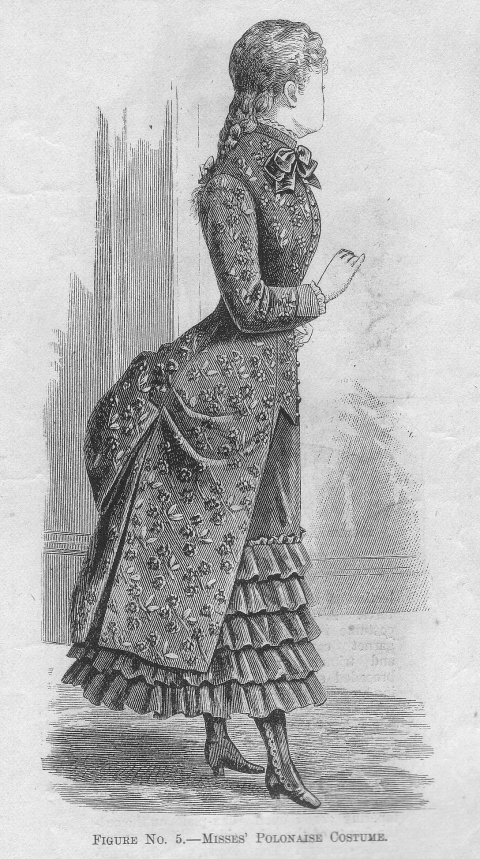

Polonaise skirts – I doubt that Mrs Jones’ purloined polonaise was quite this elaborate.
When walking in Queen Street, Mrs Jones noticed her polonaise (an elaborate draped, ruffled skirt) being paraded about on the stout and middle-aged figure of Mrs Ellen Clinch. The constables were called, and Mrs Clinch was sent to Toowoomba Gaol for six months.
When Ellen was released from Toowoomba Gaol in June 1876, she was around 53 years old. She’d been to gaol 14 times and served more than three years in total. She was ill and tired. On 17 July 1876, she died of debility in Toowoomba Hospital. That final six-month sentence probably wrecked her health.
On 2 September 1876, (Frances) Mary Ann Morris left St Vincent’s Orphanage to work in the service of Mr Beardmore, Esq. at Toowoomba. On 26 January 1879, Julia Morris left to work as a nurse-girl for Mrs Carter at South Brisbane.
Ellen Sweeny Semple Morris Clinch and William Clinch are buried in the Toowoomba Cemetery. David Semple is buried in the Ipswich Cemetery.
[i] David Morris doesn’t appear to have interacted with the police a great deal. Having gone through birth, marriage and death records at the time, it seems that he was much younger than Ellen. Perhaps he didn’t realise quite how much younger, because Ellen was quietly shaving years off her age.
[ii] Clynch was also spelled Clinch and Clench.
[iii] More like 46, and I don’t doubt that she looked it, after three husbands, five children, and 20 months in gaol over 17 years.
[iv][iv] Morgan Cavanagh (1849-1881) was a talented Irish horse trainer who came to notice in western Queensland in the 1870s. He drowned in a lagoon near the Condamine River at the age of 31.
Images in this post are sourced from the State Library of Queensland, National Archives of Australia, Public Domain images.

 Moreton Bay and More