
In the early 1860s, things went a bit bonkers – politically, legally and socially. It was as if the thrill of Separation in 1859 went to everyone’s collective head.
Governing the new colony was a fraught affair. The elected members – largely of the squatter class – struggled with the mechanics of Government and a Treasury that initially contained a few copper coins. Land sales and customs duties improved things in the following years, but a loan from London had to be resorted to.
At that dire time it was suggested that the Treasurer should go to Brisbane’s pawnbroker, Henry Heilbron, to secure a quick loan. And then a well-known man, who could not be named initially, played a little prank after a night of highjinks.
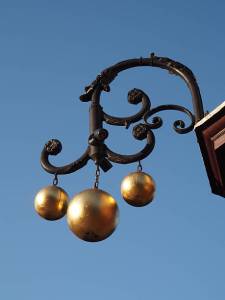
On Sunday morning last, as our respected townsman, Mr T. C. Drew, chemist, was emerging from his residence, in order to proceed to his customary devotions, he was somewhat astonished to observe the summit of the flagstaff in front of his house decorated by three brilliant golden balls, the ancient insignia of the Lombard[1] merchants in London.
Bathed in the radiant rays of the morning sun, they shone with dazzling brilliancy, and Mr Crew, after lingering upon the lovely sight for a few moments in silent admiration, gave reluctant orders for their removal, much after the manner of Cromwell when he pointed to the Speaker’s mace, and ordered his myrmidons[2] to “take away that bauble.”
Simultaneously with the transaction recorded above, Mr Heilbron, who has taken upon himself the philanthropic mission of alleviating the pains of impecuniosity and relieving such as are afflicted with Falstaff’s old complaint, atrophy in the purse[3], discovered that the emblems of his profession – the three gilt balls – had been, during the night, removed by sacrilegious hands.
He at once instituted a search through the town, and after indefatigable enquiries, extending over about twenty-four hours, succeeded in discovering with whom the valuable articles in question had been deposited.
A restoration of the property was at once effected. We suppose that this is the result of what, by juveniles who affect to be “fast men,” is termed a “spree,” but such sprees are dangerous, and may involve a visit on the part of their perpetrators to the Police Court, and subsequently to a still more inhospitable region.
We do not believe that there is any truth in the rumour that one of the celebrated legal luminaries of our Parliament, who hails from the Emerald Isle[4], and a naval officer still engaged in the government service, were seen scudding along George-street, holding aloft three gilt balls in triumph, and singing popular ditties, at a late hour on Saturday night.
The parties who set such rumours afloat should enquire more carefully into particulars before assisting to propagate what we cannot but consider a slander. At the same time we must confess that, had the balls been placed over the Treasury, there would have been more point in what, after all, appears to us to be a very senseless practical joke, much on a par with those knocker-wrenching and window smashing exploits, &c, so greatly in vogue amongst the choice spirits of “the aristocracy,” when the throne of England was adorned by the person of “the first gentleman in Europe.[5]“
[1] Lombard banking is a term once used to describe moneylending – the name is derived from the part of Northern Italy called Lombardy, where the banking system became popular.
[2] Loyal followers who obey without question.
[3] Henry IV, Part 2.
[4] The Irish legal luminary of parliament was Charles Blakeney. This was later confirmed indirectly in a bizarre work of semi-fiction.
[5] King George IV of England, who was known for his exquisite manners (except towards his long-suffering Queen).
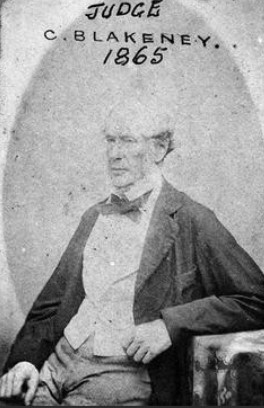
Charles William Blakeney (1802-1876) was an Irish Barrister, who became a politician and Judge in colonial Queensland. Despite his rather bleak appearance in this one known photograph, he had a reputation for extravagance and gambling as a younger man, having blown through a tidy inheritance in Ireland. At the time of the golden balls incident, he was in his late 50s.
In 1873, Blakeney heard the Harry Readford trial at Roma, which caused a sensation in legal circles. In 1875, he suffered a paralytic stroke and drowned in January 1876 after wandering from his home.
Henry Heilbron continued pawnbroking in Brisbane until March 1866, when he mysteriously decamped, leaving behind a lot of debts and an impoverished young wife.
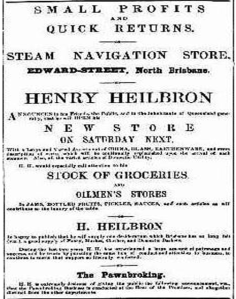
He was a well-known, but at the same time, slightly mysterious figure in post-separation Brisbane. He had acted as an interpreter for a German witness in 1860, had a residence in Edward Street and a store in Queen Street.
In September 1867, breakfast teacups landed heavily on saucers all over Brisbane, as newspaper readers found out just what that scoundrel pawnbroker had been up to after leaving his wife penniless.
Heilbron, together with “a neat and attractive looking young Englishwoman, whom he said he married in the antipodes,” was being questioned by United States Customs in San Francisco, for attempting to evade duties on a large quantity of jewellery and other goods.
The real Mrs Heilbron was living on the charity of her friends in Brisbane after Henry’s creditors took away all her furniture and belongings to pay his debts. She obtained a divorce relatively easily, because the attractive young Englishwoman with Henry was a Miss Mary Boon, hitherto the barmaid of Brisbane’s St Patrick’s Tavern. Not to be outdone, Henry Heilbron got himself a just-as-good-as-yours California divorce, and advertised it in the Brisbane newspapers.
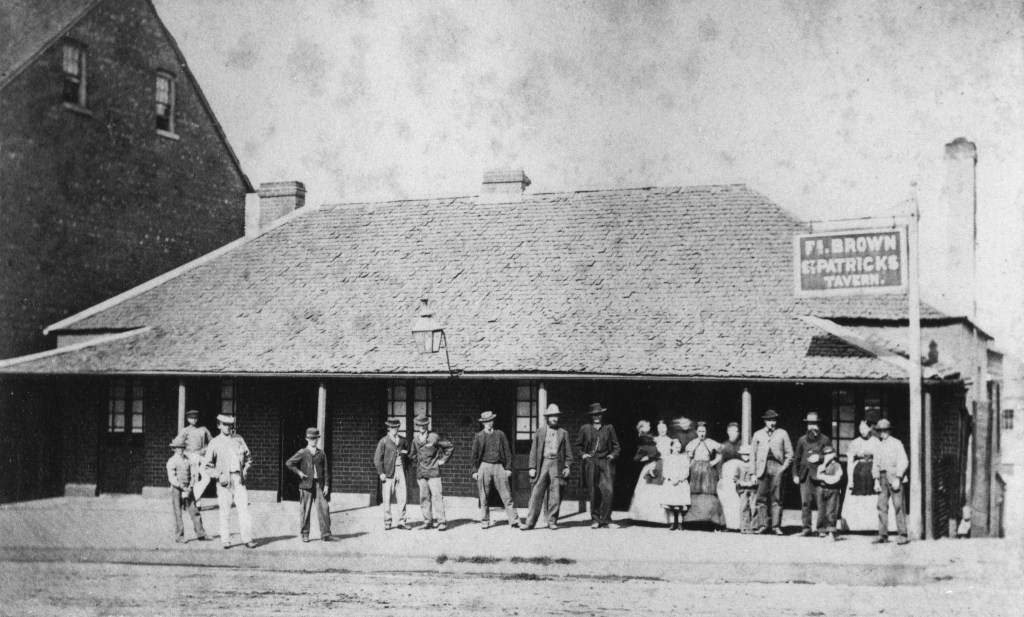
The thief unmasked, in a way.
The following tale from the Courier outs Charles Blakeney as the legal luminary who decorated an unsuspecting pharmacist’s flagpole with pawnbroker’s balls. It’s an amusing, if barely comprehensible, tale of the depleted state of the Treasury of Queensland in 1861, and an indictment of the landed gentry supposed to be running the place. (I’ve footnoted it for – some – clarity.) Read on, if you’re feeling brave…
“Raising The Wind.”
Our ancient friend the Treasurer, the other day, was overhauling the Treasury with a rueful countenance. All he could find was one of TAYLOR’S[1] calabashes[2] for a pound, a rupee, a doubtful shilling, a threepenny bit, and three of Brookes’ pennies. He had just made up his mind to go off to Pickering[3], to consult with him about the state of the colonial finances, when WATTS[4], with an air of most provoking assurance, entered, and planting his back against the door, announced that he required a few cool hundreds, and that the word was “stump-up.”
The ruler aimed at his head just missed him, but unfortunately coming into contact with the Colonial Secretary’s hat[5], which, together with its owner, had just appeared at the door, it considerably damaged that article of attire. “My dear fellah, you know we must have some money so do just fork but at once without any bothah.” MACKENZIE[6] put on an air of resignation and pointed to the contents of the Treasury. “Haven’t got any more money; don’t know what to do. Have to go through the court; put on fresh taxes; get a loan or something; go to HEILBRON’S[7], you know the place BLAKENEY[8] took the three golden balls from, they say for a lark; must spout something; don’t know what to do.”
FERRETT[9] here entered with a rather dissipated look, smoking a cigar, and bearing a large petition, together with a copy of his favourite work, “The Whole Duty of Man.”[10] He of course, having bowed to the company, informed them that the late lamented Lord NELSON was a man of small stature, who always did his duty, and that Maranoa also boasted of a patriot with a similar idiosyncrasy. He was quite well enough up in hydrostatics to know that water could not run up hill, although when moved with a spirit it had an upward tendency.
He was getting hard up and knowing the generosity of his amiable friend the Treasurer, he didn’t mind standing an oyster supper when he got his fair share of the money. MACKENZIE, not having his ruler at hand, merely consigned orally his diminutive acquaintance to warm latitudes. FERRETT contented himself, however, with digging MACKENZIE’S ribs in a playful manner, and assuring him that he would not go without his share of the rhino; after which our versatile little friend seized Watts by the waist, and commenced practicing the “Varsovienna,”[11] which he is learning at a fashionable academy.
HALY[12], the Haunted One, or the victim of the ” Ghost of Ban Ban,”[13] then entered with lugubrious aspect. He had had nocturnal visitations, and money he must have. His hon. colleague would bear him out that money was very badly wanted. He must have money, and he only wanted his fair share; but he couldn’t get on without it.
When he was in America there was a capital drink called “mint julep,” and he would only like to see it in this town. It was first-rate tack but very seductive, and he had been taken up to a good many stations; — that is, he meant to say, he had taken up a good many stations in his time. However, he must have more money now as he was ‘stumped up.’
Here poor MACKENZIE, in an agony of resignation, pointed to the treasury chest, and begun to hum ” I haven’t got a sixpence, and I haven’t got a friend.”
COXEN[14] came next in a tattered coat and dilapidated hat. Pointing to a rent in his garment beneath the elbow, he cast on MACKENZIE an imploring look; after which giving a shrill whistle, he seized MACKENZIE by the buttonhole, and, whispering in his ear, a la DICK SWIVELLER[15], the word, old gentleman, is fork out,” vanished.
LORENZO, the MAGNIFICENT,[16] followed, with a demand for instant cash. “You see, my dear Mac, kid gloves have gone up fearfully; frangipani has reached a fabulous price; white cambrics have risen; and a gentleman must have some money to meet the exigencies of the times.”
A little bill which MACALISTER[17] at this moment brought in for endorsement, at length quite exhausted the treasurer’s patience. HERBERT, versatile in resources, however, calmed him, and said that the best thing they could do was to get TAYLOR’S calabash discounted, and for some refreshment, and then go into “ways and means.”
The first idea then propounded was a loan. It was proposed to apply to HEILBRON, but there was nothing to be found which could be converted by the spouting process into cash. Pring[18] offered to pledge his legal reputation; HERBERT his; political integrity; FERRETT his oratorical fame; HALY his American experience; WATTS his debating powers; RAFF[19] the measures he had brought forward; but none of those were sufficient, to raise even a solitary sixpence upon. MACALISTER said that he had given so many unredeemed pledges already that he would not go into that line of business again. BLAKENEY had some beautifully bound copies of the Courier, but he would sooner part with his life than them.
The loan process having failed, MACKENZIE suggested that a tax on eyeglasses might raise something; but, as Herbert said, the ‘Club’ wouldn’t stand it. Of course, this idea was discarded. WATTS suggested that Editors might stand taxing, but BLAKENEY thought that they all had had enough of that. His own study of BACON[20] had convinced him that an impounding act providing for the forfeiture of Stray Pigs, and a large duty on gammon[21] would turn in a good deal.
Various other suggestions were made to MACKENZIE, none of which be seemed to approve of. That he will tax something, if it be only the patience of unfortunate reporters there can be no doubt. In the meantime, to meet present exigencies, the ministry and some of the members are bestirring themselves; Herbert intends to raise the wind by giving, some soirees fantastiques[22] and exhibiting feats of legerdemain, a la JACOBS[23]; ROYDS[24] doing the ” Sprightly ” business. WATTS has purchased an old barrel organ, with which, in the company of FERRETT to whose terpsichorean studies we have before alluded – he will perambulate the town, and perhaps thereby gain an honest penny. PRING, with an eye to the forthcoming races, has, we hear, purchased a small mahogany table, together with a thimble and the accompanying pea.
MACKENZIE himself has hired a small family, a neatly patched coat, and carefully brushed dilapidated hat. WARRY has supplied him with a few boxes of matches, and, considering the admirable vocal powers for exciting sympathy which he possesses, there can be no doubt that in the character of “The Distressed Treasurer” he will be successful in raising the wind during the cold and inclement weather, and thus be enabled to do something towards meeting the recent exacting demands made on the Treasury.
[1] James Taylor, Member for the Western Downs.
[2] The “calabash” system was the use of money orders and promissory notes instead of cash – a practice that flourished in a colony with few local banks.
[3] William Pickering, Curator of Intestate Estates.
[4] John Watts, Member for Drayton & Toowoomba.
[5] Robert George Wyndham Herbert, Queensland’s first Colonial Secretary.
[6] Sir Robert Ramsay Mackenzie, Member for Burnett.
[7] Henry Heilbron, a Brisbane pawnbroker.
[8] Charles Blakeney, and a way for the Courier to name him as the ball-thief.
[9] John Ferrett, Member for Maranoa.
[10] “The Whole Duty of Man”: Ecclesiastes 12:13, “Fear God and keep his commandments, for this is the whole duty of man.” Also refers to the book, “The Whole Duty of Man,” an anonymously published protestant tract from 1658. The book became a literary in-joke in the 19th century, with several authors putting the book in the private libraries of their characters.
[11] Varsovienne, a slow waltz that originated in Poland.
[12] Charles Robert Haly, Member for Burnett.
[13] Ban Ban was a station on the Burnett. It had been sold not long before. A long series of comic letters to the editors of the Maryborough Chronicle and the Brisbane Courier from “The Ghost of Ban Ban” made fun of Mr Haly and his political style.
[14] Charles Coxen, Member for Northern Downs.
[15] A character in Dickens’ “The Old Curiosity Shop.”
[16] I think this refers to Thomas De Lacey Moffatt, another representative of the Western Downs. Possibly.
[17] Arthur Macalister, member for Ipswich, future Premier.
[18] Ratcliffe Pring, Member for Eastern Downs.
[19] George Raff, Member for the Town of Brisbane.
[20] English philosopher, statesman and Attorney-General of England, and a nice lead-in to the stray pig joke.
[21] Flattery, deceit, pretence – A Vocabulary of Flash Language, James Hardy Vaux.
[22] Parisian-style magic shows.
[23] The Wizard Jacobs (really) appeared in Brisbane in 1858 and demonstrated his ability at legerdemain (sleight of hand).
[24] Charles James Royds, Member for Leichhardt.
 Moreton Bay and More