
Art in Queensland before Separation.
How does an artist render a completely unfamiliar world – landscapes, animals and people unlike anything the artist has seen before? A European individual, trained in the various schools and traditions of recording the world around them, would interpret northern Australia with a somewhat Euro-centric lens.
An artist accompanying a coastal expedition would have an easier time of interpreting the views. Sea, sand and sky. An artist gamely accompanying selectors into the unknown inland would be faced with the challenges of translating scrubland, gum trees, and unique fauna on a canvas or in a sketchbook.
Some artists were able to capture the wildness and newness of the land they were depicting. Others softened and anglicised what they saw – changing the tone of the greenery, neatening structures, and generally making everything look a bit more polite. On the whole, the early artists in Queensland stayed remarkably faithful to what they were seeing.
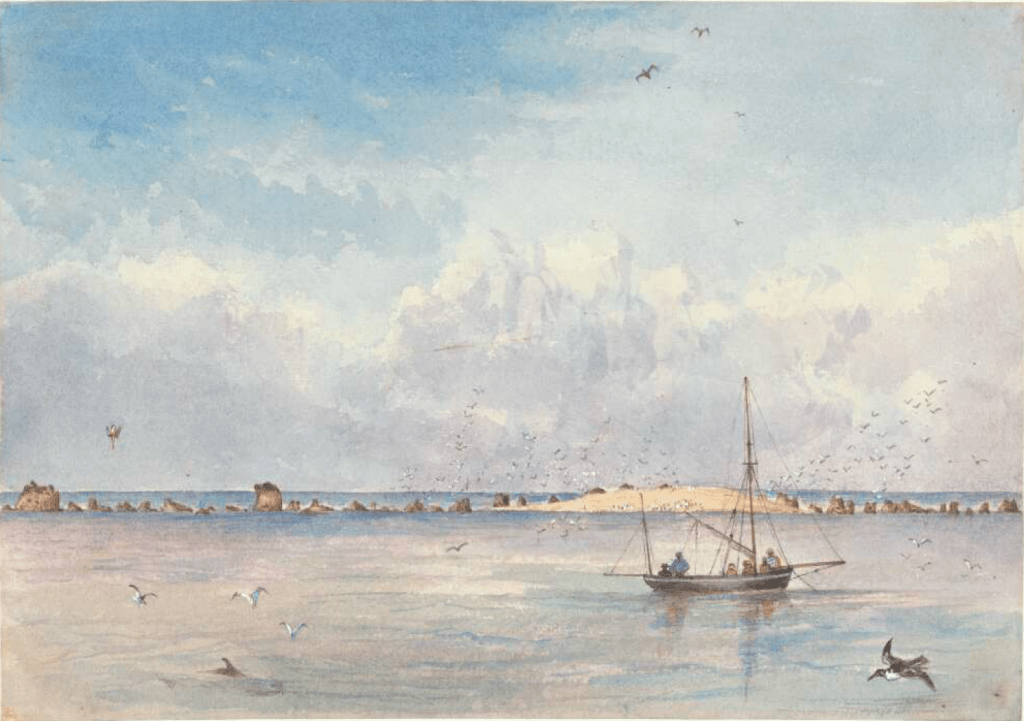
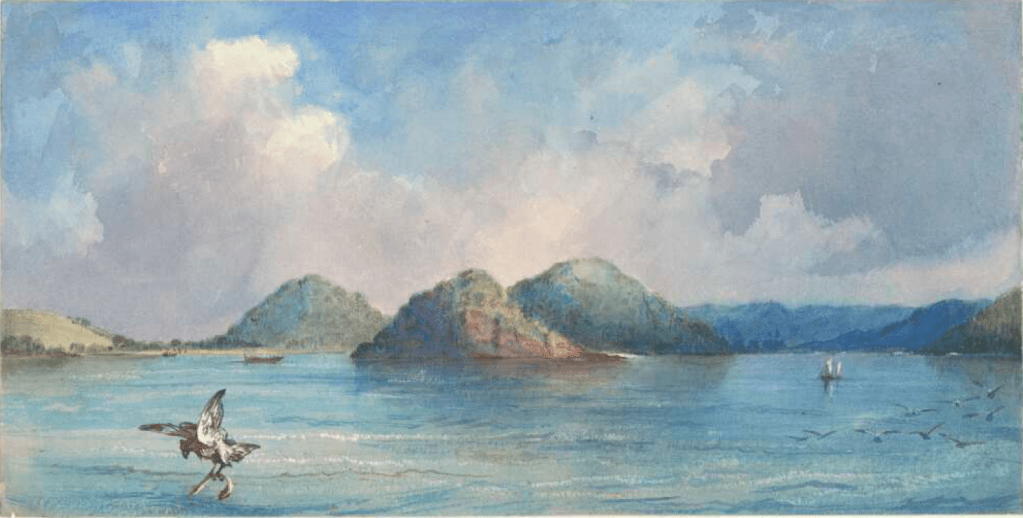
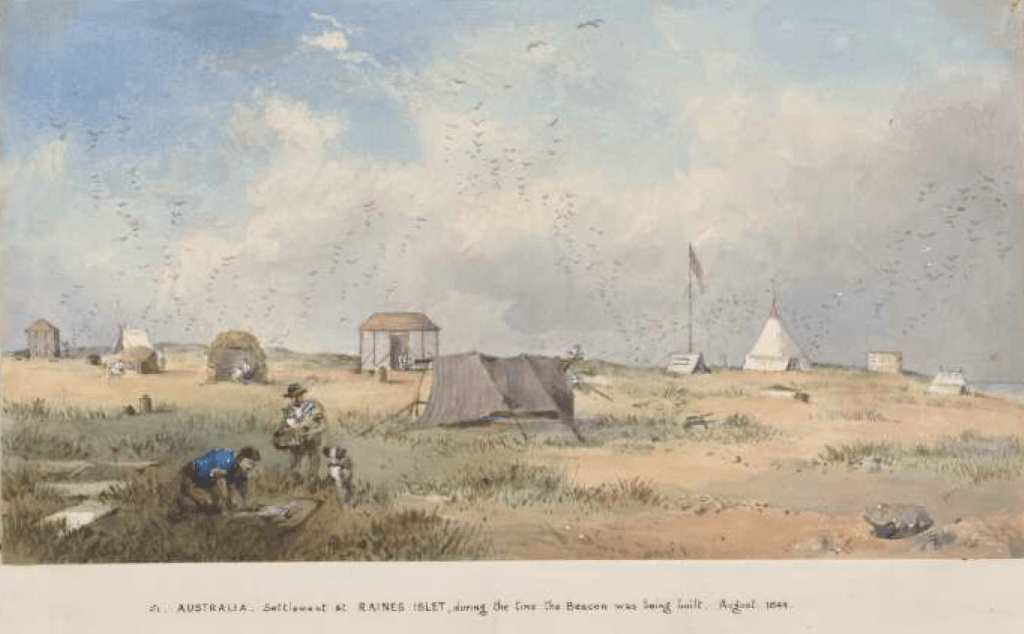
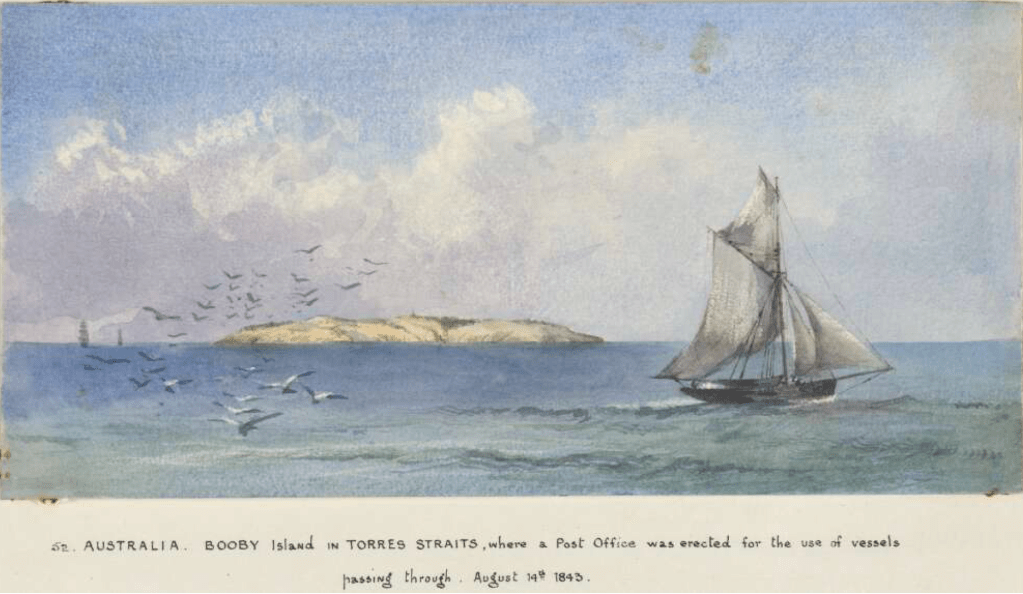
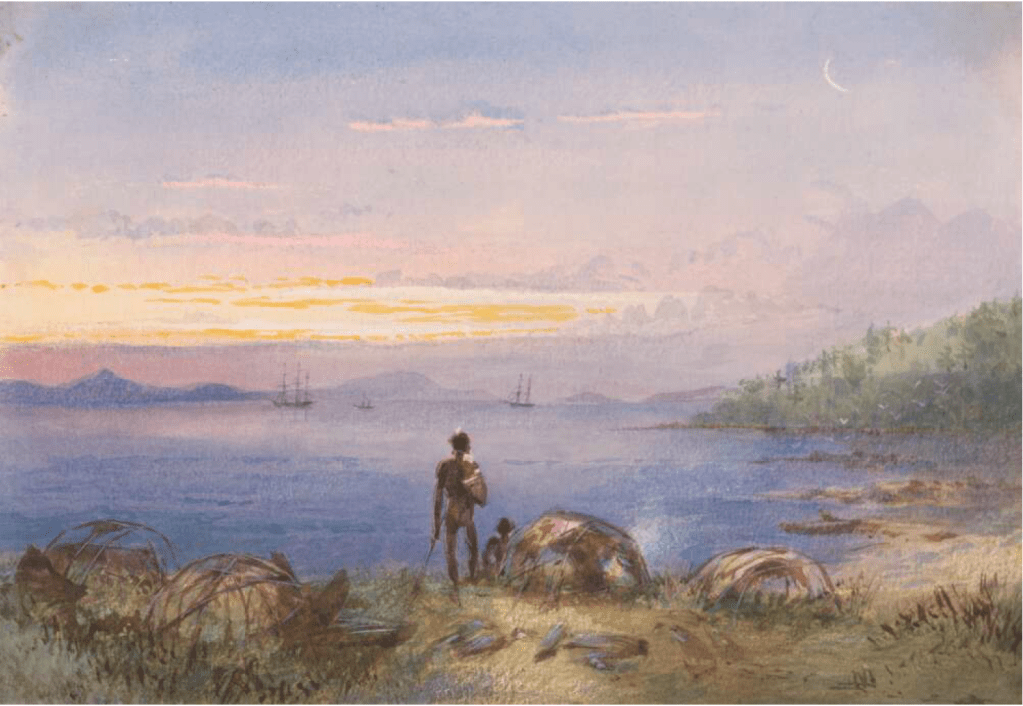
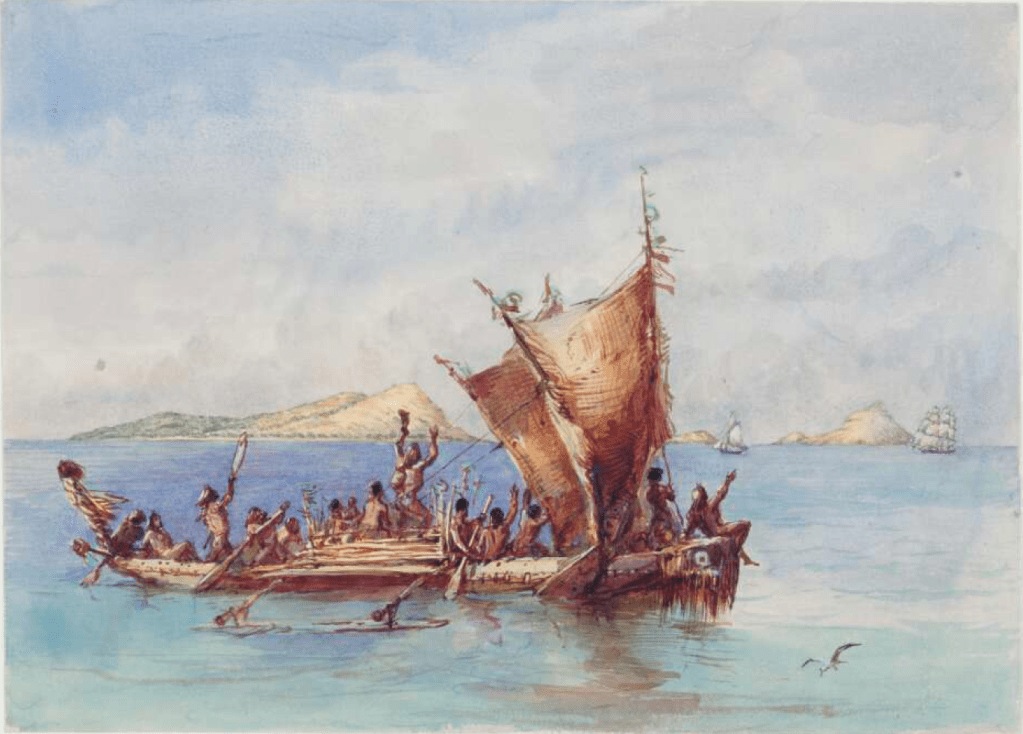
Edwin Augustus Porcher. The coast and its islands. 1843-1845.
Edwin Augustus Porcher was a navy man was on board the Royal Navy Corvette The Fly, which performed the first hydrographic survey of the coast of what is now known as Queensland. Porcher was a scientific observer and “unofficial artist” on the expedition. We will meet the official one later. The expedition took place between 1842 and 1845. Porcher’s images are clear, lively and colourful – something lacking in many of the inland art works.
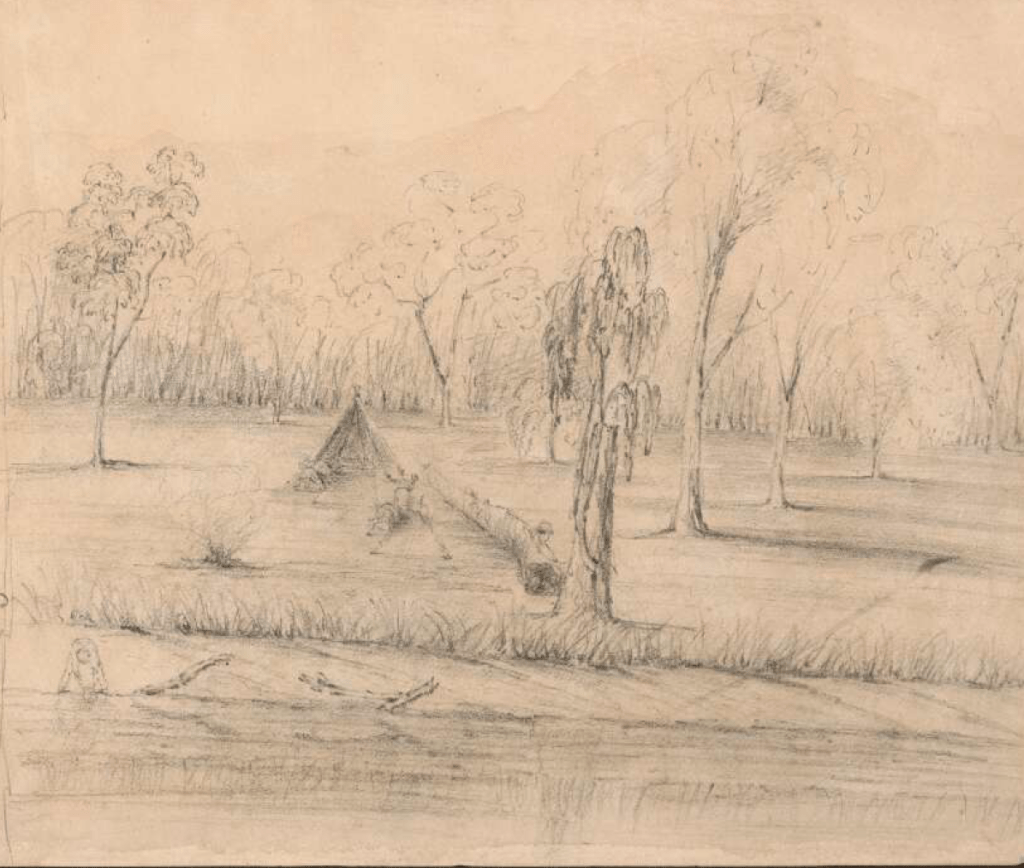
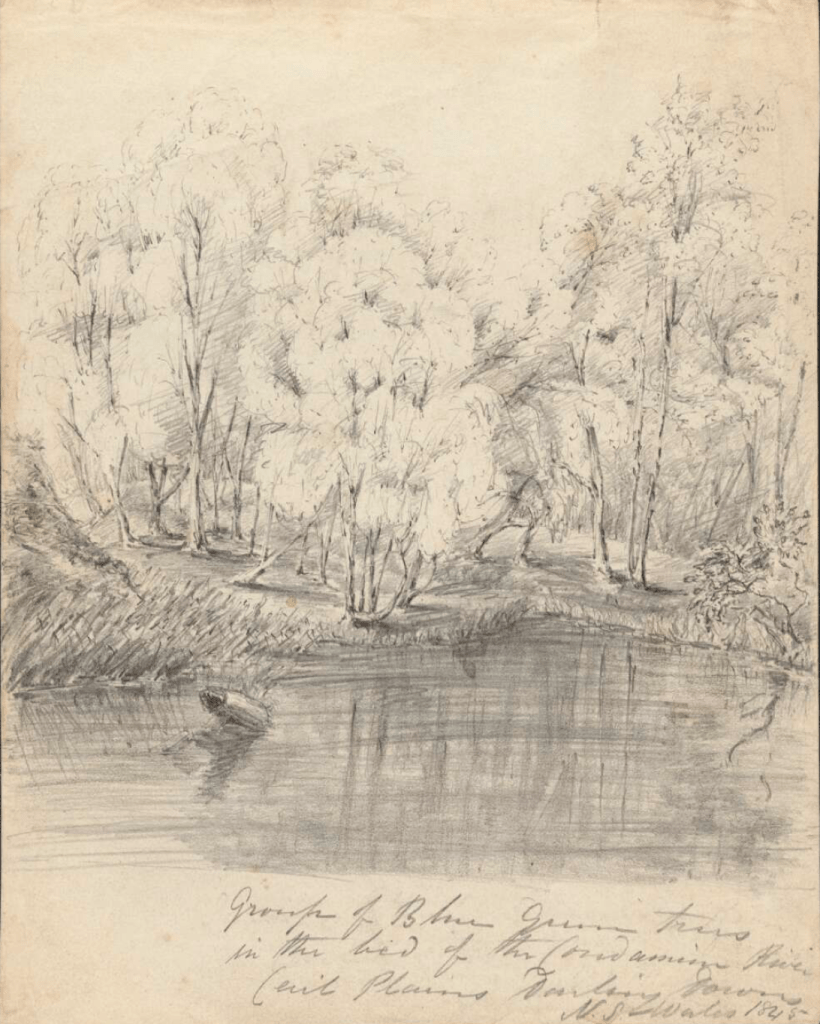
Thomas Domville Taylor records the Downs, 1845.
Thomas John Domville Taylor (1817-1889) was one of the earliest European settlers on the Darling Downs. He journeyed overland to set up Tummaville in 1842. Taylor took part in a search party looking for Leichhardt, then had to leave Australia in the late 1840s, when his father died in England. He sold his share of the run.
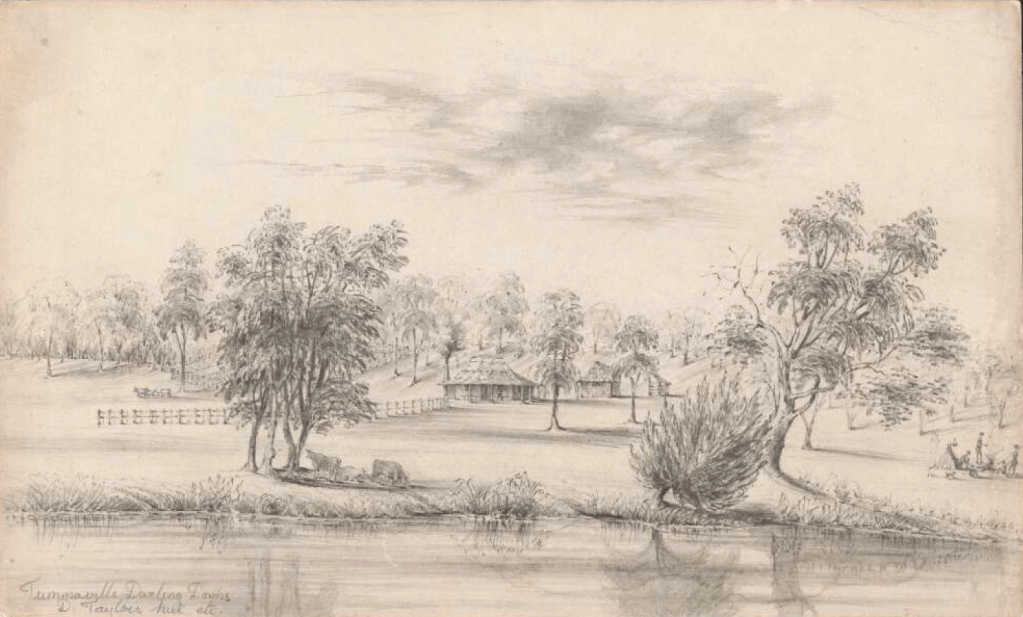
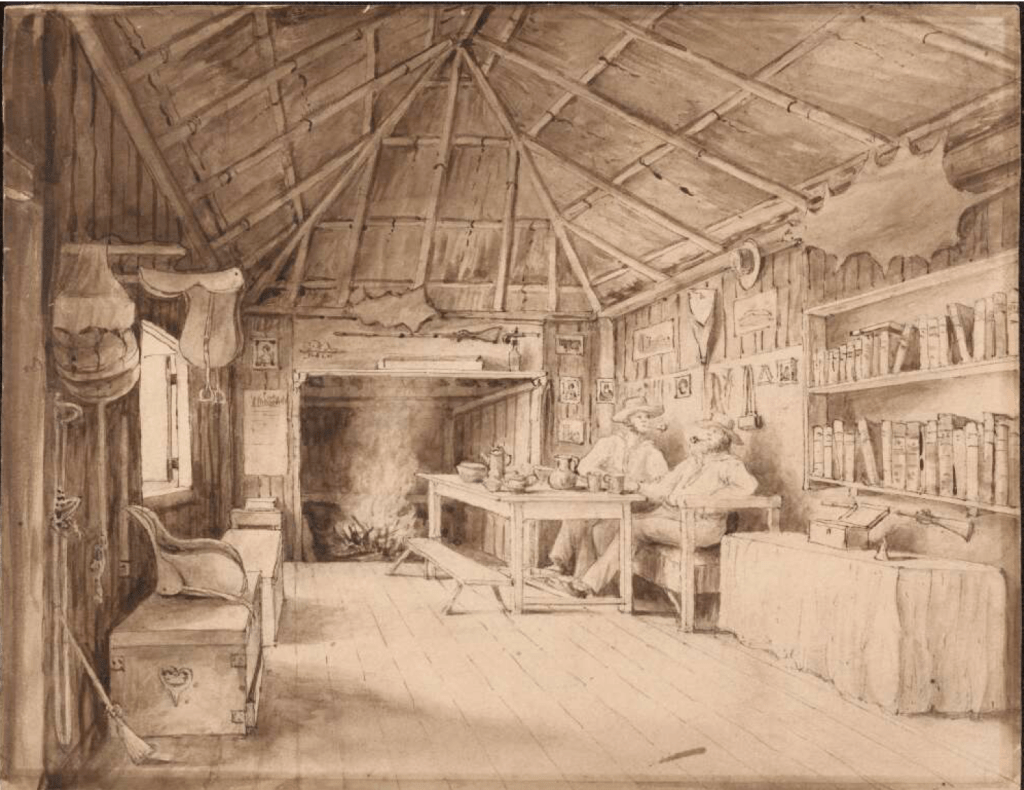
August Etienne Francois Mayer’s lithograph, 1846.
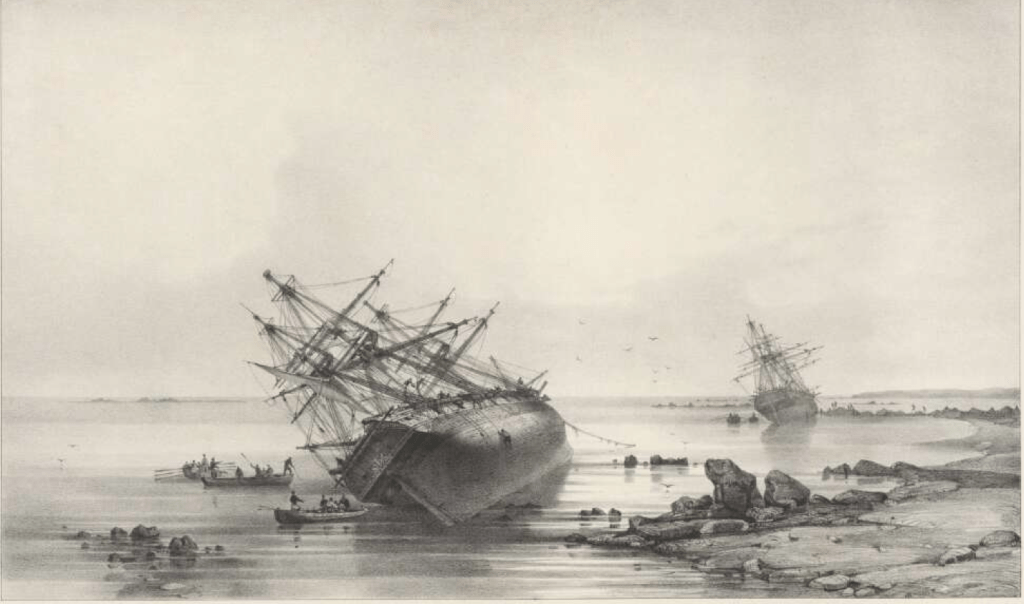
August Etienne Francois Mayer produced this exquisite image of corvettes stranded in the Torres Straits for a lithograph made by Louis Le Breton for Thierry Freres. This image is a reminder of the hazards of travelling in unfamiliar waters. The crew are leaving the wrecks in longboats. They will have to decide if the ships can be refloated or salvaged. If they go ashore, will they survive? How will they fare taking the longboats out into open sea?
Thomas Mitchell, 1846.

Sir Thomas Mitchell was the Surveyor-General of New South Wales from 1828 until his death in 1855. His fourth large-scale surveying expedition took place in 1845-6, and took place in the northern interior regions of New South Wales (areas now part of Queensland). Here Mitchell’s skilled sketching brings an outback river to life.
Harden S. Melville in the tropics, 1849.
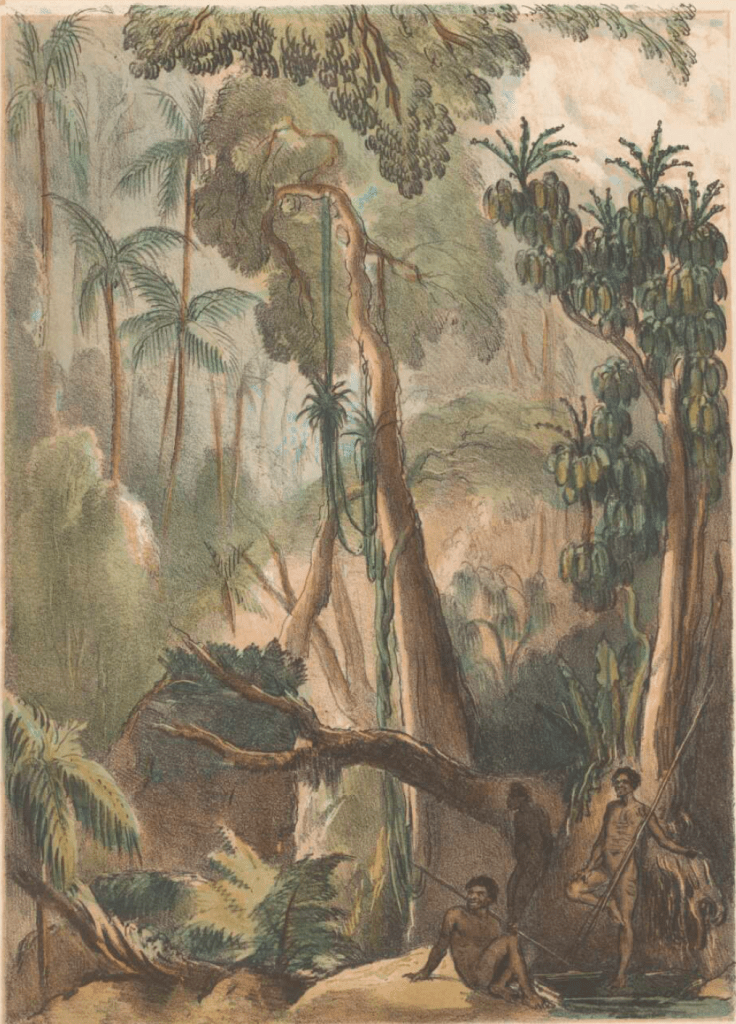
Harden Sidney Melville depicts a ravine at Gould Island as part of the book “Sketches in Australia and the Adjacent Islands,” published by Dickinson & Co in London in 1849. Melville was also on board The Fly, as a draftsman. He did not enjoy his time spent on that expedition, nor did he care for Australian scenery. Perhaps this is why Melville can’t quite manage to convey the glossy lushness of the tropical vegetation. Melville was known to have produced some caricatures of indigenous people, but on this occasion he has left his subjects with their dignity, showing them as happy and relaxed in their environment.
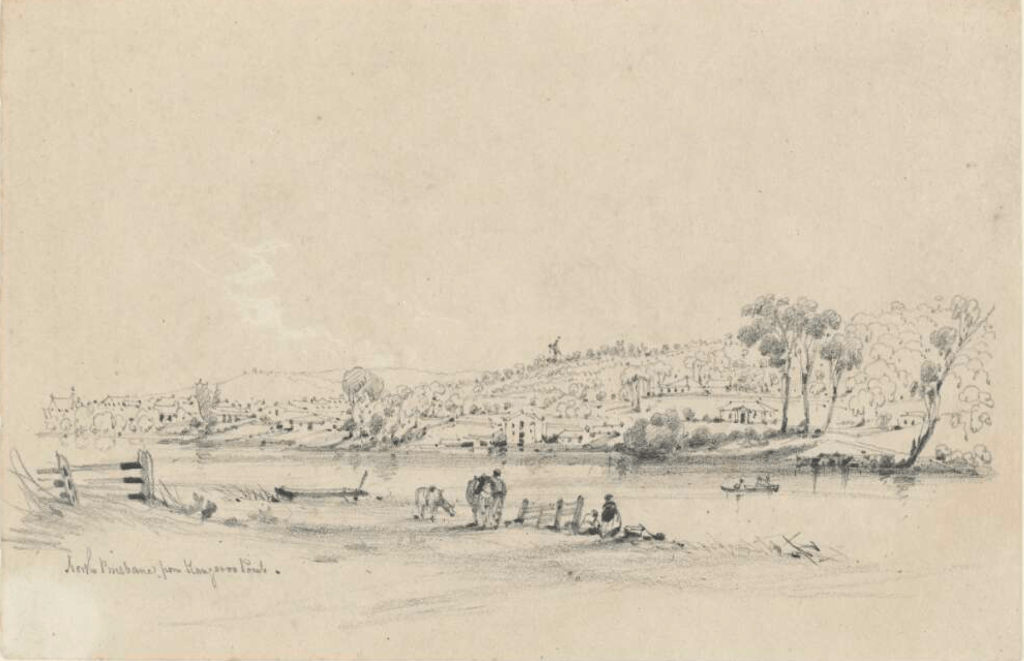
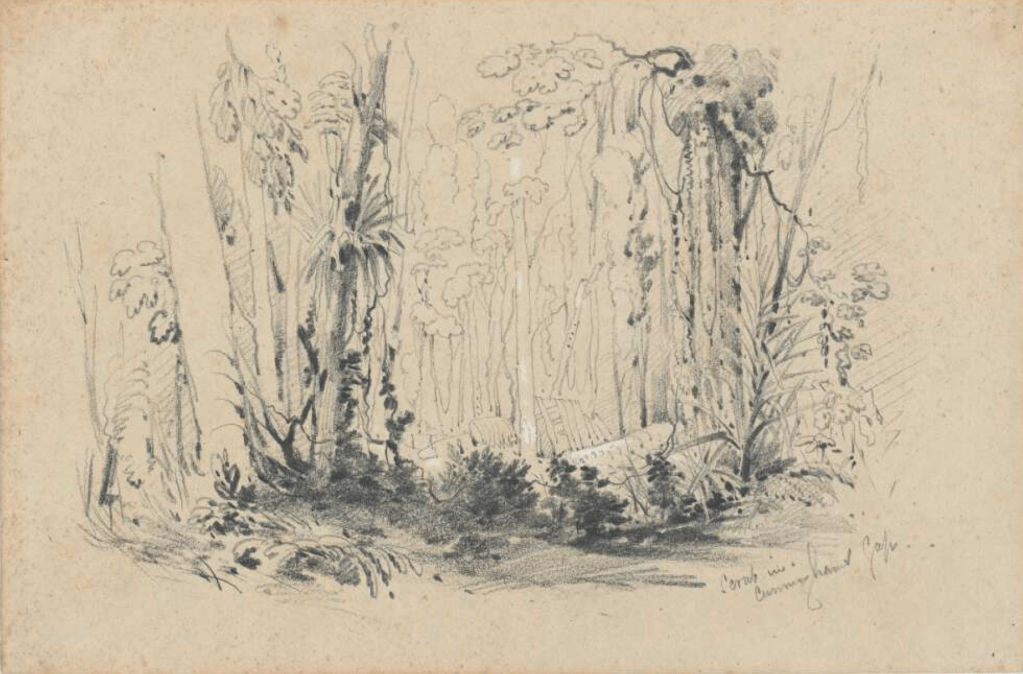
Conrad Martens visits Brisbane and Cunningham’s Gap, 1851.
Conrad Martens (1801-1878), an accomplished English landscape artist who settled in Australia in 1835, brought his sketchbook north in the early 1850s.
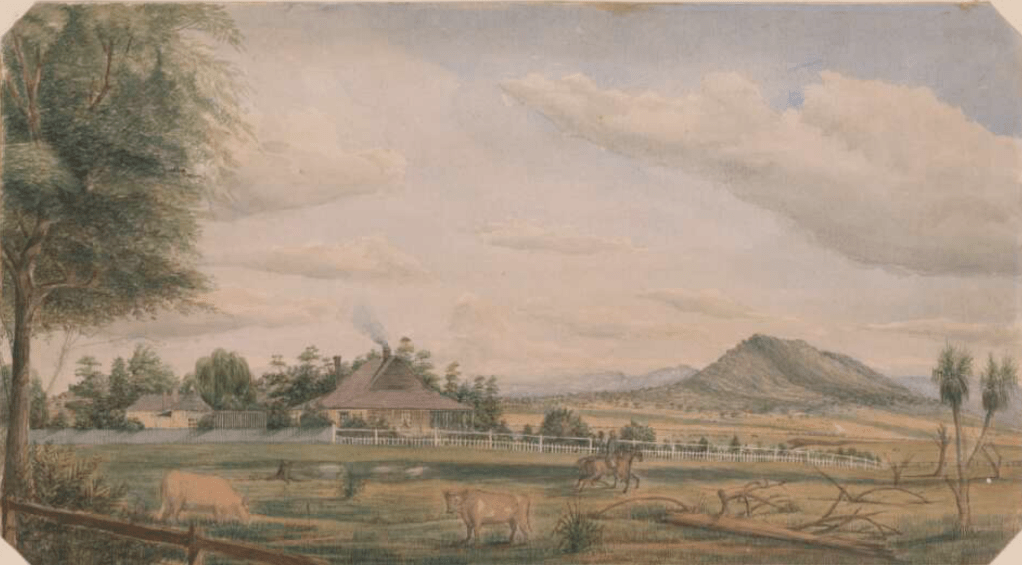
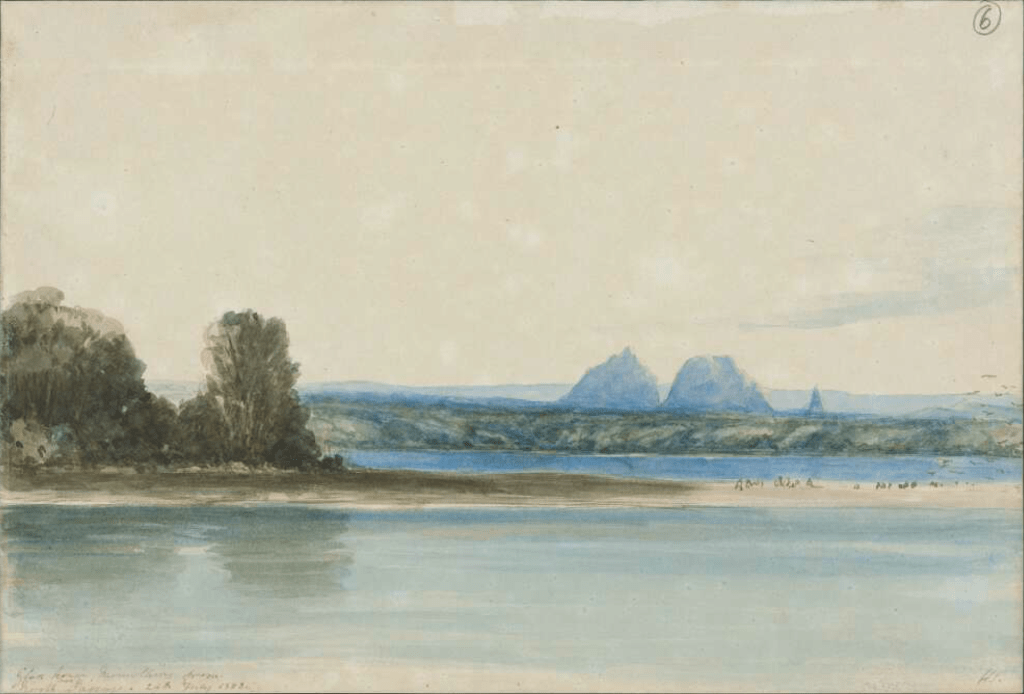
James Gay Sawkins visits Gowrie Station, 1852.
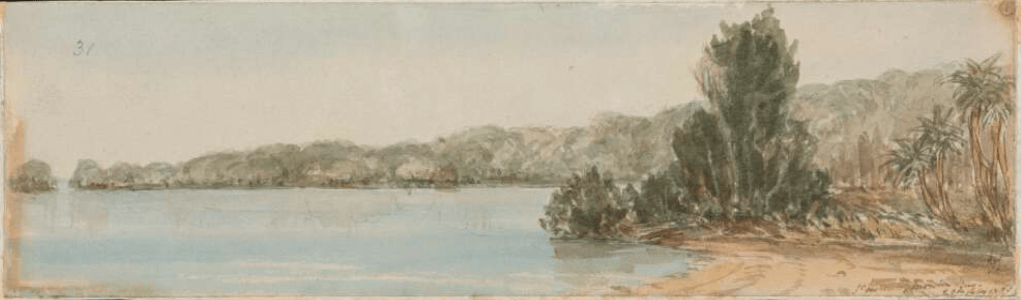
Montagu of Beaulieu, Henry John Douglas-Scott-Montagu visits Moreton Bay, 1853.
Lord Henry Scott, armed with a sketchbook and an almost improbable quantity of names, visited Moreton Bay in the early 1850s. Fortunately, his sketchbook has found its way back to Moreton Bay, and can show us the world as Scott saw it.
The Artists.
Edwin Augustus Porcher (1824-1878) worked for four years on the hydrographic survey of the north-east Australian coast. Porcher followed this up with the Middle East, Macau, Borneo, Shanghai, the Baltic Sea and Malta. After the expedition with The Fly, he took exams and was promoted through the naval service, eventually becoming a Captain. His diaries, recollections and illustrations of his life and work are held in libraries and museums worldwide.
Thomas John Domville Taylor was a European pastoralist in the early years of the frontier wars. As well as his scenery sketches, several of his drawings depict conflict between indigenous Australians and Europeans. In one, a group of armed settlers fire on a group of indigenous men, women and children. It appears that Taylor was present, or nearby, and that as a squatter, he may have taken part. The sketch is quite disturbing. After Taylor’s father died, he went to England, and never returned to Australia. His interest in the station was sold.
August Etienne Francois Mayer (1805-1890) was a distinguished French painter and lithographer. Mayer took a break from recording Arctic expeditions to record a maritime mishap in Detroit de Torres.
Sir Thomas Livingstone Mitchell. After a career in the Army, including seeing action in the Peninsular War, Mitchell cultivated his skills as a draftsman, married a general’s daughter, and began surveying. In 1828, he was appointed Surveyor-General of new South Wales. His career prior to the Fourth Expedition to Southern Queensland in 1845-6 was marked by clashes with the traditional owners of the lands (see Mount Dispersion Massacre). After completing the Fourth Expedition, Mitchell dueled- publicly and with pistols – with Sir Stuart Donaldson, a prominent critic of the Survey Department under Mitchell. Both men missed. Mitchell died in 1855, just before the report of a Royal Commission into the Survey Department was published.
Harden Sidney Melville dreamed of painting the exotic South Seas, longing to emulate Captain Cook (except the last part of course). To realise this dream, Melville joined the expedition of The Fly to the waters around North Eastern Australia, and…hated it. Particularly the scenery. Still, his time in that “dull, matter of fact” countryside came in handy. Back in London Melville completed illustrating the official record of the Fly voyage, then illustrated Leichhardt’s 1844 Journal of Exploration. Melville married in 1851, painted rather a lot of equine studies, and died in 1894.
Conrad Martens was the son of an Austrian-born English merchant, who, along with his brothers, pursued a career in the Arts. As a young man, he travelled with the HMS Hyacinth to India (1832), then joined Charles Darwin on The Beagle as he surveyed the Straits of Magellan. His friendship with Darwin endured over the decades. In 1834, Martens travelled to Tahiti and the South Sea Islands, before arriving in Sydney in 1835, and remaining in Australia for life. He carved out a career as a landscape painter, before sailing to Brisbane with his sketchbook. In South-East Queensland, he made a number of sketches, then journeyed overland back to Sydney. He stopped at a number of large stations on the way, garnering commissions to make paintings for the new settlers. He died in 1878.
James Gay Sawkins led an extraordinary life. He was born in Southampton, England, but was largely raised in the southern states of the USA. He painted for a living, claimed to have become a professor (but didn’t or couldn’t name the particular institute of learning), and went on to live and work in California, Mexico, Hawaii, Australia and England. Along the way, he seems to have married three times, and on at least one occasion, neglected to get a divorce. His first wife Jane Andras outlived him. At some point in the late 1842s, he married, or claimed to have married a person named Octavia “Rosa” Sawkins (maiden name unknown). During this relationship, he brought charges against Paul Revere’s grandson for alienating Rosa’s affections. Where Rosa went afterwards, and in what state her affections might have been, is not known. Undaunted, James Sawkins married Mary Brodie in 1855. Sawkins worked as a miner, geologist and artist in the West England. He died in 1878. One wonders what the various Mrs James Sawkins knew of his life.
Lord Henry Scott was thought to be in delicate health as a youth, and avoided bitter English winters by travelling to warm and inviting places with his tutors. In July 1853, he journeyed to Moreton Bay with his sketchbook, making a series of delightful watercolours. He had studied under Martens in Sydney, before returning to England to marry, enter Parliament, and become the first Lord Montagu of Beaulieu. He did not exhibit or sell his work during his lifetime, but his work has found its way into the collections of the National and State Libraries.
[Information on the artists’ lives has been taken from the website “Design & Art Australia Online” and Wikipedia. All the works reproduced are part of the digital collection of the National Library of Australia, and are out of copyright.]
 Moreton Bay and More