
The Moreton Bay Courier’s news of the day.
Page 1.
The Classifieds on page 1 offered the usual array of lost livestock, Holloway’s Pills advertisements, and confusing ads for drapery (strong linen duck?).
A large advertisement for an Art Union explained the use of the term “Art Union” by actually offering works of art as prizes. Works by Poole, Herrault, Wood and Martens were included. And the Martens painting of Elizabeth Bay – part of the prize pool – is now in the custody of the Caroline Simpson Library at the Museum of History New South Wales:

Page 2.
Responding to an inquiry from a reader, the Courier was obliged to point out that it was not their custom to publish the names of steerage passengers. The very idea.
An editorial of extraordinary length and dullness was devoted to Lord Monteagle (spiffing name, that) and his plan for “systematic emigration.” Apparently, having fewer poor people in the Old Dart would free up some space. You know, socially.
The Domestic Intelligence section dealt with the troubles afflicting Warwick. There were endless master-servant cases on the Downs – bad shearing, insolence, and failure to milk more than two buckets per day. The bad shearer was sent to Sydney Gaol, the insolent one got 14 days in Warwick lock-up, and two buckets of milk seemed quite reasonable to the Bench. Charge dismissed.
George Whitting, a ticket of leave holder per the Mountstuart Elphinstone, met his maker after the bullock team he had been hired to drive ran over him. The whole bullock team, poor man.
Page 3.
Page 3 contained further master-servant cases on the Downs, then mixed Local and Domestic news with Inter-Colonial items.
Local News:
Margaret Connor, mother of Mary Ann, was found not guilty of stealing some items from the Orr family of South Brisbane, who were away in Sydney. (They were away giving evidence in a trial relating to the landing of the Mountstuart Elphinstone and the murder of a cockatoo).
William Crabb suffered his second serious horse-related injury and was admitted to hospital. Unfortunately for Mr Crabb and his limbs, the invention of the horseless carriage was decades away.
The Windmill Reporter solemnly recounted the progress of a Christmas Day greasy pig chase at Kangaroo Point.
Tenders were opened for the purchase of the Windmill. The Courier hoped that it could be saved. It’s still there – 175 years later.
Inter-colonial News:
The “Devil’s River Correspondent” of the Geelong Advertiser described a wash-pen that allowed one to wash sheep without drowning them. Jolly good.
Cure of Snakebites & c. A Mr Charles Underwood had advertised in the Hobart Town Advertiser, claiming to have developed an antidote to the “bites of snakes and every description of poisonous reptiles and insects.” Underwood was said to have been a prisoner at Moreton Bay, where he “frequently exhibited his invulnerability to the poison of snakes.” A test before a government commission did not go terribly well – the snakes assembled for the test were too sleepy to bite anyone or anything. (There was a Charles Underwood at Moreton Bay between 1829 and 1833. No record of exposure to, or imperviousness against, snakebite is mentioned in the records there.)
In South Australia, a group of indigenous men were hanged for a frontier war attack on a settler. A scaffold was erected at the scene of the incident, and the men were hanged as an example to the community. Whether this was achieved or not, it was a memorable occurrence for one obviously terrified indigenous child, who related the event far and wide.
A report from an American journal named The Plough recommended that smokers should substitute hops for tobacco. “The fragrance is balsamic, and, diffused in a bedchamber, will often bring calm, refreshing sleep.” It didn’t catch on. Possibly because just about everyone preferred their hops fermented.
Page 4
The Iron Duke.
The Duke of Wellington, in old age, was spotted by a correspondent as he rode through London.
I saw the Duke of Wellington near Charing Cross. Now in his 81st year, he looked better than I have seen him do for years. He walked his horse, a steady sedate looking animal, at a slow pace. The working of his under jaw (rendered more conspicuous by his want of teeth) showed that he was mumbling some speech to himself. His seat in the saddle is ungraceful and slovenly; always was so, notwithstanding his long practice.
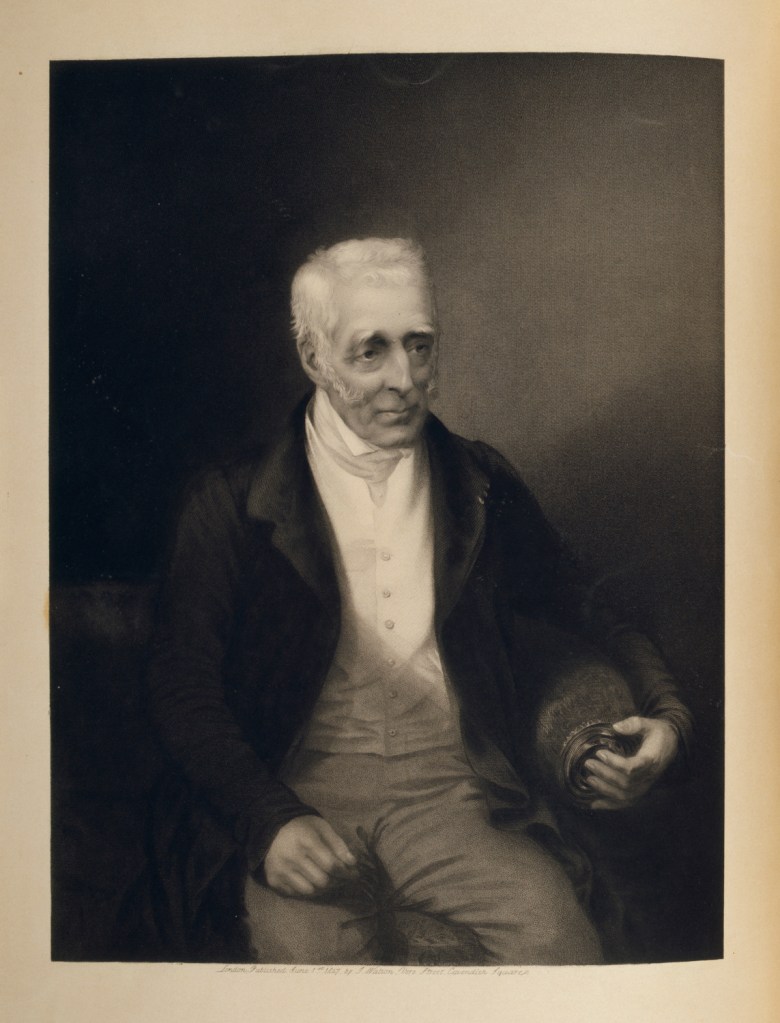
His dress — precisely the same he has worn for these ten summers. He would make no great customer at your marts of novelties for “trouserings, vestings, and coatings” just come into fashion. Yet is the dress very smart and gay for an old man – black hat, white neckcloth fastened behind with a metal clasp and plate, highly varnished and conspicuous, white waistcoat and trousers, and a light jaunty loose blue frock coat, thrown very much back so as to show the full amplitude of his white waistcoat. The people on the pavement stopped their walk and lifted their hats – even the cabmen showed him the same courtesies, which were regularly acknowledged by the customary lifting up of the fore finger of his right hand to his hat.
Cheltenham Journal
Imagine being a “female pauper” in 1840s Ireland. Somehow, it’s the fault of these young women that they were “worthless idle paupers.” They had presumably lost family, or have been unlucky in securing jobs. A long voyage to be exploited on the other side of the planet was presented as golden opportunity.
Emigration of Female Paupers. – On Thursday, the Nenagh board of guardians selected three hundred female paupers as eligible emigrants for Australia. They were all between the ages of sixteen and nineteen. They were seated in the dining-hall, some of them occupied in writing, others in reading; and all manifested deep anxiety and the utmost gratification at the idea of becoming industrious emigrants, instead of being worthless idle paupers. They were neatly and cleanly dressed; they appear active and intelligent; and although inmates of a poorhouse, they possessed rosy cheeks, smiling countenances, and healthy-looking appearances, and many of them could lay a bona fide claim to that unequalled beauty for which the daughters of Erin are so characteristic. Out of these three hundred. Lieutenant Henry, emigration agent, is to select one hundred and fifty – the number which Government will only send from any union. They will be sent off forthwith, and be provided with outfits, &c.
Times, August 25.
A Curious Story.
A letter from Loche, in Switzerland, dated April 24, gives the following. “A rather singular piece of originality has afforded some amusement. An old female servant retired into the hospital, some time back, and died there a week ago. As she was a Roman Catholic, her request was, that her mortal remains might be laid in the cemetery of the chapel of Chauffat. According to custom, all the Catholics of the locality were invited to accompany the deceased to her last resting place. The weather on the day of the funeral was most severe; six persons only were present, and two of them turned back when only halfway on the road. The other four, after having deposited the body in the burial ground, retired to the vestry, at the request of the curate, who read the deceased’s will to them. No trifling degree of surprise was exhibited on learning that the old servant had left 400 louis, which she had deposited in the savings bank, to be divided amongst such person as should follow her to the grave. The will, which was in perfect form, thus secured to each 100 louis, deposited in the savings bank. The disappointment of those who did not attend may be easily imagined.”
(By follow her to the grave, the writer – presumably – meant accompany her coffin to the churchyard, not join her in the hereafter. I hope.)
Unparalleled Villainy.
The British and Foreign Extracts also contained an article entitled, “Unparalleled Villainy.” This is the story of a prison plot concocted by a murderous doctor in order to pursue his fiendish plan for revenge upon the witness who had convicted him. It involved having a quiet word with a soon-to-be released prisoner, offering him a very large sum to (a) murder the witness, and (b) write a letter in the witness’s handwriting, confessing to the original murder, which would then secure the murderous doctor’s pardon. The plot was exposed, and the doctor took prussic acid (so easy to get one’s hands on in prison, apparently), and died.
Good Lord. The murderous Maine doctor was one Valorous Perry Coolidge (the Courier gets his name wrong). There is a bizarre postscript. When it came to claim Coolidge for burial, his father claimed that the body was not that of his son. He stated that the dead man was larger than his son and did not have part of a thumb missing. Naturally, Dr Coolidge’s father made his remarks in the hearing of someone able to contact a journalist, and naturally, conspiracy theories have raged ever since as to the identity of the person buried as Coolidge. And what became of Valorous Perry Coolidge after he possibly didn’t die.
Elsewhere:
Captain Wickham sought a gardener and a laundress. Unmarried people were, of course, preferred.
Mrs Thornton required a cook and washerwoman (well, Margaret Connor was unengaged, one suspects.)
Tenders were opened for the sale of the Windmill.
A Mr Baker lectured on natural philosophy.
A meeting was called to agitate for the dismissal of Chief Constable Fitzpatrick. (Following the shooting at York’s Hollow.)
Moreton Bay Courier (Brisbane, Qld. : 1846 – 1861), Saturday 29 December 1849.
Conrad Martens work. Caroline Simpson Library, Museum of History, New South Wales.
Various thumbnails of George Cruikshank’s drawings, public domain.
Portrait of Arthur Wellesley, First Duke of Wellington, c 1847. National Portrait Gallery of London. Used under creative license obtained from the NPG.
 Moreton Bay and More