
Noise was made. Sleep was murdered. Drunken fools could not be kept off racecourses. But, by the end of the 19th century, the celebration had developed into a family-friendly fireworks display.
1849 – the town’s 1000 or so inhabitants huzzaed. A bit. For a while.
HOW 1849 CAME TO BRISBANE. (From our Windmill Reporter.)
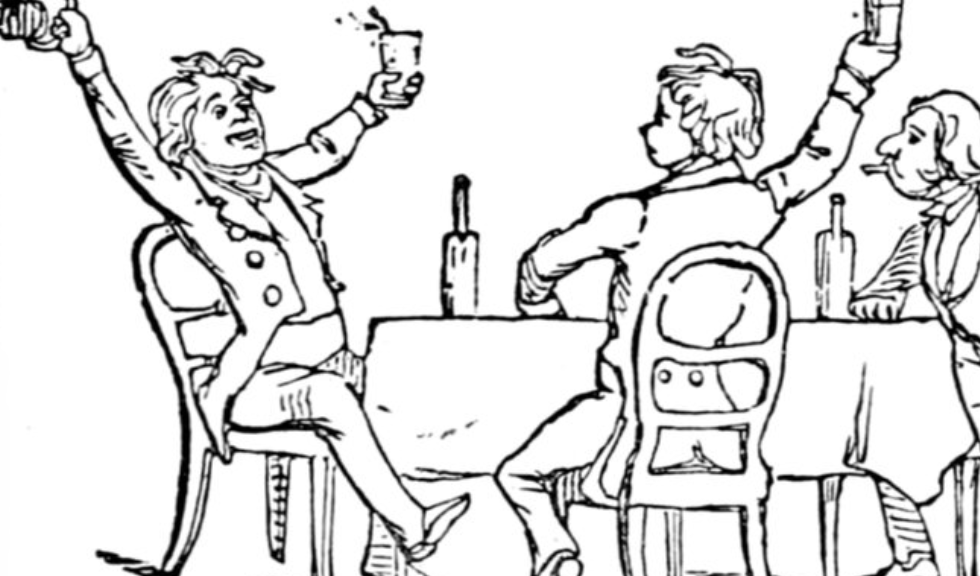
When the iron tongue of the Experiment’s bell announced to the universe the arrival of midnight, strange and diabolical sounds issued from the neighbourhood of South Brisbane.
A combination of roaring, yelling, singing, and huzzaing, mingled with the spirited barking of youthful dogs, and the melancholy howling of the more aged and lazy, created a discord which struck upon the tympanum with an effect more novel than musical; while the ill-regulated explosions of firearms – embracing the whole gamut – assisted in producing an effect, compared with which the eternal “Nix my dolly” of an amateur pianist would be merciful.
A slumbering, and somewhat testy, gentleman was aroused from his peaceful dreams, and rushed from his dormitory, bearing in one hand an ignited taper, and in the other flourishing a formidable club. As he stood, elevated, by a verandahed stage, above the opposing crowd, the faint gleam of an expiring bonfire cast a sickly light upon his indignant features, which, for a moment, awed the ungodly revellers. In stern accents he demanded the cause of this frightful uproar and was informed that the old year was going out, and the new one coming in: at which he retired, taking with him his candle, and also his bludgeon.
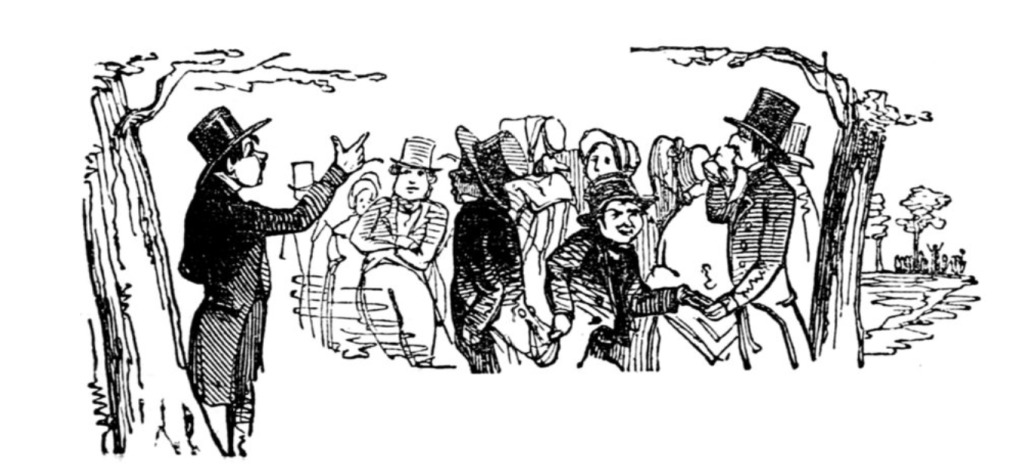
North Brisbane was aroused by the beating of a drum. In the pauses of the strokes, you might hear a screaming flute. There was laughter- and a fiddle-and a chatter, and a hum: and no one heard another speak, though nobody was mute. With tramping feet through every street, the wild musicians went; through windows wide, on every side, astonished eyes were bent. Yet there were some on whom the drum had no effect at all; and others, grunting, yawned; and turned their faces to the wall.
It might have been fondness for gin that kept half the town in a doze; or horror of shelling out tin-or indolent love for repose; but certainly a chilly welcome met the sleepless coveters of heavy wet; and all unanswered was the hearty shout, that brought the new year in, and kicked the old one out. Now a domestic reminder toll’d something very like one o’clock. Valiantly thunder’d the drum, drowning the flute and the violin. Fading, in distance, away, lost were the sounds on the morning air. Nothing was heard but a snore, drawn through the nasal tubes heavily.
New Year’s Day 1865 – a year announced by a disorderly mob on the racecourse.
The New Year’s races commenced at the New Farm Course yesterday and were all of them well contested. Indeed, had the arrangements with regard to the proper observance of racing regulations on the course been properly attended to, all would have been well.
As it was, however, we are compelled to state that the miserable attempt made to keep the course clear, even while the horses were running, was a most disgraceful failure.
The police exerted themselves to their utmost, but their number was quite inadequate, and the result may be easily understood. For the first two races some slight show of decorum was observed, but in the latter part of the day a more disorderly mob than that collected upon the running ground it would be hard to conceive.
The dawn of 1870 was greeted by noisy blackguards.
New Year’s Eve, 31 December 1869.
The new year was ushered in on Friday night with the usual demonstrations of welcome. All sorts of noisy extravagancies were resorted to; gun firing, horn blowing, bell-ringing, firework discharging, tin-kettling, &c, &c, but, on the whole, the more enthusiastic were not so roysterously and boisterously inclined as in some former years. Either chalk and paint were less plentiful, or the rowdies were less inclined than on ordinary occasions to deface walls, doors, and shutters, but the extra police patrol may perhaps have had a restraining effect.

A gang of noisy blackguards, making night hideous with their howlings, paraded Wickham-terrace, Leichhardt, Wharf, and Eagle streets, and did some little wanton damage, but it is most probable that the principals, who are pretty well known, will be brought to account for their folly in due course.
At Parish’s Hotel, where all the inmates had retired to rest, they attempted to kick in the bar door, smashed a large pane of plate glass, and when the proprietor came out and attempted to pacify them, he was assaulted. Mr. Parish has, we see, offered a reward for the discovery and conviction of the offenders. At Toes’ Hotel in Wharf-street, the Queen’s, and the Metropolitan, similar pranks were played, and it appears that the plan of operations carried on by those rather demonstrative persons was to go round to nearly every public-house and levy “black mail” from the proprietors, chiefly in the shape of bottles of grog.
Greeting 1899 – a charming family celebration.
Larrikins were in evidence, but no barkeeps were blackmailed. And nothing weird happened on the racetrack the following day.
New Year’s Eve in Brisbane, 31 December 1898.
It has been remarked by Henri Murger, the French writer, that the two necessary accessories to the thorough enjoyment of a holiday are a light heart and a heavy pocket. If that is so – and there seems scarcely any room for doubt the people of Brisbane it would seem, as proved by the way in which they have been making high holiday during the Christmas, and New Year carnival, are fairly well blest in both directions. They decided that the old year should die pleasantly, and it did, and what was more, the new year was ushered in under most favourable auspices. What a day Saturday was! It was balmy and beautiful, like unto that which Longfellow calls
” A perfect day:
Whereon no man shall work but play,
Whereon it is enough for me
Not to be doing, but to be.”
There was a bright, blue sky above, with now and again a fleecy gauze gliding across it, whilst below a quiet, cool breeze lapped through the city streets, making it pleasant and enjoyable for pedestrians, many of whom no doubt would have persisted in walking the streets even if the elements had been cruel. The heart of the shopkeeper was made happy because, from a comparatively early hour in the afternoon, the main thoroughfares were ablaze with that glory that is usually given to them on a busy Saturday night. Towards evening the crowds in Queen Street overflowed into the roadway, and the conductors of the trams found it as difficult to navigate their cars as it would be to steer a ship amongst the ice floes.
What a crowd it was! There were faces there which looked hard and severe, rendered so no doubt by the fierceness of the struggle in the battle of life. But there were kind faces, too, and the pre-dominating influence was one of good humour. As the city became illuminated the stream of humanity increased- both in George-street, which was ablaze with light, and the main avenue, and in a very short time Fireworks was king. Crackers were thrown into the air, to fall sometimes, it must be said, in dangerous proximity to inflammable material, and rockets were started heavenward to break into showers of coloured stars. The big guns boomed, and the little guns made brave efforts to reply, and so was commenced the fanfaronade which saw the old year out and the new year in which sounded the death knell of ’98 and greeted the birth of ’99.
It was a great show; one with plenty of wholesome human nature in it, and one calculated to make even a cynic smile in a kindly way. There was a good deal of shopping done, but for the most part the world and his wife came out to see the fun rather than to patronise the shops. The larrikin tribe were, of course, abroad, but their doings were, as a rule, let it be said, of an insignificant nature. They sang a great deal, blew trumpets and whistles, threw harmless missiles, gave al fresco displays of acrobatics, and appeared to think themselves very roystering blades indeed. There were flitting forms of other young people – boys occupying subordinate positions in commercial establishments, and servant girls with red faces, bright with animal spirits, yellow soap, and friction. Some men swaggered as they walked to and fro and hailed one another across the streets in a way which showed their determination to make a night of it.
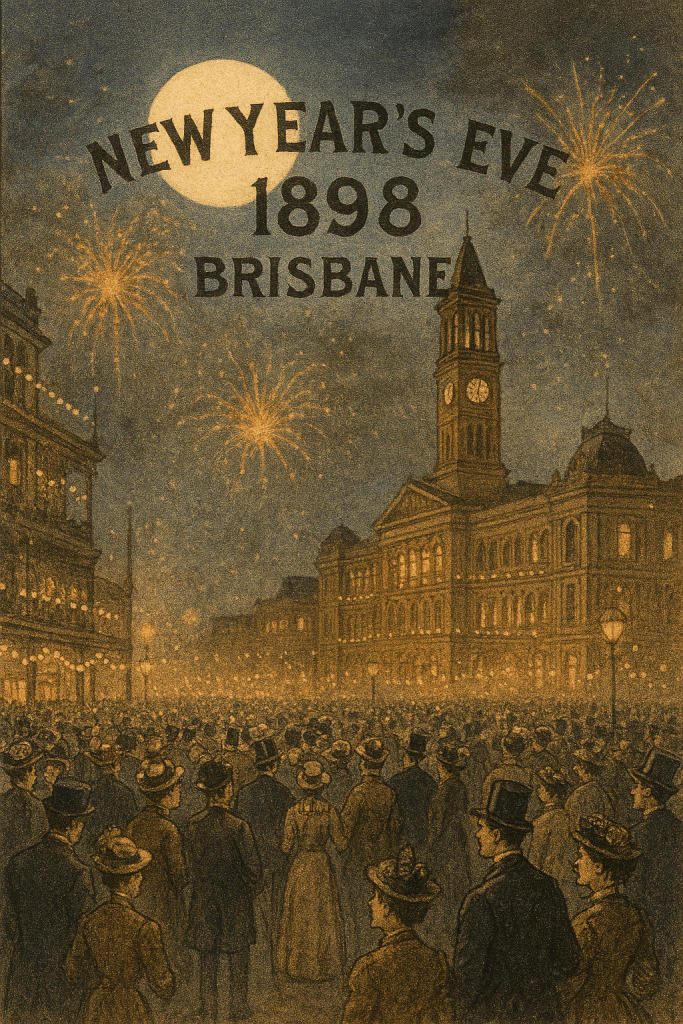
There were family groups in which the grandfather was seen leading the toddler of the third generation. There were perambulators with babies fast asleep in them, but there were other wakeful little dots, crowing at the lights, and in many instances paterfamilias was observed struggling with all kinds of parcels, which seemed to accumulate as he proceeded on his difficult way. Groups of street evangelists were to be seen praying at street corners and doing all they could to remind people that there were other worlds besides this one, and that the dying year was to be another milestone passed on the journey there. At other corners were men selling trifles and creating great amusement by their extreme volubility. Purchasers invariably hurried away when they got their parcel, for fear perhaps of a towel-horse or some other inconvenient or unportable article being added to the “lot.” There were enticing goods in the shop windows, and those places exhibiting mechanical figures at work proved an immense draw. It was a “thirsty night,” too, and “the trade” came in for a considerable amount of patronage.
Whilst all this was going on in the city, the outlying parts were by no means deserted. From many of the suburbs rockets were sent up, and there was much tin kettling, gun firing, with perhaps here and there a little gate-lifting; but in every direction good humour prevailed, and there was good hearty enjoyment to be met with on every hand.
It was not until the tired shopmen commenced putting their shutters up and the bells of church or chapel, where they were holding vigils over the dying year, called people away to a watchnight service, that the street crowds began to diminish. In a very short while, however, the fleeting year was spent, and as the hands of the clock pointed to the “witching hour” there was many a handshake, many congratulations, and much enthusiasm. Peals of joy rang out, skyward could be seen countless rockets, and for a time there was a perfect day with the steamer whistles, the bells, the rockets, and the guns, and when the noise was over and the bells of St. John’s played “Home, Sweet Home,” the memory of some no doubt went back to a New Year’s Eve spent under happy circumstances in other parts; or thought of friends who were far away, and wondered whether just then a thought was bestowed on the absent one.
However you observe, or choose not to observe, the New Year, all the very best. (And, please don’t wander about on racecourses while they are in use.)
Moreton Bay Courier (Brisbane, Qld.: 1846 – 1861), Saturday 6 January 1849, page 3
Brisbane Courier (Qld.: 1864 – 1933), Tuesday 3 January 1865, page 2
Brisbane Courier (Qld.: 1864 – 1933), Monday 3 January 1870, page 2
Brisbane Courier (Qld.: 1864 – 1933), Monday 2 January 1899, page 6
Images:
“The Comic Almanack, Volume 2” Illustrator: George Cruikshank. Out of copyright.
AI Image generated by CoPilot.
 Moreton Bay and More