| TERM | MEANING |
| Absconding | Convicts absconded from settlements frequently. Some travelled hundreds of miles on foot, usually with the help of the various indigenous groups they met along the way. Some died or were presumed to have died. The punishment for returned absconders was a significant flogging. |
| Certificate of Freedom | A certificate of freedom was issued to show that a former prisoner was now free. These certificates were issued to convicts with a specific term of sentence (7, 14 years etc). Those sentenced to life could not obtain them, and had to hope to receive a pardon. |
| Colonial Offender | A person who had been transported to Australia, and had committed a further offence. |
| Commissariat | The Commissariat housed the food and equipment for the Military and convicts. The items that could not be produced locally had to be sent by steamer from the Commissariat in Sydney. |
| Direct Transportation | Moreton Bay was set up as a place of secondary transportation – ie a convict committed another offence once in Australia, and were sent to places like Moreton Bay and Norfolk Island. After free settlement, Moreton Bay was appalled to receive several shiploads of directly transported convicts. |
| Discharged | Once a prisoner had served their colonial sentence, they were discharged back to Sydney on one of the government schooners. Once there, they were housed in Hyde Park Barracks while their paperwork was sorted out. |
| Flogging / lashes | Corporal punishment ordered by the military commandant for prisoners who committed offences such as absconding, insolence and idleness. |
| Muster | Convict musters were held throughout the colonies, and convicts were required to report to whichever police or administrative place on the appointed day. At Moreton Bay, the convicts were mustered on Sunday morning, inspected, and then had Divine Service read to them. |
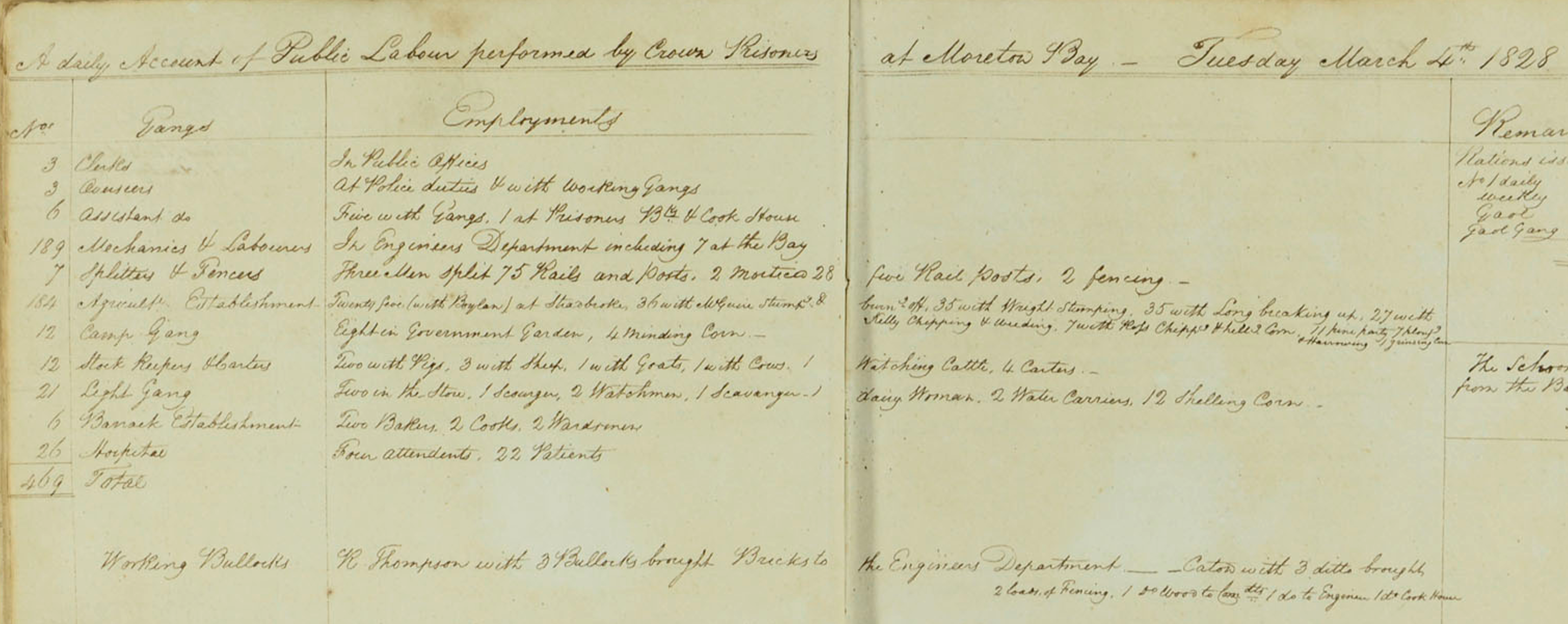
| Overseer | At Moreton Bay, convict work gangs were supervised by a convict overseer. The overseer system worked on mutual antagonism between the overseer and the men. |
| Pardon | The Governor had the power to pardon convicts under life sentences for good behaviour or special good deeds. Conditional pardons (the most common type) for transported convicts freed them on the condition that they remain in the colony. They were still serving sentences for life as far as their countries of origin were concerned. |
| Rations | Convicts received rations of clothing (2 sets per year), food, tobacco and soap. Rations of tobacco could be stopped for a period due to insolence. Under Commandant Logan (1826-1830), rations were a source of complaint, but Logan pointed out that they were within reasonable limits. Subsequent commandants increased the food allowances. |
| Scourger | A convict employed at a prison or penal settlement to inflict corporal punishment. |
| Ticket of Leave | The convict ticket of leave system was introduced as an incentive to prisoners, allowing them to work to support themselves after serving a portion of their sentence (dependent on the length of the original term). A ticket would permit the holder to work and live in a certain district. If the holder needed to move or travel between places, a ticket of leave passport had to be obtained. Tickets could be cancelled for failing to report to musters, leaving a district without permission to do so, and of course, criminal activity. |
| Transportation | Convict transportation commenced to Australia in 1788. Moreton Bay was a place of secondary transportation, meaning that transported convicts sentenced for an offence committed in the colony, were transported to Moreton Bay for punishment. |
| Worked in irons | Where a convict was made to labour in heavy chains as a particular form of punishment. |
| |

 Moreton Bay and More