
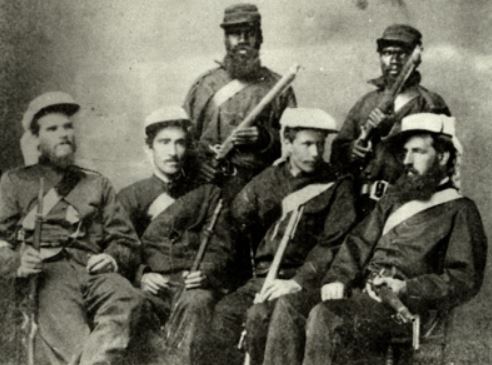
On November 9, 1867, the bodies of John Power and Patrick Cahill, members of the Police Gold Escort, were found at their camp at the Mackenzie River. They had been poisoned and shot – by their superior officer, the Gold Commissioner, Thomas Griffin. Here is the post that describes how this crime came about. ThomasContinue reading “The Inside Job – 09 November 1867”
Category Archives: Courts
Prisoners in Brisbane Gaol, 1875: Family Violence.

Domestic and family violence in the 19th century was tried and punished in a society that took a dim view of wives leaving their husbands, and of children who misbehaved. Divorce was only an option for the well-to-do, and women were seen as the property of their husbands. There were no dedicated laws preventing stalkingContinue reading “Prisoners in Brisbane Gaol, 1875: Family Violence.”
The Cunnamulla Bank Job.
It started out as a bank hold-up in a small western Queensland town. There was a shot fired, and an injury sustained. The robber’s getaway attempt descended into farce as a racehorse and a sheepdog became involved in a chase that ended up with the fugitive surrendering in a tree. In just two months, theContinue reading “The Cunnamulla Bank Job.”
“A Double Fraud, Double Treachery and Double Infamy.”
Judge Innes, Rockhampton District Court, 17 June 1867, sentencing a bigamist. Bigamy in Colonial Queensland – PART ONE Moreton Bay Courier, 1859 Whoever W.H.G. of Nanango was, he or she would have done well to take note of Brown’s Billy’s warning in the Courier’s classifieds in October,1859. Bigamy attracted stiff sentences of penal servitude, notContinue reading ““A Double Fraud, Double Treachery and Double Infamy.””
Courtroom Sketches

The glories of 19th century court reporting have been explored here before, with the emphasis on the flights of fancy indulged in by the Moreton Bay Courier’s scribes. As wondrous as the Courier’s prose can be, it could never compete with the Police Register columns of Bell’s Life in Sydney and Sporting Reviewer. Here areContinue reading “Courtroom Sketches”
Portraits in Crime Part 1

In the late 1890s, Queensland Courts began granting probation orders, and regional police stations and lockups started to record the released offenders with photographs and detailed descriptions. The photographs here are from a collection at the Queensland State Archives, Photographic records and descriptions of released male prisoners – Police Station, Longreach, 01/01/1889 – 31/12/1899. ManyContinue reading “Portraits in Crime Part 1”
Please, Governor, may we also have a Gaol?
For a place with a lot of prisoners about, and a population fond of indulging in ardent spirits, Moreton Bay was sorely lacking in a place to house criminals. There was a small lock-up in the Police Station, which occupied a part of the former Convict Barracks. It was only suitable for very short stays,Continue reading “Please, Governor, may we also have a Gaol?”
Who Lives in a Place Like This? Part 3.
The Sketch Map of Brisbane Town in 1844, and the stories behind it. 31. Taylor Shappart There was no Taylor Shappart in Brisbane in 1844. There was a tailor, John Sheppard, who lived and worked at Brisbane at the time, and later moved to Ipswich. I suspect that between the Gerler’s understanding of English namesContinue reading “Who Lives in a Place Like This? Part 3.”
True Crime in 1840s Brisbane
As reported by the Moreton Bay Courier With the exception of the murder of Robert Cox at Kangaroo Point in 1848, and the relatively distant frontier violence perpetrated by and on European settlers, life was fairly quiet in Moreton Bay in the 1840s. Still, there are columns to fill, and readers to shock, so theContinue reading “True Crime in 1840s Brisbane”
The Crimes of Women.
Mary Eileen Hagenbach, 1919 Mary Eileen Hagenbach was a tall, slender young woman of 23 years of age. A little severe-looking perhaps, an impression not helped by the fact that her hair had been chopped off roughly during a long illness. She’d just spent nearly four months in hospital after hemorrhaging during childbirth, and nowContinue reading “The Crimes of Women.”
 Moreton Bay and More