
John Sterry Baker.
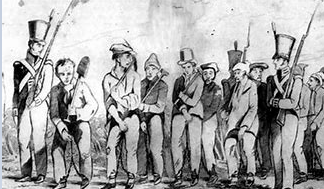
John Sterry Baker was one of the earliest Convict runaways in Queensland and he was the first to live among the Indigenous people for a significant number of years (14 in all). His story is not as well known as those of James Davis (Duramboi), David Bracewell (Wandi) and Sheik Brown, because he returned to Brisbane quietly, attracting no press stories or entries in official memoirs. His life after absconding was also quiet – giving some public service as an interpreter, before vanishing from the public record.
John Sterry Baker was born in 1798 in Norfolk, and in 1819 at Suffolk, received a sentence of transportation for life for theft. His occupation was Shepherd, which would prove his undoing in the Colony of New South Wales.
In January 1825, two lambs went missing from Mr Mudie’s run, eventually found in the possession of John Earl the local pound-keeper. John Baker, one of Mudie’s shepherds, had sold Mr Earl the sheep. Mr Mudie had been told by Baker that the animals had been killed by dingoes, but the sheep at Mr Earl’s were distinguished by markings as belonging to his run.
The Supreme Criminal Court of Sydney took a very dim view of that kind of offending, and John Baker was sentenced to death on 12 August 1825. His sentence was commuted to life and he was sent to Moreton Bay in late 1825, where the authorities noted his description – 27 years of age, 5 feet 7, with a dark complexion, dark brown hair and hazel eyes.
Christmas at the sweltering, partially-constructed penal colony must have been rather miserable, and the prospect of a lifetime of same enough to make a man take matters into his own hands.
On 08 January 1826, Baker escaped the settlement, and took his chances in the bush. He later related that he was near death with starvation and exposure, when a group of Indigenous people at the Upper Brisbane region found him, and recognised him as one of their own, Boraltchou, returned from the dead. He was welcomed and accepted into the group, who saved his life.
In the early 19th century in rural South-East Queensland, few indigenous people had encountered Europeans directly, and Baker was thought to be Boraltchou, returned, “scraped” of colour from the dead. This belief also benefited a later escapee, James Davis, who was recognised and accepted by another group as Duramboi, the late son of the leader Pamby-Pamby.
Boraltchou must have had to live by his cunning for the first few months, learning the language and customs of his new family, and being integrated into the group as a whole. From January 1826 until August 1840, Boraltchou lived as an indigenous man.
On August 4, 1840, Baker surrendered to the Commandant at Moreton Bay. The convict settlement had been decommissioned, and all but 39 prisoners sent back to Sydney. It would be another 2 years before the place would be open to free settlement, and the few officials still there would have been bemused by the sudden appearance of a naked, wild-haired man who wanted to surrender.
After some confusion as to dates, his paperwork was found, and rather than being lashed, Baker was shaved, dressed and sent to Sydney, where his proficiency with Indigenous languages – particularly those of South East Queensland – led to him being employed as an interpreter for indigenous people before the Courts.
Baker interpreted for Merridio and Neugavil in 1841 in the Sydney Supreme Court (where he was still described as being a prisoner of the Crown). Merridio and Neugavil were indigenous men, charged with the murder of William Tuck, who was killed alongside Assistant Surveyor Stapleton at Mount Lindsay in May 1840. The two men were eventually found guilty and returned to Brisbane, where they were executed in June 1841, publicly hung from the Windmill on Wickham Terrace. The Government was keen to make an example of indigenous people who killed white men, and the horrible business of the execution took place before a crowd of locals, black and white.
Baker received a Ticket of Leave, which was cancelled in 1850 for being absent from the area of Moreton Bay. Again. Some people never learn.
Baker gave details of his time away from Moreton Bay to the Rev. John Dunmore Lang and explorer Alan Cunningham, which show that communication between indigenous groups gave him information on the whereabouts of other convict absconders, exploration of the region and the closing up of the Penal Settlement at Moreton Bay.
SOURCES:
- Sydney Gazette and New South Wales Advertiser, 21 July 1825.
- Sydney Morning Herald, 17 August 1850
- Sun and New South Wales Independent Press, 06 May 1843
- Lang, J.D., Queensland Australia, a highly eligible field for emigration, p 61
- Convict Runaways of Moreton Bay, Journal of the Royal Historical Society of Queensland volume 10 issue 1: pp. 52-71 , O’Keefe, Mamie Brisbane, Qld. Royal Historical Society of Queensland, 1976
- Wild White Men in Queensland, Journal of the Royal Historical Society of Queensland volume 6 issue 1: pp. 73-93 , Cilento, Raphael, Lack, Clem Llewellyn Brisbane, Qld. Royal Historical Society of Queensland, 1959
- The Wild White Men, by Clem Lack, Truth (Brisbane, Qld.: 1900 – 1954), Sunday 15 April 1951, page 1
 Moreton Bay and More
It’s my understanding that John Sterry Baker died 17/01/1860 and is buried in the Ipswich General Cemetery, grave location unknown.
LikeLike
My understanding is that John Sterry Baker died 17/01/1860 and is buried in the Ipswich General Cemetery in a grave of unknown location
LikeLike