
George Gleeson and William Leonardo Moncado were executed together at the Brisbane Gaol on Monday, October 24, 1892. They had both been convicted and sentenced to death at the Supreme Court’s Cooktown sittings in north Queensland a mere month before.
George Gleeson

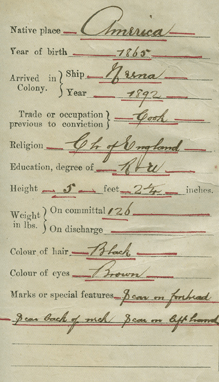
George Gleeson (pictured) was a cook at a pearling station on Prince of Wales Island, which was off the very upper tip of Australia. He was about 27 years of age, had been born in San Francisco, and raised in Calcutta. He arrived in Australia the year that he died – 1892.
Gleeson had been reprimanded by one of the owners of the pearling station over the quality of some bread he had baked, and took it very badly, and blamed another man at the station for encouraging the bosses to act against him. So upset was Gleeson that he tried to take one of the station’s canoes to go to Thursday Island to get some clothes. The station owner refused to allow him to do this, and ordered Gleeson to go and make breakfast.
Gleeson walked out, and went to cool his temper with some other residents of the island. That evening, a young man named Paddy McKiernan was reading in the parlour at the pearling station, when he heard Gleeson coming up the drive, swearing and blaspheming. There was a confrontation, Gleeson was armed and aiming a gun, and he shot McKiernan in the neck and chest.
A witness, Irvine, made haste to get a boat to Thursday Island for the Police and a doctor. George Gleeson chased Irvine for a bit, then wandered off. When the Thursday Island Police arrived, they and a posse of excited locals discovered Gleeson about 200 yards from the station house, still armed. He was arrested on the spot, and Police struggled to keep upset civilians from doing Gleeson physical harm.
Gleeson was bitterly upset at having killed Paddy McKiernan. Quotes attributed to him by witnesses to his arrest indicate that he had intended to do harm to another person at the station, not his friend McKiernan. His subsequent behaviour was quiet and remorseful. The bread reprimand may well have been the last straw, one suspects, in some racially-motivated bullying behaviour by the men he cooked for.
A great deal of attention was paid to George Gleeson’s ethnicity in press reports of the murder. The very first mention is of “an Eurasian native of Calcutta.” Further digging at trial found that he was American-born, but raised in Calcutta and of East Indian descent. Reporters stated that he was rather stout and had “a down look about him which is not pleasant to see”.
His victim, the unfortunate Paddy McKiernan, was described as a New South Wales man who, at the time Gleeson came cursing towards the station, had been seated in the parlour reading “The History of the Old and New Testament.” I’m impressed that a pearling station in the Torres Strait had a parlour, let alone a library with morally improving reading material. But, I suppose, it was 1892 after all. One never knows.
 Gleeson killed in May, was tried at Cooktown in September, and executed in Brisbane in October 1892. In less than six months, a trial was held, a petition for mercy rejected and an execution carried out. I have included this map to give an idea of the vast distances travelled in pursuit of justice in these cases. Gleeson was accompanied by another murderer, William Leonardo Moncado from Cooktown to the scaffold in Brisbane.
William Leonardo Moncado
William Moncado’s crime occurred on a brigantine, the Skitty Belle, which was lying off Thursday Island (near Prince of Wales Island) in late May.
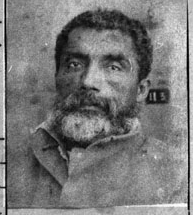
Ethnicity and race again played a large part in coverage of Moncado’s crime. He is described as “having the appearance of a light-coloured coolie” on arrival in Brisbane for his execution, appearing to be Indian in an earlier report, and finally as Chilean in the coverage of his execution. (The Gaoler at Brisbane probably gave the press Moncado’s prison card so that they could get that detail straight at the end.) The murdered man was routinely described as an Aboriginal “boy” and not named beyond “Bob”. No other details of poor Bob’s existence were kept, beyond the horrible way he died.
It was difficult to make a proper identification of Bob’s remains, as he had been dissected and parts of his body thrown overboard. It appears that a groan was heard, then Moncado was witnessed leaving Bob’s bunk at night, after which a splash was heard. Moncado was armed with a hammer and knife, which were blood-stained and hair-encrusted. Police found Bob’s genitals in Moncado’s bunk, and his killer’s bloody clothes in the box under the bed. Those are all the details that remain, because
The evidence of three black boys, countrymen of the deceased, was sufficient to fix the guilt on Moncado, but was of a character utterly unfit for publication and disclosed a depth of depravity on the part of the prisoner which renders belief in the nineteenth century civilisation almost impracticable. Warwick Examiner and Times
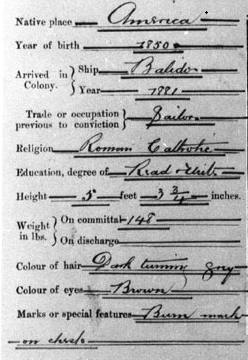
Moncado was in his forties and had been in Australia since 1881. What made him do what he did is a mystery, but hopefully he hadn’t committed a crime like that before.
Both prisoners were observed to be very aware of the gravity of their situation on arrival in Brisbane. Gleeson petitioned the Governor for clemency because he had no malice towards the man he killed, Moncado because he had no other option. Both petitions were rejected by the Executive Council, content to let the operation of the law take its course. Moncado shrugged when he heard the news, Gleeson said “If it must be, it must be” in “a foreign accent.” George Gleeson had some money, so arranged a multi-course feast at the gaol several days before the fateful one, an act that attracted aghast coverage in the local press.
The two men were executed by hanging at the Brisbane Gaol on Monday 24 October 1892. Moncado refused breakfast, but Gleeson had coffee and an egg. Moncado was the first to die, whispering “Lord Jesus, have mercy upon me, a sinner” just before the end. He died quickly, unlike Gleeson, who struggled for nearly fourteen minutes.
And that was the end of the Northern Murderers.
Sources:
Morning Bulletin (Rockhampton, Qld.: 1878 – 1954), Friday 27 May 1892, page 3
Telegraph (Brisbane, Qld.: 1872 – 1947), Friday 23 September 1892, page 4
Maryborough Chronicle, Wide Bay and Burnett Advertiser (Qld.: 1860 – 1947), Saturday 24 September 1892, page 2
Warwick Examiner and Times (Qld.: 1867 – 1919), Wednesday 5 October 1892, page 2
Telegraph (Brisbane, Qld.: 1872 – 1947), Thursday 6 October 1892, page 2
Telegraph (Brisbane, Qld.: 1872 – 1947), Friday 14 October 1892, page 2
Brisbane Courier (Qld.: 1864 – 1933), Saturday 15 October 1892, page 4
Telegraph (Brisbane, Qld.: 1872 – 1947), Monday 24 October 1892, page 5
Agency ID: 2197 Brisbane Correctional Centre. Series ID: 10836. Item ID: 17255: Photographic record, description and criminal history of “Leonardo William Moncado”, 3 October 1892. State Archives of Queensland.
Agency ID: 2197 Brisbane Correctional Centre. Series ID: 10836. Item ID: 17281: Photographic record, description and criminal history of George Gleeson, 3 October 1892. State Archives of Queensland.
Map excerpt courtesy of Whereis Qld.
 Moreton Bay and More