

In June 1865, James Alpin McPherson escaped the custody of a not particularly observant constable whilst being transported from Bowen to Rockhampton, where he was supposed to take his trial over a violent armed robbery the previous March. The bushranger pinned his shackles to a tree with the file he had used to remove them, and relieved farmers in the Mackay area of pistols and a horse.

Thus equipped, he headed south and inland over the next few months, covering roughly 640 kilometres, to resume his career in what his contemporaries elegantly called “sticking up.” What he did during the hiatus can only be imagined – travelling on horseback, camping in the bush, a little work on a station here and there, a little thieving as well. Not enough to attract unwelcome notice from the Police, but enough to keep him fed and clothed.
On 16 October 1865 the mailman on the Condamine and Taroom route was leading his trusty packhorse, when he was stopped approximately halfway between the two towns by a flashy-looking gent packing some serious heat. The robber was a tall, fair-haired young man wearing a panama or grass-tree hat, and red scarves, around the hat, over his shoulder and around his waist. He also sported patent leather boots and was armed with a double-barrelled rifle and two six-barrelled rifles.

The mailman was instructed to ride into the scrub while the bushranger sorted the mail and told his tale. He was the Wild Scotchman, a “New South Wales bushranger” (rather more glamorous than a Queensland one). He had been shot by Sir Frederick Pottinger after being surprised whilst indulging a love of literature, and had escaped from custody in order to give Queensland Police “a brushing up, as they had not life enough in them, and he wanted to brush the dust off their shoes for them.”
The needs of larceny and publicity satisfied, McPherson rode away on a “splendid bay horse” with his haul, which was a little lighter than he would have liked, due to a preponderance of useless cheques.
On 24 October, the Scotchman struck again, this time relieving the mail of a quantity of notes bound to supply the brand-new Queensland Bank at Roma. The people of Roma, who had waited a long time to get a bank in their area, set up a search party to track him. The Scotchman got the hint.
One month, and 500 kilometres later, McPherson robbed the Gayndah and Maryborough mail – twice. The bushranger took pains to brief his victim on Scotchman lore – focusing on his intellect and daring. The mailman obliged by providing the Maryborough Chronicle’s correspondent as follows:-
When about two miles on the Maryborough side of Mr. Irwin’s, I was riding leisurely along, and on rising a ridge, a man mounted on a black horse approached me on the slope of it, and presenting a revolver, called on me to stand ; he said he wanted the mailbags to see if there wasn’t a letter for the ‘Wild Scotchman;’ he made me go about two hundred yards in the bush, then compelled me to dismount and take off the bags. He next made me sit down, and after emptying out the letters, he sat down at a distance of two or three yards and commenced opening them. He told me his name was McPherson and said he didn’t make bushranging his entire occupation, but being fond of literature spent the greater part of the year in study at some place where he could rest in secluded quiet, he also said he could speak five languages; expressed his disgust at the general run of colonial newspapers, and said the Sydney Mail was the only one worth reading; didn’t care a damn for all the police in the country, as they were of no use; he said he had stuck-up the Condamine and Taroom mail, that it was the easiest job imaginable; that the Condamine mailman was a regular cur and a liar, because he had accused him of stealing his saddle when he never laid hands on it, said he believed the mailman had stuck to it. Asked if the photographers were still in Gayndah; hoped they would be quick in going down the road as he wanted a few portraits taken.

McPherson rode off with his ill-gottens, and the mailman gathered up the discarded mail headed to the Golden Fleece Station for the night. The next morning, as he headed back to Gayndah, he heard galloping behind him, and was again ordered to bail up by the Scotchman. Business was transacted rather quickly this time, and it was not ten minutes after McPherson galloped away that Police Magistrate Bligh met the mailman and proceeded to follow the bushranger’s tracks deep into the bush. Bligh and his party continued the hunt for days, determined to either catch, kill or drive away the Scotchman.
In the following weeks, a couple of letters were published in Queensland newspapers. The first was a story of McPherson’s youth in Brisbane by “a correspondent of the Guardian” and the second was signed by the Scotchman.

The first article is florid in its language and its praise of McPherson: “An opinion formed of him from appearance, however, soon alters when one has had a little conversation with him, as you then come to find out that he knows much more than you would at first give him credit for, and on more intimate acquaintance you discover that it is not an easy matter to take his measure, and in fact, that the more you know of him, the more you see that there are depths in his mind which you cannot plumb… The range of literature at his command there (the School of Arts) afforded him plenty of scope for selecting the works most to his taste, and the books that he did select, showed that he possessed an amount of intellectual discrimination, rarely to be met with in so young a man.” Indeed, he was “a member of the bushranging fraternity, of no ordinary stamp.”
The second article was the Scotchman’s letter to the editor of the Burnett Argus:
“Friend Thomas, The spirit did me move on last Saturday to take up into my hands and to peruse the periodical called and known in these parts as the Burnett Argus; and then and there I was informed of my own achievements in the Claude Duval line, putting the heroic defenders of Gayndah in general, and the Wide Bay and Burnett in particular, into a state of the greatest possible excitement.
“But, friend Thomas, although I am a bushranger I expect to be treated as a gentleman, and therefore the little bit of blarney you had in the Argus anent the bravery of Messrs. Bligh and Clohesy will, I hope, be taken at its true value. The real fact of the matter is, that when Mr. Bligh overtook me the chance which he had of my capture arose from a sudden fit of generosity on my part, as from the shaking, oscillating tendency of his knees and the pallor of his countenance, I thought he had been suddenly attacked with the fever and ague.
“Crawford, of Ideraway, was, however, the best lark of the lot. It was funny to see that fine gent. How civil he was; his eye every now and then reverting to my revolver, calculating most probably in his own mind, a possible contingency of his becoming acquainted with its contents.
” Mr. Crawford and the important band of heroes which he improvised on his return in safety to Gayndah, will I have no doubt earn a reputation only second to ‘Nap the First.’ However, when they catch me, please let me know.”
There is a similarity in style of the prose, and both letters use the word “anent”, a word fairly unusual even in 19th century letters to the editor, and one which a young man who simply couldn’t resist showing off his vocabulary might employ more than once.
On December 18, McPherson returned to the Gayndah district, sticking up the Ipswich and Nanango mail to Gayndah, and encountered the unflappable and marvellously whiskered mailman, Patrick McCallum.
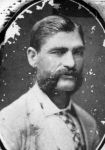
Over a campfire, McPherson showed his scar from Sir Frederick Pottinger’s gun, and interrogated the mailman about the Wild Scotchman’s reputation – he was offended when McCallum mentioned a rumour that not shooting at Police Magistrate Bligh made him seem a “cuffer.” This provoked a stream of self-justification – he was not a fool and had no desire to take life. But then he was quoted as saying that he would only shoot black policemen, considering indigenous people “cannibals” and “only fit to be shot.” His son, James Ossian McPherson, would die after a dispute with indigenous people nearly 50 years later.
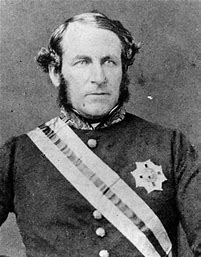
McPherson famously gave McCallum a letter addressed to “His Excellency, Sir George Ferguson Bowen, Brisbane, Queensland,” and a parcel of unwanted cheques to Mr Bligh. No doubt aware of an incident earlier in the year when Sir Frederick Pottinger had taken part in the Wowingragong races to lure Ben Hall out of hiding (he didn’t and it cost him his career), McPherson said that he intended to be at the Gayndah Christmas Races, presumably to tempt Bligh into a public confrontation.
Instead, Police Commissioner Seymour travelled to the Burnett District in late December to take charge of the search for McPherson. This move had the effect of forcing McPherson into hiding, which in turn had small towns from the west to the Burnett area seeing Wild Scotchmen behind every tree.

On 12 January 1866, the Wild Scotchman returned to Taroom, nearly 300 kilometres west, and held up the mail. Later that month, he ventured another 200 kilometres to rob the Roma mail, where it was reported that he showed great interest in the wanted posters about that town.
Just over a week later, the mail between Rockhampton and Springsure was held up. Journalists and Police began to wonder how a man could travel nearly 350 kilometres in such a short time.
February saw McPherson reported everywhere. Roma again, Springsure again. There was another rumour that the Wild Scotchman had been seen at Bald Hills (now a suburb of Brisbane), visiting his aged, and no doubt rather embarrassed, parents. Sometimes the bushranger was a tall fair-haired man, on other occasions, witnesses reported seeing a tall, swarthy-looking man. Then a Frenchman turned up in the Burnett district and harassed the mails. Who knew who was who?
On 03 March 1866, the Maryborough Chronicle had an idea.
The ‘ Wild Scotchman ‘ is today hundreds of miles North, tomorrow hundreds of miles South, the next day as many miles to the West. Our own opinion is there are more Richards than one in the field. We have the very good reason for believing the scoundrel, Macpherson, the original ‘Flying Scotchman,’ has never been far away from his old haunts in the Wide Bay and Burnett district. We have the best authority for stating that on Friday (yesterday week) he called at Galloway station, about fifty miles from Gladstone, and demanded rations, which, of course, under the compulsion of revolver law, were quickly given to him. He offered thieves’ money in payment, which was declined, and he then rode off.
As if to prove the Chronicle right, McPherson robbed the Springsure mail on 17 March. It would prove to be his last hurrah.
To be continued…
Maryborough Chronicle, Wide Bay and Burnett Advertiser (Qld. : 1860 – 1947), Saturday 24 March 1866, page 2
Brisbane Courier (Qld. : 1864 – 1933), Tuesday 6 March 1866, page 2
Maryborough Chronicle, Wide Bay and Burnett Advertiser (Qld. : 1860 – 1947), Saturday 3 March 1866, page 2
Brisbane Courier (Qld. : 1864 – 1933), Friday 23 February 1866, page 2
Brisbane Courier (Qld. : 1864 – 1933), Monday 19 February 1866, page 3
Darling Downs Gazette and General Advertiser (Toowoomba, Qld. : 1858 – 1880), Saturday 10 February 1866, page 3
Queenslander (Brisbane, Qld. : 1866 – 1939), Saturday 10 February 1866, page 4
Maryborough Chronicle, Wide Bay and Burnett Advertiser (Qld. : 1860 – 1947), Wednesday 7 February 1866, page 2
Brisbane Courier (Qld. : 1864 – 1933), Monday 5 February 1866, page 2
Dalby Herald and Western Queensland Advertiser (Qld. : 1866 – 1879), Thursday 1 February 1866, page 2
Dalby Herald and Western Queensland Advertiser (Qld. : 1866 – 1879), Thursday 18 January 1866, page 2
Brisbane Courier (Qld. : 1864 – 1933), Wednesday 17 January 1866, page 2
Maryborough Chronicle, Wide Bay and Burnett Advertiser (Qld. : 1860 – 1947), Saturday 6 January 1866, page 2
Northern Argus (Rockhampton, Qld. : 1865 – 1874), Monday 25 December 1865, page 2
Brisbane Courier (Qld. : 1864 – 1933), Saturday 23 December 1865, page 6
Queensland Times, Ipswich Herald and General Advertiser (Qld. : 1861 – 1908), Tuesday 12 December 1865, page 4
Maryborough Chronicle, Wide Bay and Burnett Advertiser (Qld. : 1860 – 1947), Wednesday 6 December 1865, page 2
Brisbane Courier (Qld. : 1864 – 1933), Saturday 2 December 1865, page 4
Brisbane Courier (Qld. : 1864 – 1933), Saturday 4 November 1865, page 5
Darling Downs Gazette and General Advertiser (Toowoomba, Qld. : 1858 – 1880), Saturday 28 October 1865, page 2
Rockhampton Bulletin and Central Queensland Advertiser (Qld. : 1861 – 1871), Tuesday 15 August 1865, page 2
Maryborough Chronicle, Wide Bay and Burnett Advertiser (Qld. : 1860 – 1947), Wednesday 5 July 1865, page 2
 Moreton Bay and More
Interested to know where You found the source of McPherson referring to the indigenous as cannibals.
LikeLike
What were the factual wrong doings of his son which resulted in a spear through the chest?
Don’t get me wrong love the blog and information but I only see newspaper articles to your references. It is a big statement that the McPherson’s had issues with the indigenous without factual evidence, i am fine if this is supported factually but if it just speculating it is not fair on James McPherson or his son. Its also not fair on descendants of the McPherson’s.
LikeLike
Hi, the sources I used were: Northern Argus (Rockhampton, Qld. : 1865 – 1874) Mon 25 Dec 1865, Page 2. THE MAIL ROBBERIES– THE WILD SCOTCHMAN AGAIN. Account of the Wild Scotchman and the mailman.
Northern Miner (Charters Towers, Qld. : 1874 – 1954), Friday 24 February 1911, page 3 (2) – Inquest on the death of McPherson’s son.
Hope this assists, and no offence was meant to any of McPherson’s descendants. Kind regards, K
LikeLike
Thank you I appreciate the link to the sources, I will go through them shortly. Appreciate it
LikeLike
I am always happy to change or amend the posts, particularly if I cause offence. K
LikeLike
Thank you so much for your open honesty, really appreciate your communications. Don’t get me wrong I really love what you do, I think this site is amazing as our Queensland history is very much not valued the way it should. I would like time to evaluate the sources before any further comments. I apologise if I have upset you in anyway and I can see how you have made the links. As I said, I would like time to evaluate sources before making a comment. Again love your work and communications. Talk soon
LikeLike
After going through both sources a few times I believe its a very harsh call on James McPherson’s son, yes not the greatest choice of words however he was under duress with having a spear lodged in his lung. He was assisting a situation where an indigenous girl was being stalked, he appears to have assisted and the stalker who not mentally stable violently attacked him. Very hard to judge him also unfortunately those times that language was quite common and judgments are being thrown upon him with modern cultural knowledge and understanding.
LikeLike
After going through both sources a few times I believe its a very harsh call on James McPherson’s son, yes not the greatest choice of words however he was under duress with having a spear lodged in his lung. He was assisting a situation where an indigenous girl was being stalked, he appears to have assisted and the stalker who not mentally stable violently attacked him. Very hard to judge him also unfortunately those times that language was quite common and judgments are being thrown upon him with modern cultural knowledge and understanding.
LikeLike
With James McPherson’s comments about his views towards the indigenous, I believe James may have actually said that and perhaps had those views. I also believe that the article possibly was created to serve as a motivating tool for black trackers. Why was the journalist trying to justify the mailman’s character so much. Also anything McPherson said during his times as a bushranger should be taken very lightly as he said many many things that weren’t true at all. Not saying this is not possible however further research with local white settlers and indigenous relationships in Burketown need to be conducted which could link the McPherson family with having racist views. Family stories say that after his death with falling from a horse an indigenous man walked and protected the family on their way to the eastern coast. A family with nasty views towards the local indigenous would not have received this favor.
LikeLike
Hello Kiel, thanks for your feedback. A couple of weeks ago, I re-evaluated what I had written in the original post, and edited it to remove the judgmental tone I’d adopted earlier. I hope that this is more satisfactory. Kind regards, Karen
LikeLike
Cheers for that and again I appreciate this blog I really do. Still don’t believe it was a dispute with the indigenous rather an involvement win a situation with the indigenous however it is your blog and I appreciate the time you have put into it.
LikeLike