
James Alpin McPherson’s criminal career came to an end at Gin Gin on 30 March 1866, when a group of local men recognised him and arranged an impromptu posse. They had the advantage of being better horsemen and shots than the police. The Maryborough Chronicle described his capture:
“A man answering to his description had been seen on the morning of the 30th ult., and had been inquiring for a road which he did not, it seems, intend to travel; he was again seen within a short distance of Munduran by two gentlemen living at Gingin, and they instantly proceeded to the Munduran head-station, and reported their suspicions as to who it was to the manager (W. Nott, Esq.), who, with praiseworthy promptitude, joined them, together with another per son, making in all a party of four, and immediately started in pursuit. They overtook him about five miles from the station, in the direction of Port Curtis. When he saw them in a full gallop, and nearly upon them, he instantly let go his pack-horse, and started at full speed down a very broken range; being well mounted they followed, and were fast gaining on him, when be pulled up and commenced to unstrap a double-barrelled gun, which he had with him; upon his commencing to do this Mr. Nott covered with his rifle, and told him that if he did not there and then throw up his arms and surrender, he would fire at him. This threat, fortunately, was sufficient, as Macpherson at once said, ‘I give myself up.’ He added, ‘ I knew you were not the police by the pace at which you followed me down that ridge,’ and he described, with some humour, the absurd attitudes which he had witnessed in police horsemanship — some holding on by the front, and some by the back of the saddle. The prisoner was very communicative and appeared cheerful. Those who were instrumental in his capture were, Messrs. W. Nott, Curry, Gadsden, and J. Walsh.”
After all his adventures this capture seemed a little anti-climactic, however McPherson was as self-aware as he was self-promoting. He was facing a long term of imprisonment, and if he kept on his dangerous path, he might face the gallows, or a bullet. The fates of famous bushrangers would have been a warning. Harry Power and Frank Gardiner were in gaol, unlikely to experience freedom for decades. The roll call of the dead would give the boldest man pause:
- Matthew “Gentleman” Brady: Hanged.
- Captain Melville: Suicide in prison.
- Edward Davis: Hanged.
- Jack Donahue, the Wild Colonial Boy: Shot by Police.
- John Dunn: Hanged aged 19.
- Ben Hall: Shot by Police
- John Gilbert: Shot by Police.
- Michael Howe: Shot by Police.
- Fred Lowry: Shot by Police.
- Dan “Mad Dog” Morgan: Shot by Police.
Three years without a roof over his head, stealing and being hunted by Police and settlers. Perhaps surrender and using his wits in a courtroom might better his chances.
When McPherson entered the courtroom on 03 April 1866, the public gallery was packed. His appearance was disappointing for those who had expected a wild, flashing-eyed outlaw bedecked with scarves. He was strong and wiry, but not remarkable-looking, and made himself comfortable in the dock as he was remanded in custody.

A week later, he was brought up on a charge if being an escaped prisoner, and the men of the hour told their tale of his capture. Irony of ironies, his captors included the Maryborough mailman, Edward Armitage, whose polite request for witness expenses is preserved in the Queensland State Archives.
McPherson was committed to the Brisbane Gaol (Petrie Terrace) to await his trial on the 1864 Bowen robbery at the next Maryborough Assizes. There was, for the time, quite a security operation to get the Wild Scotchman from the dock to the prison without attracting crowds or losing their prisoner.
The trial at Maryborough in August attracted another large crowd. McPherson was represented by a particularly able barrister, who was able to create enough doubt in the jurymen’s minds on the questions of identity and intent. The Wild Scotchman walked. Not far though, because the Attorney-General had him promptly re-arrested, this time on charges of bushranging. He was returned to Brisbane Gaol to await his trial there.
McPherson had escaped the capital charge. Now he was to be tried for larceny, and he had not been accused of any violence reported in any of his stick-ups. He might just beat the odds for famous bushrangers, a fraternity to which he was certain he belonged, and spend some time behind bars.

The Attorney-General chose the 28 November 1865 robbery of the Gayndah mail as the lead charge, aware that of the multitude of real and supposed Scotchman crimes, this one had the best chain of evidence and identity witnesses. McPherson’s counsel was a last-minute withdrawal, leaving him at a disadvantage. For an articulate man, the defendant had very little to say at this critical moment ion his life, merely saying that he was not as bad as he appeared. He had lived and worked as a decent man in the community until quite recently, and any mercy the Court could show him would be repaid in his future good life.
The Judge’s summing up and sentence was severe.
What prerogative had the prisoner to present firearms, loaded or unloaded, at any person? There are many who would prefer personal injury to that. The sentence would not be so severe as it would have been had the prisoner wounded, because he should then probably have had to pass sentence of death. On two successive days he (the prisoner) had stopped the mail— the only means of communication, it might be, between portions of the colony; and from the evidence it could be gathered these were not the only two cases of the kind. He had incited the dangerous class of the community to the commission of like crimes, by representing the police and the authorities as too weak to deal with such offenders and be hoped by the sentence he was about to pass such mistakes would be corrected. The prisoner was sentenced to twenty-five years penal servitude for each offence, the sentences to be concurrent.
James Alpin McPherson returned to the Petrie Terrace Gaol, a long-sentence man. He was looking at freedom by the age of 50, but he had escaped the gallows.

The Wild Scotchman disappeared from the public eye for some time, appearing only in reports of his good behaviour and industry, becoming the manager of a group of prisoners turning out particularly fine cabbage-tree hats. He seemed to settle in well to Brisbane Gaol, but overcrowding there meant Moreton Bay in 1870.
The next adventure of the Wild Scotchman was an escape with five other men, mostly fellow-bushrangers. They rushed the guards when the gates were being opened to bring them dinner. If they intended to make their escape from the Island itself, they were disappointed. Even hiding in bushland didn’t prevent their recapture – all were accounted for before bedtime that day. The scoundrels spent weeks on bread and water in the dark solitary confinement cells for their troubles.
In 1874, the senior McPhersons, still respectable citizens of Bald Hills, began to circulate a petition for the release of their wayward son. They were not wealthy and were in declining health. They needed the assistance of their son because their other children had grown up and married. McPherson’s excellent conduct (apart from his 45 minutes of freedom four years earlier) and industry, as well as his potential to give comfort to his aged parents, were given as reasons for praying for his release.
Prominent Queenslanders, including Judges and members of parliament, signed the petition, and it was a success. On 23 December 1874, McPherson was released from gaol by the following order:
Colonial Secretary’s Office, Brisbane, December 22, 1874. SIR, – With reference to a former petition signed by yourself and by certain members of Parliament, clergymen, Justice of the Peace, and others, for the remission of sentence in the case of James Macpherson, on a conviction for highway robbery under arms, and which, at the time is was presented, received the consideration of the Government, I am now to inform you that, on further consideration, and having regard to the good conduct and industry of the prisoner during the period of penal servitude he has already passed, a remission of the unexpired portion of his sentence has now been granted by His Excellence the Administrator of the Government, with the advice of the Executive Council, and instructions have been given for his immediate discharge. – I have the honour to be, sir, your most obedient servant, H. H. MASSIE
The Wild Scotchman disappeared into private life from that day. Although he was released to care for his aged parents, he started work as a stockman in the Blackall area in early 1875. His skill with horses and bushcraft kept him in demand, and he began to put down roots in the far western Queensland community. He eloped with an Isisford girl, Elizabeth Hoszfeldt, who pretended to be a few years older than her 17 years in order to marry her 37-year-old groom. They would have seven children, six of whom survived infancy.
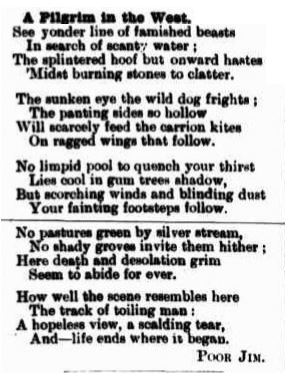
A business failure took the McPhersons further north-west, to Hughenden then to Burketown in the Gulf of Carpentaria, where James worked as a stone cutter and for the meatworks, and wrote poetry for the Charters Towers Eagle and the Worker under the nom de plume Poor Jim.
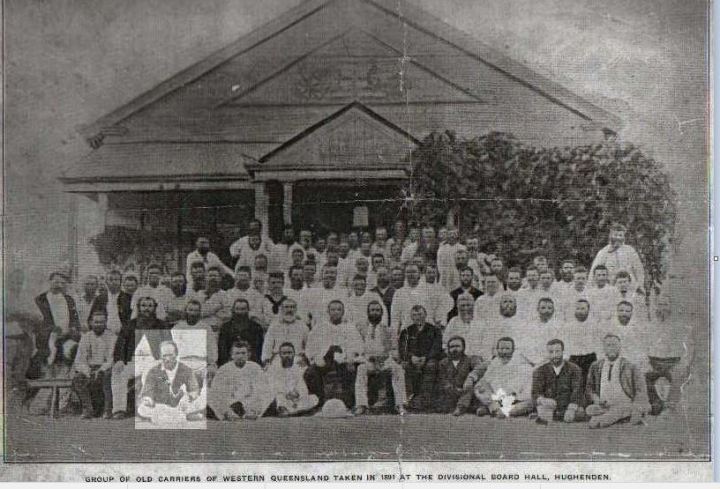
There is a photo of him in a group of “old carriers of western Queensland” at Hughenden in 1891. He sits in the front row, bearded and balding, with the slumped shoulders of a man who has known a lot of hard work and disappointments.
As Poor Jim, he wrote of his bush travels (not the criminal variety) and the social conditions experienced by the hard-working man on the land. The editor of the Eagle claimed to have secured a promise from him to write his Scotchman memoirs, but fate intervened.
James McPherson died in his bed on 23 July 1895 from severe injuries sustained in a fall from his horse on the way home from a friend’s funeral.
McPHERSON FAMILY:
John McPherson (1811-1896) married Eslpeth Bruce (1813-1888) in 1838. They had 10 children:
Jane 1838 – 1916
Donald Bruce 1839-1895
James Alpin 1841-1895
Christina Ann 1842-1903
William 1843-1888
John Bruce 1845-1925 and twin
Margaret Kennedy 1845-1926
Russell 1846-1933
George Bruce 1849-1938
Rachel 1851-1915
James McPherson married Elizabeth Annie Hoszfeldt (1861-1943) in 1878. Their children were:
Elspeth Ann (1880-1966)
James Ossian McPherson (1882-1911)
George Henry born 1884
John Robert (1886-1931)
Thomas Donald (1887-1887)
Flora Jane (1889-1983)
Bruce Clement (1891-1975)
SOURCES:
Week (Brisbane, Qld. : 1876 – 1934), Friday 26 July 1895, page 13
Queensland Times, Ipswich Herald and General Advertiser (Qld. : 1861 – 1908), Thursday 4 July 1895, page 7
Queensland Times, Ipswich Herald and General Advertiser (Qld. : 1861 – 1908), Tuesday 9 April 1895, page 7
Western Star and Roma Advertiser (Toowoomba, Qld. : 1875 – 1948), Wednesday 27 March 1895, page 2
Queensland Figaro and Punch (Brisbane, Qld. : 1885 – 1889), Saturday 19 November 1887, page 18
Western Champion (Blackall/Barcaldine, Qld. : 1879 – 1891), Wednesday 28 July 1880, page 2 (2)
Telegraph (Brisbane, Qld. : 1872 – 1947), Tuesday 8 June 1875, page 3
Mackay Mercury and South Kennedy Advertiser (Qld. : 1867 – 1887), Saturday 16 January 1875, page 2
Rockhampton Bulletin (Qld. : 1871 – 1878), Thursday 24 December 1874, page 2
Rockhampton Bulletin (Qld. : 1871 – 1878), Monday 4 January 1875, page 2
Telegraph (Brisbane, Qld. : 1872 – 1947), Wednesday 23 December 1874, page 2
Brisbane Courier (Qld. : 1864 – 1933), Saturday 6 June 1874, page 6
Rockhampton Bulletin (Qld. : 1871 – 1878), Monday 27 April 1874, page 2
Queensland Times, Ipswich Herald and General Advertiser (Qld. : 1861 – 1908), Thursday 9 May 1872, page 2
Brisbane Courier (Qld. : 1864 – 1933), Saturday 6 May 1871, page 5
Brisbane Courier (Qld. : 1864 – 1933), Tuesday 12 April 1870, page 2
Rockhampton Bulletin and Central Queensland Advertiser (Qld. : 1861 – 1871), Tuesday 12 April 1870, page 2
Queensland Times, Ipswich Herald and General Advertiser (Qld. : 1861 – 1908), Tuesday 22 June 1869, page 3
Brisbane Courier (Qld. : 1864 – 1933), Tuesday 23 April 1867, page 3
Maryborough Chronicle, Wide Bay and Burnett Advertiser (Qld. : 1860 – 1947), Saturday 15 September 1866, page 2
Maryborough Chronicle, Wide Bay and Burnett Advertiser (Qld. : 1860 – 1947), Saturday 25 August 1866, page 2
Dalby Herald and Western Queensland Advertiser (Qld. : 1866 – 1879), Thursday 19 April 1866, page 2
Maryborough Chronicle, Wide Bay and Burnett Advertiser (Qld. : 1860 – 1947), Saturday 14 April 1866, page 2
Maryborough Chronicle, Wide Bay and Burnett Advertiser (Qld. : 1860 – 1947), Wednesday 4 April 1866, page 2
Sabatech.net
Queensland State Archives Digital Image ID 2791 Brief to the Crown (No. 2) by Robert Little, Solicitor, regarding the case Regina v J McPherson otherwise called the Wild Scotchman, dated 20 August 1866
Queensland State Archives, Digital Image ID 4662: Letter from Edward Armitage to the Attorney-General, requesting compensation for being discharged from his employment as a result of travelling to Brisbane to testify re the capture of McPherson alias “Wild Scotchman”, dated 17 September 1866
 Moreton Bay and More
Thank you so much for this wonderful site. That is the first time I saw the photo of James as a Courier. I am a descendant with George Bruce being my Great Great Grandfather. I have been doing my own research with James and trying to gain as much information as I can. I am trying to find more of the poetry he wrote especially on St Helena and more information on which brother was in the mental asylum in Brisbane. Your site I found very useful
Thank You
LikeLike