
The first photo is haunting. It is called “The Gold Escort” and features the first two Police officers killed on active duty in Queensland, and their murderer, Gold Commissioner Thomas Griffin.

The people in the photograph are (seated, left to to right: Sergeant James Julian, Constable Patrick William Cahill, Constable John Francis Power, Gold Commissioner Thomas John Griffin. (Standing: the names of the two Native Police Officers have not been recorded.)
Sergeant Julian gazes mildly up and to the right of the photo and Constable Cahill stares out into the middle distance. The two indigenous men in their dark cloth caps look off to the right. They have all had to remain very still for the photographer, and they have, in their various ways, tuned out slightly.
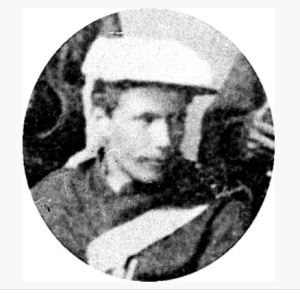
Not Constable Power. His upper torso turns towards the stout, bearded man on the right. Power fixes Griffin with his eye. He is gazing intently at his own killer.
Looking at a detail of the photo doesn’t yield much more. Is he smiling at some private joke? He seems to be concealing a smile. Or does what looks like a pale moustache lead to that impression? Has he been instructed to gaze at Griffin, or off in that direction?
It is very unusual in Victorian photography to have one person looking at the other so intently. Usually subjects gaze off into the distance in the manner of Cahill and Julian, looking as sombre as physically possible. One’s station in life and all that.
Someone who understood one’s station in life better than most was Thomas John Griffin. He gazes across his men, two of whom would prove more useful to him dead than alive) making sure that the camera catches all of his gravitas. Griffin was used to concealment. He hid – stole in fact – a letter critical of him to the Magistrate at Clermont, he concealed his gambling debts and also his inability to repay Chinese miners debts to the tune of £252.
Arrogance, or sheer foolhardiness, or both, led Griffin to rob the escort, killing two of his men in the process. He gave contradictory statements and seemed hugely surprised that anyone would question his word.
Griffin would go to the gallows the following year. A week after his execution, the sexton of Rockhampton Cemetery noticed that the grave had been disturbed, and on examination of the grave, confirmed that someone had removed and stolen Griffin’s head.
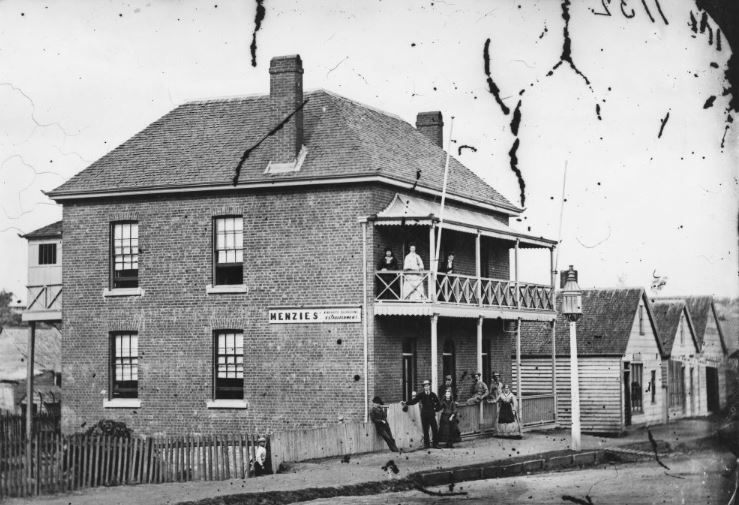
So much is happening in this picture. You have the three respectable looking ladies on the first floor balcony, two of them appear to be in mourning. Fashion has gradually coaxed them out of the mile-wide crinolines of a few years before, but they have not embraced the new silhouette entirely. Guests? Owners? Proprietress and guests?
The aura of respectability is gradually undermined by the figures on the ground. There is a lady in middle years wearing a dark apron who may be a servant, with a man standing behind her.
There is another man sitting cheekily along the front railings, not an attitude that would invite the most select guests to stop at your boarding establishment. If the lady in the apron was the landlady, she would be unlikely to stand next to someone who was sprawled along her railings in such a lax manner. She would, one suspects, be boxing ears.
A man and a girl who appears to be a teenager pose near the fence and face the distant camera. I thinks she’s still a minor, because she hasn’t let her skirts down in the coming of age tradition of the time. She may be in mourning, but then the black and white photography converts all dark clothing to black.
To the left of that couple is an extremely shady looking individual, leaning against the fence at such an angle that the viewer needs to look twice at the fence to see if it’s falling down. It’s not, it’s just the depth of his slouch. Magnifying the photograph shows that he is looking off to the left of the photo under the brim of his hat. I imagine that any respectable Victorian papa or mama would give the establishment a wide berth at the sight of him.
Then there is a puzzling little figure emerging seemingly from the ground by the fence, but in reality from a set of steps behind the fence. It appears to be a child, or at least a young teen, and may be what the larrikin slouching on the fence was looking at. The boy’s posture shows a little surprise at being in the picture. He turns slightly and stares quizzically at the camera, and we can only guess what he was up to that day.
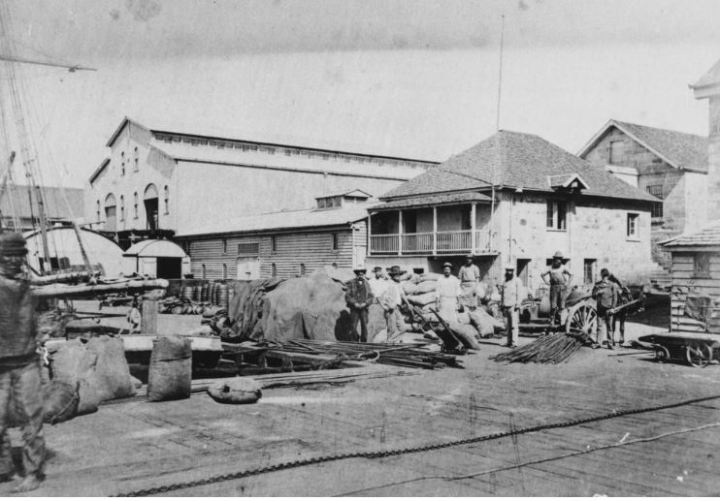
It’s just a brief moment in time – vessels are being loaded and unloaded, carts and barrows are being employed to make the job a little easier. Casks are lined up under a balcony, and flour sacks are being loaded up.
The men are attired and employed according to their station in life. There are men in white smocks and aprons taking up the flour under the supervision of a heavily bearded man in a pale suit.
Another man, either in overalls or shirtless – it’s hard to tell – stands on the wagon, surrounded by people who are triumphantly inappropriately dressed for the subtropical weather.

And there on the very edge of the picture, slightly blurred, and definitely not intended to be caught in the frame of this tableau of white men and commerce is the figure of a dark-skinned man. He is barefoot, wears a cloth cap and is dressed shabbily. Perhaps he is a hand on one of the ships, or a wharfie. He squints at the unfamiliar camera from the edge of the frame, and throws everything off balance.
 Moreton Bay and More