
The excitement in town on Wednesday and Thursday was such as has not been witnessed by the oldest inhabitant. It was actually possible to see four people in the streets together, and many and conflicting were the rumours and fears.
Moreton Bay Free Press, 1853
A Strange Vessel at the Bay
On 25 March 1853, a launch entered Moreton Bay by the south passage and beached at Amity Point after encountering some rough seas. Those on board the boat took portable necessities with them and went on foot to find help.

Encountering some indigenous people at Stradbroke, the boat’s crew asked for assistance in finding the nearest white man, which was provided. Here the crew divided, and three men were ordered at gunpoint to remain at the beach until the others returned.
The indigenous men, no doubt relieved that in this case the white men were aiming guns at each other rather than them, took the sailors to Fernando Gonzales, a Manila-born fisherman, who had a camp on the island.
The sailors told Fernando that they had been on a schooner which had been wrecked nearby, and could they borrow his boat to go and get their valuables? Fernando wasn’t keen, so the shipwrecked sailors asked him to speak to their Captain, who was a little way down the beach. Fernando went to see this Captain, and while he was away from his camp, everything he owned was looted and his boat taken.
The men at the beach turned out to be a Coxswain named Forsyth, and Constable Henry Bordmore. With them was a prisoner of the Crown. All had come from the Norfolk Island Penal Colony, under considerable duress, after a convict crew unloading a boat overwhelmed their guard and took the launch. Constable Bordmore was a hostage, and the coxswain had been saved from drowning. The prisoner with them was nervous about the attitude of the other escaped convicts, and chose to remain with the hostages.
As Fernando’s stolen boat sailed past the little party on the beach, the pirates sent two of their men ashore to collect the wavering prisoner. They were unarmed, and the shore party was able to tie them up. Their comrades sailed off towards the river, minus three of their own, and their hostages.

Samuel Sneyd
The following Monday, a local fisherman named Timothy Duffy came across the stranded group, and after hearing their astonishing tale, brought them into Brisbane Town on Tuesday to see Chief Constable Samuel Sneyd. Sneyd wasted no time securing the escaped convicts – Robert Mitchell, Denis Griffiths and James Clegg – in Brisbane Gaol, then saddled up and set about searching, and warning people in outlying areas of the danger of six armed Norfolk Island escapees at the Bay.
The small population of Brisbane Town trembled at the thought of a boatload of armed pirates rampaging through their hamlet. The Customs Boat set about searching.
The three that are apprehended are Mitchell, Griffiths, and Clegg. They are fine specimens of the animal, man, as brutalised by crime and Norfolk Island.
Empire, Sydney.
A Strange Sail
Meanwhile, several boats in the Bay had noticed a strange sail in their sights. The Steamer Brothers noticed a sailing boat full of men and hailed the vessel, which did not respond. That night, the sailors on board the Agricola heard a boat with muffled oars pass by them in the darkness.
On Wednesday morning, the crew of the barque Acacia, which was heading out to Sydney, met a boat full of men who claimed to be the survivors of a shipwreck near Wide Bay. The captain of the Acacia kindly provided the survivors with breakfast, and the men chatted harmlessly with some members of the Harbour Master’s staff, who were on board to help the Acacia navigate out of the bay. The runaways were enjoying their breakfast aboard the Acacia when the Customs Boat and constables sailed blithely by.

of the period
Refreshed, confident in their shipwrecked sailors’ guise, and full of helpful information about the Pilot Station, the men returned to their boat and headed towards the river. No-one thought a great deal of the encounter at the time, because the convicts had turned their uniforms inside out to hide the arrows.
Hours later, as the Harbour Master’s vessel returned, the men in the fishing boat pulled up alongside them, and, friendly demeanour gone, boarded at gunpoint. The men demanded that the crew exchange clothing and boats. After inflicting this humiliation, the convict pirates took off in the official vessel to visit the Pilot’s Station, leaving the Harbour Master’s men with Fernando’s fishing boat and wearing the tatty and no doubt rather malodorous prisoner’s uniforms.
The same evening, the excitement was kept up by the arrival of the Harbour Master’s crew in Fernando’s boat, rigged out in the clothes of the pirates. Being naturally mistaken in their unpleasant disguise, they were seized, at first, as the veritable pirates themselves, but the familiar form of Bowles soon dispelled the illusion.
The Moreton Bay Free Press, 1853
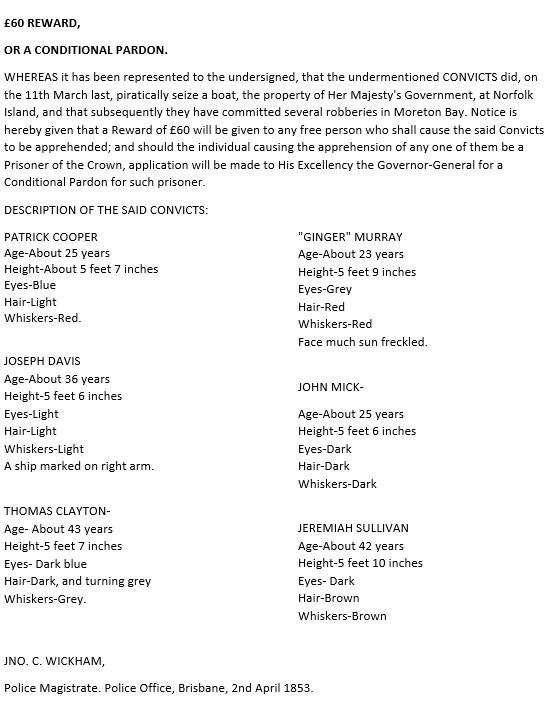
By now it was Wednesday night and the identities of the remaining Norfolk Island escapees were confirmed, and a reward offered for their capture.
The Pilot’s Very Bad Day
On Thursday morning, the interest of the tale was still further increased by the appearance of Mr. Watson, the pilot, sans coat and hat, and with a very disconsolate aspect, going up the street to the Court House.
The Moreton Bay Free Press
Watson had been at home when six men came ashore, claiming to belong to one of the ships in the Bay. Mr Watson seems to have been at best an unobservant man, because by that time, the convict pirates were dressed as members of the Harbour Master’s staff, and were using the official vessel.
Despite this shortcoming, Mr Watson was hospitable, and invited the group to his house for some refreshments. After a few pleasantries, the Pilot found himself pushed onto a sofa, and deprived of his clothes, liquor, provisions, watch and money. One of Mr Watson’s children made an appearance, and, seeing the pickle Father was in, ran off to alert their neighbours. The pirates fired a warning shot, fortunately missing the child.
Mr Watson, deprived of just about everything, and having witnessed the attempted murder of one of his children, prevailed on his attackers to leave him a bottle of rum. A man with priorities. The convicts gave him back a bottle, and bade adieu, thoughtfully staving in Watson’s boat, so that he could not pursue them.

Captain Wickham
Watson spent the night patching up his vessel, and made the miserable journey into town to see Captain Wickham at the Court-house. Wickham, a Royal Navy veteran, was a man of action. He chartered a schooner, the Swallow, and put the word out for volunteers to assist him in rounding up these blackguards. He was rewarded with a solid crew of men, including Captain Geary, the Harbour Master (no doubt anxious to retrieve his vessel), and Mr F.E. Bigge, JP.
The one able-bodied man who was unwilling to join the mission was, unfortunately, the engineer of the Swallow. After considerable persuasion, the party got underway on Thursday evening.
And then, for weeks, nothing. The three runaways already captured – Mitchell, Griffiths and Clegg – were sent to Sydney, and then to Van Diemen’s Land, to be sentenced again, this time for the theft and destruction of the launch from Norfolk Island, valued at £50.

prior to being sent to Van Diemen’s Land.
The Government reward for the capture of the remaining six was now £100 from the Government at Van Diemen’s Land, in addition to the £60 from Moreton Bay.
Captured
On 19 May 1853, fisherman Eugene Lucette arrived in Brisbane with the Harbour Master’s boat in tow. He and his crew of indigenous men had retrieved it from among the mangroves at the mouth of the river, having watched the escapees bring it ashore.
Another search party was organised, this time with the Customs Department, Chief Constable Sneyd and volunteers. They went ashore where the Harbour Master’s boat had been landed, and located the fugitives the following morning, with the help of indigenous trackers. The convict pirates were surrounded and gave up quietly, probably tired of playing hide and seek in the unfamiliar waters of the Bay.
Transportation Beyond the Seas
The Attorney-General was spoiled for choice for charges to place against the recaptured Norfolk Island convicts. He decided on the one charge that had the greatest chance of success. It was the first offence which could be proved to have taken place on land at Moreton Bay, the robbery of Fernando Gonzales of his boat and belongings. Mr Gonzales might have been a more credible witness than Watson, the Pilot who begged for his rum back after his child was shot at.
Edward Sullivan, James Godfrey, John Mick, Joseph Davis, James Murray, and Thomas Clayton were found guilty and sentenced to 15 years’ transportation beyond the seas.
Beyond the seas turned out to be Van Diemen’s Land, where the final charge of seizing the launch at Norfolk Island still loomed.
They are mostly gigantic looking men, of a daring aspect, and severally gave their names as follows: John Sullivan, John Merry, John Meek, Thomas Clayton, Joseph Cooper, and John Davis. The prisoners, who were heavily ironed, were formally charged by Mr. D. C. Simpson; and remanded until Thursday.
Hobart Town Advertiser.
The convict pirates of Norfolk Island were heavily shackled, and heavily sentenced. But they were not finished with piracy. Not by a long shot. Their next target won them even greater infamy, and will be the subject of the next post.
 Moreton Bay and More
CONGRATULATIONS! Your blog has been included in INTERESTING BLOGS in FRIDAY FOSSICKING athttps://thatmomentintime-crissouli.blogspot.com/2020/11/friday-fossicking-27th-nov-2020.html
Thank you, Chris
LikeLiked by 1 person
Very Interesting… Stories about Sea always fascinate me. ❤
LikeLiked by 1 person