
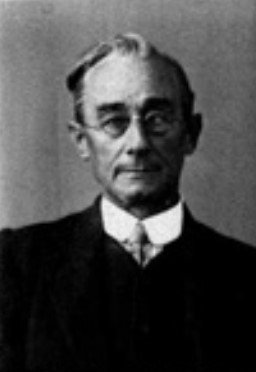
In the Queensland Police Service Watch-house Entry Books, a photograph of a respectable-looking middle-aged man is accompanied by a string of aliases, each more bizarre than the last. He could be the local vicar, but for all of those names. He was imprisoned for bigamy, something that was far more common in those far-off days before computer databases. People often married again in the belief that a previous spouse had passed away. It could have been a mistake. But all those aliases …
The man was charged as Gordon Vane Tempest Simpson. The name hints at the Londonderry line of Vane-Tempest-Stewarts, and the long-expired Baronetcy of Vane-Tempest. Flash.
Then the aliases are listed: Sydney Burge, Dr Burge, Gordon Tempest, Cecil Aubrey Pierpont, Cecil de Vere, then “Penny etc”. The Watch-house keeper ran out of room, and probably patience.
Some bemused investigation turned up a man with a life so outrageous that it exhausted the police and judiciary for five decades. He couldn’t have lived that life today, too much data checking and identification. He was a rogue entirely of his time, peddling pseudo-aristocratic and professional connections to gullible colonials in far-off Australia.
Rather than start chronologically, I’ll start with three cases that pretty much summed Mr, er, Simpson, up.
The Doctor’s Dilemma
In April 1887, the Police Station at Geelong, Victoria had a caller. An aristocratic young man, exquisitely dressed, introduced himself as Thomas H. Penny, and he wanted to clear a little matter up, if it was alright. You see, there was a warrant issued from the Bench in Melbourne, a mistake really, but he wanted to turn himself in and get it all sorted out.
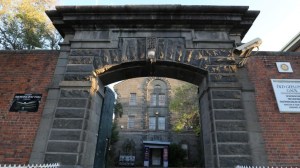
The charge was larceny as a bailee, and after getting instructions on the charge from Melbourne, the Geelong Police realised that the charge against young Penny was that he had stolen the borrowed clothes he stood before them wearing.

The Court was advised that Mr Penny had asked to borrow a suit of clothes from a Mr Stanley. Mr Penny told Stanley that he was a doctor, and that he had to see a patient at Brighton, and couldn’t possibly enter a respectable home in his own threadbare attire. Mr Penny received three months. Mr Stanley received a civil judgment for £12. I doubt that Mr Penny paid it.
The Baronet at Blackheath
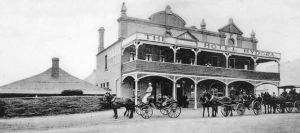
Blackheath is a picturesque town in New South Wales, high up in the Blue Mountains, about 130 kilometres from Sydney. After being thus named by Lachlan Macquarie – strangely, he didn’t name it after himself – a settlement grew up in the 1830s and 40s. Charles Darwin had a pint at the Scotch Thistle Inn in 1836.
In 1903, an English chap named Cecil R Aubrey came to town, to seek employment as a piano and organ tuner. After a few weeks enjoying the altitude and rural charms of Blackheath, he made it known that he had come into a baronetcy, and would be pleased to be addressed as Sir Cecil Aubrey Pierpont.
Sir Cecil declared that he would be good for £3000 a year, once all the tedious paperwork was dealt with. In the meantime, he felt that his appearance should match his new station in life, and could he possibly borrow, oh, let’s see – silk hat and frock coat, buggy, down-payment on a nice station perhaps, er, you know.
Suitably attired and with an air of gentility, Sir Cecil set about calling on local worthies, taking the opportunity to introduce Lady Pierpont, a new addition to the family. The aristocratic couple left calling cards with their titles to introduce themselves to proper society.
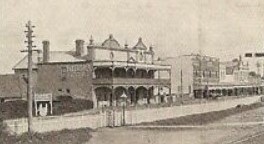
Sir Cecil gave a recital, held dinner parties, and promised donations to local churches. The time came when he decided to leave Blackheath for his new station, and he settled up his accounts by cheque, and cashed some cheques drawn in his favour. Sir Cecil and Lady Pierpont were well clear of town when the cheques came back unpaid. Inconvenient, that.
When apprehended on a warrant and returned to Katoomba for court proceedings, the Bench gave him twelve months’ hard labour. It appeared that “Sir” Cecil had been in trouble before on larceny and false pretences, and had been previously sentenced to terms adding up to thirteen years.
The Constant Husband
In April 1927, Plain Clothes Constable Angus was working the night shift in the Bundaberg Police Station, when a quiet, distinguished-looking man walked in at 10:30 pm, advised that he was Vane Tempest Simpson, and asked to be charged with bigamy. He would provide a statement of his guilt.
Somewhat puzzled, PC Angus asked why he wanted to do this. The Englishman explained. He asked if Angus had heard that he had married Mae Rose Death at Bundaberg several weeks before. Angus replied that he had.
“That is right. To-day we had a bit of a quarrel and she said that I had deceived her and she wanted a divorce. I told her I would never give her a divorce, and she said, ‘If you do not give me grounds for a divorce, I will give you grounds for one.’ On the face of that I came round to tell you what I have done so that she will be free.”
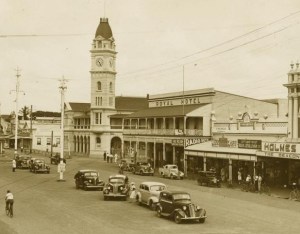
parking situation.
When the matter came before the Bench, the Court was made aware of who Vane Tempest Simpson was, and how he had come to commit bigamy. He admitted that he had married Minna Elizabeth Platzke in Maryborough in 1917.
Simpson had a job selling musical instruments, and romanced a young English girl named Mae Rose Death. He promised her a settlement of £250 and a dress allowance and she agreed to marry him.
To no-one’s surprise except the young wife’s, the promises that had lured her into matrimony had not been kept. They quarreled, and Simpson decided to give her grounds for the divorce, earning himself two years in prison in the process.
And that’s where we get to that photo with all the aliases. Who was this man, and what had he done?
The Life of Mr Thomas Penny
Thomas Henry Augustine Penny was born in Southampton on 27 September 1865, to Isaac and Eliza Penny. He married his first wife, Gertrude Hemstead in 1884, and they had a son. In 1886, Thomas Penny left his wife and fled England for Australia after a two-month prison term for false pretences and a few open police investigations, arriving in Melbourne on the Beecroft.
THOMAS PENNY, CECIL DE VERE, cecil royle aubrey
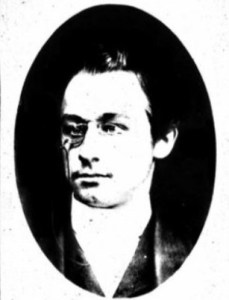
In December 1886, Penny was arrested for his first Colonial offence. He spent the following ten years in and out of prisons in Victoria and New South Wales, using first his own name, then the alias Cecil de Vere.
On release from prison in 1896, Cecil de Vere began to style himself as Cecil Royle Aubrey. He married (bigamously) Alice Hyacinth Brewer in Sydney in October 1896. Marital bliss was brief because Aubrey was charged in December 1896 with obtaining money by a valueless cheque, and received a four year prison term. Despite Alice giving him an address to return to from prison in 1900, he never appeared at that place, and she never saw or heard from him again.
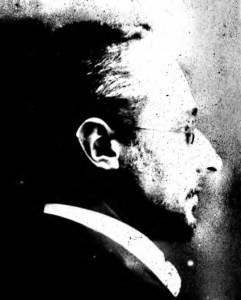
In October 1900, Tasmanian Police arrested Cecil Royal Aubrey and a young woman named Ada Elizabeth O’Rourke for obtaining money through a valueless cheque. Described by court reporters as “a respectable looking and well-dressed young man,” Aubrey was imprisoned for two years. Miss O’Rourke entered into a good behaviour bond. On Aubrey’s release from prison in 1902, he married Ada O’Rourke.
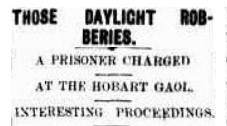
The following year, Sir Cecil Aubrey Pierpont fleeced the good people of Blackheath in company with a woman whose identity was not disclosed. It is most likely to have been Ada Aubrey Pierpont.
His first wife Gertrude was still living and in England. His second wife Alice divorced him in 1904 on the grounds of desertion and Aubrey’s criminal history.
cecil rowe
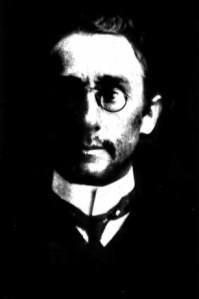
A charge of false pretences in Victoria in 1905 brought another year in prison, and, as Cecil Rowe, he received a sentence of five years in 1909 for the same offence in Tenterfield, New South Wales. Cecil Rowe had also been in south-west Queensland, claiming to be a journalist from the Bulletin. The publication disowned him in ringing tones when contacted by skeptical locals.
Emerging back into society in proper style, Cecil Royle Aubrey married Marion Cameron in St Andrew’s Cathedral, Sydney on 20 November 1913. He then spent 1915 in prison under the name Cecil Royle Aubrey. Guess the charge.
GORDON ROWE
On release in 1916, rather than return to Marion Aubrey, he reinvented himself as Gordon Rowe, and married a woman named Hannah Devis. His behaviour hadn’t changed with his name, and he relocated to Sydney to avoid a warrant for Gordon Rowe, not to mention an investigation for posing as an optometrist.
Perhaps New South Wales was getting too hot for Gordon Rowe, because he relocated to Queensland, called himself Gordon Cecil Tempest, and married Minna Elizabeth Platzke in 1917.
GORDON TEMPEST, DR BRUCE BURGE, GORDON VANE TEMPEST SIMPSON
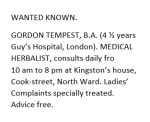
Having posed as a surgeon in the 1880s, and an optometrist in the war years, it was no great stretch for Gordon Tempest to pose as a herbalist. Perhaps Ladies’ Complaints included their prospects as potential wives and/or marks.
In 1919, Gordon became Dr Sydney Bruce Burge, and was convicted for false pretences – again – and also for attempting to procure an abortion on a teenaged girl who had been impregnated by her boss.
That case was reported in horrendous detail by the tabloid, the Truth. The employer of the girl did not have her consent, and when she became pregnant, he conspired with “Dr” Burge for a certain procedure to take place. Dr Burge tried his best, but a baby boy was born healthy, while his mother required months in hospital to be well enough to give evidence.
During Burge’s seven years’ hard labour sentence for the conspiracy and abortion charge, Hannah Devis filed for divorce from Gordon Rowe on the ground of desertion and Marion Cameron obtained a warrant for desertion against Cecil Aubrey from the Children’s Court at Sydney. Several of the marriages had produced children.
On release in 1927, Gordon Vane Tempest Simpson roamed north, and in Bundaberg married Mae Rose Death. He then handed himself in to Police for bigamy, resulting in another two years’ imprisonment. Probably better to plead guilty to one count of bigamy, than face the prospect of a further five counts.
gordon simpson
Gordon Simpson left gaol in Brisbane in 1929, and led a peripatetic life in New South Wales and Victoria, swindling where he could.
He did not remarry, and probably didn’t want to tempt fate by doing so. He’d served one stretch for bigamy, and he could have been liable for another five.
“How long has he been carrying on this way?” – Magistrate Arnold
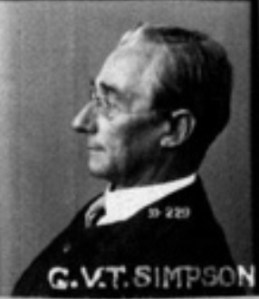
In 1931 at Parkes in New South Wales, Sergeant Ferris was making enquiries about a man travelling the area, posing as doctor of medicine. He met with Gordon Simpson, and realised that Simpson did not fit the description of the medicine man, who was much taller. Out of caution, Ferris asked Simpson to confirm that he was employed by the Department of Health as a doctor. Simpson replied that he was employed by the Health Department of South Australia to examine children at the schools. That wasn’t what Ferris had asked, so he followed up with the South Australian Government. No Dr Gordon Simpson was registered to practice. Simpson pleaded guilty and was fined £50 with the alternative of 100 days in custody. Before Simpson could make that choice, charges of defrauding a church of £20 were proffered. He was remanded to Blaney to face those.
THE NIGHT OF DESPAIR
The Brown’s Creek Methodist church had found a sterling man in Gordon Simpson. He played the organ beautifully, and filled in as a lay preacher. When the church needed a replacement organ, Simpson offered to purchase a good second-hand one from a dealer nearby, and was entrusted with £20 to go and make the purchase. Neither the money or the organ materialised. The Bench gave him two years, argued down to 23 months after this tearful speech from the dock:
“What chance has a man got who has been in prison? Every man’s hand is against him. A man tries to drag himself out of the mire of a misspent and wasted life, and just when he feels he has reached ground, he is thrust back into the night of despair.”
Gordon Simpson, 1931
Simpson was genuinely concerned that he would die in prison. He didn’t. There were two more gaol terms – two and six months respectively, in South Australia for failing to pay hotel bills, then he went and sinned no more.
After living in a halfway house for prison reform in Victoria, he was quiet through the 1940s, and finally passed away in Cheltenham in December 1952 at the age of 87. Under his own name, Thomas Henry Augustine Penny.
A Selection of Press Descriptions.
Descriptions from the press gallery go some way to explaining why people (mostly) trusted Thomas Penny. He looked so – credible.
1887
- An aristocratic looking individual.
- A highly enameled three-star aristocrat, with a Roman nose and a plug hat.
1889
- A delicately wrought tough with a smug visage.
1889
- An elegant looking young man.
- A mild-looking young man, through whose spectacles fairly beamed gentleness and morality.
1900
- He had every appearance of a “swell,” even in his branded gaol suit.
1931
- A cultured gentlemanly-looking man; with grizzled hair and a pleasant expression, and neatly attired in a navy-blue suit sat in the dock at the Police Court yesterday morning, and to the uninitiated, it would seem that some professional man was merely taking an airing in that insalubrious portion of the Court. He looked the courteous type of old gentleman to whom one would entrust his last half-penny.
- Bespectacled and pious-looking.
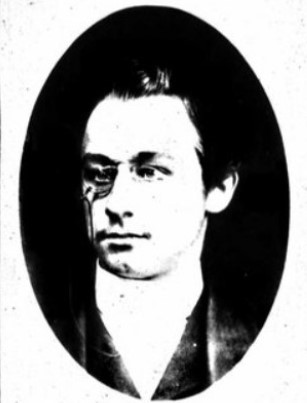
1886 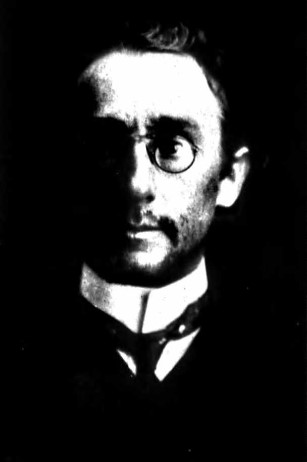
1909
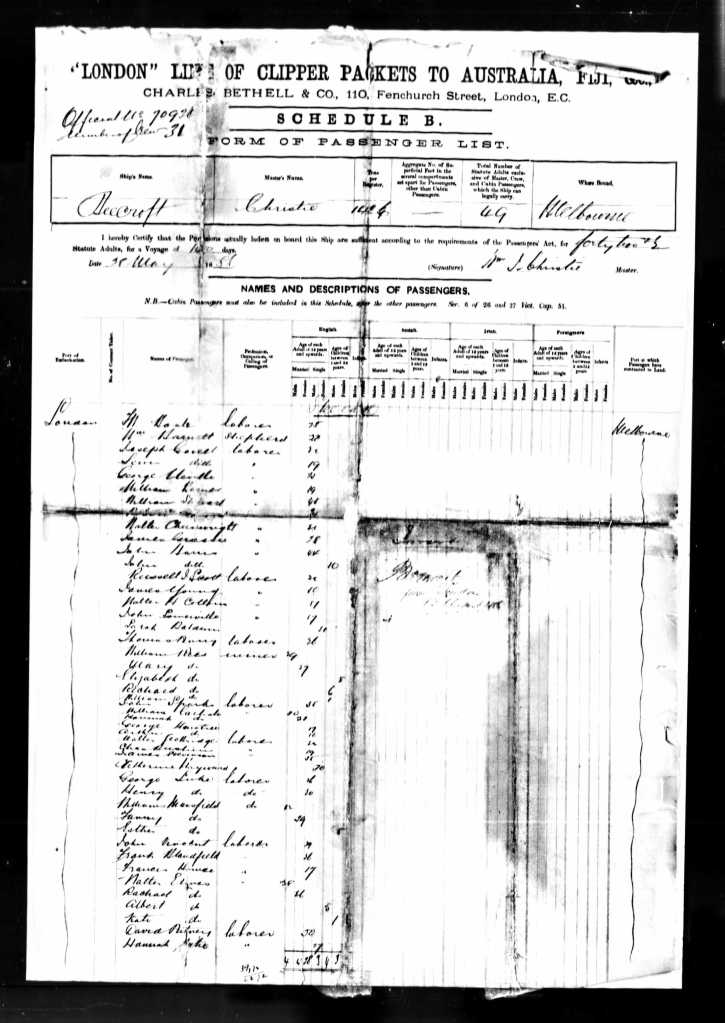
Passenger List Beecroft 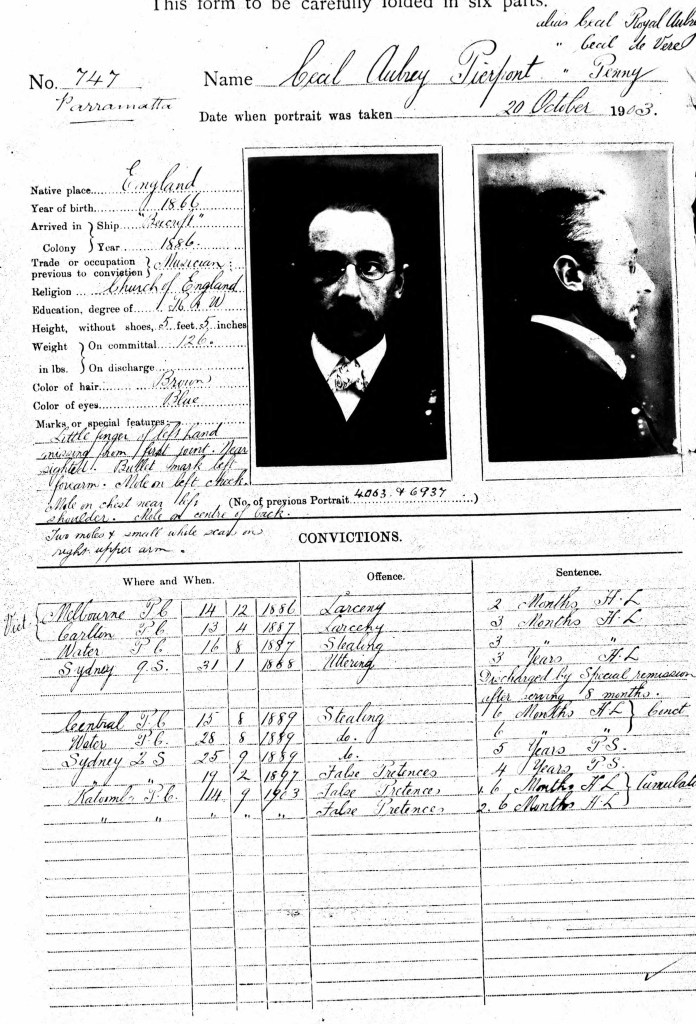
1896 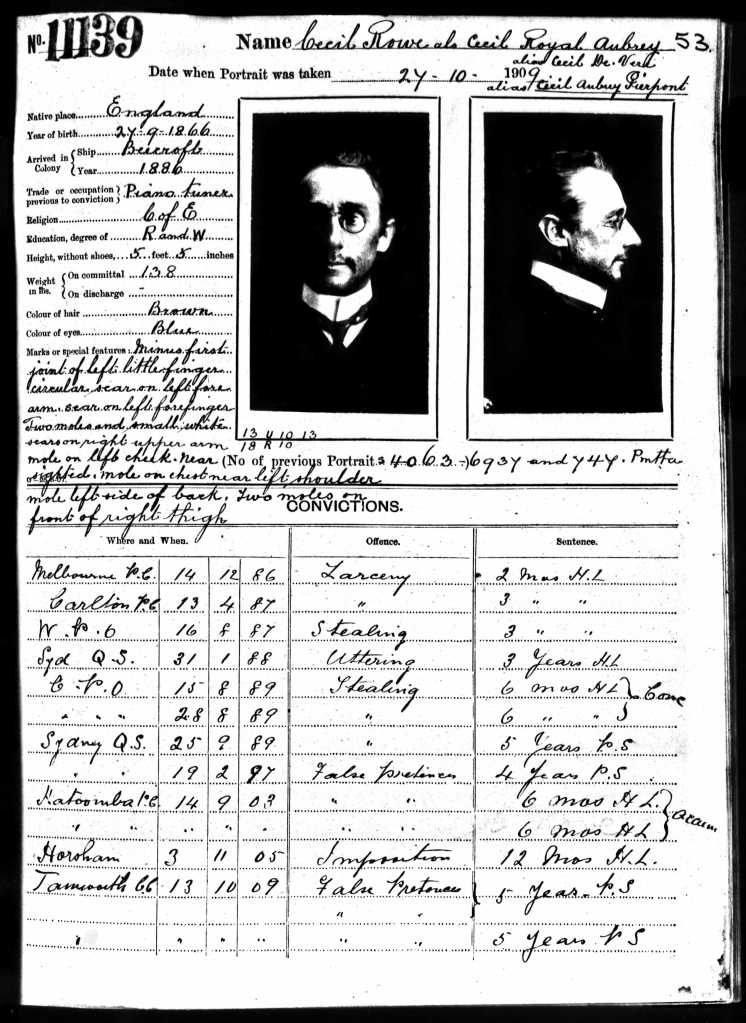
1909 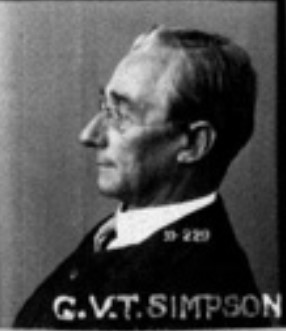
1927 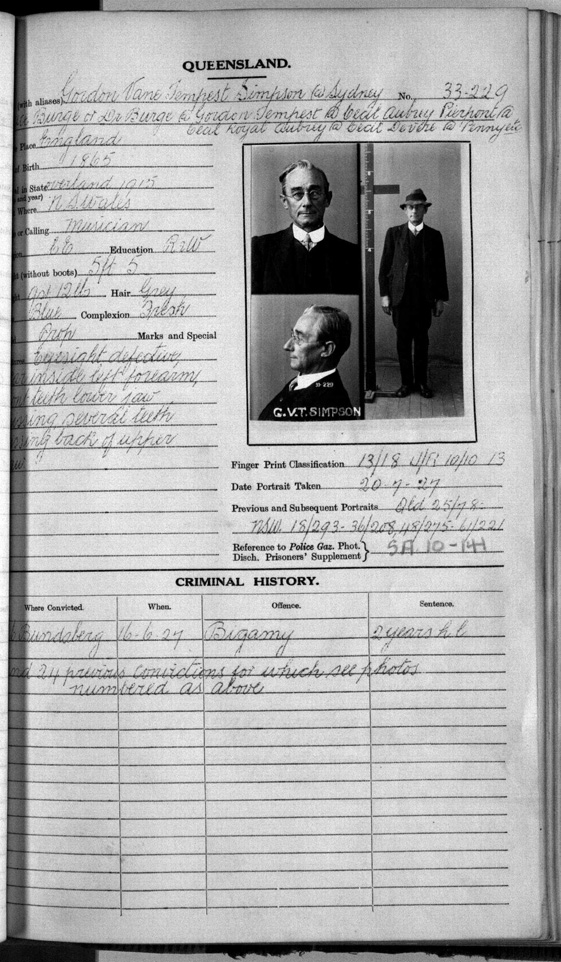
1927 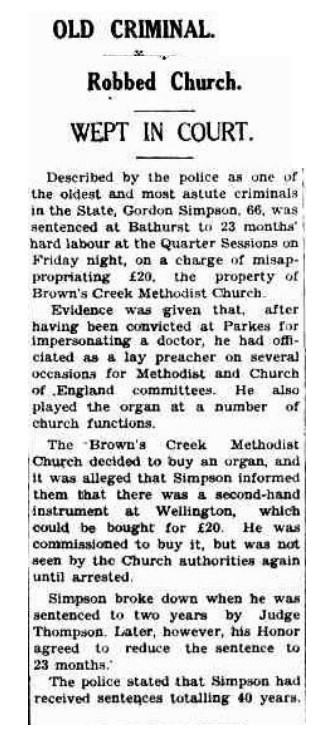
1931
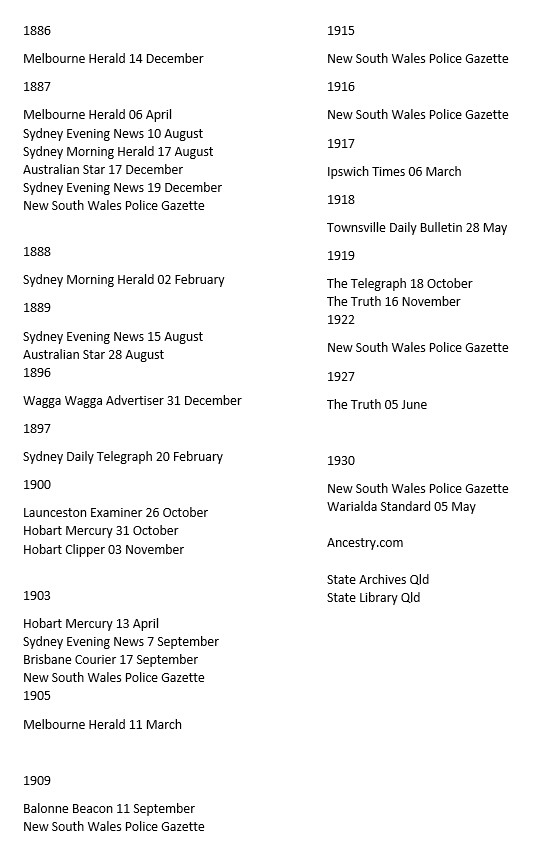
SOURCES:
 Moreton Bay and More
I was the original researcher of Thomas Henry Augustine Penny. He married my wife’s ancestor Hannah Devis using the alias Gordon Rowe. About ten years ago his grand daughter Janet Patricia Davey contacted me desperate to find her errant grandfather whom she had never met. Her mother Dora was abandoned by him when she was a babe in arms. The information they had about him was sparse to say the least. His name Gordon Rowe, Occupation: Optician and a date and place of birth . The only way I made the link between this alias and who turned out to be Thomas Penny was by a vague reference to a Gordon Rowe who was posing as a Optician in a Police Gazette. This led me to other Police Gazettes which allowed me to make a tenuous connection. From then on it was a veritable roller coaster ride with new unbelievable and sometimes unpalatable revelations being uncovered almost every day. To say it took over my life is an understatement. Both Patricia and her mother have since passed away. I was never sure whether I did them a disservice in discovering the true Thomas Penny. Perhaps they would have been better not knowing his true character. Sometimes ignorance is truly bliss.
Geoff Marsh
LikeLike