
CONVICT SNAPSHOTS: EDWARD STEELE

Imagine being a person of colour in 1808. Now imagine being a person of colour in Halifax, Nova Scotia in 1808. Your skin colour would be the first, and often the only, thing anyone noticed about you – a situation that did not change through your whole life, no matter where you fetched up. And if you were Edward Steele, you fetched up in a lot of unlikely places – mostly far-flung gaols.
Distant Shores
Edward Steele left Halifax in his teens and took up work on board ships. He could visit distant shores, and in some of them, he could blend in with the locals. And not be a man apart.
In 1826, Steele was in Glasgow and was caught housebreaking:
“Edward Steel, seaman, man of colour and Henry Mason, weaver, were charged with housebreaking and theft, and with being habit and repute thieves. Mason pleaded guilty and the evidence of a few witnesses having established the guilt of Steel, they were sentenced, the former to seven, and the latter to fourteen years’ transportation.” Edinburgh Advertiser.
The fact that Steele was also charged as being a “habit and repute” thief suggests that he had a criminal history in Scotland already, and that this was starting to have serious consequences.
Edward Steele arrived in Sydney on the Guildford in July 1827, aged 19. It took him just over six months to be back before the Courts in serious trouble, this time housebreaking and repeated absconding charges. The Bench sent him to Moreton Bay for three years.
The Bay
Steele arrived at the Bay in May 1828 and, miraculously, remained at the settlement for his entire sentence. Until Moreton Bay, Steele’s reaction to a threatening or unpleasant situation was to effect a quick escape. It may be that Edward Steele had not been in Australia long enough to feel confident enough to take to the bush from a remote settlement. Or perhaps it was the presence of men like him in such a small space that kept him there.
Edward Steele wasn’t the only man of colour doing time at Moreton Bay. To keep him company there was James Thomas of Santa Dominga. There were his fellow African Americans – Thomas Jackson of Boston, William Coss from New York, and Ephraim Montgomery of Philadelphia. There was Francis Andrews, from who came all the way from Africa, and John Brown, a black man from London. Sheik Brown and George Brown, two charming rogues from the East Indies (and not related), rounded out the group. Mind you, Sheik and George were always absconding from the settlement. Any interaction they had with Steele would have been fleeting.

Then there were the indigenous people, who did not interact with the town the way they did in Sydney. There was no town in Brisbane, just a life support system for a remote gaol. The indigenous people of the Moreton Bay area were still assessing the strangers in their country at the time Edward Steele served his sentence. At times, there was cooperation to bring in runaways, at others they clashed with the interlopers in their maize fields. But generally, they kept their distance.
Edward Steele returned to Sydney July 1831, re-offended promptly, and was admitted to Darlinghurst Gaol in October. His eventual destination would be Norfolk Island for three years. A note in the Entrance Books for Darlinghurst describes Steele’s behaviour in custody as “tolerable.”

According to Steele’s convict records, he spent most of the 1830s and 1840s in Gaols around Sydney. Obviously, he had a known tendency to relieve other people of their goods, but the sheer number of occasions that he is present at a place of correction was only explained by an article detailing an arrest in 1845.
‘Stevey’ the Scourger
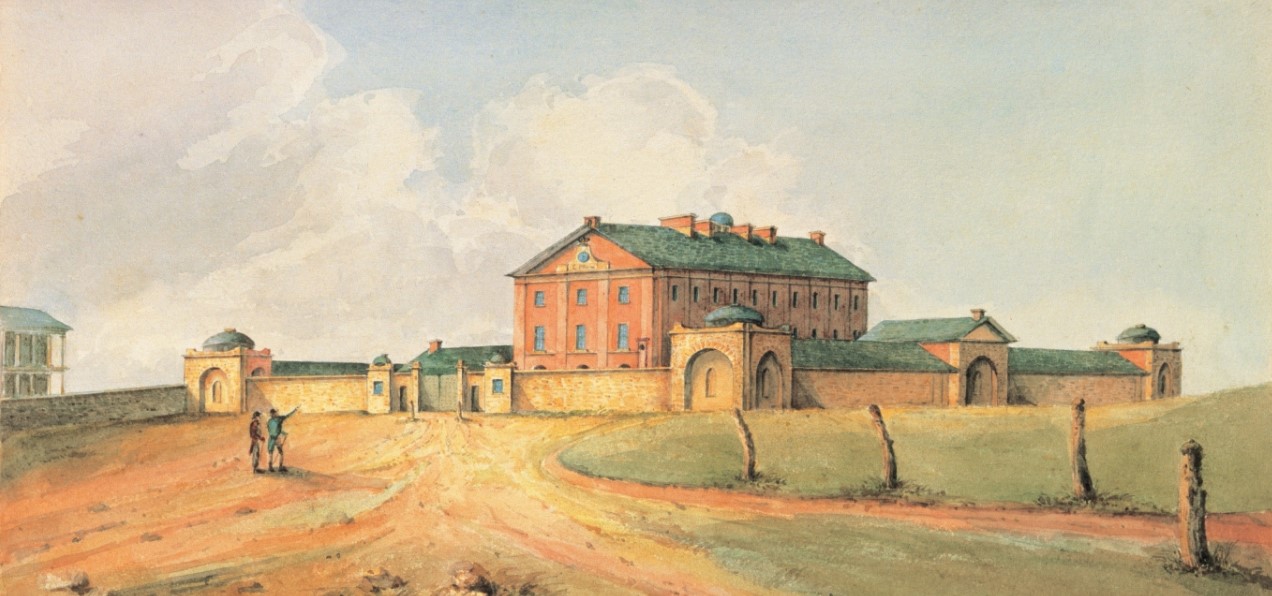
It appeared that Steele had employed at Hyde Park Barracks as a “scourger” by the Barracks Superintendent, Timothy Lane. A scourger was a flogger employed to apply the lash to prisoners as directed by the Courts. Mr Steele was good at this work, and Mr Lane approved of his good work. Mr Lane was known to protest a great deal to the contrary, but he found corporal punishment to be most effective. And satisfying.

This work made Edward Steele a man apart in a sense beyond his appearance. No convict felt any fondness for overseers, but that was nothing compared to the uninhibited loathing for the scourger. Steele could argue that he was just doing the job assigned to him, and that someone had to do it. But his fellow convicts would not forget, particularly if they found him in their midst in the future.
The newspapers certainly remembered the “black scourger” (nicknamed “Stevey” for reasons long lost to history); and brought Steele’s past to light any time he caught the attention of the authorities.
After the issue of a ticket of leave in 1851 – quickly cancelled when Steele found himself unable to remain in the district of Yass – Edward Steele gradually faded from public view.
Steele’s former employer Timothy Lane retired from Hyde Park Barracks and found his way to the new Colony of Melbourne. It seems fitting then that the last mention I can find is of a black convict named Edward Steele working as a scourger on a road gang building the early roads of Melbourne. Perhaps Steele followed Mr Lane south.

 Moreton Bay and More