
Some places have hardly been touched by time. Others have changed beyond all recognition. Here are some then and now shots from throughout Queensland.
Edison Lane, Brisbane 1888


“Hello, Office of Workplace Health and Safety? Yes, I’d like to report a series of breaches, please. There is a man without a safety harness, hi-vis or personal protective equipment, clambering about on a flimsy power generator pole. Also, there are two men on the roof, four floors up, ditto the safety gear, and PPE; a lot of people are leaning out of high windows, and then there are a couple of men with a horse… Hello? Hello? No, this is not a prank call.”
The Barton White & Co Power Station was the brainchild of Edward Gustavus Campbell Barton, who went into business with C.F. White with the aim of providing electrical light to Brisbane. This was Brisbane’s first power station, and was located in Edison Lane, off Creek Street. Recent excavations at William Street unearthed some marvelously intact Edison Tubes, used to power old Brisbane.
Customs House Brisbane, 1889

Mercifully, the distinctive Customs House building has survived the years. Despite occupying insanely valuable riverside real estate, no-one has yet applied a wrecking ball to it. A little greenery has added to the building’s charms, but the view of the river has been obscured by the towers surrounding it.

Old Cleveland Road, Brisbane, 1871

The Sydney Evening News of Saturday last has the following telegram: ‘A story leaked out today of a gallant rescue by Lord Lamington (the Governor) of a lady who had been assailed by two ruffians. His Excellency last Saturday returned from Wellington Point Show (a distance of about fourteen miles) on his bicycle. On the old Cleveland road he saw a European and a Chinaman on horseback trying to gallop down a lady, also on horseback. The Governor rode in between, despite the insults of the two men, and escorted the lady safely into town. The lady is the wife of a well-known dentist.’
Maryborough Chronicle, Wide Bay and Burnett Advertiser (Qld.: 1860 – 1947), Wednesday 28 July 1897, page 2
Old Cleveland Road runs for about 20 kilometres today, and is one of the major arterial roads of the city. I can’t tell which part is pictured above, but below is an aerial view of part of the Old Cleveland Road today.
In the light of Lord Lamington’s heroics, I should point out that today the Governor no longer has to ride his bicycle about, having at his disposal an impressive official vehicle and driver. Although I’m sure that His Excellency the Honourable Paul de Jersey, AC, would not hesitate to save the honour of the wife of a well-known dentist, were such honour being imperiled in his vicinity.

Victoria Bridge, 1893

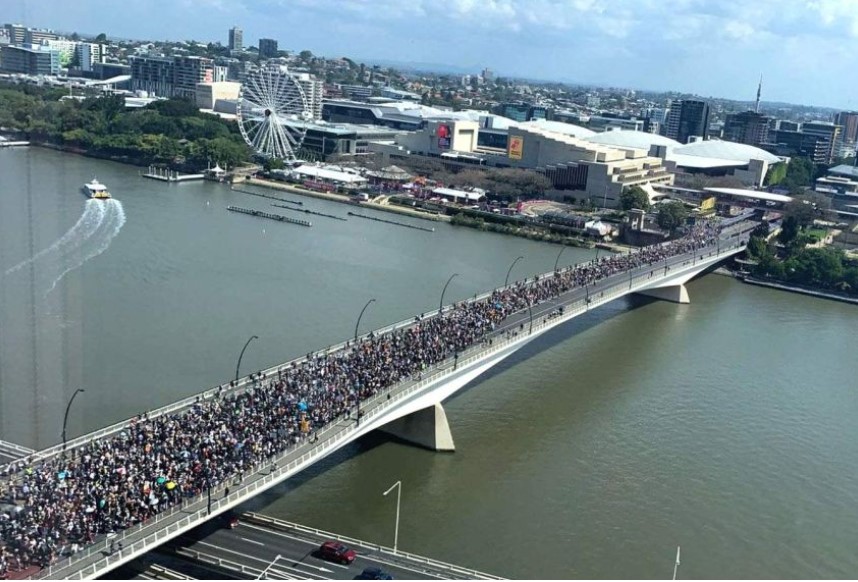
(Photo: Shannon Iwanow for ABC News).
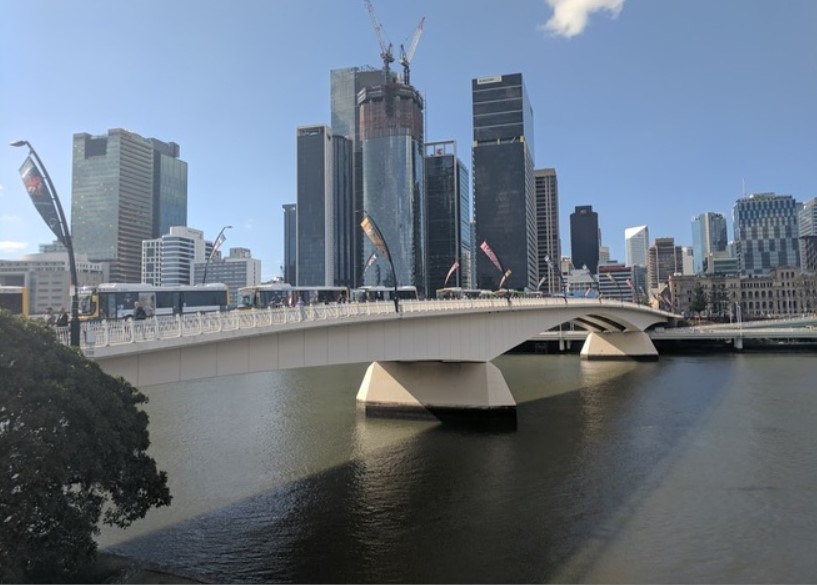
(Photo: WeekendNotes.com)
After decades of congestion, the Victoria Bridge has been closed to general traffic, allowing buses, cyclists and pedestrians only to cross. Unsurprisingly, shade structures for pedestrians are being considered next. And unsurprisingly, no-one can agree on the type of shade structures to erect.
Shamrock Street Blackall, 1885
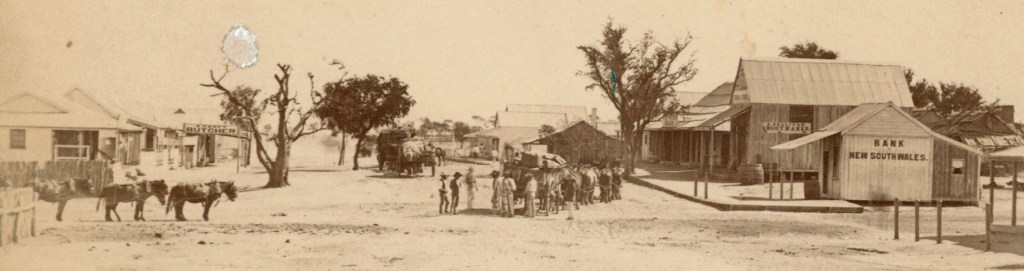
Traffic in Shamrock Street, Blackall in 1885. Two heavily-loaded road trains occupy Shamrock Street as another waits to enter.
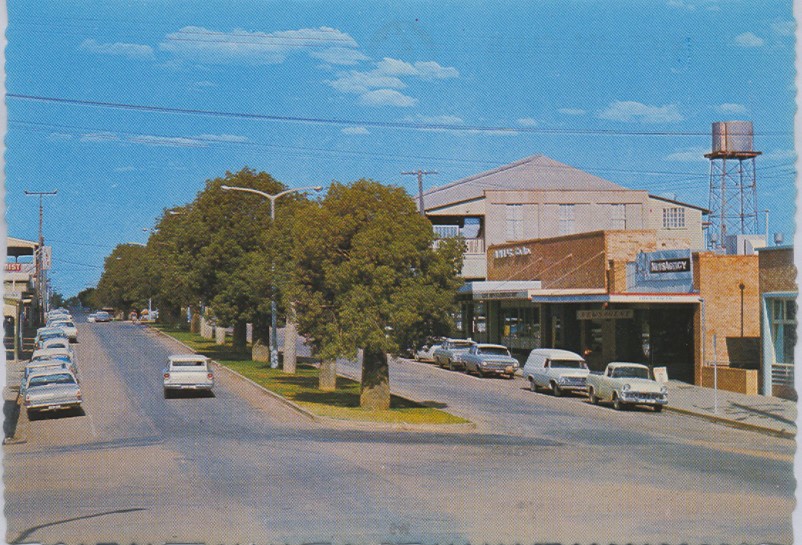
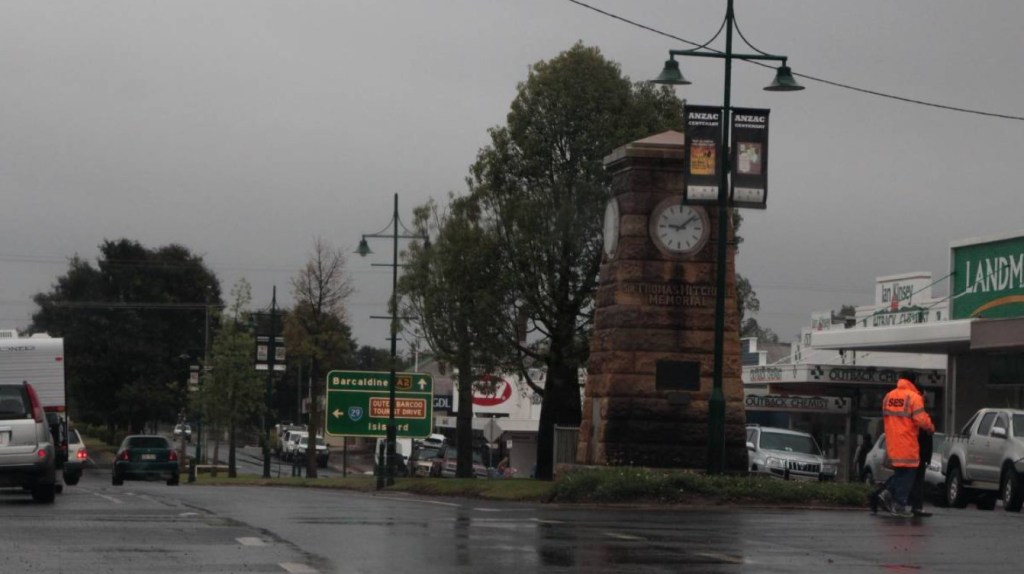
Blackall is the actual location of the black stump, a fabled marker for cartographers in the 19th century. Ask any Australian of a certain vintage for directions to somewhere remote, and you’ll inevitably hear that it’s about 25 miles past the black stump.
 Moreton Bay and More