
There were few more haunting fears for the lone traveler than that of becoming ill or injured and of dying alone, in the middle of nowhere. 19th century Europeans had little idea of bushcraft – how to find edible plants, how to locate clean drinking water, even how to dress and when to travel to avoid sunstroke. “Found dead in the bush” became a commonly used phrase in the early days of European settlement, so prevalent that a casual search of the records yields hundreds of reports.
Mostly it was the menfolk who perished in the bush, as they tended remote herds or searched for seasonal work. The prospect of not knowing about the solitary, terrible death of a husband, son or brother kept the Missing Friends columns of newspapers busy with plaintive requests for any information.
The Unknown Traveller
Sadly, many who perished in the outback were unable to be identified. Police and Coroners published whatever information they had, but often family and friends were so far away that they could not hope to see the newspaper reports.
WM Armstrong, Coroner for Drayton wrote to the Editor of the Toowoomba Chronicle in April 1862[i], hoping to return the skeletal remains of a young man to his family,
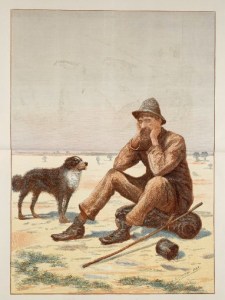
“From inspection of the bones and clothes, I am of opinion that he was a person of respectability, about the age of fifteen or sixteen years. He was dressed in a suit of brownish plaid tweed; had on a brown Garibaldi hat; half-Wellington boots, with brass tacks in the soles; round his neck a green silk handkerchief, with a small white raised flower; he also had a silk pocket-handkerchief, white ground, with a large red pattern; and a strong back-handled knife in his coat. I have got all these things in my possession; they may perhaps serve to identify him. May I beg that you will give publicity to this letter, as I have seen many advertisements lately for missing friends.”
From the absence of any damage to the young man’s body, the Coroner concluded that he had died of sickness or starvation while camped out in the bush.
The same sad conclusion was drawn about an unidentified man found near Charleville in 1880[ii]. “A man was found dead in the bush by Mr A B Jones, Jun., and his stockman, about eight miles from Gowrie cattle station, direct east; he was lying on his back in his blankets. There was not the slightest sign of any struggle he seemed to have died quite quietly. A magisterial enquiry was held, but there was nothing by which to trace his identity nor show the cause of his death. He had a swag and a water bag, and his boots were placed together by the side of his blanket.”
Sometimes, the difference between life and death could be a matter of being a couple of miles off the beaten track.[iii] “On Thursday afternoon while a young man named Geddes was out on Bungeworgorai run, about fifteen miles from Roma, he came across the dead body of a man lying in the bush. Geddes was looking for horses at that time and had got into an infrequently used part of the run. The police went out yesterday, and from what they saw it is believed that the unfortunate man had been dead a couple of months. There was nothing about the place that would afford any clue calculated to lead to the man’s identity, and the remains were interred near where they were found. A magisterial enquiry will probably be held.”
Heat, Exposure and Alcohol
Often, dehydration and sunstroke killed the unwary European. These deaths generally took place in the blistering summer months, when foot travel should not have been considered after 10 am and before 4 pm. Still, the need to work, or to find work, drove people beyond their endurance.
The elderly poor were most vulnerable. “The Commissioner of Police has received a telegram from Hughenden stating that the body of a man named William Stevens, aged 70, has been found dead in the bush. He left Cambridge for Richmond Downs on the 4th instant; and was found dead two days afterwards. His death is attributed to sunstroke.[iv]”
Combine the terrible heat with a seasonal drinking spree, and the results were deadly. The Courier found the tale of a young shepherd who disappeared without any alarm being raised a particularly grievous one. [v]
“One more unfortunate of the male sex was recently found dead in the bush about a mile and a half from the Winton Arms, a bush “public” situated on the run of the same name. If the particulars are correct as they were related to me, there seems to have been shameful and inhuman neglect somewhere, on the part of somebody. The deceased, a shepherd named McGuire, was employed on Winton station, and had, I am told, been drinking at the house mentioned.
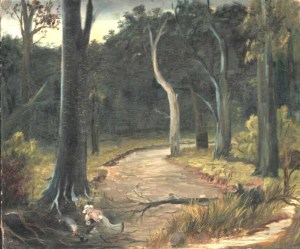
“He left there on the Sunday before Christmas, the unhappy possessor of three bottles of brandy, and nothing was heard of him until the end of January, when his fleshless skeleton was found under a tree not far removed from the track, two empty bottles lying near, significant enough of the cause of death. The weather was fearfully hot about that time, and heat and spirit together doubtless rendered the poor fellow’s insensate orgy fatal.
“The story goes that during the enquiry, it transpired that no effort had been made to find the man when he was known to be missing, nor was any report made to the police of his disappearance. He had left all his effects in his hut, and his sheep in the yard. The latter were cared for, the former was left to lie where he had drained his grog bottle to the last drop, without search being made for him. There certainly appears to have been a rumour that McGuire had been seen burr cutting on another run, but no attempt seems to have been made to find was whether the report was true or false. I give the facts as they were narrated to me, if true, I repeat that there must have been shameful neglect somewhere. Such deaths are common enough, God knows, and too often the fate of such infatuated sots remains a mystery to man, but it seems only a duty that mankind owes to his brotherhood everywhere at least to try to succour.”
Discussing another case, the Warwick Times was less sympathetic, and rather more succinct[vi]. “There could be no doubt that death resulted from the combined effects of rum and the fierce rays of a vertical sun, to which he was probably exposed for a day or two before he provided another victim to the prevalent and destructive custom among the working classes of drinking their hard-earned wages.”
As hard as it is to imagine suburban Enoggera, currently undergoing the indignities of renovation and gentrification, being considered the bush, it was remote enough in 1887 for a former policeman to succumb to sub-tropical heat and alcohol and be found “dead in the bush”[vii].
Far from a Doctor
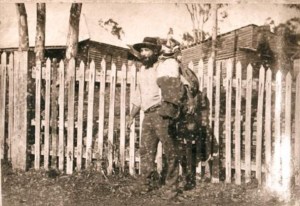
A traveller suffering a medical episode far from help was doomed. A “respectably dressed” man, identified by a letter in his pocket as Otto Grasondorf, was found dead some distance from Toowoomba in 1867. The post-mortem revealed a death from epilepsy, a condition not well understood or effectively treated in those days.
In Maryborough, poor Elizabeth Gallacher, a young woman who ventured off the beaten track just a few hundred yards to visit and console a bereaved friend, died of heart failure before she could be found and helped. Her baby, whom she had brought with her, was sound asleep by her side.[viii]
When an elderly shepherd named George Trehan was found dead in the bush, it was discovered that he had been ill for some time with heart disease but had kept working because he simply unable to afford not to. “Deceased had no means except a small balance of wages, which was handed over to the police magistrate[ix].” Nice to know that the pittance went to the proper authorities then.
No Suspicious Circumstances
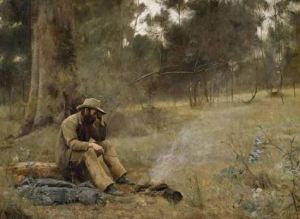
“No suspicious circumstances” today is the media’s code for death by suicide. Quite a few of the lonely souls who tended sheep on vast stations, or who tramped about the Colony, looking for work with very little prospect of getting it, succumbed to despair. Some had probably been suffering mental illness for a long time, and the privations of bush life made them determined to take their lives. The unidentified man found near Charleville in 1880 (see above) had a half-full bottle of strychnine in his boot.
In Charters Towers, the very newly married sister of Warden Charters (after whom the town was named), was found dead in the bush with a garter about her neck, which turned out to be suicide “whilst labouring under a fit of insanity brought on by drink.[x]”
The Queensland Times published an article by a Christopher Delaney[xi], about a childhood friend from Glasgow, whose life – once full of promise – had become one of incessant misery. The man in question had risen above humble beginnings to become a lawyer but had succumbed to “dissipated habits” that cost him his job and his mental health.
The Colonies were of course suggested as a remedy for his woes, a place where he could make a new life. The man was found dead in the bush a year or so after his arrival. Delaney did not think his friend had taken his own life, but a poem written by the deceased man, date the day he died, strongly suggested otherwise. It was called “The Lay of the Hopeless.[xii]”
Lost
Getting lost in the bush was fatal. Over-confidence about one’s bush skills was also fatal, as this poor young man discovered at Charleville in 1880.
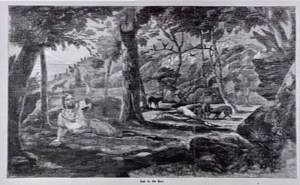
“It appears from the evidence that the poor fellow was fencing on Gooladdy Station, and that he left the camp to look for his horses. His mates tried to dissuade him from going, as he was not a good bushman and might, they said, get lost. He went, however, and, almost as a matter of course, perished. There is nothing connected with bush life so lamentable as this false shame of being considered a bad bushman; it has led hundreds to perish miserably. In this case the victim died the most horrible of all deaths—namely, death from thirst. It was shewn, in evidence, that he had made a fire and roasted an opossum and left half of it where he had cooked it, and as he had only been dead a couple of days when found, and the tracks about the fire did not seem to be more than two days old, the probabilities are that he perished from thirst[xiii].
An elderly man at Cunnamulla went off on his own and was found dead some days later[xiv]. He left a note – “February 15. Feeling lost in the bush. Got off road looking for water.—W. G. Head.”
Richard Hill, travelling with a group of friends from Samford to Brisbane – a 30-minute drive today – became separated from them as they, too, became lost. The companions made it to Brisbane, but Hill was found dead in a dry creek bed some days later[xv].
No wonder so many people sought their missing friends through the papers and agencies. As Europeans spread out into the unknown regions of Queensland, death from snake or spider bites, ill-health, exposure or despair became an occupational hazard. And life for those at home, without word of their breadwinner, could be intolerable:
“DENNIS CALLAGHAN your wife Margaret and her children are destitute. Rockhampton. Dennis Callaghan left Rockhampton in January last in charge of some cattle for the Burdekin district. If this should meet the eye of anyone acquainted with the abovementioned person, he will oblige by informing him that his wife and children are in Rockhampton in a state of destitution”[xvi].
[i] Toowoomba Chronicle and Queensland Advertiser (Qld. : 1861 – 1875), Thursday 17 April 1862, page 2.
[ii] Brisbane Courier (Qld. : 1864 – 1933), Wednesday 29 December 1880, page 2.
[iii] Darling Downs Gazette (Qld. : 1881 – 1922), Monday 29 May 1882, page 2.
[iv] Telegraph (Brisbane, Qld. : 1872 – 1947), Friday 23 February 1883, page 2.
[v] Brisbane Courier (Qld. : 1864 – 1933), Saturday 13 March 1875, page 6.
[vi] Warwick Examiner and Times (Qld. : 1867 – 1919), Saturday 11 January 1868, page 2
[vii] Darling Downs Gazette (Qld. : 1881 – 1922), Monday 3 January 1887, page 3.
[viii] Warwick Examiner and Times (Qld. : 1867 – 1919), Thursday 9 May 1867, page 2
[ix] Maryborough Chronicle, Wide Bay and Burnett Advertiser (Qld. : 1860 – 1947), Saturday 25 January 1879, page 3
[x] Dalby Herald and Western Queensland Advertiser (Qld. : 1866 – 1879), Saturday 7 June 1879, page 3
[xi] Queensland Times, Ipswich Herald and General Advertiser (Qld. : 1861 – 1908), Thursday 9 May 1878, page 4
[xii] “The first verse reads,
“Away! I cannot mingle more In festive crowds of mortals vain
My days of youth and bliss are o’er,
And joy will ne’er be mine again.
I’m sick of all that earth can give,
To soothe the sorrows of my breast;
There’s nought for which I wish to live
I only long to be at rest.
[xiii] Queenslander (Brisbane, Qld. : 1866 – 1939), Saturday 10 April 1880, page 454.
[xiv] Telegraph (Brisbane, Qld. : 1872 – 1947), Thursday 21 February 1889, page 4.
[xv][xv] Brisbane Courier (Qld. : 1864 – 1933), Saturday 23 January 1875, page 5
[xvi] Rockhampton Bulletin and Central Queensland Advertiser (Qld. : 1861 – 1871), Saturday 23 May 1863, page 3
“Lost in the Bush,” published Illustrated Melbourne Post., October 25, 1865. Roberts, JR (Engraver), Jackson, Arthur Levett, 1834-1888 (artist). Print – wood engraving.
“Lost! a sketch from the Riverina,” published Illustrated Australian News, July 3, 1880. Ashton, Julian 1851-1942 (Engraver).
“The Swagman’s Rest, Evening, Australia,” Painting: oil on canvas. National Library of Australia.
“Gladstone and District 1885- Travelling Bushman [swagman],” Photographic collection of postal and telecommunication services in Queensland. National Archives of Australia.
 Moreton Bay and More